Recognition: unknown
Robustness of bound states in the continuum in metasurface based on Ge₂Sb₂Te₅ versus structural imperfections
Pith reviewed 2026-05-08 06:48 UTC · model grok-4.3
The pith
Quasi-BIC quality factors in GST metasurfaces stay robust to random trapezoidal shape variations
A machine-rendered reading of the paper's core claim, the machinery that carries it, and where it could break.
Core claim
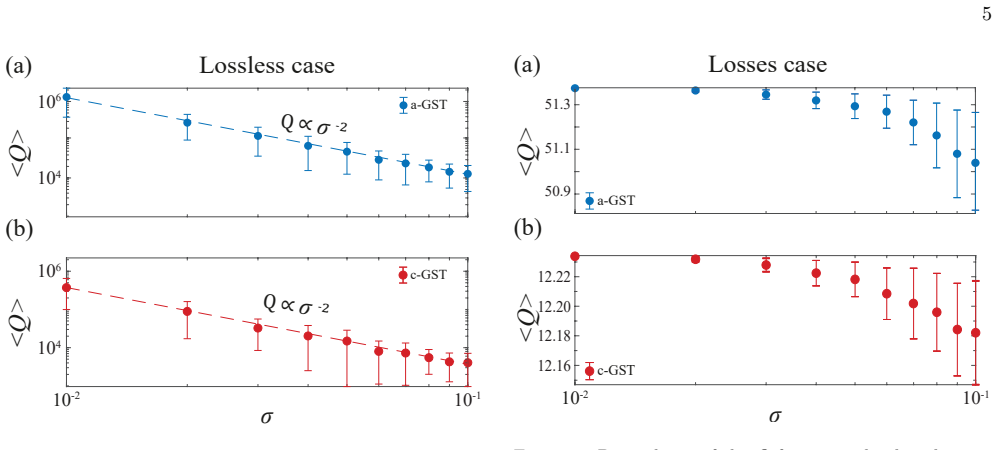
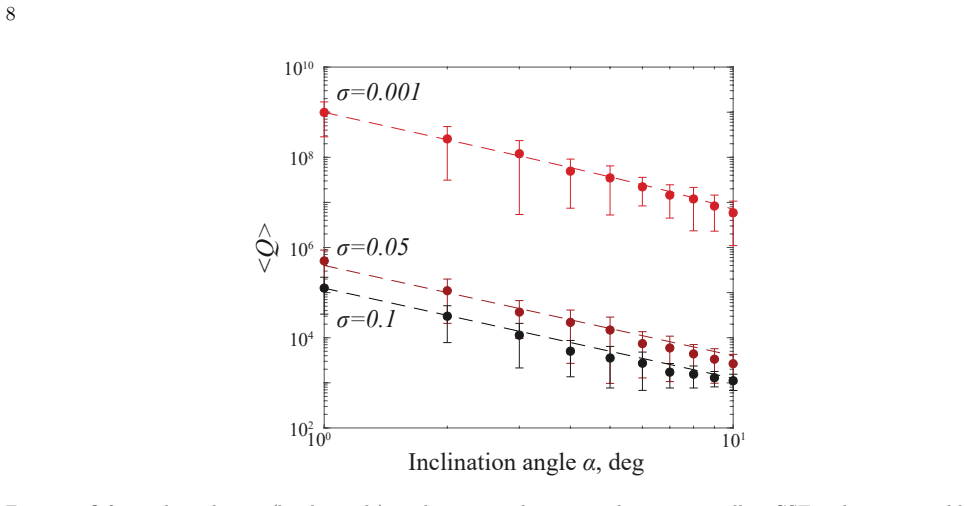
The quality factor of quasi-BICs supported by GST bars remains robust under random element-to-element variations of the trapezoid angle for both GST phases. Analytical and numerical estimates without material losses indicate that the Q factor scales inversely with the square of the disorder amplitude. Transition to identical isosceles trapezoids reduces the Q factor in the amorphous phase because of absorption changes linked to the resonance shift. The Q factor tolerates geometric imperfections when dispersion near the BIC wavelength is insignificant but varies when dispersion is substantial.
What carries the argument
quasi-bound states in the continuum (quasi-BICs) in a GST bar metasurface, where C2 symmetry preservation under random trapezoidal deviations enables robust Q-factor behavior against disorder
If this is right
- The Q factor scales inversely quadratic with the amplitude of disorder when material losses are absent.
- Both amorphous and crystalline GST phases exhibit Q-factor robustness to random trapezoid angle variations.
- Substantial dispersion near the BIC wavelength alters the tolerance to geometric imperfections.
- Stable moderate Q factors support phase-shifting applications in GST-based metasurfaces.
Where Pith is reading between the lines
- Moderate fabrication variations in bar shapes may be acceptable for maintaining BIC performance in real devices.
- Similar robustness properties could be tested in metasurfaces using other phase-change materials.
- Practical photonic devices might benefit from relaxed precision requirements in lithography processes.
Load-bearing premise
The analysis assumes trapezoidal deviations represent the dominant imperfection and that C2 symmetry remains intact.
What would settle it
Experimental measurement of Q factors in fabricated samples with quantified random trapezoid angle variations, verifying the inverse-quadratic scaling in the absence of losses.
Figures


read the original abstract
We study the impact of lithography imperfections on quasi-bound states in the continuum (quasi-BICs) supported by a one-dimensional metasurface of Ge$_2$Sb$_2$Te$_5$ (GST) bars with trapezoidal deviations from rectangular cross-sections. Several mechanisms of quality ($Q$) factor scaling, including the impact of material losses, dispersion, and geometric imperfections are established. We demonstrate that transition to identical isosceles trapezoids, despite preserving the required $C_2$ symmetry, reduces the $Q$ factor in the amorphous phase due to absorption changes accompanying the resonance shift. Further, the $Q$ factor remains robust for both GST phases under random element-to-element variations of the trapezoid angle, while analytical and numerical estimations in the absence of material losses show inverse-quadratic scaling of the Q factor with the disorder amplitude. We reveal that in the GST-based metasurface, the $Q$ factor is tolerant to geometric imperfections for insignificant dispersion near the BIC wavelength, but changes in case of substantial dispersion. The phase shifting and established robustness of BICs in GST can be useful for applications where stable moderate $Q$ factors are essential.
Editorial analysis
A structured set of objections, weighed in public.
Referee Report
Summary. The manuscript studies the impact of lithography imperfections, modeled as trapezoidal deviations from rectangular cross-sections in a 1D metasurface of Ge2Sb2Te5 bars, on quasi-bound states in the continuum. It claims that the Q factor remains robust under random element-to-element trapezoid angle variations for both GST phases, exhibits inverse-quadratic scaling with disorder amplitude in the absence of material losses, reduces for identical isosceles trapezoids in the amorphous phase due to resonance shift and absorption, and is tolerant to geometric imperfections when dispersion near the BIC wavelength is insignificant but changes with substantial dispersion.
Significance. If the results on robustness and scaling hold under the modeled conditions, this provides useful insights into fabrication tolerances for BIC-based tunable metasurfaces using phase-change materials, supporting applications needing stable moderate Q factors such as sensors or modulators. The combination of analytical estimations and numerical simulations for disorder effects is a strength.
major comments (1)
- [§3] §3 (modeling of geometric imperfections): The robustness and inverse-quadratic Q scaling are demonstrated only for random trapezoid-angle fluctuations that preserve C2 symmetry (isosceles trapezoids in a periodic supercell). The central claim of robustness versus 'structural imperfections' and 'lithography imperfections' is load-bearing on this assumption, yet the manuscript provides no analysis or simulations for symmetry-breaking defects (e.g., left/right base-angle mismatch or sidewall tilt) that lift BIC protection even at zero disorder amplitude, especially when material dispersion and GST-phase absorption are present.
minor comments (2)
- [Abstract] Abstract: The statement on inverse-quadratic scaling and robustness lacks any mention of the specific disorder amplitude range, numerical error analysis, or full parameter specifications used in the estimations.
- [Throughout] Throughout: Clarify in text and figures whether the scaling laws are purely analytical derivations or involve fitting, and ensure consistent notation for Q factor and disorder amplitude when dispersion is included.
Simulated Author's Rebuttal
We thank the referee for the constructive and detailed review of our manuscript on the robustness of quasi-BICs in GST metasurfaces. The feedback highlights an important scope limitation in our modeling of imperfections, which we address below. We are prepared to revise the manuscript to improve clarity without overstating our results.
read point-by-point responses
-
Referee: §3 (modeling of geometric imperfections): The robustness and inverse-quadratic Q scaling are demonstrated only for random trapezoid-angle fluctuations that preserve C2 symmetry (isosceles trapezoids in a periodic supercell). The central claim of robustness versus 'structural imperfections' and 'lithography imperfections' is load-bearing on this assumption, yet the manuscript provides no analysis or simulations for symmetry-breaking defects (e.g., left/right base-angle mismatch or sidewall tilt) that lift BIC protection even at zero disorder amplitude, especially when material dispersion and GST-phase absorption are present.
Authors: We thank the referee for this observation. Our study deliberately models trapezoidal deviations as random element-to-element variations of the base angle while enforcing isosceles shapes (preserving C2 symmetry) within a periodic supercell. This corresponds to a common class of lithography imperfections that do not immediately destroy the underlying symmetry protection of the BIC. We focused on this regime because it allows the quasi-BIC to survive with a finite but reduced Q factor, enabling the study of disorder-induced scaling (inverse-quadratic in the lossless limit) and the interplay with material losses and dispersion. Symmetry-breaking defects, such as left/right angle mismatch or non-uniform sidewall tilt, would indeed lift the C2 symmetry and eliminate the BIC even at zero disorder amplitude; this is a fundamental property of symmetry-protected BICs and was outside the intended scope of examining how disorder perturbs an existing quasi-BIC. We acknowledge that the manuscript language referring to 'structural imperfections' and 'lithography imperfections' could be read more broadly than intended. To address the referee's concern, we will revise the abstract, introduction, and conclusions to explicitly state that the modeled imperfections preserve C2 symmetry, add a brief discussion of why symmetry-breaking cases are excluded (as they trivially suppress the BIC), and note that real fabrication may include a mixture of both types. This constitutes a partial revision that clarifies the claims without requiring new extensive simulations. revision: partial
Circularity Check
No significant circularity in the derivation chain
full rationale
The paper derives the inverse-quadratic Q-factor scaling with disorder amplitude via explicit analytical and numerical estimations performed in the absence of material losses. This scaling is obtained from perturbation analysis of the symmetry-protected BIC under C2-preserving trapezoid-angle variations and does not reduce to a fitted parameter or input data by construction. No self-definitional loops, fitted inputs renamed as predictions, load-bearing self-citations, or ansatz smuggling are present in the provided claims or abstract. The robustness statements rest on independent numerical simulations and standard BIC perturbation theory that remain externally verifiable.
Axiom & Free-Parameter Ledger
axioms (1)
- domain assumption Electromagnetic theory and material dispersion relations for GST in amorphous and crystalline phases
Reference graph
Works this paper leans on
-
[1]
C. W. Hsu, B. Zhen, A. D. Stone, J. D. Joannopoulos, and M. Soljačić, Nat. Rev. Mater. 1, 1 (2016)
2016
-
[2]
Koshelev, A
K. Koshelev, A. Bogdanov, and Y. Kivshar, Opt. Pho- ton. News 31, 38 (2020)
2020
-
[3]
E. E. Maslova, M. V. Rybin, A. A. Bogdanov, and Z. F. Sadrieva, Nanophotonics 10, 4313 (2021)
2021
-
[4]
Z. F. Sadrieva, M. A. Belyakov, M. A. Balezin, P. V. Kapitanova, E. A. Nenasheva, A. F. Sadreev, and A. A. Bogdanov, Phys. Rev. A 99, 053804 (2019)
2019
-
[5]
E. N. Bulgakov and A. F. Sadreev, Phys. Rev. A 99, 033851 (2019)
2019
-
[6]
M. S. Sidorenko, O. N. Sergaeva, Z. F. Sadrieva, C. Roques-Carmes, P. S. Muraev, D. N. Maksimov, and A. A. Bogdanov, Phys. Rev. Appl. 15, 034041 (2021)
2021
-
[7]
K. V. Semushev, Z. Zhao, A. Proskurin, M. Song, X. Liu, M. V. Rybin, E. E. Maslova, and A. A. Bog- danov, Physical Review Applied 25, 014038 (2026)
2026
-
[8]
D. J. Singh, J. Appl. Phys. 113, 203101 (2013)
2013
-
[9]
J. A. Frantz, J. D. Myers, A. Clabeau, et al. , Opt. Mater. Express, OME 13, 3631 (2023)
2023
-
[10]
M. A. Vincenti, L. Carletti, D. de Ceglia, et al. , Opt. Express 32, 31956 (2024)
2024
-
[11]
Y. K. Srivastava, R. T. Ako, M. Gupta, M. Bhaskaran, S. Sriram, and R. Singh, Applied Physics Letters 115, 151105 (2019)
2019
-
[12]
X. Zhao, C. Yin, B. Zhang, J. Chen, Z. Sheng, Z. Zhang, L. Deng, and L. Bi, Nanoscale Adv. 5, 1729 (2023)
2023
-
[13]
H.-J. Park, I. Kim, H. Lee, J. Park, and J. Rho, ACS Nano 17, 4089 (2023)
2023
-
[14]
A. I. Solomonov, M. E. Bochkarev, S. I. Pavlov, P. I. Lazarenko, V. V. Kovalyuk, A. D. Golikov, G. N. Golts- man, S. A. Kozyukhin, S. A. Dyakov, M. V. Rybin, and A. B. Pevtsov, Phys. Rev. B 108, 085127 (2023)
2023
-
[15]
C. L. Holloway et al. , Appl. Phys. Lett. 124, 260701 (2024)
2024
-
[16]
Koshelev, S
K. Koshelev, S. Lepeshov, M. Liu, A. Bogdanov, and Y. Kivshar, Phys. Rev. Lett. 121, 193903 (2018)
2018
-
[17]
L. Ni, J. Jin, C. Peng, et al. , Opt. Express 25, 5580 (2017)
2017
-
[18]
D. N. Maksimov, P. S. Pankin, D.-W. Kim, M. Song, C. Peng, and A. A. Bogdanov, Phys. Rev. B 112, 235303 (2025)
2025
-
[19]
S. Han, L. Cong, Y. K. Srivastava, B. Qiang, M. V. Rybin, A. Kumar, R. Jain, W. X. Lim, V. G. Achanta, S. S. Prabhu, Q. J. Wang, Y. S. Kivshar, and R. Singh, Advanced Materials 31, 1901921 (2019)
2019
-
[20]
Liang, K
Y. Liang, K. Koshelev, F. Zhang, H. Lin, S. Lin, J. Wu, B. Jia, and Y. Kivshar, Nano Letters 20, 6351 (2020)
2020
-
[21]
K. Fan, I. V. Shadrivov, and W. J. Padilla, Optica 6, 169 (2019)
2019
-
[22]
Aigner, A
A. Aigner, A. Tittl, J. Wang, T. Weber, Y. Kivshar, S. A. Maier, and H. Ren, Science Advances 8, eadd4816 (2022)
2022
-
[23]
Barreda, C
A. Barreda, C. Zou, A. Sinelnik, E. Menshikov, I. Sinev, T. Pertsch, and I. Staude, Opt. Mater. Express, OME 12, 3132 (2022) . Appendix A: F ourier expansion The Fourier coefficients of the array permittivity are calculated as εm(y) = 1 N a "2N −2X ℓ=0 Z xℓ+1 xℓ ε e−im 2π N a x dx + 2N −2X ℓ=0 Z xℓ+2 xℓ+1 e−im 2π N a x dx # , (A1) where ε is the permittivit...
2022
discussion (0)
Sign in with ORCID, Apple, or X to comment. Anyone can read and Pith papers without signing in.