Recognition: unknown
The multi-fractal nature of pedestrian arrival times
Pith reviewed 2026-05-08 04:23 UTC · model grok-4.3
The pith
Pedestrian arrivals exhibit multifractal scaling with scale-dependent correlations across timescales.
A machine-rendered reading of the paper's core claim, the machinery that carries it, and where it could break.
Core claim
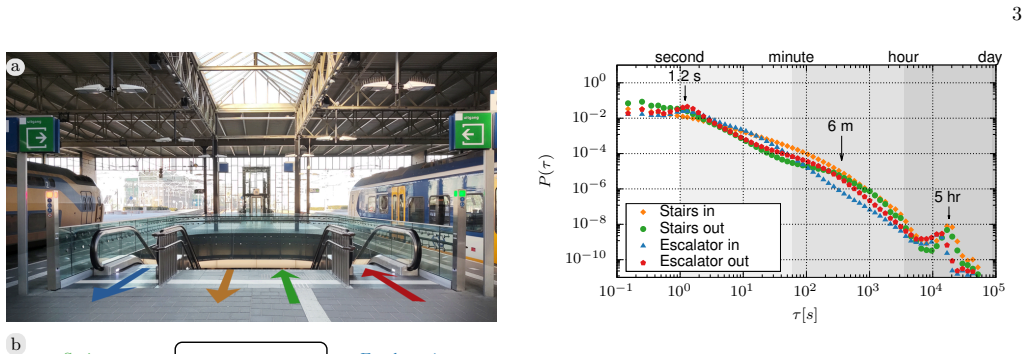
The central claim is that pedestrian arrival processes cannot be fully characterized by inter-arrival time statistics alone. Instead, they exhibit clear multifractal scaling that reveals scale-dependent correlations across a broad range of timescales. This is demonstrated through a framework of generalized fractal dimensions applied to a large dataset of movements.
What carries the argument
Generalized fractal dimensions framework that captures the heterogeneous structure of arrival times beyond standard point-process descriptions.
If this is right
- Distinct temporal regimes can be identified that correspond to external forcing from schedules and collective behaviors.
- More realistic synthetic arrival processes can be constructed based on the quantified multifractal properties.
- The method applies to understanding non-trivial arrival processes in other physical or biological systems.
Where Pith is reading between the lines
- The multifractal analysis might extend to traffic or animal movement data to uncover similar scale dependencies.
- Urban planners could use these insights to design better station layouts that mitigate peak-time correlations.
- Future models could incorporate these scaling laws to simulate crowd dynamics more accurately over long periods.
Load-bearing premise
The observed multifractal scaling reflects intrinsic properties of the arrival dynamics and is not an artifact of the particular station, data recording method, or chosen analytical framework.
What would settle it
Repeating the analysis on arrival data from a different location or using an alternative method for detecting multifractality that shows no such scaling would falsify the claim.
Figures


read the original abstract
Pedestrian arrival times exhibit complex temporal organization across multiple scales, shaped by working hours, transportation schedules, and collective behaviors - features often neglected in conventional pedestrian arrival models. Using a dataset comprising over 23 million pedestrian movements at a Dutch railway station, we show that arrival processes cannot be fully characterized by inter-arrival time statistics alone. Instead, we demonstrate that pedestrian arrivals exhibit clear multifractal scaling, revealing scale-dependent correlations across a broad range of timescales. To quantify these properties, we apply a framework based on generalized fractal dimensions, which captures the heterogeneous structure of arrivals beyond standard point-process descriptions. This approach enables the identification of distinct temporal regimes associated with external forcing and provides a quantitative basis for constructing more realistic synthetic arrival processes. Beyond pedestrian dynamics, this approach offers methodological relevance for understanding non-trivial arrival processes in other physical or biological systems.
Editorial analysis
A structured set of objections, weighed in public.
Referee Report
Summary. The paper analyzes over 23 million pedestrian arrival records from a Dutch railway station and claims that arrival processes exhibit multifractal scaling across timescales that cannot be explained by inter-arrival time distributions alone. Using generalized fractal dimensions, the authors identify distinct temporal regimes linked to external schedules and collective behavior, arguing that this framework enables more realistic synthetic arrival models and applies to other point processes.
Significance. If the multifractal scaling is shown to arise from intrinsic correlations rather than rate modulation, the work would strengthen empirical descriptions of pedestrian flows in transportation settings and supply a quantitative tool for detecting scale-dependent structure in non-stationary point processes.
major comments (2)
- [Methods and Results sections] The central claim that multifractality reveals intrinsic scale-dependent correlations (beyond inter-arrival statistics) requires explicit surrogate controls that preserve the empirical intensity λ(t) while destroying higher-order temporal structure. No such test is described in the methods or results; without it, the reported scaling is consistent with external rate variations alone.
- [Results] The abstract and introduction state that arrivals cannot be fully characterized by inter-arrival statistics, yet the quantitative comparison between the multifractal spectrum and the spectrum obtained from a rate-modulated Poisson process (or equivalent null model) is not provided. This comparison is load-bearing for the claim that the observed multifractality is non-trivial.
minor comments (2)
- [Data section] The dataset description should include explicit exclusion criteria, station-specific filtering steps, and any handling of sensor artifacts or incomplete records.
- [Figures] Figure captions and axis labels for the generalized fractal dimension plots should state the range of q values used and the fitting procedure for the scaling exponents.
Simulated Author's Rebuttal
We thank the referee for their careful reading of our manuscript and for highlighting the need for explicit null-model comparisons to strengthen the interpretation of the multifractal scaling. We address each major comment below and will incorporate the suggested analyses in the revised version.
read point-by-point responses
-
Referee: [Methods and Results sections] The central claim that multifractality reveals intrinsic scale-dependent correlations (beyond inter-arrival statistics) requires explicit surrogate controls that preserve the empirical intensity λ(t) while destroying higher-order temporal structure. No such test is described in the methods or results; without it, the reported scaling is consistent with external rate variations alone.
Authors: We agree that surrogate controls preserving the empirical intensity λ(t) are necessary to isolate intrinsic correlations. In the revised manuscript we will add a dedicated section describing the construction of rate-modulated Poisson surrogates that match the observed time-varying arrival rate while randomizing higher-order temporal structure. We will then recompute the generalized fractal dimensions on these surrogates and compare them directly with the empirical results, thereby quantifying the excess multifractality attributable to correlations beyond rate modulation. revision: yes
-
Referee: [Results] The abstract and introduction state that arrivals cannot be fully characterized by inter-arrival statistics, yet the quantitative comparison between the multifractal spectrum and the spectrum obtained from a rate-modulated Poisson process (or equivalent null model) is not provided. This comparison is load-bearing for the claim that the observed multifractality is non-trivial.
Authors: We acknowledge that a side-by-side quantitative comparison is required to support the claim. We will include new figures and text in the Results section that overlay the multifractal spectra (and associated scaling exponents) of the empirical arrival process with those obtained from the rate-modulated Poisson surrogates. This will allow readers to see the scale ranges where the empirical data deviate significantly from the null model, thereby substantiating that inter-arrival statistics alone are insufficient. revision: yes
Circularity Check
No circularity: empirical multifractal scaling demonstrated directly from data
full rationale
The paper applies generalized fractal dimensions to a large empirical dataset of pedestrian arrivals to identify multifractal scaling and temporal regimes. No equations, parameters, or derivations are presented that reduce by construction to fitted inputs, self-definitions, or self-citation chains. The central claim rests on observable scaling properties in the raw arrival times, which are independently verifiable against the dataset and external benchmarks without requiring the paper's own fitted values or prior self-referential results. This is a standard data-driven empirical analysis with no load-bearing circular steps.
Axiom & Free-Parameter Ledger
axioms (1)
- domain assumption Generalized fractal dimensions capture heterogeneous temporal structure in arrival processes
Reference graph
Works this paper leans on
-
[1]
Signal construction We start with a single interval of lengthLthat contains Narrivals. The interval is then split into two equally sized sub-intervals, and theNarrivals are distributed between them according to a binomial distribution with probabilityp∈(0,1): Nleft ∼Binomial(N, p) (A1) Nright =N−N left (A2) so that the total count is exactly preserved at ...
-
[2]
At each level, the probability of a given interval depends only on how many times it follows each branch
Analytic derivation ofτ(q)andD(q) To derive the expected fractal dimension we compute the partition sumZ q at cascade levelκ. At each level, the probability of a given interval depends only on how many times it follows each branch. An interval that takes the left branchjtimes (and the right branchκ−jtimes) has probability pi,κ =p j(1−p) κ−j.(A3) The numbe...
-
[3]
7 we compare the fractal dimension computed by our algorithm against the analytic prediction of (A7) for a cascade withN= 10 10 arrivals,κ= 20 levels, and p= 0.3
Numerical validation In Fig. 7 we compare the fractal dimension computed by our algorithm against the analytic prediction of (A7) for a cascade withN= 10 10 arrivals,κ= 20 levels, and p= 0.3. The numerical and analytic curves are in ex- cellent agreement across the full range ofq, confirming that our implementation correctly recovers the general- ized fra...
-
[4]
K. G. Wilson, Problems in physics with many scales of length, Sci. Am.241, 158 (1979)
1979
-
[5]
Benzi and F
R. Benzi and F. Toschi, Lectures on turbulence, Phys. Rep.1021, 1 (2023)
2023
-
[6]
Frisch,Turbulence: The Legacy of A.N
U. Frisch,Turbulence: The Legacy of A.N. Kolmogorov (Cambridge University Press, 1995)
1995
-
[7]
P. J. E. Peebles,The Large-Scale Structure of the Uni- verse(Princeton University Press, 1980)
1980
-
[8]
Karsai, H.-H
M. Karsai, H.-H. Jo, K. Kaski,et al.,Bursty human dy- namics, SpringerBriefs in Complexity (Springer, Cham, 2018)
2018
-
[9]
Y. Liu, R. Alsaleh, and T. Sayed, Modeling pedestrian temporal violations at signalized crosswalks: A random intercept parametric survival model, Transp. Res. Rec. 2676, 707 (2022)
2022
-
[10]
Government of the Netherlands, Ministry of Infrastruc- ture and Water Management, Public transport in 2040 - outlines of a vision for the future (2019), (unpublished)
2040
-
[11]
D. J. Daley and D. Vere-Jones,An Introduction to the Theory of Point Processes, Springer Series in Statistics (Springer New York, New York, NY, 1998)
1998
-
[12]
P. J. Diggle,Statistical analysis of spatial and spatio- temporal point patterns, 3rd ed. (CRC Press, 2013) pp. 1–264
2013
-
[13]
A. G. Hawkes, Spectra of some self-exciting and mutually exciting point processes, Biometrika58, 83 (1971)
1971
-
[14]
Corral and M
´A. Corral and M. Garc´ ıa del Muro, Finite-size scaling of human-population distributions over fixed-size cells and its relation to fractal spatial structure, Phys. Rev. E106, 054310 (2022)
2022
-
[15]
Meyer and L
S. Meyer and L. Held, Power-law models for infectious disease spread, Ann. Appl. Stat.8, 1612 (2014)
2014
-
[16]
G. O. Mohler, M. B. Short, P. J. Brantingham, F. P. Schoenberg, and G. E. Tita, Self-exciting point process modeling of crime, J. Am. Stat. Assoc.106, 100 (2011)
2011
-
[17]
Zuriguel, D
I. Zuriguel, D. R. Parisi, R. C. Hidalgo, C. Lozano, A. Janda, P. A. Gago, J. P. Peralta, L. M. Ferrer, L. A. Pugnaloni, E. Cl´ ement,et al., Clogging transition of many-particle systems flowing through bottlenecks, Sci. Rep.4, 7324 (2014)
2014
-
[18]
Garcim´ art´ ın, J
A. Garcim´ art´ ın, J. M. Pastor, L. M. Ferrer, J. J. Ramos, C. Mart´ ın-G´ omez, and I. Zuriguel, Flow and clogging of a sheep herd passing through a bottleneck, Phys. Rev. E 91, 022808 (2015)
2015
-
[19]
Souzy, I
M. Souzy, I. Zuriguel, and A. Marin, Transition from clogging to continuous flow in constricted particle sus- pensions, Phys. Rev. E101, 060901 (2020)
2020
-
[20]
W. E. Leland, M. S. Taqqu, W. Willinger, and D. V. Wilson, On the self-similar nature of Ethernet traffic, IEEE/ACM Trans. Netw.2, 1 (1994)
1994
-
[21]
R. H. Riedi, M. S. Crouse, V. J. Ribeiro, and R. G. Bara- niuk, A multifractal wavelet model with application to network traffic, IEEE Trans. Inf. Theory45, 992 (1999)
1999
-
[22]
Calvet and A
L. Calvet and A. Fisher, Multifractality in asset returns: Theory and evidence, Rev. Econ. Stat.84, 381 (2002)
2002
-
[23]
C. A. S. Pouw, A. Corbetta, A. Gabbana, C. van der Laan, and F. Toschi, High-statistics pedestrian dynam- ics on stairways and their probabilistic fundamental dia- grams, Transp. Res. Part C Emerg. Technol.159, 104468 (2024)
2024
-
[24]
C. A. S. Pouw, F. Toschi, F. van Schadewijk, and A. Cor- betta, Monitoring physical distancing for crowd manage- ment: Real-time trajectory and group analysis, PLoS ONE15, 1 (2020)
2020
-
[25]
C. A. S. Pouw, G. G. M. van der Vleuten, A. Corbetta, and F. Toschi, Data-driven physics-based modeling of pedestrian dynamics - dataset: Pedestrian trajecto- ries at eindhoven train station, 10.5281/zenodo.13784588 (2024)
-
[26]
Telesca, V
L. Telesca, V. Lapenna, and M. Macchiato, Mono-and multi-fractal investigation of scaling properties in tem- poral patterns of seismic sequences, Chaos Solit. Fractals 19, 1 (2004)
2004
-
[27]
Salat, R
H. Salat, R. Murcio, and E. Arcaute, Multifractal methodology, Physica A473, 467 (2017)
2017
-
[28]
J. M. Diego, E. Mart´ ınez-Gonz´ alez, J. Sanz, S. Moller- ach, and V. J. Mart´ ınez, Partition function based analy- sis of cosmic microwave background maps, Mon. Not. R. Astron. Soc.306, 427 (1999)
1999
-
[29]
Benzi, L
R. Benzi, L. Biferale, A. Crisanti, G. Paladin, M. Vergas- sola, and A. Vulpiani, A random process for the construc- tion of multiaffine fields, Phys. D (Amsterdam, Neth.) 65, 352 (1993)
1993
-
[30]
Biferale, G
L. Biferale, G. Boffetta, A. Celani, A. Crisanti, and A. Vulpiani, Mimicking a turbulent signal: Sequential multiaffine processes, Phys. Rev. E57, R6261 (1998)
1998
-
[31]
Benzi, L
R. Benzi, L. Biferale, and F. Toschi, Intermittency in turbulence: Multiplicative random process in space and time, J. Stat. Phys.113, 783 (2003)
2003
discussion (0)
Sign in with ORCID, Apple, or X to comment. Anyone can read and Pith papers without signing in.