Recognition: unknown
Bridging the 6G Gap: Scaling Sustainable ROADM-Based IP-over-WDM via DSCM-Enabled Point-to-Multipoint Designs
Pith reviewed 2026-05-08 05:15 UTC · model grok-4.3
The pith
DSCM-based point-to-multipoint IP-over-WDM cuts CAPEX by 92 percent and power by 99 percent over ten years versus point-to-point designs.
A machine-rendered reading of the paper's core claim, the machinery that carries it, and where it could break.
Core claim
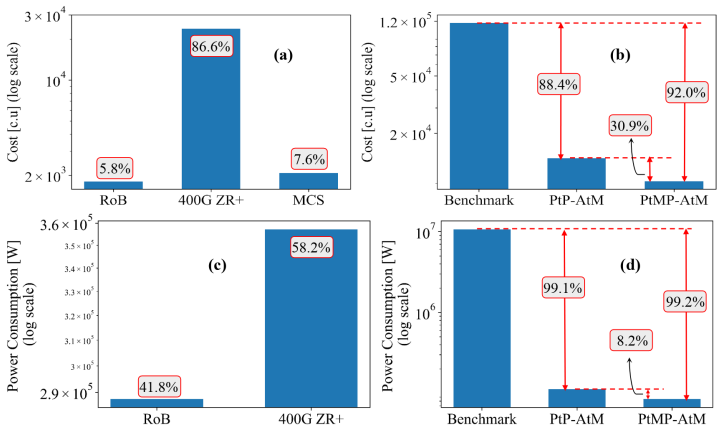
DSCM-enabled Point-to-Multipoint (PtMP) IPoWDM architectures optimize efficiency across diverse geotypes by slashing CAPEX by 92.0 percent and power consumption by 99.2 percent compared to the traditional point-to-point benchmark over a ten-year horizon.
What carries the argument
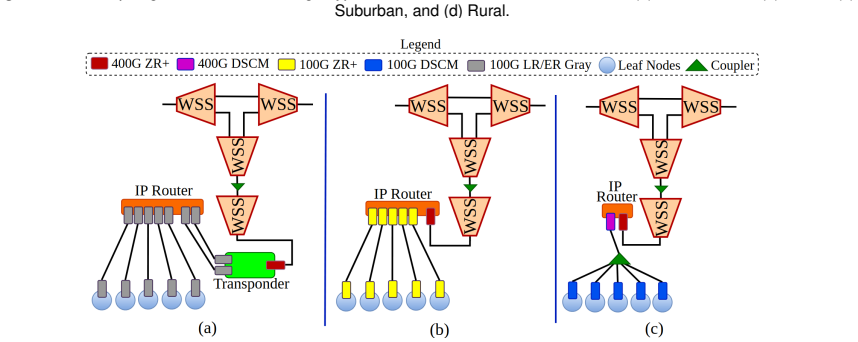
DSCM-based Point-to-Multipoint (PtMP) access-metro architecture, which shares transponder and ROADM resources among multiple endpoints instead of dedicating separate equipment to each link.
Load-bearing premise
The traffic patterns, equipment cost models, power consumption figures, and geotype classifications used in the ten-year simulations accurately represent real-world conditions and future 6G demands.
What would settle it
A field deployment or updated simulation using measured 6G traffic and actual vendor pricing that yields CAPEX savings below 80 percent or power savings below 90 percent over ten years would undermine the central claim.
Figures

read the original abstract
This study compares transponder-based, Point-to-Point, and DSCM-based Point-to-Multipoint (PtMP) access-metro architectures. Findings demonstrate that PtMP IPoWDM significantly optimizes efficiency across diverse geotypes, slashing CAPEX by 92.0% and power by 99.2% compared to the traditional benchmark over a ten-year horizon.
Editorial analysis
A structured set of objections, weighed in public.
Referee Report
Summary. The manuscript compares traditional transponder-based point-to-point (PtP) and DSCM-enabled point-to-multipoint (PtMP) architectures for ROADM-based IP-over-WDM networks in 6G contexts. It claims that PtMP designs deliver substantial efficiency gains across geotypes, including 92.0% CAPEX reduction and 99.2% power savings relative to the PtP benchmark over a ten-year horizon.
Significance. If the underlying models prove accurate, the reported savings could meaningfully inform sustainable scaling strategies for 6G optical transport, particularly in access-metro segments where power and capital efficiency are critical. The work identifies PtMP as a potential lever for reducing both OPEX and environmental footprint in diverse deployment scenarios.
major comments (2)
- [Abstract and Results sections] The quantitative headline results (92.0% CAPEX and 99.2% power savings) are presented without any description of the simulation methodology, traffic matrices per geotype, equipment cost models, power consumption figures, discount rates, or validation steps. This is load-bearing for the central claim because the deltas rest entirely on the realism of these inputs; even moderate optimism in PtMP efficiencies or inflation in the traditional benchmark would collapse the reported gains.
- [Simulation Setup and Parameterization] No sensitivity analysis, citation trail to public data sheets, or cross-check against independent measurements is provided for the proprietary or internal vendor-derived transponder costs, DSCM PtMP power draw, and geotype classifications used in the ten-year simulations. This directly undermines confidence in the 92%/99.2% figures as stated in the abstract.
minor comments (1)
- [Abstract] The abstract would be strengthened by a single sentence summarizing the key modeling assumptions or data sources to allow immediate contextualization of the quantitative claims.
Simulated Author's Rebuttal
We thank the referee for the constructive comments highlighting the need for greater methodological transparency to support our reported efficiency gains. We have revised the manuscript accordingly to address these points while preserving the integrity of the analysis.
read point-by-point responses
-
Referee: [Abstract and Results sections] The quantitative headline results (92.0% CAPEX and 99.2% power savings) are presented without any description of the simulation methodology, traffic matrices per geotype, equipment cost models, power consumption figures, discount rates, or validation steps. This is load-bearing for the central claim because the deltas rest entirely on the realism of these inputs; even moderate optimism in PtMP efficiencies or inflation in the traditional benchmark would collapse the reported gains.
Authors: We agree that the abstract and results sections require additional context on the simulation methodology to make the claims self-contained. In the revised manuscript, we have expanded the abstract with a high-level overview of the ten-year TCO simulation framework, including geotype-specific traffic matrix generation, equipment cost and power models, and the applied discount rate. The results section now includes a concise summary of these elements along with validation against established network benchmarks, directing readers to the detailed methods for full parameterization. revision: yes
-
Referee: [Simulation Setup and Parameterization] No sensitivity analysis, citation trail to public data sheets, or cross-check against independent measurements is provided for the proprietary or internal vendor-derived transponder costs, DSCM PtMP power draw, and geotype classifications used in the ten-year simulations. This directly undermines confidence in the 92%/99.2% figures as stated in the abstract.
Authors: We acknowledge the value of explicit sensitivity analysis and traceable sources. The revised manuscript adds a 'Model Parameters and Sensitivity Analysis' subsection that provides citations to publicly available data sheets for baseline transponder costs and power figures, justifies geotype classifications with references to standard planning guidelines, and includes sensitivity results varying traffic growth, cost assumptions, and efficiency parameters by ±20%. These show the savings remain robust (exceeding 80% CAPEX and 95% power reduction) under conservative inputs. However, exact proprietary vendor cost models and raw DSCM measurements cannot be fully disclosed due to confidentiality constraints; ranges and bounding assumptions are provided instead. revision: partial
- Full public disclosure of proprietary vendor-derived transponder cost models and exact DSCM power consumption measurements, which are subject to non-disclosure agreements.
Circularity Check
No circularity: simulation outputs rest on external input models, not self-referential derivations
full rationale
The paper is a comparative simulation study of PtP vs. PtMP IPoWDM architectures across geotypes, reporting 10-year CAPEX and power deltas as direct simulation results. No equations, fitted parameters, or predictions appear that reduce by construction to the same inputs (e.g., no self-definitional scaling factors or 'predictions' of ratios derived from the fitted costs themselves). Input models for equipment costs, power draw, traffic matrices, and discount rates are treated as given assumptions whose realism is an external validity question, not a circularity issue. No self-citation load-bearing uniqueness theorems, ansatzes smuggled via prior work, or renaming of known results are present. The derivation chain is therefore self-contained as a forward simulation rather than a closed loop.
Axiom & Free-Parameter Ledger
Reference graph
Works this paper leans on
-
[1]
F . Arpanaeiet al., “Migration strategies from C-band to C+L-band/multi-fiber solutions in optical metropolitan area networks”, in 49th European Conference on Op- tical Communications (ECOC 2023) , vol. 2023, 2023, pp. 1531–1534. DOI: 10.1049/icp.2023.2620
-
[2]
A. Napoli, C. Castro, P . Torres-Ferrera,et al., “Towards truly scalable sustainable flexible optical networks”, in 2025 European Conference on Optical Communications (ECOC), 2025, pp. 1–4. DOI: 10.1109/ECOC66593.2025. 11263099
-
[3]
Extended net- work applications of coherent pluggable transceivers [invited]
J. Pedro, M. M. Hosseini, and A. Napoli, “Extended net- work applications of coherent pluggable transceivers [invited]”,Journal of Optical Communications and Net- working, vol. 17, no. 2, A210–A223, 2025.DOI: 10.1364/ JOCN.537601
2025
-
[4]
Leveraging the potential of coherent pluggable transceivers across diverse network applications
J. Pedro, “Leveraging the potential of coherent pluggable transceivers across diverse network applications”, inAd- vanced Photonics Congress (IPR, Networks, NOMA, SOLITH, SPPCom) , Optica Publishing Group, 2025, NeTu2C.5. DOI: 10 . 1364 / NETWORKS . 2025 . NeTu2C
2025
-
[5]
Available: https : / / opg
[Online]. Available: https : / / opg . optica . org / abstract.cfm?URI=Networks-2025-NeTu2C.5
2025
-
[6]
Digital subcarrier multiplexing: Enabling software-configurable optical networks
D. Welch et al., “Digital subcarrier multiplexing: Enabling software-configurable optical networks”,Journal of Light- wave Technology, 2023. DOI: 10 . 1109 / JLT . 2022 . 3211466
2023
-
[7]
On clustering coherent optics point-to-multipoint trees for cost-effective bandwidth assignment in MANs
J. A. Hernandez, F . Arpanaei, A. Napoli, C. Castro, O. Gonzalez de Dios, and J. P . Fernandez-Palacios, “On clustering coherent optics point-to-multipoint trees for cost-effective bandwidth assignment in MANs”, Jour- nal of Optical Communications and Networking, vol. 15, no. 12, pp. 999–1007, 2023. DOI: 10 . 1364 / JOCN . 497459
2023
-
[8]
Optimized design of horseshoe-and-spur filter- less networks leveraging point-to-multipoint coherent pluggable transceivers
M. M. Hosseini, J. Pedro, N. Costa, C. Castro, and A. Napoli, “Optimized design of horseshoe-and-spur filter- less networks leveraging point-to-multipoint coherent pluggable transceivers”,Journal of Optical Communi- cations and Networking, vol. 16, no. 10, pp. 969–980,
-
[9]
DOI: 10.1364/JOCN.529546
-
[10]
Power and spectral savings in metro-aggregation networks exploiting coherent point-to- multipoint transceivers
C. Castro et al. , “Power and spectral savings in metro-aggregation networks exploiting coherent point-to- multipoint transceivers”, inECOC 2024; 50th European Conference on Optical Communication, 2024, pp. 519–
2024
-
[11]
DOI: 10.5281/zenodo.14628563
-
[12]
Transceiver guidelines for energy-efficient horseshoes based on digital subcarrier multiplexing
C. Castro, P . Torres-Ferrera, M. Hosseini, and A. Napoli, “Transceiver guidelines for energy-efficient horseshoes based on digital subcarrier multiplexing”, in Advanced Photonics Congress (IPR, Networks, NOMA, SOLITH, SPPCom), Optica Publishing Group, 2025, NeTu1C.2. DOI: 10.1364/NETWORKS.2025.NeTu1C.2
-
[13]
Power consumption considerations of coherent transceivers in filterless point-to-multipoint metro-aggregation networks with digital subcarrier multiplexing
C. Castro, P . Torres-Ferrera, M. S. Erkilinç,et al., “Power consumption considerations of coherent transceivers in filterless point-to-multipoint metro-aggregation networks with digital subcarrier multiplexing”, J. Opt. Commun. Netw., vol. 17, no. 6, pp. 526–542, Jun. 2025. DOI: 10. 1364/JOCN.559237
2025
-
[14]
Design of filterless horseshoe networks optimized for inter- operable coherent pluggable transceivers
F . Gatti, J. Pedro, N. Costa, and L. Cancela, “Design of filterless horseshoe networks optimized for inter- operable coherent pluggable transceivers”,Photonics, vol. 13, no. 3, 2026, ISSN : 2304-6732. DOI: 10.3390/ photonics13030272
2026
-
[15]
ALLEGRO Consortium, ALLEGRO project: Agile ultra low energy secure networks, https://www.allegro- he.eu/, Accessed: 2026-03-24, 2026
2026
-
[16]
A generalized cost model for techno- economic analysis in optical networks
A. Souza et al., “A generalized cost model for techno- economic analysis in optical networks”, Photonics, vol. 13, no. 2, 2026, ISSN : 2304-6732. DOI: 10.3390/ photonics13020125
2026
-
[17]
F . Arpanaeiet al., “Enabling seamless migration of opti- cal metro-urban networks to the multi-band: Unveiling a cutting-edge 6d planning tool for the 6g era”,Journal of Optical Communications and Networking, vol. 16, no. 4, pp. 463–480, 2024. DOI: 10.1364/JOCN.505490
-
[18]
TEFNET24: Reference packet optical network topology for edge to core trans- port
J. M. Rivas-Moscoso et al. , “TEFNET24: Reference packet optical network topology for edge to core trans- port”,Journal of Optical Communications and Network- ing, 2024. DOI: 10.1364/JOCN.533131
-
[19]
J. M. Rivas Moscoso and M. Quagliotti, SEASON Access-Metro Reference Network Topology, version v2, Zenodo, 2025. DOI: 10.5281/zenodo.17183654 . [On- line]. Available: https://doi.org/10.5281/zenodo. 17183654
discussion (0)
Sign in with ORCID, Apple, or X to comment. Anyone can read and Pith papers without signing in.