Recognition: 1 theorem link
· Lean Theorem3DSS: 3D Surface Splatting for Inverse Rendering
Pith reviewed 2026-05-14 22:08 UTC · model grok-4.3
The pith
A differentiable surface splatting renderer recovers shape, materials, and lighting from multi-view images by turning reconstruction kernels into per-layer opacity.
A machine-rendered reading of the paper's core claim, the machinery that carries it, and where it could break.
Core claim
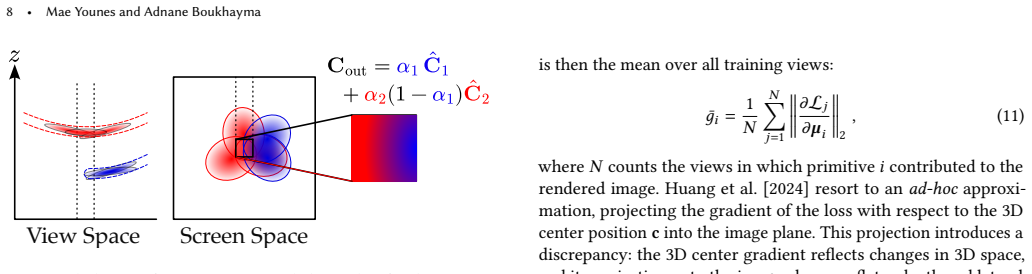
Surface separation at the heart of splatting can be stated directly in terms of the reconstruction kernels, yielding a coverage-based compositing model whose per-layer opacity equals the accumulated EWA weight; this model produces anti-aliased edges and informative gradients that, when combined with forward microfacet shading and density-aware refinement, jointly optimize shape, spatially varying BRDF, and HDR illumination from multi-view images.
What carries the argument
Coverage-based compositing model whose per-layer opacity is taken directly from the accumulated Elliptical Weighted Average reconstruction weight.
If this is right
- Optimized oriented point sets convert to meshes via standard reconstruction, allowing editing and rendering in conventional pipelines.
- Anti-aliased visibility gradients improve convergence when recovering fine geometry from sparse views.
- Co-optimization of environment lighting and materials becomes possible without separate light-probe capture.
- Density-aware refinement automatically adds points where coverage is low, reducing manual tuning.
Where Pith is reading between the lines
- The same kernel-derived opacity could be adapted to other point-based representations beyond surface splats.
- Because gradients flow through coverage, the method may extend to dynamic sequences where point motion must be recovered.
- The explicit surface representation may simplify insertion of the recovered assets into physics simulators compared with implicit fields.
Load-bearing premise
The surface separation problem can be expressed solely through the reconstruction kernels without additional heuristics.
What would settle it
A quantitative comparison on scenes with thin structures or sharp silhouettes showing whether 3DSS produces measurably lower silhouette error and more stable gradients than Gaussian-splatting or mesh-based baselines under identical optimization budgets.
Figures









read the original abstract
We present 3D Surface Splatting (3DSS), the first differentiable surface splatting renderer for physically-based inverse rendering from multi-view images. Our central insight is that the surface separation problem at the heart of surface splatting admits a direct formulation in terms of the reconstruction kernels themselves. From this foundation we derive a coverage-based compositing model whose per-layer opacity arises directly from the accumulated Elliptical Weighted Average reconstruction weight, yielding anti-aliased silhouettes and informative visibility gradients at sparsely covered edges. Combined with forward microfacet shading under co-optimized HDR environment lighting and density-aware adaptive refinement, 3DSS jointly recovers shape, spatially-varying BRDF materials, and illumination. Because the optimized representation is a set of oriented surface samples, it bridges natively to mesh-based workflows via surface reconstruction from oriented point cloud methods. We evaluate 3DSS against mesh-based, implicit, and Gaussian-splatting baselines across geometry reconstruction, novel-view synthesis, and novel-illumination relighting.
Editorial analysis
A structured set of objections, weighed in public.
Referee Report
Summary. The paper introduces 3D Surface Splatting (3DSS) as the first differentiable surface splatting renderer for physically-based inverse rendering from multi-view images. Its central claim is that the surface separation problem admits a direct formulation in terms of reconstruction kernels, from which a coverage-based compositing model is derived whose per-layer opacities arise directly from accumulated Elliptical Weighted Average (EWA) weights. This is combined with forward microfacet shading, co-optimized HDR environment lighting, and density-aware adaptive refinement to jointly recover shape, spatially-varying BRDF materials, and illumination from oriented surface samples, with evaluation against mesh-based, implicit, and Gaussian-splatting baselines on geometry reconstruction, novel-view synthesis, and relighting.
Significance. If the kernel-based compositing derivation holds and produces correct visibility gradients without explicit depth sorting, the method would provide a useful bridge between point-based and mesh representations for inverse rendering tasks, potentially improving anti-aliased edge handling and gradient informativeness over existing splatting approaches. The parameter-free nature of the opacity formulation and the native compatibility with surface reconstruction pipelines are notable strengths if empirically validated.
major comments (2)
- [Abstract] Abstract and central derivation: The claim that per-layer opacity arises directly from accumulated EWA reconstruction weights assumes that 2D kernel accumulation alone encodes correct front-to-back visibility separation for overlapping surface samples at different depths. This may not hold without additional sorting or ray-based compositing, potentially leading to incorrect silhouettes or non-informative gradients in regions of projection overlap; a concrete counter-example or proof of ordering invariance is needed to support the load-bearing step.
- [Evaluation] Evaluation section: The reported improvements over Gaussian-splatting and implicit baselines on sparsely covered edges rely on the differentiability of the proposed compositing; without ablation isolating the coverage model from adaptive refinement and lighting optimization, it is unclear whether the gains are attributable to the kernel formulation or to other components.
minor comments (2)
- [Methods] Notation for EWA weights and coverage accumulation should be defined explicitly in the methods section with a small diagram of overlapping kernels to clarify the compositing formula.
- [Results] The transition from optimized point samples to mesh via surface reconstruction is mentioned but lacks quantitative metrics on reconstruction fidelity in the results.
Simulated Author's Rebuttal
We thank the referee for their thoughtful and constructive review. We address each major comment below and will incorporate clarifications and additional experiments in the revised manuscript.
read point-by-point responses
-
Referee: [Abstract] Abstract and central derivation: The claim that per-layer opacity arises directly from accumulated EWA reconstruction weights assumes that 2D kernel accumulation alone encodes correct front-to-back visibility separation for overlapping surface samples at different depths. This may not hold without additional sorting or ray-based compositing, potentially leading to incorrect silhouettes or non-informative gradients in regions of projection overlap; a concrete counter-example or proof of ordering invariance is needed to support the load-bearing step.
Authors: We appreciate the referee's focus on the core derivation. The coverage-based compositing is obtained by expressing surface separation directly in terms of the EWA reconstruction kernels, so that per-layer opacity equals the normalized accumulated weight; this formulation is designed to be invariant to projection order because the weights encode local coverage density rather than requiring explicit depth. To strengthen the claim, the revision will add a dedicated subsection containing (i) a short proof that the compositing operator is ordering-invariant under the kernel accumulation and (ii) a concrete counter-example on synthetic overlapping disks at different depths, showing that silhouettes and visibility gradients remain correct without sorting. revision: yes
-
Referee: [Evaluation] Evaluation section: The reported improvements over Gaussian-splatting and implicit baselines on sparsely covered edges rely on the differentiability of the proposed compositing; without ablation isolating the coverage model from adaptive refinement and lighting optimization, it is unclear whether the gains are attributable to the kernel formulation or to other components.
Authors: We agree that isolating the coverage model is necessary for a clear attribution of gains. The revised manuscript will include a new ablation table that compares the full 3DSS pipeline against an otherwise identical variant that replaces the coverage-derived opacity with conventional alpha blending (while retaining the same adaptive refinement schedule and co-optimized HDR lighting). Quantitative metrics on edge sharpness, gradient magnitude at silhouettes, and novel-view PSNR will be reported to demonstrate the specific contribution of the kernel-based compositing. revision: yes
Circularity Check
No significant circularity; derivation presented as direct from kernels
full rationale
The paper's central step claims the surface separation problem admits a direct formulation in reconstruction kernels, from which the coverage-based compositing model and per-layer opacity follow directly as accumulated EWA weight. No equations or steps are shown reducing this to a fitted parameter, self-definition, or self-citation chain. The derivation is presented as self-contained mathematical insight without load-bearing reliance on prior author work or renaming of known results. This matches the default expectation of non-circular papers.
Axiom & Free-Parameter Ledger
Lean theorems connected to this paper
-
IndisputableMonolith/Foundation/AlexanderDuality.leanalexander_duality_circle_linking unclear?
unclearRelation between the paper passage and the cited Recognition theorem.
Our central insight is that the surface separation problem at the heart of surface splatting admits a direct formulation in terms of the reconstruction kernels themselves. From this foundation we derive a coverage-based compositing model whose per-layer opacity arises directly from the accumulated Elliptical Weighted Average reconstruction weight
What do these tags mean?
- matches
- The paper's claim is directly supported by a theorem in the formal canon.
- supports
- The theorem supports part of the paper's argument, but the paper may add assumptions or extra steps.
- extends
- The paper goes beyond the formal theorem; the theorem is a base layer rather than the whole result.
- uses
- The paper appears to rely on the theorem as machinery.
- contradicts
- The paper's claim conflicts with a theorem or certificate in the canon.
- unclear
- Pith found a possible connection, but the passage is too broad, indirect, or ambiguous to say the theorem truly supports the claim.
Reference graph
Works this paper leans on
- [1]
-
[2]
IEEE Transactions on Visualization & Computer Graphics , volume=
Ewa splatting , author=. IEEE Transactions on Visualization & Computer Graphics , volume=. 2002 , publisher=
work page 2002
-
[3]
Proceedings-Graphics Interface , pages=
Perspective accurate splatting , author=. Proceedings-Graphics Interface , pages=
-
[4]
Proceedings of the First Eurographics conference on Point-Based Graphics , pages=
Phong splatting , author=. Proceedings of the First Eurographics conference on Point-Based Graphics , pages=
-
[5]
Proceedings of the 28th annual conference on Computer graphics and interactive techniques , pages=
Surface splatting , author=. Proceedings of the 28th annual conference on Computer graphics and interactive techniques , pages=
-
[6]
Proceedings of the 1968 23rd ACM national conference , pages=
A two-dimensional interpolation function for irregularly-spaced data , author=. Proceedings of the 1968 23rd ACM national conference , pages=
work page 1968
-
[7]
ACM Transactions on Graphics (ToG) , volume=
Modular primitives for high-performance differentiable rendering , author=. ACM Transactions on Graphics (ToG) , volume=. 2020 , publisher=
work page 2020
-
[8]
Proceedings of the IEEE/CVF international conference on computer vision , pages=
Soft rasterizer: A differentiable renderer for image-based 3d reasoning , author=. Proceedings of the IEEE/CVF international conference on computer vision , pages=
-
[9]
Advances in neural information processing systems , volume=
Learning to predict 3d objects with an interpolation-based differentiable renderer , author=. Advances in neural information processing systems , volume=
-
[10]
ACM Transactions on Graphics (TOG) , volume=
Differentiable monte carlo ray tracing through edge sampling , author=. ACM Transactions on Graphics (TOG) , volume=. 2018 , publisher=
work page 2018
-
[11]
ACM Transactions on Graphics (TOG) , volume=
Reparameterizing discontinuous integrands for differentiable rendering , author=. ACM Transactions on Graphics (TOG) , volume=. 2019 , publisher=
work page 2019
-
[12]
ACM Transactions on Graphics (TOG) , volume=
Unbiased warped-area sampling for differentiable rendering , author=. ACM Transactions on Graphics (TOG) , volume=. 2020 , publisher=
work page 2020
-
[13]
ACM Transactions on Graphics (ToG) , volume=
Mitsuba 2: A retargetable forward and inverse renderer , author=. ACM Transactions on Graphics (ToG) , volume=. 2019 , publisher=
work page 2019
-
[14]
uller, Thomas and Fidler, Sanja , title =
Munkberg, Jacob and Hasselgren, Jon and Shen, Tianchang and Gao, Jun and Chen, Wenzheng and Evans, Alex and M\"uller, Thomas and Fidler, Sanja , title = ". Proceedings of the IEEE/CVF Conference on Computer Vision and Pattern Recognition (CVPR) , month =. 2022 , pages =
work page 2022
-
[15]
ACM Transactions on Graphics (ToG) , volume=
A reflectance model for computer graphics , author=. ACM Transactions on Graphics (ToG) , volume=. 1982 , publisher=
work page 1982
-
[16]
ACM Transactions on Graphics (ToG) , volume=
Screened poisson surface reconstruction , author=. ACM Transactions on Graphics (ToG) , volume=. 2013 , publisher=
work page 2013
-
[17]
SIGGRAPH 2024 Conference Papers , year =
2D Gaussian Splatting for Geometrically Accurate Radiance Fields , author=. SIGGRAPH 2024 Conference Papers , year =
work page 2024
-
[18]
ACM Transactions on Graphics (TOG) , volume=
A hardware architecture for surface splatting , author=. ACM Transactions on Graphics (TOG) , volume=. 2007 , publisher=
work page 2007
-
[19]
Proceedings of the ACM on Computer Graphics and Interactive Techniques , volume=
Filtering after shading with stochastic texture filtering , author=. Proceedings of the ACM on Computer Graphics and Interactive Techniques , volume=. 2024 , publisher=
work page 2024
-
[20]
Real shading in unreal engine 4 , author=. Proc. Physically Based Shading Theory Practice , volume=
-
[21]
Proceedings of the IEEE/CVF conference on computer vision and pattern recognition , pages=
Mip-nerf 360: Unbounded anti-aliased neural radiance fields , author=. Proceedings of the IEEE/CVF conference on computer vision and pattern recognition , pages=
-
[22]
Proceedings of the IEEE/CVF conference on computer vision and pattern recognition , pages=
Depth anything: Unleashing the power of large-scale unlabeled data , author=. Proceedings of the IEEE/CVF conference on computer vision and pattern recognition , pages=
-
[23]
The Thirty-ninth Annual Conference on Neural Information Processing Systems , year=
Anti-aliased 2d gaussian splatting , author=. The Thirty-ninth Annual Conference on Neural Information Processing Systems , year=
-
[24]
ACM Transactions On Graphics (TOG) , volume=
Differentiable surface splatting for point-based geometry processing , author=. ACM Transactions On Graphics (TOG) , volume=. 2019 , publisher=
work page 2019
-
[25]
Postgraduate Study Report DC-PSR , year=
Representing and rendering surfaces with points , author=. Postgraduate Study Report DC-PSR , year=
-
[26]
The use of points as a display primitive , author=. 1985 , publisher=
work page 1985
-
[27]
Fundamentals of texture mapping and image warping , author=. 1989 , publisher=
work page 1989
-
[28]
Physically based rendering: From theory to implementation , author=. 2023 , publisher=
work page 2023
-
[29]
Proceedings of the 2010 ACM SIGGRAPH symposium on Interactive 3D Graphics and Games , pages=
Lean mapping , author=. Proceedings of the 2010 ACM SIGGRAPH symposium on Interactive 3D Graphics and Games , pages=
work page 2010
-
[30]
ACM Transactions on Graphics (TOG) , volume=
Linear efficient antialiased displacement and reflectance mapping , author=. ACM Transactions on Graphics (TOG) , volume=. 2013 , publisher=
work page 2013
- [31]
- [32]
- [33]
-
[34]
Robust Monte Carlo methods for light transport simulation , author=. 1998 , publisher=
work page 1998
-
[35]
Proceedings of the 11th annual conference on Computer graphics and interactive techniques , pages=
Compositing digital images , author=. Proceedings of the 11th annual conference on Computer graphics and interactive techniques , pages=
-
[36]
IEEE Computer Graphics and Applications , volume=
Creating raster omnimax images from multiple perspective views using the elliptical weighted average filter , author=. IEEE Computer Graphics and Applications , volume=. 2007 , publisher=
work page 2007
-
[37]
Proceedings of the 11th annual conference on Computer graphics and interactive techniques , pages=
The A-buffer, an antialiased hidden surface method , author=. Proceedings of the 11th annual conference on Computer graphics and interactive techniques , pages=
-
[38]
Proceedings of the 27th annual conference on Computer graphics and interactive techniques , pages=
Surfels: Surface elements as rendering primitives , author=. Proceedings of the 27th annual conference on Computer graphics and interactive techniques , pages=
-
[39]
Surface splatting: Theory, extensions and implementation , author=
-
[40]
Proceedings of the 27th annual conference on Computer graphics and interactive techniques , pages=
QSplat: A multiresolution point rendering system for large meshes , author=. Proceedings of the 27th annual conference on Computer graphics and interactive techniques , pages=
-
[41]
Computer graphics forum , volume=
Object space EWA surface splatting: A hardware accelerated approach to high quality point rendering , author=. Computer graphics forum , volume=. 2002 , organization=
work page 2002
-
[42]
Proceedings of the IEEE/CVF Conference on Computer Vision and Pattern Recognition , pages=
Gs-ir: 3d gaussian splatting for inverse rendering , author=. Proceedings of the IEEE/CVF Conference on Computer Vision and Pattern Recognition , pages=
-
[43]
Proceedings of the IEEE/CVF conference on computer vision and pattern recognition , pages=
Gaussianshader: 3d gaussian splatting with shading functions for reflective surfaces , author=. Proceedings of the IEEE/CVF conference on computer vision and pattern recognition , pages=
-
[44]
European Conference on Computer Vision , pages=
Relightable 3d gaussians: Realistic point cloud relighting with brdf decomposition and ray tracing , author=. European Conference on Computer Vision , pages=. 2024 , organization=
work page 2024
-
[45]
IEEE Transactions on Pattern Analysis and Machine Intelligence , year=
Gir: 3d gaussian inverse rendering for relightable scene factorization , author=. IEEE Transactions on Pattern Analysis and Machine Intelligence , year=
-
[46]
Proceedings of the 32nd ACM international conference on multimedia , pages=
Absgs: Recovering fine details in 3d gaussian splatting , author=. Proceedings of the 32nd ACM international conference on multimedia , pages=
-
[47]
ACM Transactions on Graphics (ToG) , volume=
Gaussian opacity fields: Efficient adaptive surface reconstruction in unbounded scenes , author=. ACM Transactions on Graphics (ToG) , volume=. 2024 , publisher=
work page 2024
- [48]
-
[49]
IEEE Computer graphics and Applications , volume=
Display of surfaces from volume data , author=. IEEE Computer graphics and Applications , volume=. 2002 , publisher=
work page 2002
-
[50]
IEEE Transactions on Visualization and Computer Graphics , volume=
Optical models for direct volume rendering , author=. IEEE Transactions on Visualization and Computer Graphics , volume=. 2002 , publisher=
work page 2002
- [51]
-
[52]
arXiv preprint arXiv:2412.19282 , year=
Reflective gaussian splatting , author=. arXiv preprint arXiv:2412.19282 , year=
-
[53]
arXiv preprint arXiv:2506.13348 , year=
TextureSplat: Per-Primitive Texture Mapping for Reflective Gaussian Splatting , author=. arXiv preprint arXiv:2506.13348 , year=
-
[54]
Adam: A Method for Stochastic Optimization
Adam: A method for stochastic optimization , author=. arXiv preprint arXiv:1412.6980 , year=
work page internal anchor Pith review Pith/arXiv arXiv
-
[55]
Proceedings of the 19th annual conference on computer graphics and interactive techniques , pages=
Surface reconstruction from unorganized points , author=. Proceedings of the 19th annual conference on computer graphics and interactive techniques , pages=
-
[56]
Proceedings of the IEEE/CVF conference on computer vision and pattern recognition , pages=
Sugar: Surface-aligned gaussian splatting for efficient 3d mesh reconstruction and high-quality mesh rendering , author=. Proceedings of the IEEE/CVF conference on computer vision and pattern recognition , pages=
-
[57]
Theory of Probability & Its Applications , volume=
On estimating regression , author=. Theory of Probability & Its Applications , volume=. 1964 , publisher=
work page 1964
-
[58]
Smooth regression analysis , author=. Sankhy. 1964 , publisher=
work page 1964
-
[59]
Advances in neural information processing systems , volume=
Implicit neural representations with periodic activation functions , author=. Advances in neural information processing systems , volume=
-
[60]
Proceedings of the IEEE/CVF Conference on Computer Vision and Pattern Recognition , pages=
Neural kernel surface reconstruction , author=. Proceedings of the IEEE/CVF Conference on Computer Vision and Pattern Recognition , pages=
-
[61]
Advances in Neural Information Processing Systems Datasets and Benchmarks Track , year=
Stanford-ORB: a real-world 3D object inverse rendering benchmark , author=. Advances in Neural Information Processing Systems Datasets and Benchmarks Track , year=
-
[62]
Proceedings of the IEEE/CVF Conference on Computer Vision and Pattern Recognition , pages=
Nefii: Inverse rendering for reflectance decomposition with near-field indirect illumination , author=. Proceedings of the IEEE/CVF Conference on Computer Vision and Pattern Recognition , pages=
-
[63]
ACM Transactions on Graphics (ToG) , volume=
Nerfactor: Neural factorization of shape and reflectance under an unknown illumination , author=. ACM Transactions on Graphics (ToG) , volume=. 2021 , publisher=
work page 2021
-
[64]
Proceedings of the IEEE/CVF conference on computer vision and pattern recognition , pages=
Physg: Inverse rendering with spherical gaussians for physics-based material editing and relighting , author=. Proceedings of the IEEE/CVF conference on computer vision and pattern recognition , pages=
-
[65]
Proceedings of the IEEE/CVF International Conference on Computer Vision , pages=
Nerd: Neural reflectance decomposition from image collections , author=. Proceedings of the IEEE/CVF International Conference on Computer Vision , pages=
-
[66]
Advances in Neural Information Processing Systems , volume=
Multiview neural surface reconstruction by disentangling geometry and appearance , author=. Advances in Neural Information Processing Systems , volume=
-
[67]
Communications of the ACM , volume=
Nerf: Representing scenes as neural radiance fields for view synthesis , author=. Communications of the ACM , volume=. 2021 , publisher=
work page 2021
-
[68]
Proceedings of the 33rd ACM International Conference on Multimedia , pages=
RTR-GS: 3D Gaussian Splatting for Inverse Rendering with Radiance Transfer and Reflection , author=. Proceedings of the 33rd ACM International Conference on Multimedia , pages=
-
[69]
ACM SIGGRAPH 2024 Conference Papers , pages=
3d gaussian splatting with deferred reflection , author=. ACM SIGGRAPH 2024 Conference Papers , pages=
work page 2024
-
[70]
Advances in Neural Information Processing Systems , volume=
Deep marching tetrahedra: a hybrid representation for high-resolution 3d shape synthesis , author=. Advances in Neural Information Processing Systems , volume=
- [71]
-
[72]
Kato, Hiroharu and Ushiku, Yoshitaka and Harada, Tatsuya , booktitle =. Neural
-
[73]
Instant Neural Graphics Primitives with a Multiresolution Hash Encoding , journal =
Thomas M. Instant Neural Graphics Primitives with a Multiresolution Hash Encoding , journal =
-
[74]
Proceedings of the IEEE/CVF Conference on Computer Vision and Pattern Recognition (CVPR) , pages =
Direct Voxel Grid Optimization: Super-fast Convergence for Radiance Fields Reconstruction , author =. Proceedings of the IEEE/CVF Conference on Computer Vision and Pattern Recognition (CVPR) , pages =
-
[75]
Proceedings of the IEEE/CVF Conference on Computer Vision and Pattern Recognition (CVPR) , pages =
Plenoxels: Radiance Fields without Neural Networks , author =. Proceedings of the IEEE/CVF Conference on Computer Vision and Pattern Recognition (CVPR) , pages =
-
[76]
Wang, Peng and Liu, Lingjie and Liu, Yuan and Theobalt, Christian and Komura, Taku and Wang, Wenping , booktitle =
-
[77]
Advances in Neural Information Processing Systems (NeurIPS) , year =
Volume Rendering of Neural Implicit Surfaces , author =. Advances in Neural Information Processing Systems (NeurIPS) , year =
-
[78]
Liu, Yuan and Wang, Peng and Lin, Cheng and Long, Xiaoxiao and Wang, Jiepeng and Liu, Lingjie and Komura, Taku and Wang, Wenping , journal =
-
[79]
Jin, Haian and Liu, Isabella and Xu, Peijia and Zhang, Xiaoshuai and Han, Songfang and Bi, Sai and Zhou, Xiaowei and Xu, Zexiang and Su, Hao , booktitle =
-
[80]
Yu, Zehao and Chen, Anpei and Huang, Binbin and Sattler, Torsten and Geiger, Andreas , booktitle =. Mip-Splatting: Alias-free
discussion (0)
Sign in with ORCID, Apple, or X to comment. Anyone can read and Pith papers without signing in.