Recognition: unknown
Intrinsic Floquet Generation and 1/I Quantum Oscillations in a Sliding Charge-Density Wave
Pith reviewed 2026-05-08 06:34 UTC · model grok-4.3
The pith
A sliding charge-density wave converts its spatial periodicity into temporal periodicity to produce an exactly solvable Floquet ladder whose sidebands appear as 1/I oscillations in tunneling spectroscopy.
A machine-rendered reading of the paper's core claim, the machinery that carries it, and where it could break.
Core claim
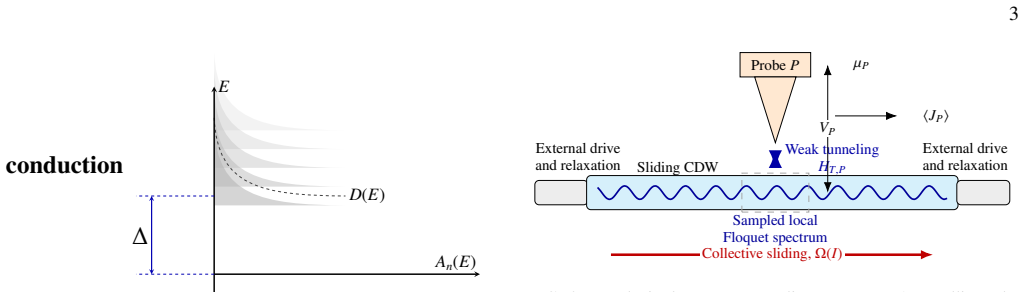
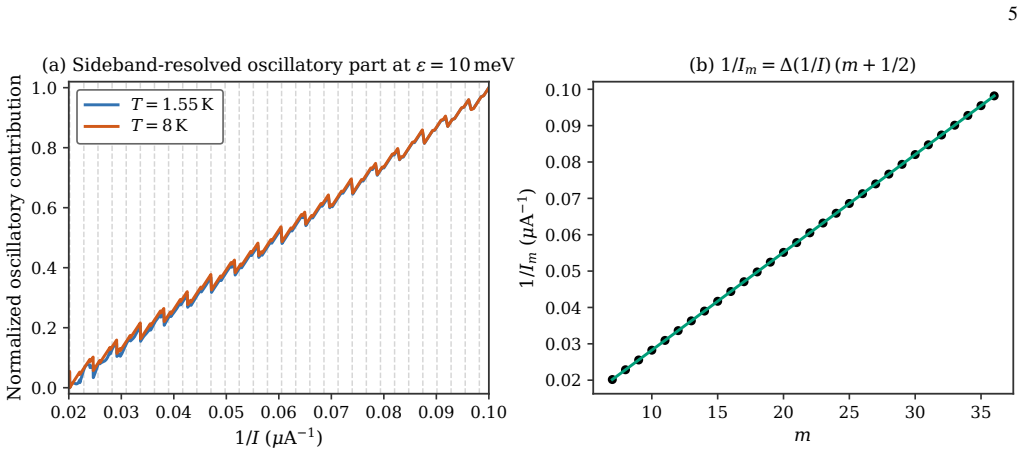
The isolated sliding-CDW problem is exactly solvable in Floquet form, yielding split gap edges and a ladder of Floquet sidebands. Weak-probe tunneling spectroscopy naturally yields an inverse-current (1/I) oscillation as a fixed-bias cut of the sideband ladder. Matching the observed oscillation period to theory indicates that the macroscopic current must percolate through a highly localized coherent filament, with an effective channel number orders of magnitude smaller than the geometric chain count. Inelastic phase-slip dephasing near the contacts explains the strong suppression of oscillation visibility on outer voltage probes.
What carries the argument
The exact Floquet solution for the uniformly sliding charge-density wave, which converts spatial periodicity into temporal periodicity and generates an intrinsic ladder of sidebands protected by the insulating gap.
If this is right
- A sliding CDW functions as an intrinsic dc-to-ac converter that generates high-frequency quantum states from steady current alone.
- Tunneling spectroscopy at fixed bias directly maps the Floquet sideband ladder through the resulting 1/I oscillations.
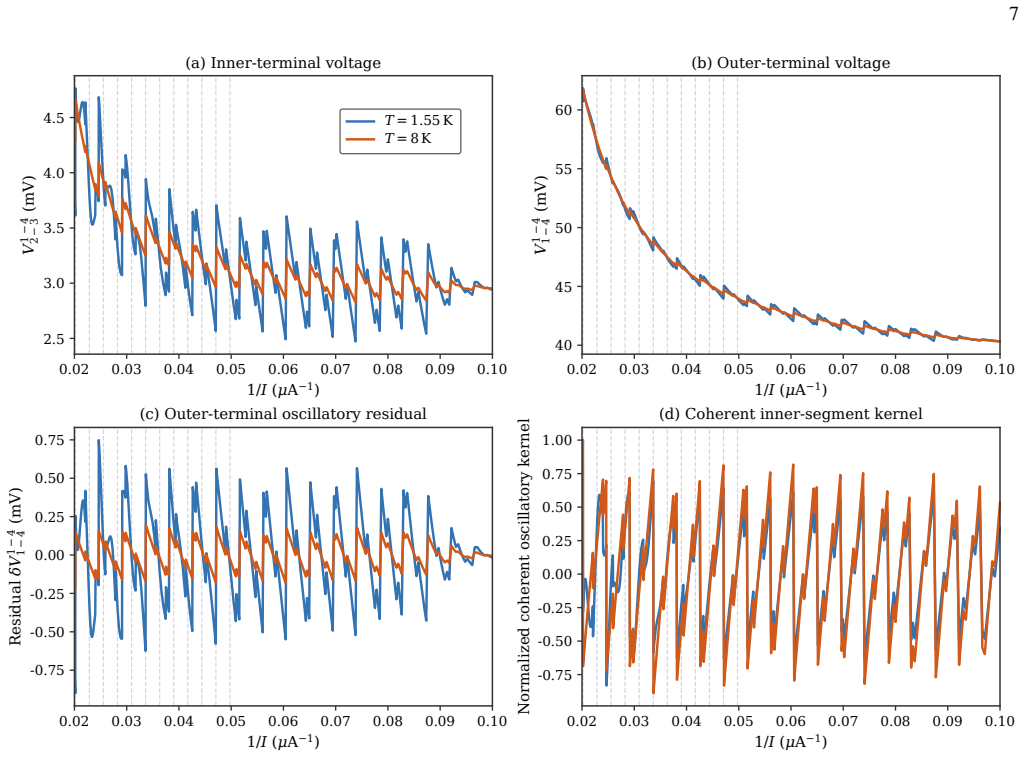
- Oscillation visibility is suppressed on outer voltage probes by inelastic phase slips near the contacts.
- The spatial-to-temporal conversion mechanism supplies a transport interpretation of the 1/I quantum oscillations observed in quasi-one-dimensional CDW insulators.
- The insulating gap protects Floquet coherence, suggesting a route to intrinsically driven quantum devices.
Where Pith is reading between the lines
- The filament-localization requirement implies that coherence length, rather than sample width, sets the effective dimensionality in sliding CDW transport.
- Contact engineering to reduce phase-slip rates near the electrodes could increase oscillation visibility in multiterminal devices.
- The same spatial-to-temporal conversion may operate in other sliding periodic systems, such as spin-density waves or artificial superlattices.
- Extending the model beyond the non-interacting limit could reveal interaction-induced modifications to the Floquet sideband spacing.
Load-bearing premise
The macroscopic current percolates through a highly localized coherent filament whose effective channel number is orders of magnitude smaller than the geometric chain count.
What would settle it
An independent measurement of the effective conducting channel number (for example via shot-noise spectroscopy or critical-current scaling) that finds a value comparable to the geometric chain count would falsify the filament model required to match the oscillation amplitude.
Figures






read the original abstract
The realization of intrinsic, tunable high-frequency quantum states without external radiation is a major goal in condensed matter physics and quantum device engineering. Here, we demonstrate that a uniformly sliding charge-density wave (CDW) acts as an intrinsic dc-to-ac converter, transforming spatial periodicity into temporal periodicity to realize a unique periodically driven quantum state. We show that the isolated sliding-CDW problem is exactly solvable in Floquet form, yielding split gap edges and a ladder of Floquet sidebands. Using this exact solution, we reveal that weak-probe tunneling spectroscopy naturally yields an inverse-current ($1/I$) oscillation as a fixed-bias cut of the sideband ladder. Matching the observed oscillation period to theory indicates that the macroscopic current must percolate through a highly localized coherent filament, with an effective channel number orders of magnitude smaller than the geometric chain count. Furthermore, using a segmented multiterminal model, we demonstrate that inelastic phase-slip dephasing near the contacts explains the strong suppression of oscillation visibility on outer voltage probes. Ultimately, our results provide a rigorous transport interpretation of the striking $1/I$ quantum oscillations recently observed in quasi-one-dimensional CDW insulators. More broadly, they highlight a universal spatial-to-temporal conversion mechanism where the insulating gap protects Floquet coherence, offering a novel paradigm for intrinsically driven quantum devices.
Editorial analysis
A structured set of objections, weighed in public.
Referee Report
Summary. The paper claims that a uniformly sliding charge-density wave realizes an intrinsic Floquet state exactly solvable without external driving, producing split gap edges and a ladder of sidebands. Weak-probe tunneling then yields 1/I oscillations as a fixed-bias cut through this ladder. Period matching implies the current flows via a highly localized coherent filament with effective channels orders of magnitude below geometric count. A segmented multiterminal model accounts for dephasing and probe-dependent visibility, offering a transport interpretation of observed 1/I quantum oscillations in quasi-1D CDW insulators.
Significance. Should the exact Floquet solution and the resulting transport interpretation prove correct, this manuscript would represent a notable contribution to condensed matter physics by establishing a mechanism for intrinsic dc-to-ac conversion and Floquet coherence in CDW systems. It provides a potential resolution to the origin of 1/I oscillations and suggests a universal spatial-to-temporal conversion protected by the gap, with implications for designing intrinsically driven quantum devices. The emphasis on an exact solution is a positive aspect if substantiated.
major comments (3)
- The assertion of an 'exact' Floquet solution for the isolated sliding-CDW problem, yielding split gap edges and a sideband ladder that produces 1/I oscillations, is made without derivation steps, explicit formulas for the sidebands, or error estimates. This absence prevents verification of how the fixed-bias cut leads to the inverse-current oscillation.
- The effective channel number is fixed by matching the observed oscillation period to the theoretical sideband spacing. This introduces circularity since the 1/I feature is used to define the parameter that then explains the data. No independent evidence is given for the required highly localized coherent filament whose channel count is orders of magnitude smaller than the geometric chain count.
- The explanation of oscillation suppression via inelastic phase-slip dephasing near contacts in the segmented model depends on the filamentary current assumption. Without microscopic justification for the extreme localization needed to match both period and amplitude, the transport interpretation does not follow directly from the solvable model.
Simulated Author's Rebuttal
We thank the referee for the thorough and constructive review of our manuscript. The comments highlight important points regarding the presentation of the Floquet solution and the transport interpretation. We address each major comment below and have revised the manuscript to improve clarity, add explicit derivations, and expand discussions on the physical implications.
read point-by-point responses
-
Referee: The assertion of an 'exact' Floquet solution for the isolated sliding-CDW problem, yielding split gap edges and a sideband ladder that produces 1/I oscillations, is made without derivation steps, explicit formulas for the sidebands, or error estimates. This absence prevents verification of how the fixed-bias cut leads to the inverse-current oscillation.
Authors: We agree that the original manuscript presented the Floquet solution too concisely. The exact solvability follows from a Galilean boost to the sliding frame combined with a time-dependent phase factor in the order parameter, leading to a time-periodic Hamiltonian with period set by the CDW velocity. In the revised manuscript we have added a new subsection (Section II.B) that derives the Floquet Hamiltonian explicitly, gives the closed-form sideband energies E_n(k) = ±√[(v_F k)^2 + Δ^2] + n ħ ω_s (where ω_s = v_CDW * Q_CDW), and shows the resulting tunneling current integral at fixed bias. We also include a brief error analysis for the weak-probe and low-temperature approximations. These additions allow direct verification of the fixed-bias cut through the sideband ladder producing the 1/I periodicity. revision: yes
-
Referee: The effective channel number is fixed by matching the observed oscillation period to the theoretical sideband spacing. This introduces circularity since the 1/I feature is used to define the parameter that then explains the data. No independent evidence is given for the required highly localized coherent filament whose channel count is orders of magnitude smaller than the geometric chain count.
Authors: The sideband spacing itself is fixed by independently measured CDW parameters (velocity and wavevector) and does not rely on the oscillation data. Matching the observed period to this predicted spacing then determines the effective number of coherent channels N_eff ≈ 10^2–10^3, which is indeed much smaller than the geometric chain count. This inference is a physical conclusion rather than a circular fit; the model then uses the same N_eff to predict the oscillation amplitude. We acknowledge that direct microscopic evidence (e.g., from imaging) is absent. In the revision we have added a paragraph discussing possible origins of such localization (strong pinning centers or current-induced filamentation) and note that the amplitude consistency provides an internal check. We have also clarified that N_eff is an effective parameter whose microscopic origin remains an open question. revision: partial
-
Referee: The explanation of oscillation suppression via inelastic phase-slip dephasing near contacts in the segmented model depends on the filamentary current assumption. Without microscopic justification for the extreme localization needed to match both period and amplitude, the transport interpretation does not follow directly from the solvable model.
Authors: The segmented multiterminal model is constructed to reproduce the probe-position dependence seen in experiment once the filamentary current distribution is assumed. The dephasing length scale near the contacts is set by the inelastic phase-slip rate, which is independently estimated from the CDW gap and temperature. While the extreme localization is inferred from the period matching, the same assumption simultaneously accounts for the observed suppression on outer probes. We have expanded the discussion in the revised text to emphasize that the transport interpretation is a consistent phenomenological framework built on the exact Floquet solution, but we agree that a first-principles microscopic theory of filament formation is not provided and lies outside the present scope. revision: partial
- A first-principles microscopic justification for the formation and stability of the highly localized coherent filaments is not available in the current work and would require additional theoretical modeling or spatially resolved experiments.
Circularity Check
Filament channel number fitted to observed oscillation period to match amplitude
specific steps
-
fitted input called prediction
[Abstract]
"Matching the observed oscillation period to theory indicates that the macroscopic current must percolate through a highly localized coherent filament, with an effective channel number orders of magnitude smaller than the geometric chain count."
The effective channel number is fixed by fitting to the period of the observed 1/I oscillations. This fitted value is then used to explain why the sideband-ladder oscillations remain visible (rather than being suppressed by ensemble averaging over many chains), so the amplitude match and overall transport interpretation are partly forced by the same data used to determine the parameter.
full rationale
The exact Floquet solution for the isolated sliding CDW and the resulting sideband ladder constitute an independent derivation that predicts 1/I oscillations in weak-probe tunneling as a fixed-bias cut. However, the central transport interpretation—that this ladder explains the observed oscillations—requires introducing a highly localized coherent filament whose effective channel number is orders of magnitude smaller than the geometric count. This number is obtained by matching the observed oscillation period to the theoretical sideband spacing, after which the same parameter is invoked to account for oscillation visibility and amplitude. This constitutes a fitted-input-called-prediction step that partially reduces the explanatory claim to data matching rather than an a priori prediction from the isolated model alone.
Axiom & Free-Parameter Ledger
free parameters (1)
- effective channel number
axioms (1)
- domain assumption The sliding CDW is uniformly sliding and isolated from external radiation or disorder
invented entities (1)
-
highly localized coherent filament
no independent evidence
Reference graph
Works this paper leans on
-
[1]
Co-Authoring with AI: How I Wrote a Physics Paper About AI, Using AI
Panel (a) shows the inner-terminal voltageV 1−4 2−3 (I) versus 1/I. Panel (b) shows the raw outer-terminal voltageV 1−4 1−4 (I) versus 1/I. Panel (c) shows the oscillatory residual obtained after subtracting the smooth background from panel (b). Panel (d) shows the normalized coherent kernelO osc(I,T). In this minimal visibility model the coherent respons...
work page internal anchor Pith review Pith/arXiv arXiv
-
[2]
Fr ¨ohlich, On the theory of superconductivity: the one- dimensional case, Proceedings of the Royal Society of London
H. Fr ¨ohlich, On the theory of superconductivity: the one- dimensional case, Proceedings of the Royal Society of London. Series A. Mathematical and Physical Sciences223, 296 (1954)
1954
-
[3]
R. E. Peierls,Quantum Theory of Solids(Oxford University Press, Oxford, 1955)
1955
-
[4]
Gr ¨uner, The dynamics of charge-density waves, Rev
G. Gr ¨uner, The dynamics of charge-density waves, Rev. Mod. Phys.60, 1129 (1988)
1988
-
[5]
Monceau, Electronic crystals: an experimental overview, Adv
P. Monceau, Electronic crystals: an experimental overview, Adv. Phys.61, 325 (2012)
2012
-
[6]
A. W. Overhauser, Giant spin density waves, Phys. Rev. Lett.4, 462 (1960)
1960
-
[7]
A. W. Overhauser, Spin density waves in an electron gas, Phys. Rev.128, 1437 (1962)
1962
-
[8]
Gr ¨uner, The dynamics of spin-density waves, Rev
G. Gr ¨uner, The dynamics of spin-density waves, Rev. Mod. Phys.66, 1 (1994)
1994
-
[9]
P. A. Lee, T. M. Rice, and P. W. Anderson, Conductivity from charge or spin density waves, Solid State Commun.14, 703 (1974)
1974
-
[10]
Monceau, N
P. Monceau, N. P. Ong, A. M. Portis, A. Meerschaut, and J. Rouxel, Electric-field breakdown of charge-density-wave- induced anomalies in NbSe3, Phys. Rev. Lett.37, 602 (1976)
1976
-
[11]
Fukuyama and P
H. Fukuyama and P. A. Lee, Dynamics of the charge-density wave. I. Impurity pinning in a single chain, Phys. Rev. B17, 535 (1978). 14
1978
-
[12]
P. A. Lee and T. M. Rice, Electric field depinning of charge density waves, Phys. Rev. B19, 3970 (1979)
1979
-
[13]
R. M. Fleming and C. C. Grimes, Sliding-mode conductivity in NbSe3: Observation of a threshold electric field and conduction noise, Phys. Rev. Lett.42, 1423 (1979)
1979
-
[14]
Bardeen, Theory of non-Ohmic conduction from charge- density waves in NbSe3, Phys
J. Bardeen, Theory of non-Ohmic conduction from charge- density waves in NbSe3, Phys. Rev. Lett.42, 1498 (1979)
1979
-
[15]
Grifoni and P
M. Grifoni and P. H ¨anggi, Driven quantum tunneling, Physics Reports304, 229 (1998)
1998
-
[16]
Platero and R
G. Platero and R. Aguado, Photon-assisted transport in semi- conductor nanostructures, Physics Reports395, 1 (2004)
2004
-
[17]
Kohler, J
S. Kohler, J. Lehmann, and P. H ¨anggi, Driven quantum trans- port on the nanoscale, Physics Reports406, 379 (2005)
2005
-
[18]
Bukov, L
M. Bukov, L. D’Alessio, and A. Polkovnikov, Universal high- frequency behavior of periodically driven systems: from dy- namical stabilization to floquet engineering, Adv. Phys.64, 139 (2015)
2015
-
[19]
Oka and S
T. Oka and S. Kitamura, Floquet engineering of quantum mate- rials, Annu. Rev. Condens. Matter Phys.10, 387 (2019)
2019
-
[20]
M. S. Rudner and N. H. Lindner, Band structure engineering and non-equilibrium dynamics in floquet topological insulators, Nat. Rev. Phys.2, 229 (2020)
2020
-
[21]
Kittel,Introduction to Solid State Physics, 8th ed
C. Kittel,Introduction to Solid State Physics, 8th ed. (Wiley, 2004)
2004
-
[22]
J. M. Ziman,Principles of the Theory of Solids(Cambridge University Press, 1964)
1964
-
[23]
N. W. Ashcroft and N. D. Mermin,Solid State Physics(Saun- ders College, Philadelphia, 1976)
1976
-
[24]
T. Le, R. Jiang, L. Tu, R. Bian, Y . Ma, Y . Shi, K. Jia, Z. Li, Z. Lyu, X. Cao, J. Shen, G. Liu, Y . Shi, F. Liu, Y . Zhou, L. Lu, and F. Qu, Inverse-current quantum electro-oscillations in a charge-density wave insulator, Phys. Rev. B109, 245123 (2024)
2024
-
[25]
Floquet, Sur les ´equations diff´erentielles lin ´eaires `a coeffi- cients p ´eriodiques, Annales scientifiques de l’ ´Ecole Normale Sup´erieure 2e s´erie,12, 47 (1883)
G. Floquet, Sur les ´equations diff´erentielles lin ´eaires `a coeffi- cients p ´eriodiques, Annales scientifiques de l’ ´Ecole Normale Sup´erieure 2e s´erie,12, 47 (1883)
-
[26]
J. H. Shirley, Solution of the schr¨odinger equation with a hamil- tonian periodic in time, Phys. Rev.138, B979 (1965)
1965
-
[27]
Sambe, Steady states and quasienergies of a quantum- mechanical system in an oscillating field, Phys
H. Sambe, Steady states and quasienergies of a quantum- mechanical system in an oscillating field, Phys. Rev. A7, 2203 (1973)
1973
-
[28]
G. D. Mahan,Many-Particle Physics, 3rd ed. (Plenum, New York, 2000)
2000
-
[29]
G. S. Uhrig, M. H. Kalthoff, and J. K. Freericks, Positivity of the spectral densities of retarded floquet green functions, Phys. Rev. Lett.122, 130604 (2019)
2019
-
[30]
B ¨uttiker, Four-terminal phase-coherent conductance, Phys
M. B ¨uttiker, Four-terminal phase-coherent conductance, Phys. Rev. Lett.57, 1761 (1986)
1986
-
[31]
A. I. Larkin and A. A. Varlamov,Theory of Fluctuations in Su- perconductors, revised ed., International Series of Monographs on Physics, V ol. 127 (Oxford University Press, Oxford, 2009)
2009
-
[32]
Imry,Introduction to Mesoscopic Physics, 2nd ed
Y . Imry,Introduction to Mesoscopic Physics, 2nd ed. (Oxford University Press, Oxford, 2002)
2002
-
[33]
Jauho, N
A.-P. Jauho, N. S. Wingreen, and Y . Meir, Time-dependent transport in interacting and noninteracting resonant-tunneling systems, Phys. Rev. B50, 5528 (1994)
1994
-
[34]
Stefanucci and R
G. Stefanucci and R. van Leeuwen,Nonequilibrium Many-Body Theory of Quantum Systems: A Modern Introduction(Cam- bridge University Press, Cambridge, 2013)
2013
-
[35]
Haug and A.-P
H. Haug and A.-P. Jauho,Quantum Kinetics in Transport and Optics of Semiconductors, 2nd ed., Springer Series in Solid- State Sciences, V ol. 123 (Springer, Berlin, 2008)
2008
-
[36]
J. S. Schwinger, Brownian motion of a quantum oscillator, Jour- nal of Mathematical Physics2, 407 (1961)
1961
-
[37]
L. V . Keldysh, Diagram technique for nonequilibrium pro- cesses, Sov. Phys. JETP20, 1018 (1965)
1965
-
[38]
Rammer and H
J. Rammer and H. Smith, Quantum field-theoretical methods in transport theory of metals, Rev. Mod. Phys.58, 323 (1986)
1986
-
[39]
Kamenev and A
A. Kamenev and A. Levchenko, Keldysh technique and non- linearσ-model: basic principles and applications, Advances in Physics58, 197 (2009)
2009
discussion (0)
Sign in with ORCID, Apple, or X to comment. Anyone can read and Pith papers without signing in.