Recognition: unknown
Axion-Like Particle Dark Matter Intensity Mapping: A New Probe via Cross-Correlation with Galaxy Surveys
Pith reviewed 2026-05-08 05:40 UTC · model grok-4.3
The pith
Cross-correlating radio intensity maps with local galaxy surveys offers a new way to search for axion-like particle dark matter.
A machine-rendered reading of the paper's core claim, the machinery that carries it, and where it could break.
Core claim
Axion-like particles as cold dark matter can decay radiatively into two photons with a rate boosted by the presence of ambient photon fields from the CMB and extragalactic radio background; cross-correlating the resulting radio intensity map with the three-dimensional galaxy distribution from 2MRS at z less than or equal to 0.1 isolates this contribution and enables constraints on ALP parameters using SKA Phase 2 observations.
What carries the argument
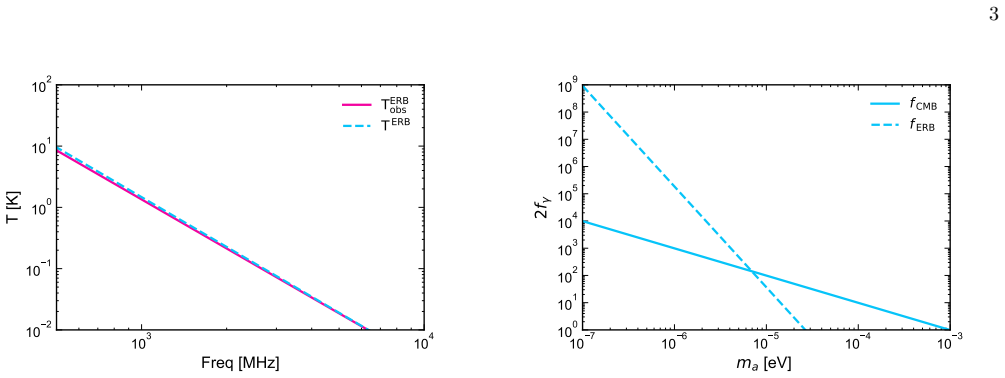
The cross-correlation power spectrum between radio intensity mapping and galaxy overdensity, incorporating the stimulated ALP decay term driven by CMB and bottom-up modeled extragalactic radio background photons.
If this is right
- ALP dark matter at micro-eV masses produces a measurable radio signal when stimulated by ambient light, allowing constraints from intensity mapping.
- Cross-correlation with galaxy surveys at z less than or equal to 0.1 suppresses contamination and isolates the ALP contribution.
- SKA Phase 2 achieves sufficient sensitivity for this probe to serve as a complementary search channel.
- The method extends intensity mapping techniques from cosmology to particle dark matter searches on cosmic scales.
Where Pith is reading between the lines
- Independent measurements of the extragalactic radio background would reduce modeling uncertainty and strengthen the reliability of any ALP signal claim.
- The same cross-correlation framework could be applied to higher-redshift surveys or other radio telescopes to expand the mass range probed.
- If a signal appears, its frequency dependence could help distinguish ALP decay from other radio sources or alternative dark matter models.
Load-bearing premise
The bottom-up modeled extragalactic radio background accurately captures the ambient photon field that stimulates ALP decay and that this stimulated signal dominates over other astrophysical contributions in the cross-correlation with 2MRS galaxies at z less than or equal to 0.1.
What would settle it
SKA Phase 2 radio intensity maps showing no detectable excess cross-correlation power with 2MRS galaxies at low redshift, after subtracting known astrophysical contributions, would demonstrate that the predicted ALP DM signal cannot be extracted this way.
Figures


read the original abstract
The particle nature of dark matter (DM) remains one of the most significant enigmas in modern cosmology. Axion-like particles (ALPs), as well-motivated candidates for cold dark matter, can undergo radiative decay into photon pairs, a process that is significantly enhanced in the presence of ambient radiation fields. In this work, we propose a novel probe of $\mu{\rm eV}$-scale ALP DM by cross-correlating radio intensity mapping (IM) with the large-scale galaxy distribution from the 2MASS Redshift Survey (2MRS) in the local universe ($z\leq 0.1$). We develop a comprehensive theoretical framework that incorporates stimulated decay effects driven by both the Cosmic Microwave Background (CMB) and a bottom-up modeled extragalactic radio background (ERB). By forecasting the sensitivity of the Square Kilometre Array (SKA) Phase 2, we demonstrate that this cross-correlation technique provides a promising and complementary approach to searching for ALP DM signals. This study establishes a new proof-of-concept for utilizing next-generation radio telescopes to probe ALP dark matter on cosmic scales.
Editorial analysis
A structured set of objections, weighed in public.
Referee Report
Summary. The manuscript develops a theoretical framework for probing μeV-scale axion-like particle (ALP) dark matter via cross-correlation of radio intensity mapping (from SKA Phase 2) with the 2MRS galaxy survey at z ≤ 0.1. It incorporates stimulated ALP decay driven by the CMB and a bottom-up modeled extragalactic radio background (ERB), then forecasts the sensitivity of the resulting cross-power spectrum as a complementary search channel.
Significance. If the central forecast is robust, the work establishes a new proof-of-concept for using next-generation radio intensity mapping to constrain ALP dark matter on cosmic scales, offering a distinct handle from direct detection or other astrophysical bounds. The explicit inclusion of stimulated decay and the use of realistic survey specifications are positive features.
major comments (3)
- [§3.2] §3.2 (ERB construction): the bottom-up integration over source populations is presented without quantitative observational anchors or uncertainty bands at the GHz frequencies relevant for μeV ALPs; because the stimulation factor enters linearly in the decay rate, any systematic offset in the radio luminosity function or spectral-index distribution directly rescales the predicted cross-correlation amplitude.
- [§4.3] §4.3 (cross-power forecast): the claim that the ALP-stimulated term dominates over local astrophysical radio emission (synchrotron, free-free) from 2MRS galaxies at z ≤ 0.1 is not supported by an explicit scale- or frequency-dependent separation analysis or by an error budget that marginalizes over ERB parameters; the reported SKA sensitivity therefore rests on an untested assumption about signal dominance.
- [§5] §5 (sensitivity results): error propagation from the ERB model parameters is omitted from the forecast; the quoted detection thresholds assume the central ERB realization without marginalization, which understates the uncertainty on the ALP coupling limit.
minor comments (2)
- [Abstract] The abstract and introduction would benefit from a single sentence clarifying the precise frequency band and redshift slice in which the ERB stimulation is evaluated.
- [§2] Notation for the ALP-photon coupling and the ERB intensity should be defined once in §2 and used consistently in all subsequent equations.
Simulated Author's Rebuttal
We thank the referee for their thorough review and valuable suggestions, which have helped improve the clarity and robustness of our manuscript. We address each major comment below and have made revisions where necessary to strengthen the analysis.
read point-by-point responses
-
Referee: [§3.2] §3.2 (ERB construction): the bottom-up integration over source populations is presented without quantitative observational anchors or uncertainty bands at the GHz frequencies relevant for μeV ALPs; because the stimulation factor enters linearly in the decay rate, any systematic offset in the radio luminosity function or spectral-index distribution directly rescales the predicted cross-correlation amplitude.
Authors: We acknowledge the referee's concern regarding the lack of explicit observational anchors and uncertainty quantification in the ERB model. The original construction relied on established radio luminosity functions and source counts from the literature. In the revised manuscript, we have added quantitative comparisons to observational data at relevant GHz frequencies, including constraints from the ARCADE 2 experiment and other radio surveys. We have also introduced uncertainty bands by varying the spectral index distribution within observational ranges. These additions are now presented in an updated §3.2, providing better justification for the ERB model used in our forecasts. revision: yes
-
Referee: [§4.3] §4.3 (cross-power forecast): the claim that the ALP-stimulated term dominates over local astrophysical radio emission (synchrotron, free-free) from 2MRS galaxies at z ≤ 0.1 is not supported by an explicit scale- or frequency-dependent separation analysis or by an error budget that marginalizes over ERB parameters; the reported SKA sensitivity therefore rests on an untested assumption about signal dominance.
Authors: The referee is correct that an explicit demonstration of signal dominance is required. We have performed additional analysis in the revised §4.3, including a scale- and frequency-dependent comparison between the ALP-stimulated decay signal and the local astrophysical radio emissions (synchrotron and free-free) from 2MRS galaxies. Using models for the local radio emission correlated with galaxy density, we show that the ALP term dominates on the scales of interest for the cross-correlation. We have also included a discussion of how ERB parameter variations affect this dominance. This new analysis supports our sensitivity claims and is detailed in the updated manuscript. revision: yes
-
Referee: [§5] §5 (sensitivity results): error propagation from the ERB model parameters is omitted from the forecast; the quoted detection thresholds assume the central ERB realization without marginalization, which understates the uncertainty on the ALP coupling limit.
Authors: We agree that omitting error propagation from ERB parameters understates the uncertainties. In the revised Section 5, we now marginalize over the key ERB model parameters (normalization, spectral index, etc.) when computing the detection thresholds and ALP coupling limits. This results in updated, more conservative sensitivity forecasts, which are presented with the corresponding error budgets. The revised figures and text incorporate this marginalization. revision: yes
Circularity Check
No circularity: sensitivity forecast derived from external ERB model and standard ALP decay physics
full rationale
The paper constructs a theoretical model for stimulated ALP decay using the CMB plus a bottom-up integration over radio source populations for the ERB, then computes the expected cross-power spectrum with 2MRS galaxies and forecasts SKA Phase 2 detectability. No equation in the derivation chain defines a quantity in terms of itself, renames a fit as a prediction, or reduces the central forecast to a self-citation whose content is unverified. The ERB modeling step is an independent calculation (not fitted to the target cross-correlation), and the forecast is a forward prediction under stated assumptions rather than a tautology. The result remains falsifiable by future observations and does not collapse to its inputs by construction.
Axiom & Free-Parameter Ledger
free parameters (2)
- ALP mass and coupling
- ERB model parameters
axioms (2)
- domain assumption ALPs as cold dark matter undergo radiative decay to photon pairs with rate enhanced by ambient radiation fields
- standard math Standard Lambda-CDM cosmology governs galaxy distribution and CMB at low redshift
Reference graph
Works this paper leans on
-
[1]
Aghanim et al
N. Aghanim et al. Planck 2018 results. VI. Cosmological parameters.Astron. Astrophys., 641:A6, 2020. [Erratum: Astron.Astrophys. 652, C4 (2021)]
2018
-
[2]
Blumenthal, S
George R. Blumenthal, S. M. Faber, Joel R. Primack, and Martin J. Rees. Formation of Galaxies and Large Scale Structure with Cold Dark Matter.Nature, 311:517–525, 1984
1984
-
[3]
Exploring the Role of Axions and Other WISPs in the Dark Universe.Phys
Andreas Ringwald. Exploring the Role of Axions and Other WISPs in the Dark Universe.Phys. Dark Univ., 1:116–135, 2012
2012
-
[4]
WISPy Cold Dark Matter.JCAP, 06:013, 2012
Paola Arias, Davide Cadamuro, Mark Goodsell, Joerg Jaeckel, Javier Redondo, and Andreas Ringwald. WISPy Cold Dark Matter.JCAP, 06:013, 2012
2012
-
[5]
David J. E. Marsh. Axion Cosmology.Phys. Rept., 643:1– 79, 2016
2016
-
[6]
Irastorza and Javier Redondo
Igor G. Irastorza and Javier Redondo. New experimental approaches in the search for axion-like particles.Prog. Part. Nucl. Phys., 102:89–159, 2018
2018
-
[7]
Co, Lawrence J
Raymond T. Co, Lawrence J. Hall, and Keisuke Hari- gaya. Predictions for Axion Couplings from ALP Coge- nesis.JHEP, 01:172, 2021
2021
-
[8]
Wise, and Frank Wilczek
John Preskill, Mark B. Wise, and Frank Wilczek. Cos- mology of the Invisible Axion.Phys. Lett. B, 120:127– 132, 1983
1983
-
[9]
L. F. Abbott and P. Sikivie. A Cosmological Bound on the Invisible Axion.Phys. Lett. B, 120:133–136, 1983
1983
-
[10]
The Not So Harmless Axion.Phys
Michael Dine and Willy Fischler. The Not So Harmless Axion.Phys. Lett. B, 120:137–141, 1983
1983
-
[11]
C. B. Adams et al. Axion Dark Matter. InSnowmass 2021, 3 2022
2021
-
[12]
An introduction to axions and their detection.SciPost Phys
Igor Garcia Irastorza. An introduction to axions and their detection.SciPost Phys. Lect. Notes, 45:1, 2022
2022
-
[13]
Any light particle search II —Tech- nical Design Report.JINST, 8:T09001, 2013
Robin B¨ ahre et al. Any light particle search II —Tech- nical Design Report.JINST, 8:T09001, 2013
2013
-
[14]
Braine et al
T. Braine et al. Extended Search for the Invisible Axion with the Axion Dark Matter Experiment.Phys. Rev. Lett., 124(10):101303, 2020
2020
-
[15]
Ajello et al
M. Ajello et al. Search for Spectral Irregularities due to Photon–Axionlike-Particle Oscillations with the Fermi Large Area Telescope.Phys. Rev. Lett., 116(16):161101, 2016
2016
-
[16]
Anastassopoulos et al
V. Anastassopoulos et al. New CAST Limit on the Axion- Photon Interaction.Nature Phys., 13:584–590, 2017
2017
-
[17]
Searching for the possible signal of the photon-axionlike particle oscillation in the combined GeV and TeV spectra of supernova remnants
Zi-Qing Xia, Yun-Feng Liang, Lei Feng, Qiang Yuan, Yi-Zhong Fan, and Jian Wu. Searching for the possible signal of the photon-axionlike particle oscillation in the combined GeV and TeV spectra of supernova remnants. Phys. Rev. D, 100(12):123004, 2019
2019
-
[18]
Limits on axion-like particles from Mrk 421 with 4.5-year period observations by ARGO- YBJ and Fermi-LAT.Phys
Hai-Jun Li, Jun-Guang Guo, Xiao-Jun Bi, Su-Jie Lin, and Peng-Fei Yin. Limits on axion-like particles from Mrk 421 with 4.5-year period observations by ARGO- YBJ and Fermi-LAT.Phys. Rev. D, 103(8):083003, 2021
2021
-
[19]
Andrea Caputo, Marco Regis, Marco Taoso, and Samuel J. Witte. Detecting the Stimulated Decay of Ax- ions at RadioFrequencies.JCAP, 03:027, 2019
2019
-
[20]
Safdi, and Zhiquan Sun
Anson Hook, Yonatan Kahn, Benjamin R. Safdi, and Zhiquan Sun. Radio Signals from Axion Dark Matter Conversion in Neutron Star Magnetospheres.Phys. Rev. Lett., 121(24):241102, 2018
2018
-
[21]
Foster, Samuel J
Joshua W. Foster, Samuel J. Witte, Matthew Lawson, Tim Linden, Vishal Gajjar, Christoph Weniger, and Ben- jamin R. Safdi. Extraterrestrial Axion Search with the Breakthrough Listen Galactic Center Survey.Phys. Rev. Lett., 129(25):251102, 2022
2022
-
[22]
Search for Axion Dark Matter with MeerKAT UHF Sideband in 1051–1088 MHz.Res
Mengtian Li, Hao Chen, Wen-Qing Guo, Yogesh Chan- dola, Bohao Duan, and Nick Houston. Search for Axion Dark Matter with MeerKAT UHF Sideband in 1051–1088 MHz.Res. Astron. Astrophys., 25(7):075010, 2025
2025
-
[23]
Andrea Caputo, Carlos Pe˜ na Garay, and Samuel J. Witte. Looking for Axion Dark Matter in Dwarf Spheroidals.Phys. Rev. D, 98(8):083024, 2018. [Erra- tum: Phys.Rev.D 99, 089901 (2019)]
2018
-
[24]
Constraining axion-like particles dark matter in Coma Berenices with FAST.Phys
Wen-Qing Guo, Zi-Qing Xia, and Xiaoyuan Huang. Constraining axion-like particles dark matter in Coma Berenices with FAST.Phys. Lett. B, 852:138631, 2024
2024
-
[25]
Bauer, David J
Jurek B. Bauer, David J. E. Marsh, Ren´ ee Hloˇ zek, Hamsa Padmanabhan, and Alex Lagu¨ e. Intensity Mapping as a Probe of Axion Dark Matter.Mon. Not. Roy. Astron. Soc., 500(3):3162–3177, 2020
2020
-
[26]
Searching for eV-mass Axion-like Par- ticles with Cross Correlations between Line Intensity and Weak Lensing Maps.Phys
Masato Shirasaki. Searching for eV-mass Axion-like Par- ticles with Cross Correlations between Line Intensity and Weak Lensing Maps.Phys. Rev. D, 103:103014, 2021
2021
-
[27]
Forecasts for decaying dark matter from cross-correlation between line intensity map- ping and large scale structures surveys.Eur
Jiali Wu and Jun-Qing Xia. Forecasts for decaying dark matter from cross-correlation between line intensity map- ping and large scale structures surveys.Eur. Phys. J. C, 85(4):390, 2025
2025
-
[28]
Particle dark matter searches in the anisotropic sky.Front
Nicolao Fornengo and Marco Regis. Particle dark matter searches in the anisotropic sky.Front. Physics, 2:6, 2014
2014
-
[29]
Asantha Cooray and Ravi K. Sheth. Halo Models of Large Scale Structure.Phys. Rept., 372:1–129, 2002
2002
-
[30]
Sheth, H
Ravi K. Sheth, H. J. Mo, and Giuseppe Tormen. El- lipsoidal collapse and an improved model for the number and spatial distribution of dark matter haloes.Mon. Not. Roy. Astron. Soc., 323:1, 2001. [31]https://camb.readthedocs.io/en/latest/
2001
-
[31]
The stellar- to-halo mass relation over the past 12 Gyr: I
Giacomo Girelli, Lucia Pozzetti, Micol Bolzonella, Carlo Giocoli, Federico Marulli, and Marco Baldi. The stellar- to-halo mass relation over the past 12 Gyr: I. Standard ΛCDM model.Astron. Astrophys., 634:A135, 2020
2020
-
[32]
G¨ urkan, M
G. G¨ urkan, M. J. Hardcastle, D. J. B. Smith, P. N. Best, N. Bourne, G. Calistro-Rivera, G. Heald, M. J. Jarvis, I. Prandoni, H. J. A. R¨ ottgering, J. Sabater, T. Shimwell, C. Tasse, and W. L. Williams. LOFAR/H-ATLAS: the low-frequency radio luminosity-star formation rate rela- tion.mnras, 475(3):3010–3028, April 2018
2018
-
[33]
Main Sequence
J. S. Speagle, C. L. Steinhardt, P. L. Capak, and J. D. Silverman. A Highly Consistent Framework for the Evo- lution of the Star-Forming “Main Sequence” from z ˜0-6. apjs, 214(2):15, October 2014
2014
-
[34]
D. J. Fixsen, A. Kogut, S. Levin, M. Limon, P. Lubin, P. Mirel, M. Seiffert, J. Singal, E. Wollack, T. Villela, and C. A. Wuensche. ARCADE 2 Measurement of the Absolute Sky Brightness at 3-90 GHz.apj, 734(1):5, June 2011
2011
-
[35]
Singal et al
J. Singal et al. The Second Radio Synchrotron Back- ground Workshop: Conference Summary and Report. Publ. Astron. Soc. Pac., 135(1045):036001, 2023
2023
-
[36]
Lineros, Marco Regis, and Marco Taoso
Nicolao Fornengo, Roberto A. Lineros, Marco Regis, and Marco Taoso. The isotropic radio background revisited. JCAP, 04:008, 2014
2014
-
[37]
Dark Matter Halo Mass Profiles
Dan Coe. Dark Matter Halo Mass Profiles. 5 2010
2010
-
[38]
Sheth and Giuseppe Tormen
Ravi K. Sheth and Giuseppe Tormen. Large scale bias 9 and the peak background split.Mon. Not. Roy. Astron. Soc., 308:119, 1999
1999
-
[39]
M. F. Skrutskie, R. M. Cutri, R. Stiening, M. D. Wein- berg, S. Schneider, J. M. Carpenter, C. Beichman, R. Capps, T. Chester, J. Elias, J. Huchra, J. Liebert, C. Lonsdale, D. G. Monet, S. Price, P. Seitzer, T. Jar- rett, J. D. Kirkpatrick, J. E. Gizis, E. Howard, T. Evans, J. Fowler, L. Fullmer, R. Hurt, R. Light, E. L. Kopan, K. A. Marsh, H. L. McCallon...
2006
-
[40]
Huchra, Lucas M
John P. Huchra, Lucas M. Macri, Karen L. Masters, Thomas H. Jarrett, Perry Berlind, Michael Calkins, Aidan C. Crook, Roc Cutri, Pirin Erdoˇ gdu, Emilio Falco, Teddy George, Conrad M. Hutcheson, Ofer Lahav, Jeff Mader, Jessica D. Mink, Nathalie Martimbeau, Stephen Schneider, Michael Skrutskie, Susan Tokarz, and Michael Westover. The 2MASS Redshift Survey—D...
2012
-
[41]
Angular power spectrum of galaxies in the 2MASS Redshift Survey.Mon
Shin’ichiro Ando, Aur´ elien Benoit-L´ evy, and Eiichiro Komatsu. Angular power spectrum of galaxies in the 2MASS Redshift Survey.Mon. Not. Roy. Astron. Soc., 473(4):4318–4325, 2018
2018
-
[42]
Power spectrum tomography of dark matter annihilation with local galaxy distribution
Shin’ichiro Ando. Power spectrum tomography of dark matter annihilation with local galaxy distribution. JCAP, 10:061, 2014
2014
-
[43]
Characterizing the local gamma-ray Universe via angular cross-correlations.Phys
Simone Ammazzalorso, Nicolao Fornengo, Shunsaku Ho- riuchi, and Marco Regis. Characterizing the local gamma-ray Universe via angular cross-correlations.Phys. Rev. D, 98(10):103007, 2018
2018
-
[44]
Berlind, David H
Zheng Zheng, Andreas A. Berlind, David H. Weinberg, Andrew J. Benson, Carlton M. Baugh, Shaun Cole, Romeel Dave, Carlos S. Frenk, Neal Katz, and Cedric G. Lacey. Theoretical models of the halo occupation distri- bution: Separating central and satellite galaxies.Astro- phys. J., 633:791–809, 2005
2005
-
[45]
R. A. Battye, I. W. A. Browne, C. Dickinson, G. Heron, B. Maffei, and A. Pourtsidou. HI intensity mapping : a single dish approach.Mon. Not. Roy. Astron. Soc., 434:1239–1256, 2013
2013
-
[46]
Santos, Pedro G
Stefano Camera, Mario G. Santos, Pedro G. Ferreira, and Luis Ferramacho. Cosmology on Ultra-Large Scales with HI Intensity Mapping: Limits on Primordial non- Gaussianity.Phys. Rev. Lett., 111:171302, 2013
2013
-
[47]
Synergies across the spectrum for particle dark matter indirect detection: how HI intensity map- ping meets gamma rays.JCAP, 07:044, 2020
Elena Pinetti, Stefano Camera, Nicolao Fornengo, and Marco Regis. Synergies across the spectrum for particle dark matter indirect detection: how HI intensity map- ping meets gamma rays.JCAP, 07:044, 2020
2020
-
[48]
A. R. Offringa, J. Singal, S. Heston, S. Horiuchi, and D. M. Lucero. Measurement of the anisotropy power spectrum of the radio synchrotron background.Mon. Not. Roy. Astron. Soc., 509(1):114–121, 2021
2021
discussion (0)
Sign in with ORCID, Apple, or X to comment. Anyone can read and Pith papers without signing in.