Recognition: unknown
Narrowband-to-broadband switchable and polarization-insensitive terahertz metasurface absorber enabled by phase-change material
Pith reviewed 2026-05-08 06:35 UTC · model grok-4.3
The pith
A metasurface terahertz absorber switches from narrowband to broadband absorption by triggering the phase transition in vanadium dioxide patches.
A machine-rendered reading of the paper's core claim, the machinery that carries it, and where it could break.
Core claim
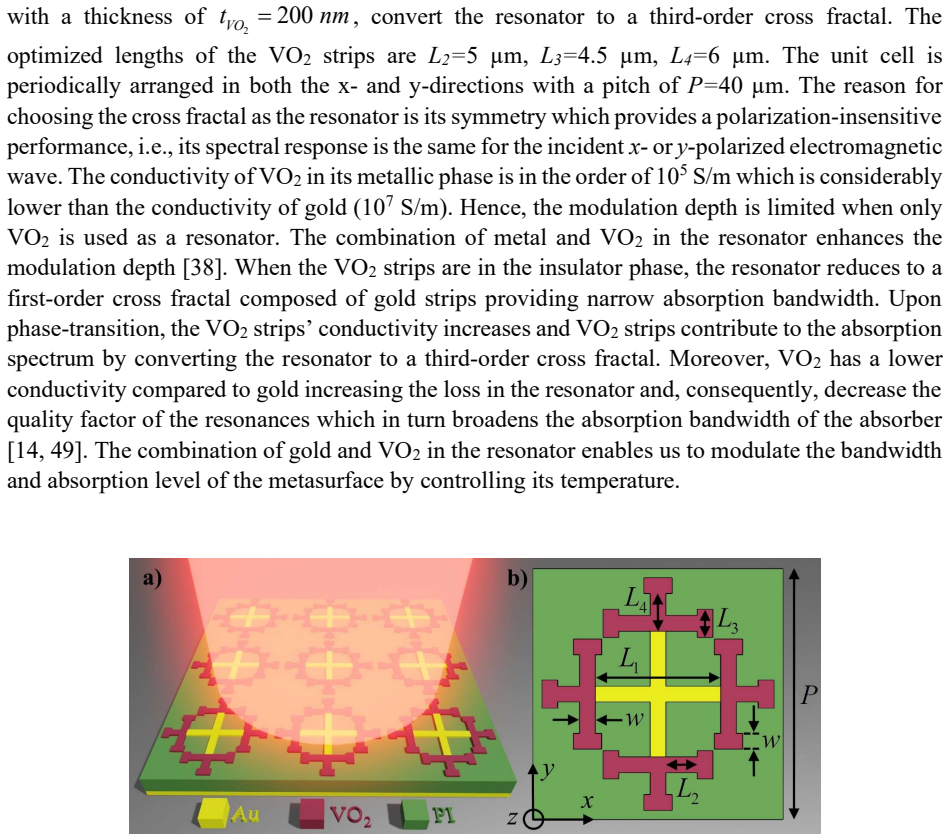
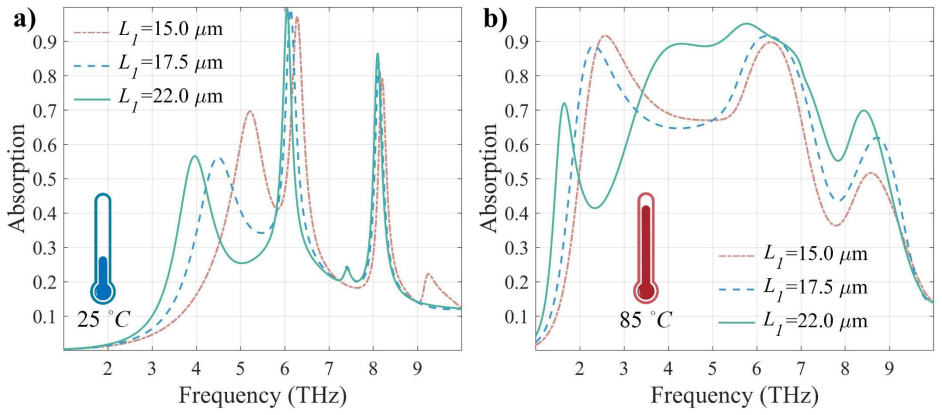
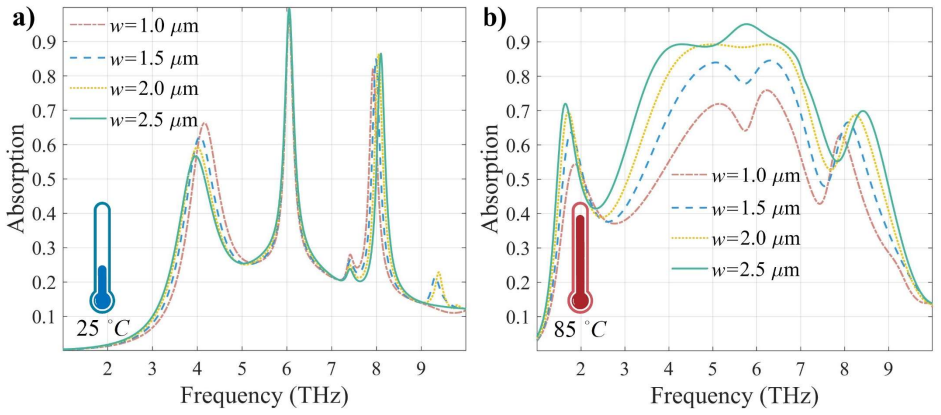
The metasurface absorber consists of a hybrid cross fractal resonator separated from a gold ground plane by a polyimide spacer. In the insulating phase of VO2, it exhibits narrowband absorption at 6.05 THz with 0.99 absorption and 0.35 THz FWHM. Upon transition to the metallic phase, connecting the VO2 patches converts the first-order cross fractal to a third-order one, achieving broadband absorption with 6.17 THz FWHM exceeding 0.5 from 3.57 to 8.45 THz, while remaining polarization insensitive and effective up to 65 degrees incidence.
What carries the argument
The hybrid cross fractal resonator with embedded VO2 patches, which converts from first-order to third-order fractal geometry upon the insulator-to-metal transition of VO2.
If this is right
- Absorption remains above 0.5 across 3.57-8.45 THz in the metallic state for angles up to 65 degrees.
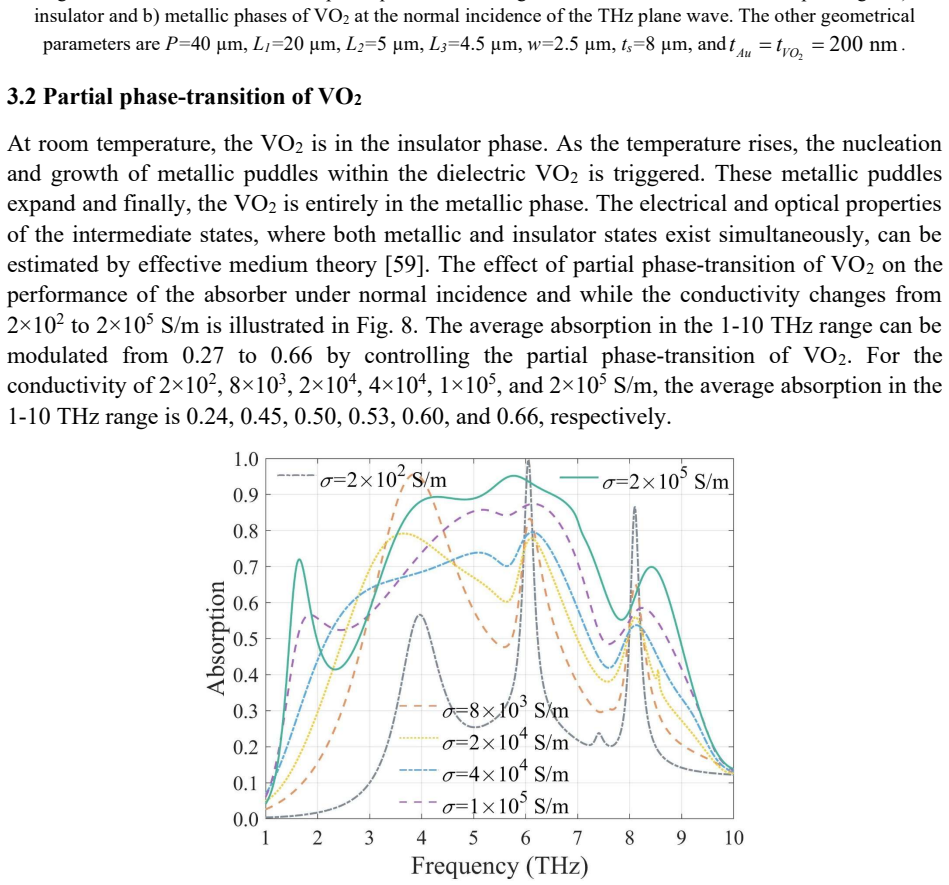
- Partial phase transitions in VO2 enable continuous tuning of absorption bandwidth and level.
- The design maintains performance independent of incident wave polarization due to its symmetric structure.
- Switching occurs via connecting VO2 patches to the gold fractal pattern.
Where Pith is reading between the lines
- Such a switchable absorber could enable dynamic terahertz filters that adapt to different signal environments without mechanical changes.
- Integration with temperature control circuits might allow real-time bandwidth adjustment in terahertz communication systems.
- Similar phase-change integration could extend to other frequency bands if scaled appropriately.
Load-bearing premise
The finite element method simulations accurately predict the electromagnetic response and the phase-transition behavior of VO2 in the actual fabricated device.
What would settle it
Measuring the absorption spectrum of a fabricated prototype before and after thermally inducing the VO2 phase transition to verify the shift from narrowband peak at 6.05 THz to broadband coverage.
Figures





read the original abstract
A terahertz absorber with controllable and switchable bandwidth and insensitive to polarization is of great interest. Here, we propose and demonstrate a metasurface absorber with switchable bandwidth based on a phase-change material of vanadium dioxide (VO2) and verify its performance by the finite element method simulations. The metasurface absorber is composed of a hybrid cross fractal as a resonator separated from a gold ground-plane by a polyimide spacer. Switching from narrowband to broadband absorber is achieved via connecting VO2 patches to the gold first-order cross fractal converting the resonator to a third-order cross fractal. In the insulator phase of VO2, the main narrowband absorption occurs at the frequency of 6.05 THz with a 0.99 absorption and a full-width half-maximum (FWHM) of 0.35 THz. Upon insulator-to-metal transition of VO2, the metasurface achieves a broadband absorption with the FWHM of 6.17 THz. The simulations indicate that by controlling the partial phase-transition of VO2, we can tune the bandwidth and absorption level of the absorber. Moreover, the designed absorber is insensitive to polarization due to symmetry and works well for a very wide range of incident angles. In the metallic state of VO2, the absorber has an absorption exceeding 0.5 in the 3.57-8.45 THz frequency range with incident angles up to 65{\deg}.
Editorial analysis
A structured set of objections, weighed in public.
Referee Report
Summary. The paper proposes a polarization-insensitive terahertz metasurface absorber using a hybrid cross-fractal resonator incorporating vanadium dioxide (VO2) patches on a polyimide spacer above a gold ground plane. In the insulating phase of VO2 the device exhibits narrowband absorption (peak 0.99 at 6.05 THz, FWHM 0.35 THz); upon insulator-to-metal transition the resonator converts to a third-order fractal yielding broadband absorption (FWHM 6.17 THz, absorption >0.5 over 3.57–8.45 THz). Finite-element simulations indicate that partial VO2 phase transitions allow continuous tuning of bandwidth and absorption level, with the structure remaining effective up to 65° incidence.
Significance. If the reported simulation results are reproducible, the work demonstrates a compact, dynamically switchable THz absorber whose bandwidth can be tuned via the phase-change material without external bias networks. The symmetry-based polarization insensitivity and wide-angle performance are practical advantages for potential sensing or imaging applications. The absence of experimental validation and the noted numerical inconsistency, however, limit the strength of the claims at present.
major comments (3)
- [Abstract] Abstract: the stated broadband FWHM of 6.17 THz is inconsistent with the reported absorption >0.5 interval of 3.57–8.45 THz (width 4.88 THz). This discrepancy indicates either an error in the definition or extraction of FWHM or a reporting inconsistency that must be resolved before the broadband performance claim can be accepted.
- [Abstract] Abstract and simulation description: all performance metrics rest on finite-element simulations with no experimental validation, no reported mesh-convergence study, no explicit VO2 conductivity model during the partial transition, and no boundary-condition details. These omissions make the central claims about tunable bandwidth via partial phase transition only partially supported.
- [Abstract] Abstract: the modeling of partial VO2 phase transition by uniform conductivity scaling in FEM does not capture the inhomogeneous metallic-domain nucleation and percolation that occurs in real VO2 films. This assumption is load-bearing for the tuning claim and requires either experimental confirmation or an effective-medium treatment to be credible.
minor comments (1)
- [Abstract] The abstract would benefit from a brief statement of the simulation software, frequency range, and material parameters used for VO2 and gold.
Simulated Author's Rebuttal
We thank the referee for the thorough and constructive review of our manuscript. We have carefully considered each major comment and provide point-by-point responses below. Where revisions are warranted, we will update the manuscript accordingly to strengthen the presentation of our simulation results.
read point-by-point responses
-
Referee: [Abstract] Abstract: the stated broadband FWHM of 6.17 THz is inconsistent with the reported absorption >0.5 interval of 3.57–8.45 THz (width 4.88 THz). This discrepancy indicates either an error in the definition or extraction of FWHM or a reporting inconsistency that must be resolved before the broadband performance claim can be accepted.
Authors: We thank the referee for identifying this numerical inconsistency. The absorption spectrum in the metallic state of VO2 indeed exceeds 0.5 over the interval 3.57–8.45 THz (bandwidth 4.88 THz). The reported FWHM of 6.17 THz in the abstract is an error that arose during manuscript preparation. In the revised version we will correct the abstract to state the bandwidth consistently as 4.88 THz (absorption > 0.5) and will ensure the same definition and value appear in the results section and figure captions. We will also clarify that, for the broadband case, we report the frequency range satisfying the >0.5 absorption criterion rather than a conventional Lorentzian FWHM. revision: yes
-
Referee: [Abstract] Abstract and simulation description: all performance metrics rest on finite-element simulations with no experimental validation, no reported mesh-convergence study, no explicit VO2 conductivity model during the partial transition, and no boundary-condition details. These omissions make the central claims about tunable bandwidth via partial phase transition only partially supported.
Authors: We agree that additional simulation details are required. In the revised manuscript we will add a dedicated methods subsection that reports (i) the mesh-convergence study (including element size and residual error), (ii) all boundary conditions (periodic in the transverse plane and PML in the propagation direction), and (iii) the precise VO2 conductivity values used for the insulating, metallic, and intermediate states, together with the scaling procedure employed for partial transitions. Regarding experimental validation, the present work is a finite-element demonstration of the proposed concept; we will explicitly note this scope limitation in the abstract and conclusions while emphasizing that the simulations establish the design principles for subsequent fabrication and measurement. revision: partial
-
Referee: [Abstract] Abstract: the modeling of partial VO2 phase transition by uniform conductivity scaling in FEM does not capture the inhomogeneous metallic-domain nucleation and percolation that occurs in real VO2 films. This assumption is load-bearing for the tuning claim and requires either experimental confirmation or an effective-medium treatment to be credible.
Authors: We acknowledge that uniform conductivity scaling is a simplified approximation that does not reproduce the spatially inhomogeneous nucleation and percolation dynamics of real VO2 films. This is a recognized limitation of the modeling approach. In the revision we will add an explicit discussion of the approximation, its prevalence in the literature for similar metasurface studies, and its potential quantitative differences from experimental behavior. We will also examine whether an effective-medium treatment can be incorporated for the partial-transition regime and will state that definitive validation of the continuous tuning would ultimately require experimental confirmation. revision: partial
- Absence of experimental validation of the partial phase-transition tuning behavior, as the manuscript reports only finite-element simulations.
Circularity Check
No circularity; electromagnetic response derived from standard FEM modeling of proposed geometry
full rationale
The paper proposes a hybrid cross-fractal metasurface geometry incorporating VO2 patches and computes its absorption spectra via finite-element simulations in the insulator and metallic phases of VO2. All reported quantities (resonant frequency 6.05 THz, FWHM values, broadband range 3.57-8.45 THz, angular insensitivity) are direct outputs of these simulations rather than fitted parameters or self-referential definitions. No self-citations, uniqueness theorems, or ansatzes imported from prior author work appear in the provided derivation chain; the design-to-response mapping follows conventional Maxwell-equation solving without reducing to its own inputs by construction.
Axiom & Free-Parameter Ledger
axioms (1)
- domain assumption Finite element method simulations can accurately model the electromagnetic response of the metasurface and the phase transition of VO2.
Reference graph
Works this paper leans on
-
[1]
3D metamaterials,
M. Kadic, G. W. Milton, M. van Hecke, and M. Wegener, "3D metamaterials," Nature Reviews Physics, vol. 1, no. 3, pp. 198-210, 2019
2019
-
[2]
Metamaterials: a new frontier of science and technology,
Y. Liu and X. Zhang, "Metamaterials: a new frontier of science and technology," Chemical Society Reviews, vol. 40, no. 5, pp. 2494-2507, 2011
2011
-
[3]
Silicon nitride waveguide devices based on gradient-index lenses implemented by subwavelength silicon grating metamaterials,
S. H. Badri and M. Gilarlue, "Silicon nitride waveguide devices based on gradient-index lenses implemented by subwavelength silicon grating metamaterials," Applied Optics, vol. 59, no. 17, pp. 5269-5275, 2020
2020
-
[4]
Near-zero-index wires,
L. La Spada and L. Vegni, "Near-zero-index wires," Optics express, vol. 25, no. 20, pp. 23699-23708, 2017
2017
-
[5]
Inverse-designed metastructures that solve equations,
N. M. Estakhri, B. Edwards, and N. Engheta, "Inverse-designed metastructures that solve equations," Science, vol. 363, no. 6433, pp. 1333-1338, 2019
2019
-
[6]
Curvilinear metasurfaces for surface wave manipulation,
L. La Spada, C. Spooner, S. Haq, and Y. Hao, "Curvilinear metasurfaces for surface wave manipulation," Scientific reports, vol. 9, no. 1, pp. 1-10, 2019
2019
-
[7]
Plasmonic optical and chiroptical response of self-assembled Au nanorod equilateral trimers,
N. J. Greybush, V. Pacheco-Peña, N. Engheta, C. B. Murray, and C. R. Kagan, "Plasmonic optical and chiroptical response of self-assembled Au nanorod equilateral trimers," ACS nano, vol. 13, no. 2, pp. 1617-1624, 2019
2019
-
[8]
Graphene acoustic plasmon resonator for ultrasensitive infrared spectroscopy,
I.-H. Lee, D. Yoo, P. Avouris, T. Low, and S.-H. Oh, "Graphene acoustic plasmon resonator for ultrasensitive infrared spectroscopy," Nature nanotechnology, vol. 14, no. 4, pp. 313-319, 2019
2019
-
[9]
Modeling, design, and synthesis of gram-scale monodispersed silver nanoparticles using microwave-assisted polyol process for metamaterial applications,
Z. Lalegani, S. S. Ebrahimi, B. Hamawandi, L. La Spada, and M. Toprak, "Modeling, design, and synthesis of gram-scale monodispersed silver nanoparticles using microwave-assisted polyol process for metamaterial applications," Optical Materials, vol. 108, p. 110381, 2020
2020
-
[10]
Coupling Si3N4 waveguide to SOI waveguide using transformation optics,
S. H. Badri and M. Gilarlue, "Coupling Si3N4 waveguide to SOI waveguide using transformation optics," Optics Communications, vol. 460, p. 125089, 2020
2020
-
[11]
Geometrically flat hyperlens designed by transformation optics,
S. So and J. Rho, "Geometrically flat hyperlens designed by transformation optics," Journal of Physics D: Applied Physics, vol. 52, no. 19, p. 194003, 2019
2019
-
[12]
Polygonal Maxwell’s fisheye lens via transformation optics as multimode waveguide crossing,
S. H. Badri, H. R. Saghai, and H. Soofi, "Polygonal Maxwell’s fisheye lens via transformation optics as multimode waveguide crossing," Journal of Optics, vol. 21, no. 6, p. 065102, 2019
2019
-
[13]
Ultrashort waveguide tapers based on Luneburg lens,
S. H. Badri and M. M. Gilarlue, "Ultrashort waveguide tapers based on Luneburg lens," Journal of Optics, vol. 21, no. 12, p. 125802, 2019
2019
-
[14]
Vanadium dioxide integrated metasurfaces with switchable functionalities at terahertz frequencies,
F. Ding, S. Zhong, and S. I. Bozhevolnyi, "Vanadium dioxide integrated metasurfaces with switchable functionalities at terahertz frequencies," Advanced Optical Materials, vol. 6, no. 9, p. 1701204, 2018
2018
-
[15]
Metasurface holograms reaching 80% efficiency,
G. Zheng, H. Mühlenbernd, M. Kenney, G. Li, T. Zentgraf, and S. Zhang, "Metasurface holograms reaching 80% efficiency," Nature nanotechnology, vol. 10, no. 4, pp. 308-312, 2015. 16
2015
-
[16]
Electromagnetic reprogrammable coding-metasurface holograms,
L. Li et al. , "Electromagnetic reprogrammable coding-metasurface holograms," Nature communications, vol. 8, no. 1, pp. 1-7, 2017
2017
-
[17]
Realization of broadband cross-polarization conversion in transmission mode in the terahertz region using a single-layer metasurface,
W. Liu et al., "Realization of broadband cross-polarization conversion in transmission mode in the terahertz region using a single-layer metasurface," Optics letters, vol. 40, no. 13, pp. 3185-3188, 2015
2015
-
[18]
Ultra-wideband high-efficiency reflective linear-to-circular polarization converter based on metasurface at terahertz frequencies,
Y. Jiang, L. Wang, J. Wang, C. N. Akwuruoha, and W. Cao, "Ultra-wideband high-efficiency reflective linear-to-circular polarization converter based on metasurface at terahertz frequencies," Optics express, vol. 25, no. 22, pp. 27616-27623, 2017
2017
-
[19]
A true metasurface antenna,
M. El Badawe, T. S. Almoneef, and O. M. Ramahi, "A true metasurface antenna," Scientific reports, vol. 6, no. 1, pp. 1-8, 2016
2016
-
[20]
Metasurface antennas: new models, applications and realizations,
M. Faenzi et al., "Metasurface antennas: new models, applications and realizations," Scientific reports, vol. 9, no. 1, pp. 1-14, 2019
2019
-
[21]
A broadband metasurface-based terahertz flat-lens array,
Q. Wang et al., "A broadband metasurface-based terahertz flat-lens array," Advanced Optical Materials, vol. 3, no. 6, pp. 779-785, 2015
2015
-
[22]
Transmissive terahertz metalens with full phase control based on a dielectric metasurface,
D. Jia et al., "Transmissive terahertz metalens with full phase control based on a dielectric metasurface," Optics letters, vol. 42, no. 21, pp. 4494-4497, 2017
2017
-
[23]
Liquid crystal programmable metasurface for terahertz beam steering,
J. Wu et al., "Liquid crystal programmable metasurface for terahertz beam steering," Applied Physics Letters, vol. 116, no. 13, p. 131104, 2020
2020
-
[24]
Ultrathin metasurface-based carpet cloak for terahertz wave,
M. Wei et al., "Ultrathin metasurface-based carpet cloak for terahertz wave," Optics express, vol. 25, no. 14, pp. 15635-15642, 2017
2017
-
[25]
Dual-mode on-to-off modulation of plasmon-induced transparency and coupling effect in patterned graphene-based terahertz metasurface,
Z. Liu et al., "Dual-mode on-to-off modulation of plasmon-induced transparency and coupling effect in patterned graphene-based terahertz metasurface," Nanoscale research letters, vol. 15, no. 1, pp. 1-9, 2020
2020
-
[26]
Experimental realization of a terahertz all-dielectric metasurface absorber,
X. Liu, K. Fan, I. V. Shadrivov, and W. J. Padilla, "Experimental realization of a terahertz all-dielectric metasurface absorber," Optics express, vol. 25, no. 1, pp. 191-201, 2017
2017
-
[27]
Subwavelength grating waveguide filter based on cladding modulation with a phase-change material grating,
S. H. Badri and S. G. Farkoush, "Subwavelength grating waveguide filter based on cladding modulation with a phase-change material grating," Applied Optics, vol. 60, no. 10, pp. 2803-2810, 2021
2021
-
[28]
Reconfigurable bandpass optical filters based on subwavelength grating waveguides with a Ge2Sb2Te5 cavity,
S. H. Badri, M. M. Gilarlue, S. G. Farkoush, and S.-B. Rhee, "Reconfigurable bandpass optical filters based on subwavelength grating waveguides with a Ge2Sb2Te5 cavity," J. Opt. Soc. Am. B, vol. 38, no. 4, pp. 1283-1289, 2021
2021
-
[29]
Phase change memory,
H.-S. P. Wong et al., "Phase change memory," Proceedings of the IEEE, vol. 98, no. 12, pp. 2201- 2227, 2010
2010
-
[30]
Recent progress in phase-change memory technology,
G. W. Burr et al., "Recent progress in phase-change memory technology," IEEE Journal on Emerging and Selected Topics in Circuits and Systems, vol. 6, no. 2, pp. 146-162, 2016
2016
-
[31]
Dynamic Thermal Emission Control Based on Ultrathin Plasmonic Metamaterials Including Phase-Changing Material GST,
Y. Qu, Q. Li, K. Du, L. Cai, J. Lu, and M. Qiu, "Dynamic Thermal Emission Control Based on Ultrathin Plasmonic Metamaterials Including Phase-Changing Material GST," Laser & Photonics Reviews, vol. 11, no. 5, p. 1700091, 2017
2017
-
[32]
Imaging Through a Fano-Resonant Dielectric Metasurface Governed by Quasi--bound States in the Continuum,
C. Zhou, X. Qu, S. Xiao, and M. Fan, "Imaging Through a Fano-Resonant Dielectric Metasurface Governed by Quasi--bound States in the Continuum," Physical Review Applied, vol. 14, no. 4, p. 044009, 2020
2020
-
[33]
Optical radiation manipulation of Si-Ge2Sb2Te5 hybrid metasurfaces,
C. Zhou et al., "Optical radiation manipulation of Si-Ge2Sb2Te5 hybrid metasurfaces," Optics express, vol. 28, no. 7, pp. 9690-9701, 2020
2020
-
[34]
Dynamic metasurfaces using phase-change chalcogenides,
F. Ding, Y. Yang, and S. I. Bozhevolnyi, "Dynamic metasurfaces using phase-change chalcogenides," Advanced Optical Materials, vol. 7, no. 14, p. 1801709, 2019
2019
-
[35]
Enabling switchable and multifunctional terahertz metasurfaces with phase-change material,
D. Wang, S. Sun, Z. Feng, and W. Tan, "Enabling switchable and multifunctional terahertz metasurfaces with phase-change material," Optical Materials Express, vol. 10, no. 9, pp. 2054- 2065, 2020. 17
2054
-
[36]
Achieving broadband absorption and polarization conversion with a vanadium dioxide metasurface in the same terahertz frequencies,
Z. Song and J. Zhang, "Achieving broadband absorption and polarization conversion with a vanadium dioxide metasurface in the same terahertz frequencies," Optics express, vol. 28, no. 8, pp. 12487-12497, 2020
2020
-
[37]
Vanadium dioxide-assisted broadband absorption and linear- to-circular polarization conversion based on a single metasurface design for the terahertz wave,
D. Yan, M. Meng, J. Li, J. Li, and X. Li, "Vanadium dioxide-assisted broadband absorption and linear- to-circular polarization conversion based on a single metasurface design for the terahertz wave," Optics Express, vol. 28, no. 20, pp. 29843-29854, 2020
2020
-
[38]
All-Optical Switchable Vanadium Dioxide Integrated Coding Metasurfaces for Wavefront and Polarization Manipulation of Terahertz Beams,
J. Li et al., "All-Optical Switchable Vanadium Dioxide Integrated Coding Metasurfaces for Wavefront and Polarization Manipulation of Terahertz Beams," Advanced Theory and Simulations, vol. 3, no. 1, p. 1900183, 2020
2020
-
[39]
Active controllable dual broadband terahertz absorber based on hybrid metamaterials with vanadium dioxide,
J. Huang, J. Li, Y. Yang, J. Li, Y. Zhang, and J. Yao, "Active controllable dual broadband terahertz absorber based on hybrid metamaterials with vanadium dioxide," Optics express, vol. 28, no. 5, pp. 7018-7027, 2020
2020
-
[40]
Active Tuning from Narrowband to Broadband Absorbers Using a Sub-wavelength VO2 Embedded Layer,
A. K. Osgouei, H. Hajian, B. Khalichi, A. E. Serebryannikov, A. Ghobadi, and E. Ozbay, "Active Tuning from Narrowband to Broadband Absorbers Using a Sub-wavelength VO2 Embedded Layer," Plasmonics, pp. 1-9, 2021
2021
-
[41]
Hybrid resonators and highly tunable terahertz metamaterials enabled by vanadium dioxide (VO 2),
S. Wang, L. Kang, and D. H. Werner, "Hybrid resonators and highly tunable terahertz metamaterials enabled by vanadium dioxide (VO 2)," Scientific reports, vol. 7, no. 1, pp. 1-8, 2017
2017
-
[42]
Terahertz bandstop-to-bandpass converter based on VO2 hybrid metasurface,
T. Li et al., "Terahertz bandstop-to-bandpass converter based on VO2 hybrid metasurface," Journal of Physics D: Applied Physics, 2021
2021
-
[43]
Broadband switchable terahertz half-/quarter-wave plate based on metal-VO 2 metamaterials,
J. Luo, X. Shi, X. Luo, F. Hu, and G. Li, "Broadband switchable terahertz half-/quarter-wave plate based on metal-VO 2 metamaterials," Optics Express, vol. 28, no. 21, pp. 30861-30870, 2020
2020
-
[44]
A broadband terahertz absorber using multi-layer stacked bars,
S. Liu, H. Chen, and T. J. Cui, "A broadband terahertz absorber using multi-layer stacked bars," Applied Physics Letters, vol. 106, no. 15, p. 151601, 2015
2015
-
[45]
A dynamically adjustable broadband terahertz absorber based on a vanadium dioxide hybrid metamaterial,
Y. Liu, Y. Qian, F. Hu, M. Jiang, and L. Zhang, "A dynamically adjustable broadband terahertz absorber based on a vanadium dioxide hybrid metamaterial," Results in Physics, vol. 19, p. 103384, 2020
2020
-
[46]
Observation of toroidal pulses of light,
A. Zdagkas et al., "Observation of toroidal pulses of light," arXiv preprint arXiv:2102.03636, 2021
-
[47]
Electromagnetic toroidal excitations in matter and free space,
N. Papasimakis, V. Fedotov, V. Savinov, T. Raybould, and N. Zheludev, "Electromagnetic toroidal excitations in matter and free space," Nature materials, vol. 15, no. 3, pp. 263-271, 2016
2016
-
[48]
Tunable ultra-narrowband terahertz perfect absorber by using metal- insulator-metal microstructures,
R. Xu, X. Liu, and Y.-S. Lin, "Tunable ultra-narrowband terahertz perfect absorber by using metal- insulator-metal microstructures," Results in Physics, vol. 13, p. 102176, 2019
2019
-
[49]
Ultra-broadband terahertz metamaterial absorber,
J. Zhu et al., "Ultra-broadband terahertz metamaterial absorber," Applied Physics Letters, vol. 105, no. 2, p. 021102, 2014
2014
-
[50]
Metamaterial electromagnetic wave absorbers,
C. M. Watts, X. Liu, and W. J. Padilla, "Metamaterial electromagnetic wave absorbers," Advanced materials, vol. 24, no. 23, pp. OP98-OP120, 2012
2012
-
[51]
A dual band terahertz metamaterial absorber,
H. Tao et al., "A dual band terahertz metamaterial absorber," Journal of physics D: Applied physics, vol. 43, no. 22, p. 225102, 2010
2010
-
[52]
Terahertz absorber with reconfigurable bandwidth based on isotropic vanadium dioxide metasurfaces,
Z. Song, M. Wei, Z. Wang, G. Cai, Y. Liu, and Y. Zhou, "Terahertz absorber with reconfigurable bandwidth based on isotropic vanadium dioxide metasurfaces," IEEE Photonics Journal, vol. 11, no. 2, pp. 1-7, 2019
2019
-
[53]
Broadband and high modulation-depth THz modulator using low bias controlled VO 2-integrated metasurface,
G. Zhou et al., "Broadband and high modulation-depth THz modulator using low bias controlled VO 2-integrated metasurface," Optics express, vol. 25, no. 15, pp. 17322-17328, 2017
2017
-
[54]
Electronically-controlled beam-steering through vanadium dioxide metasurfaces,
M. R. M. Hashemi, S.-H. Yang, T. Wang, N. Sepúlveda, and M. Jarrahi, "Electronically-controlled beam-steering through vanadium dioxide metasurfaces," Scientific reports, vol. 6, no. 1, pp. 1-8, 2016
2016
-
[55]
Thermally switchable terahertz wavefront metasurface modulators based on the insulator-to-metal transition of vanadium dioxide,
T. Wang et al., "Thermally switchable terahertz wavefront metasurface modulators based on the insulator-to-metal transition of vanadium dioxide," Optics express, vol. 27, no. 15, pp. 20347- 20357, 2019. 18
2019
-
[56]
Switchable ultrathin quarter-wave plate in terahertz using active phase-change metasurface,
D. Wang et al., "Switchable ultrathin quarter-wave plate in terahertz using active phase-change metasurface," Scientific reports, vol. 5, no. 1, pp. 1-9, 2015
2015
-
[57]
Terahertz electric response of fractal metamaterial structures,
F. Miyamaru et al., "Terahertz electric response of fractal metamaterial structures," Physical Review B, vol. 77, no. 4, p. 045124, 2008
2008
-
[58]
Octave- spanning broadband absorption of terahertz light using metasurface fractal-cross absorbers,
M. Kenney, J. Grant, Y. D. Shah, I. Escorcia-Carranza, M. Humphreys, and D. R. Cumming, "Octave- spanning broadband absorption of terahertz light using metasurface fractal-cross absorbers," Acs Photonics, vol. 4, no. 10, pp. 2604-2612, 2017
2017
-
[59]
Modified Maxwell Garnett model for hysteresis in phase change materials,
J. D. Frame, N. G. Green, and X. Fang, "Modified Maxwell Garnett model for hysteresis in phase change materials," Optical Materials Express, vol. 8, no. 7, pp. 1988-1996, 2018
1988
-
[60]
Electromagnetic parameter retrieval from inhomogeneous metamaterials,
D. Smith, D. Vier, T. Koschny, and C. Soukoulis, "Electromagnetic parameter retrieval from inhomogeneous metamaterials," Physical review E, vol. 71, no. 3, p. 036617, 2005
2005
-
[61]
Terahertz switching between broadband absorption and narrowband absorption,
Z. Song, A. Chen, and J. Zhang, "Terahertz switching between broadband absorption and narrowband absorption," Optics express, vol. 28, no. 2, pp. 2037-2044, 2020
2037
-
[62]
Bidirectional band-switchable nano-film absorber from narrowband to broadband,
F. Wang et al., "Bidirectional band-switchable nano-film absorber from narrowband to broadband," Optics Express, vol. 29, no. 4, pp. 5110-5120, 2021
2021
-
[63]
Terahertz bifunctional absorber based on a graphene-spacer-vanadium dioxide-spacer-metal configuration,
M. Zhang and Z. Song, "Terahertz bifunctional absorber based on a graphene-spacer-vanadium dioxide-spacer-metal configuration," Optics express, vol. 28, no. 8, pp. 11780-11788, 2020
2020
discussion (0)
Sign in with ORCID, Apple, or X to comment. Anyone can read and Pith papers without signing in.