Recognition: unknown
Local droplet etching-assisted quantum dot epitaxy for telecom C-band quantum light emitters
Pith reviewed 2026-05-08 06:30 UTC · model grok-4.3
The pith
Local droplet etching produces symmetric InGaAs quantum dots emitting single photons at telecom C-band wavelengths with 0.2 meV linewidths.
A machine-rendered reading of the paper's core claim, the machinery that carries it, and where it could break.
Core claim
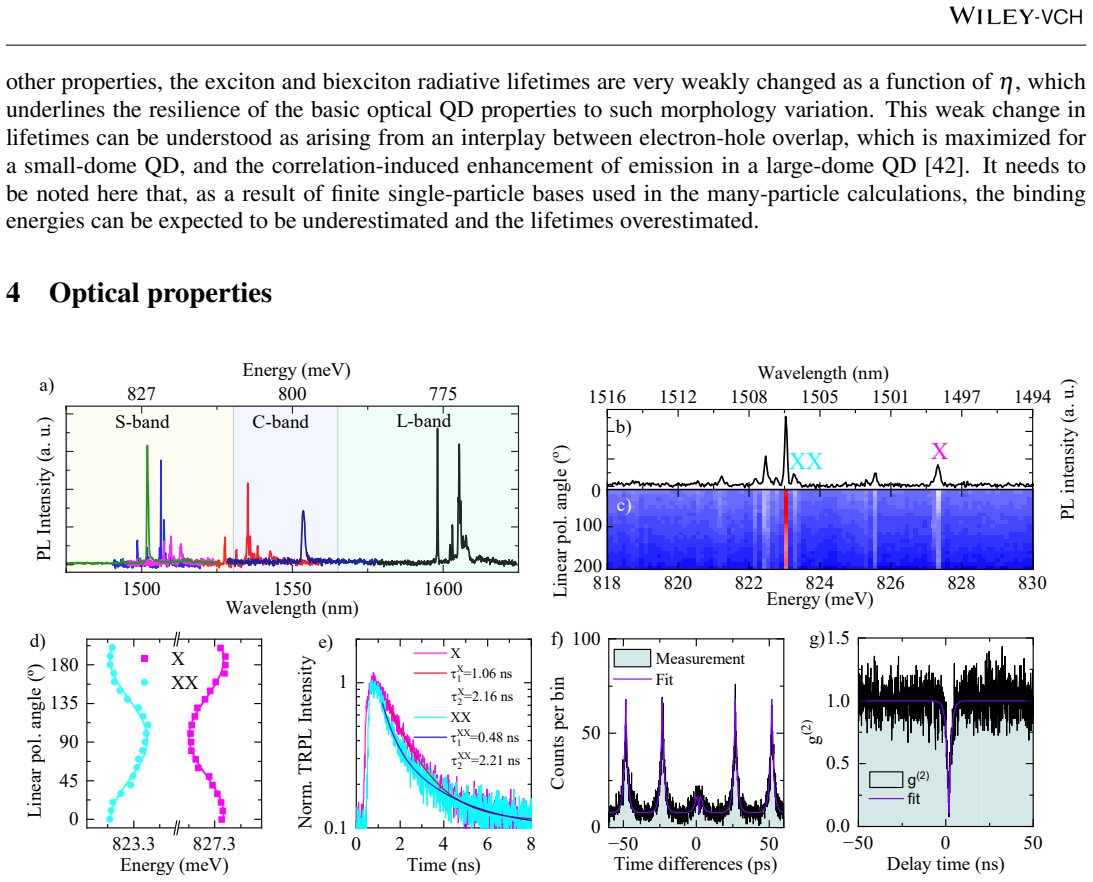
Telecom-emitting epitaxial quantum dots fabricated using the local droplet etching approach form well-defined, low-density (10^9/cm²) InxGa1-xAs dots inside symmetric LDE nanoholes (in-plane aspect ratio 1.14) in In0.52Al0.48As. Transmission electron microscopy confirms structural integrity and interface quality. Photoluminescence shows narrow lines of 0.2 meV, while second-order autocorrelation yields g(2)(0) = 0.07 ± 0.02 under above-band continuous-wave excitation and g(2)(0) = 0.16 ± 0.18 under pulsed excitation. Numerical modeling supports these optical properties and accounts for emission persisting to liquid-nitrogen temperatures.
What carries the argument
Local droplet etching nanoholes that template the self-assembled growth of InGaAs quantum dots, enforcing in-plane symmetry and compositional control inside the InAlAs barrier.
If this is right
- New material combinations can be integrated via LDE to reach other target wavelengths without changing the etching geometry.
- Low areal density reduces the chance of multiple dots contributing to a single optical mode in photonic devices.
- Emission that survives to liquid-nitrogen temperatures relaxes the cryogenic requirements for some quantum-communication protocols.
- The measured g(2) values under both continuous-wave and pulsed drive indicate purity sufficient for basic entanglement experiments once the dots are placed in cavities.
Where Pith is reading between the lines
- The same LDE template could be combined with strain tuning or electric fields to produce entangled photon pairs from a single dot.
- Because the nanohole shape is set before dot nucleation, the approach may allow deterministic placement of dots relative to photonic crystal cavities.
- Extending the modeling to include phonon-assisted processes could predict how linewidths change with temperature and guide growth optimization.
- The reported density and symmetry suggest the method is compatible with wafer-scale processing needed for quantum networks.
Load-bearing premise
That the structural symmetry and clean interfaces seen in TEM directly produce the narrow linewidths and low g(2) values without hidden defect states that would broaden emission or raise background counts in real devices.
What would settle it
Fabricating additional samples and measuring linewidths consistently above 0.5 meV or g(2)(0) values above 0.3 under the same excitation conditions would falsify the claim that LDE yields high-optical-quality C-band emitters.
Figures

read the original abstract
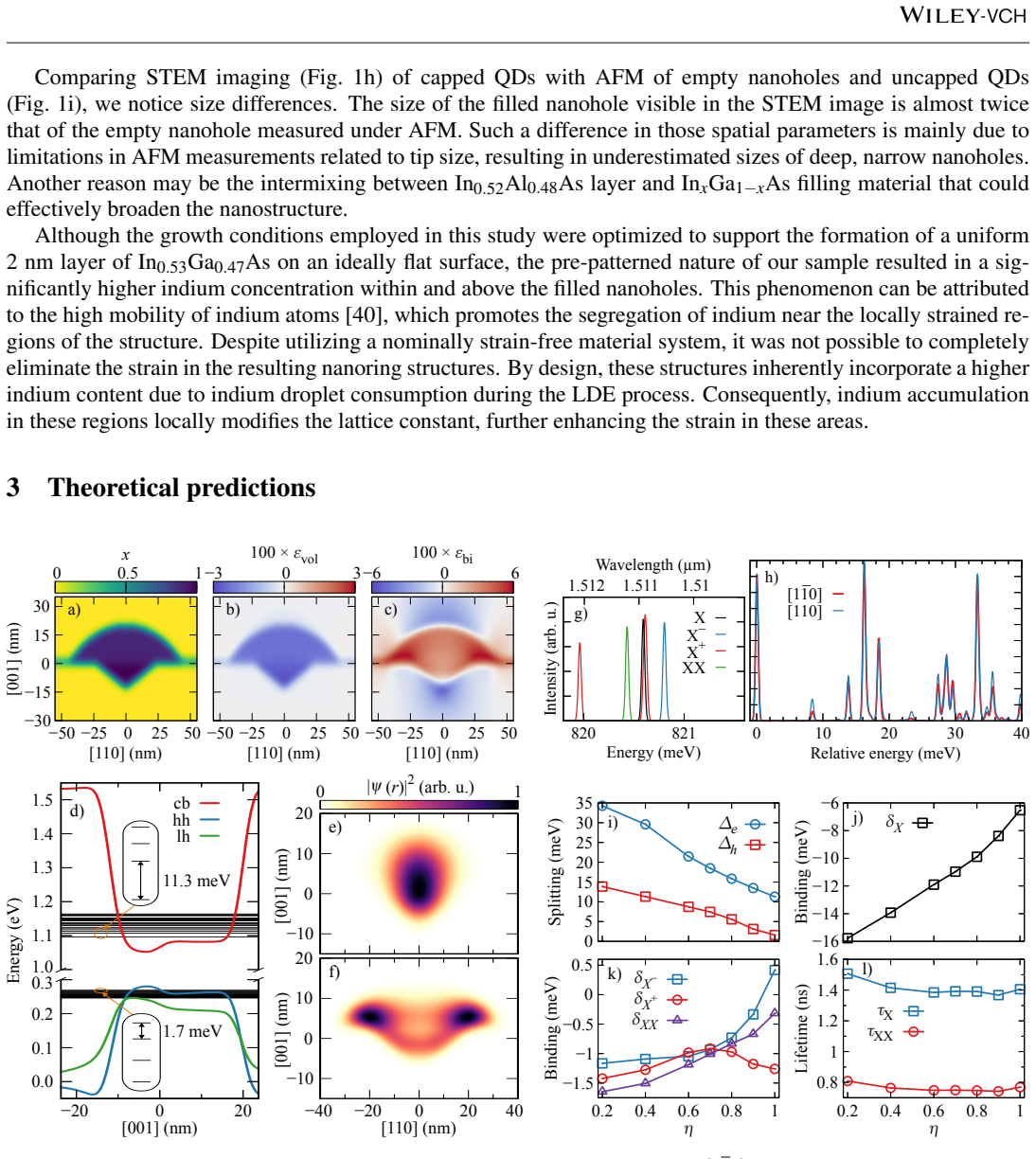
Significant progress in quantum light sources for quantum communication applications requires reproducible and symmetric quantum emitters acting as single-photon sources capable of generating entangled photons on demand at specific telecom wavelengths. Here, we propose telecom-emitting epitaxial quantum dots (QDs) fabricated using the local droplet etching (LDE) approach. The resulting well-defined, low-density ($10^9$/cm$^2$) QDs based on In$_{x}$Ga$_{1-x}$As are formed in symmetric LDE nanoholes (in-plane aspect ratio of 1.14) in In$_{0.52}$Al$_{0.48}$As. Detailed transmission electron microscopy provides comprehensive insight into the structural integrity, interface quality, and compositional profiles of the QDs, which underpin their promising optical properties. Photoluminescence spectroscopy reveals narrow emission lines (0.2 meV) and high optical quality, while second-order autocorrelation measurements confirm clear single-photon emission, with $g^{(2)}(0)=0.07\pm0.02$ under above-band continuous-wave excitation and $g^{(2)}(0)=0.16 \pm 0.18$ under pulsed excitation. Precise numerical modeling, combining multiband $\boldsymbol{k} \cdot \boldsymbol{p}$ and configuration-interaction methods, supports the optical characterization and identifies thermal excitation pathways that explain the persistence of emission up to liquid-nitrogen temperatures. These results highlight the versatility of the LDE approach for integrating new material systems and pave the way toward scalable fabrication of quantum light sources with tailored emission properties.
Editorial analysis
A structured set of objections, weighed in public.
Referee Report
Summary. The paper demonstrates the use of local droplet etching (LDE) to fabricate low-density (10^9 cm^{-2}), symmetric In_x Ga_{1-x} As quantum dots embedded in In_{0.52} Al_{0.48} As barriers for telecom C-band single-photon sources. TEM characterization confirms well-defined nanoholes with in-plane aspect ratio 1.14 and high interface quality. Photoluminescence shows narrow linewidths of 0.2 meV, while autocorrelation measurements yield g^{(2)}(0) = 0.07 ± 0.02 (CW above-band) and 0.16 ± 0.18 (pulsed), confirming single-photon emission. Multiband k·p combined with configuration-interaction modeling interprets thermal excitation pathways that sustain emission up to liquid-nitrogen temperatures.
Significance. If the reported structural-optical correlation holds, the work provides a reproducible LDE route to symmetric, low-density QDs with direct experimental evidence of telecom single-photon emission and good optical quality. The direct measurements (TEM, PL linewidths, g^{(2)} statistics) are load-bearing and not derived from the modeling, which serves only for interpretation; this strengthens the case for scalable integration of III-V quantum emitters in quantum communication.
major comments (1)
- Results section on single-photon statistics: the pulsed g^{(2)}(0) = 0.16 ± 0.18 carries a large uncertainty that approaches the single-photon threshold; a quantitative discussion of background subtraction, fitting procedure, and how this value still supports the 'clear single-photon emission' claim is needed to make the evidence fully robust.
minor comments (4)
- Abstract and methods: the indium fraction x in In_x Ga_{1-x} As is not numerically specified; state the nominal or measured value used in growth and modeling.
- Modeling section: clarify whether the k·p + CI calculation uses any parameters fitted to the present PL data or is entirely predictive from literature values, to address potential circularity concerns.
- Figure captions (TEM and PL panels): include explicit scale bars, error-bar definitions for linewidth histograms, and the number of QDs sampled for the reported density and aspect-ratio statistics.
- Discussion: expand the comparison to prior LDE QD works in other material systems to better highlight the novelty of the InGaAs/InAlAs telecom implementation.
Simulated Author's Rebuttal
We thank the referee for the positive assessment of our work and the constructive comment on the single-photon statistics. We address the point below and will revise the manuscript to incorporate additional quantitative details as requested.
read point-by-point responses
-
Referee: Results section on single-photon statistics: the pulsed g^{(2)}(0) = 0.16 ± 0.18 carries a large uncertainty that approaches the single-photon threshold; a quantitative discussion of background subtraction, fitting procedure, and how this value still supports the 'clear single-photon emission' claim is needed to make the evidence fully robust.
Authors: We agree that the relatively large uncertainty on the pulsed g^{(2)}(0) value warrants further clarification to strengthen the evidence. In the revised manuscript we will add a dedicated paragraph in the results section that (i) describes the background subtraction procedure applied to the raw coincidence histogram, (ii) details the fitting routine (including the functional form and any constraints) used to extract g^{(2)}(0), and (iii) provides a quantitative bound showing that even the upper limit of the uncertainty interval (0.34) remains well below the 0.5 threshold conventionally used to confirm single-photon character. This addition will make explicit why the data continue to support the claim of clear single-photon emission under pulsed excitation. revision: yes
Circularity Check
No significant circularity; results are direct experimental measurements
full rationale
The paper reports experimental outcomes from LDE growth, TEM imaging (symmetry, density, interfaces), PL spectroscopy (0.2 meV linewidths), and autocorrelation measurements (g^{(2)}(0) values). These are presented as observed data, not derived quantities. The k·p + CI modeling is described only as supporting interpretation of thermal pathways and does not reduce the headline metrics to parameters fitted from the same dataset or via self-referential equations. No self-definitional steps, fitted-input predictions, or load-bearing self-citations appear in the provided chain; the work is self-contained against external benchmarks.
Axiom & Free-Parameter Ledger
free parameters (1)
- Indium fraction x in InxGa1-xAs
axioms (2)
- domain assumption Multiband k·p envelope-function approximation accurately describes confined states in these strained QDs.
- domain assumption Configuration-interaction method captures the dominant Coulomb and exchange effects for few-particle states in the dots.
Reference graph
Works this paper leans on
-
[1]
Wang, Zh. M. and Liang, B. L. and Sablon, K. A. and Salamo, G. J. , year =. Nanoholes fabricated by self-assembled gallium nanodrill on GaAs(100) , volume =. Appl. Phys. Lett. , publisher =. doi:10.1063/1.2713745 , number =
-
[2]
and Reindl, Marcus and Schimpf, Christian and Trotta, Rinaldo and Rastelli, Armando , year =
da Silva, Saimon Filipe Covre and Undeutsch, Gabriel and Lehner, Barbara and Manna, Santanu and Krieger, Tobias M. and Reindl, Marcus and Schimpf, Christian and Trotta, Rinaldo and Rastelli, Armando , year =. GaAs quantum dots grown by droplet etching epitaxy as quantum light sources , volume =. Appl. Phys. Lett. , publisher =. doi:10.1063/5.0057070 , number =
-
[3]
2024 , Eprint =
Teemu Hakkarainen and Joonas Hilska and Arttu Hietalahti and Sanna Ranta and Markus Peil and Emmi Kantola and Abhiroop Chellu and Efsane Sen and Jussi-Pekka Penttinen and Mircea Guina , Title =. 2024 , Eprint =
2024
-
[4]
and Li, Xinlei and Mazur, Yuriy I
Wu, Jiang and Wang, Zhiming M. and Li, Xinlei and Mazur, Yuriy I. and Salamo, Gregory J. , year =. Fabrication of ultralow-density quantum dots by droplet etching epitaxy , volume =. Journal of Materials Research , publisher =. doi:10.1557/jmr.2017.408 , number =
-
[5]
Phonon-assisted radiative recombination of excitons confined in strongly anisotropic nanostructures , author =. Phys. Rev. B , volume =. 2014 , month =
2014
-
[6]
Vurgaftman and J
I. Vurgaftman and J. R. Meyer and L. R. Ram-Mohan , title =. J. Appl. Phys. , volume =. 2001 , doi =
2001
-
[7]
I. Sa. Band parameters of. J. Appl. Phys. , volume =. 2010 , DOI =
2010
-
[8]
Tse and J
G. Tse and J. Pal and U. Monteverde and R. Garg and V. Haxha and M. A. Migliorato and S. Tomi. Non-linear piezoelectricity in zinc blende. J. Appl. Phys. , volume =. 2013 , DOI =
2013
-
[9]
Amirtharaj and David G
Paul M. Amirtharaj and David G. Seiler , isbn =. Optical Properties of Semiconductors , publisher =. Handbook of Optics, Vol. 2: Devices, Measurements, and Properties, Second Edition , year =
-
[10]
Exciton lifetime and emission polarization dispersion in strongly in-plane asymmetric nanostructures , author =. Phys. Rev. B , volume =. 2017 , month =
2017
-
[11]
Bahder, Thomas B. , journal =. Eight-band k. 1990 , month =. doi:10.1103/PhysRevB.41.11992 , url =
-
[12]
Gauge-invariant discretization in multiband envelope function theory and g factors in nanowire dots , author =. Phys. Rev. B , volume =. 2008 , month =. doi:10.1103/PhysRevB.78.075317 , url =
-
[13]
Dominant role of the shear strain induced admixture in spin-flip processes in self-assembled quantum dots , author =. Phys. Rev. B , volume =. 2018 , month =. doi:10.1103/PhysRevB.97.245313 , url =
-
[14]
Electron states in a double quantum dot with broken axial symmetry , author =. Phys. Rev. B , volume =. 2014 , month =. doi:10.1103/PhysRevB.90.085437 , url =
-
[15]
Electronic structure of ultrasmall quantum-well boxes , author =. Phys. Rev. Lett. , volume =. 1987 , month =. doi:10.1103/PhysRevLett.59.1140 , url =
-
[16]
Crystal Growth & Design , volume =
Sala, Elisa Maddalena and In Na, Young and Heffernan, Jon , title =. Crystal Growth & Design , volume =. 2024 , doi =
2024
-
[17]
Atkinson, P. and Zallo, E. and Schmidt, O. G. , title =. Journal of Applied Physics , volume =. 2012 , issn =. doi:10.1063/1.4748183 , url =
-
[18]
Nature Materials , volume =
Gurioli, Massimo and Wang, Zhiming and Rastelli, Armando and Kuroda, Takashi and Sanguinetti, Stefano , title =. Nature Materials , volume =. 2019 , doi =
2019
-
[19]
Nanoscale Research Letters , volume =
Fuster, David and González, Yolanda and González, Luisa , title =. Nanoscale Research Letters , volume =. 2014 , doi =
2014
-
[20]
Chen, Chen and Yan, Jun-Yong and Babin, Hans-Georg and Wang, Jiefei and Xu, Xingqi and Lin, Xing and Yu, Qianqian and Fang, Wei and Liu, Run-Ze and Huo, Yong-Heng and Cai, Han and Sha, Wei E. I. and Zhang, Jiaxiang and Heyn, Christian and Wieck, Andreas D. and Ludwig, Arne and Wang, Da-Wei and Jin, Chao-Yuan and Liu, Feng , title =. Nature Communications ...
2024
-
[21]
Nanomaterials , VOLUME =
Heyn, Christian and Gräfenstein, Andreas and Pirard, Geoffrey and Ranasinghe, Leonardo and Deneke, Kristian and Alshaikh, Ahmed and Bester, Gabriel and Hansen, Wolfgang , TITLE =. Nanomaterials , VOLUME =. 2022 , NUMBER =
2022
-
[22]
Optical and Quantum Electronics , volume =
Shen, Jiaxin and Lv, Hongliang and Ni, Haiqiao and Liu, Hanqing and Su, Xiangbin and Zhang, Jing and Shang, Xiangjun and Zhuo, Zhiyao and Li, Shulun and Chen, Yao and Sun, Baoquan and Zhang, Yu and Niu, Zhichuan , title =. Optical and Quantum Electronics , volume =. 2021 , doi =
2021
-
[23]
Nanoscale Research Letters , volume =
Heyn, Christian and Bartsch, Thorben and Sanguinetti, Stefano and Jesson, David and Hansen, Wolfgang , title =. Nanoscale Research Letters , volume =. 2015 , doi =
2015
-
[24]
Nanophotonics , doi =
Droplet epitaxy symmetric InAs/InP quantum dots for quantum emission in the third telecom window: morphology, optical and electronic properties , author =. Nanophotonics , doi =
-
[25]
and Na, Young In and Godsland, Max and Heffernan, Jon , title =
Sala, Elisa M. and Na, Young In and Godsland, Max and Heffernan, Jon , title =. physica status solidi (RRL) – Rapid Research Letters , volume =. doi:https://doi.org/10.1002/pssr.202300340 , url =
-
[26]
and Spinnler, Clemens and Ritzmann, Julian and Löbl, Matthias C
Zhai, Liang and Nguyen, Giang N. and Spinnler, Clemens and Ritzmann, Julian and Löbl, Matthias C. and Wieck, Andreas D. and Ludwig, Arne and Javadi, Alisa and Warburton, Richard J. , title =. Nature Nanotechnology , volume =. doi:10.1038/s41565-022-01131-2 , url =
-
[27]
and Nguyen, Giang N
Babin, Hans Georg and Ritzmann, Julian and Bart, Nikolai and Schmidt, Marcel and Kruck, Timo and Zhai, Liang and Löbl, Matthias C. and Nguyen, Giang N. and Spinnler, Clemens and Ranasinghe, Leonardo and Warburton, Richard J. and Heyn, Christian and Wieck, Andreas D. and Ludwig, Arne , TITLE =. Nanomaterials , VOLUME =. 2021 , NUMBER =
2021
-
[28]
Applied Physics Letters , volume =
Kors, Andrei and Reithmaier, Johann Peter and Benyoucef, Mohamed , title =. Applied Physics Letters , volume =. 2018 , issn =. doi:10.1063/1.5023184 , url =
-
[29]
Heyn, Ch. and Jesson, D. E. , title =. Applied Physics Letters , volume =. 2015 , issn =. doi:10.1063/1.4934218 , url =
-
[30]
Xiaoying Huang and Hancheng Zhong and Jiawei Yang and Lin Liu and Jin Liu and Ying Yu and Siyuan Yu , title =. 2020 , month =. doi:10.1088/1361-6528/abb1e9 , url =
-
[31]
Nanoscale Research Letters , volume =
Heyn, Christian and Zocher, Michel and Schnüll, Sandra and Hansen, Wolfgang , title =. Nanoscale Research Letters , volume =. 2016 , issn =. doi:10.1186/s11671-016-1648-6 , url =
-
[32]
Kabatas, Mohamed A
El Ghazi, Haddou and En-nadir, Redouane and Basyooni-M. Kabatas, Mohamed A. and Ibrahim, Jamal Eldin F. M. and Sali, Ahmed , title=. Frontiers in Nanotechnology , volume=. 2024 , doi=
2024
-
[33]
Lee, J. H. and Wang, Zh. M. and Strom, N. W. and Mazur, Yu. I. and Salamo, G. J. , title =. Applied Physics Letters , volume =. 2006 , month =. doi:10.1063/1.2388049 , url =
-
[34]
Watanabe, Katsuyuki and Koguchi, Nobuyuki and Gotoh, Yoshihiko , title =. 2000 , month =. doi:10.1143/JJAP.39.L79 , url =
-
[35]
Nanometer-scale GaAs ring structure grown by droplet epitaxy , journal =. 2005 , note =. doi:https://doi.org/10.1016/j.jcrysgro.2004.12.119 , url =
-
[36]
Somaschini, C and Bietti, S and Koguchi, N and Sanguinetti, S , title =. 2011 , month =. doi:10.1088/0957-4484/22/18/185602 , url =
-
[37]
Mano, T. and Kuroda, T. and Sanguinetti, S. and Ochiai, T and Tateno, T. and Kim, J. and Noda, T. and Kawabe, M. and Sakoda, K. and Kido, G. and Koguchi, N. , title =. 2005 , month =. doi:10.1021/nl048192+ , url =
-
[38]
and Wang, Z.M
Lee, J.H.J. and Wang, Z.M. and Kim, E.S.E. and Kim, N.Y. and Park, S. and Salamo, G. , title =. 2009 , month =
2009
-
[39]
Somaschini, C and Bietti, S and Sanguinetti, S and Koguchi, N and Fedorov, A , title =. 2010 , month =. doi:10.1088/0957-4484/21/12/125601 , url =
-
[40]
Nanophotonics , doi =
Solid-state single-photon sources operating in the telecom wavelength range , author =. Nanophotonics , doi =. 2025 , lastchecked =
2025
-
[41]
Stress-driven nucleation of coherent islands: theory and experiment , journal =. 2002 , note =. doi:https://doi.org/10.1016/S0169-4332(01)00727-9 , url =
-
[42]
Li, Xinlei and Cao, Yuanyuan and Yang, Guowei. Thermodynamic theory of two-dimensional to three-dimensional growth transition in quantum dots self-assembly. Phys. Chem. Chem. Phys. 2010. doi:10.1039/B927189A
-
[43]
Stranski–Krastanov mechanism of growth and the effect of misfit sign on quantum dots nucleation , journal =. 2017 , issn =. doi:https://doi.org/10.1016/j.susc.2017.05.018 , url =
-
[44]
Cao, Xin and Zhang, Yiteng and Ma, Chenxi and Wang, Yinan and Brechtken, Benedikt and Haug, Rolf J. and Rugeramigabo, Eddy P. and Zopf, Michael and Ding, Fei , title =. AIP Advances , volume =. 2022 , month =. doi:10.1063/5.0088012 , url =
-
[45]
Universal Growth Scheme for Quantum Dots with Low Fine-Structure Splitting at Various Emission Wavelengths , author =. Phys. Rev. Appl. , volume =. 2017 , month =. doi:10.1103/PhysRevApplied.8.014013 , url =
-
[46]
Gammon and E
D. Gammon and E. S. Snow and B. V. Shanabrook and D. S. Katzer and D. Park , title =. Science , volume =. 1996 , doi =
1996
-
[47]
Exciton relaxation and coupling dynamics in a GaAs/AlxGa1−xAs quantum well and quantum dot ensemble , author =. Phys. Rev. B , volume =. 2011 , doi =
2011
-
[48]
Ghodsi Nahri and C
D. Ghodsi Nahri and C. H. Raymond Ooi , journal =. Modeling temperature-dependent shift of photoluminescence peak of In(Ga)As quantum dots with acoustic and optical phonons as two oscillators , volume =. 2014 , doi =
2014
-
[49]
Near-critical Stranski-Krastanov growth of InAs/InP quantum dots , journal =
Berdnikov, Yury and Holewa, Pawe. Near-critical Stranski-Krastanov growth of InAs/InP quantum dots , journal =. 2024 , doi =
2024
-
[50]
and Heyn, C
Stemmann, A. and Heyn, C. and K. Local droplet etching of nanoholes and rings on GaAs and AlGaAs surfaces , journal =. 2008 , doi =
2008
-
[51]
and Stemmann, A
Heyn, C. and Stemmann, A. and K. Highly uniform and strain-free GaAs quantum dots fabricated by filling of self-assembled nanoholes , journal =. 2009 , doi =
2009
-
[52]
and Garcia Jr., Ailton J
Covre Da Silva, Saimon F. and Garcia Jr., Ailton J. and Aigner, Maximilian and Weidinger, Christian and Krieger, Tobias M. and Undeutsch, Gabriel and Deneke, Christoph and Bashir, Ishrat and Manna, Santanu and Peter, Melina and Brytavskyi, Ievgen and Aberl, Johannes and Rastelli, Armando , title =. Nano Letters , year =
-
[53]
Stevenson, R. M. and Young, R. J. and Atkinson, P. and Cooper, K. and Ritchie, D. A. and Shields, A. J. , journal =. A semiconductor source of triggered entangled photon pairs , year =
-
[54]
and Suffczyński, J
Dousse, A. and Suffczyński, J. and Beveratos, A. and Krebs, O. and Lemaître, A. and Sagnes, I. and Bloch, J. and Voisin, P. and Senellart, P. , journal =. Ultrabright source of entangled photon pairs , year =
-
[55]
and Aberl, J
Huber, D and Reindl, M. and Aberl, J. and Rastelli , A. and Trotta, R. , journal =. Semiconductor quantum dots as an ideal source of polarization-entangled photon pairs on-demand: a review , year =
-
[56]
and Lindner, N
Akopian, N. and Lindner, N. H. and Poem, E. and Berlatzky, Y. and Avron, J. and Gershoni, D. , journal =. Entangled Photon Pairs from Semiconductor Quantum Dots , year =
-
[57]
and Ulrich, S
Hafenbrak, R. and Ulrich, S. M. and Michler, P. and Wang, L. and Rastelli, A. and Schmidt, O. G. , journal =. Triggered polarization-entangled photon pairs from a single quantum dot up to 30 K , year =
-
[58]
Pathak, P. K. and Hughes, S. , journal =. Cavity-assisted fast generation of entangled photon pairs through the biexciton-exciton cascade , year =
-
[59]
Effect of carrier emission and retrapping on luminescence time decays in InAs/GaAs quantum dots , author =. Phys. Rev. B , volume =. 1997 , month =. doi:10.1103/PhysRevB.56.13314 , url =
-
[60]
Size dependence of the wavefunction of self-assembled InAs quantum dots from time-resolved optical measurements , author =. Phys. Rev. B , volume =. 2008 , month =. doi:10.1103/PhysRevB.77.073303 , url =
-
[61]
Luminescence properties of InAs quantum dots formed by a modified self-assembled method , journal =. 2012 , issn =. doi:https://doi.org/10.1016/j.jlumin.2012.01.057 , url =
-
[62]
Optical and electronic properties of low-density InAs/InP quantum-dot-like structures designed for single-photon emitters at telecom wavelengths , author =. Phys. Rev. B , volume =. 2020 , month =. doi:10.1103/PhysRevB.101.195304 , url =
discussion (0)
Sign in with ORCID, Apple, or X to comment. Anyone can read and Pith papers without signing in.