Recognition: unknown
A statistical look on kinematic planes of satellite galaxies II: The physics behind their early formation in TNG50 MW/M31-like galaxies
Pith reviewed 2026-05-08 07:48 UTC · model grok-4.3
The pith
Early kinematically persistent planes of satellite galaxies are fossil remnants of high-redshift anisotropic collapse driven by the local Cosmic Web.
A machine-rendered reading of the paper's core claim, the machinery that carries it, and where it could break.
Core claim
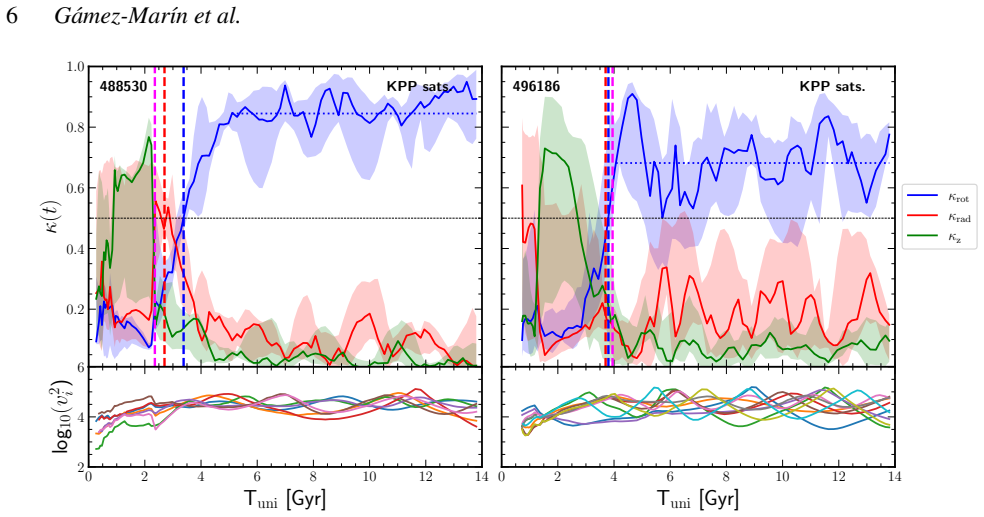
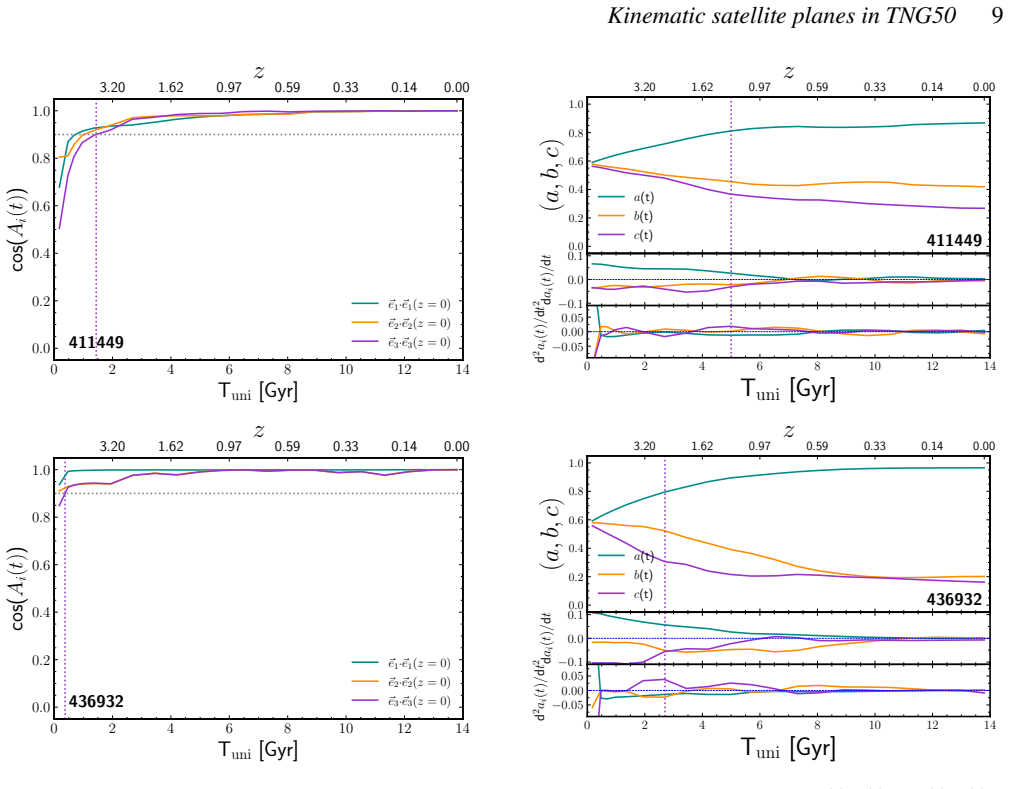
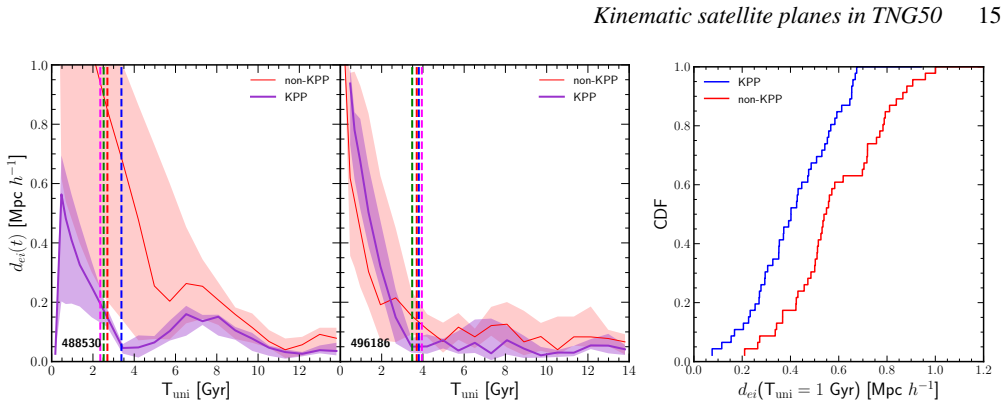
In the TNG50 sample, roughly 67 percent of early KPPs show satellite orbital poles aligned with the Lagrangian Volume's strongest-collapse axis e3 and about 20 percent with the intermediate axis e2. Kinematic analysis shows that motions perpendicular to these planes decay early, leaving rotation-dominated disks. The characteristic timescales for satellites to settle onto a common orbital plane, for orbital-pole clustering, and for LV shape evolution are quasi-coeval and peak at T_uni approximately 4 Gyr during the fast mass-assembly phase of the host halo.
What carries the argument
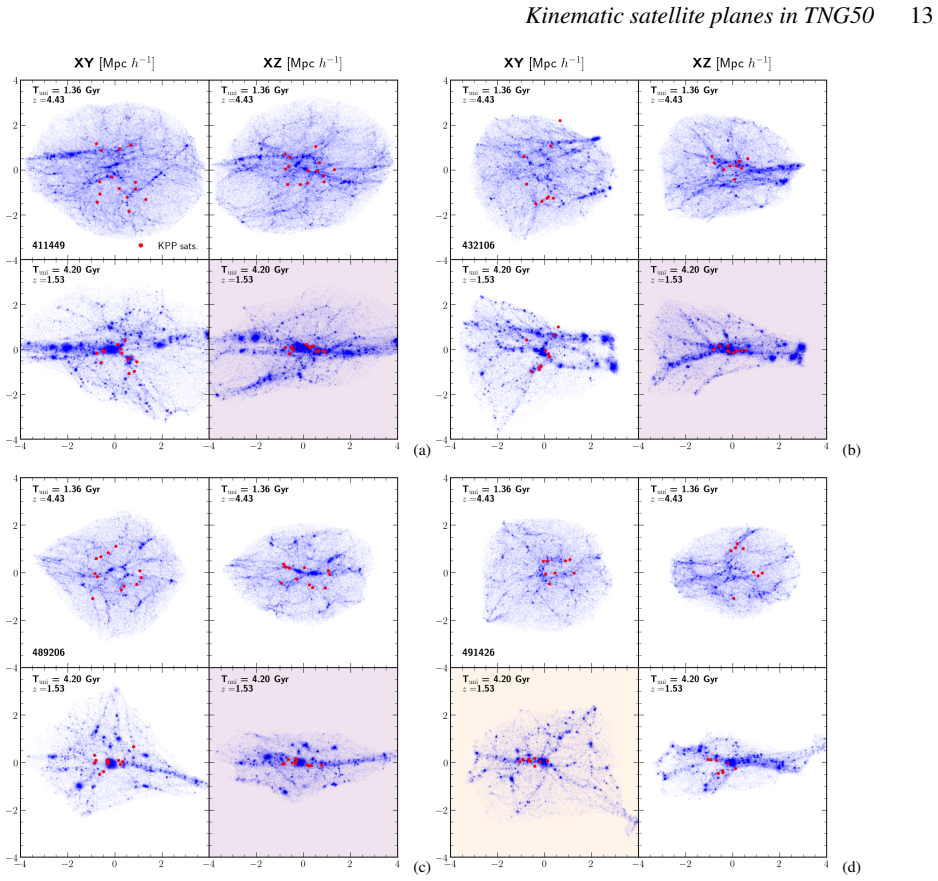
Lagrangian Volumes surrounding each host-satellite system, whose principal collapse directions are tracked via reduced tensor-of-inertia analysis and compared to the clustering of satellite orbital poles.
If this is right
- Satellite orbital poles should remain aligned with the local Cosmic Web's collapse directions long after the initial formation epoch.
- Early KPPs are expected to appear as thin, rotation-supported structures once vertical and radial velocities have decayed.
- The same alignment and timescale patterns should appear in other Lambda-CDM simulations that resolve comparable host-satellite systems.
- The planes form during the rapid mass-assembly phase and then persist as fossil features.
Where Pith is reading between the lines
- Satellite-plane orientations observed around other galaxies today may serve as tracers of the early Cosmic Web geometry in their surroundings.
- If the same alignment mechanism operates at higher resolution, it would tie small-scale satellite kinematics directly to large-scale structure formation.
- This early imprint could help explain why some observed satellite planes remain coherent despite later mergers and accretion.
Load-bearing premise
The TNG50 simulation together with the chosen sample of 190 systems and the specific definition of early KPPs faithfully reproduces the relevant physics without numerical resolution effects or selection biases that could artificially generate the reported alignments and timescales.
What would settle it
Absence of the reported alignments between satellite orbital poles and Lagrangian Volume principal axes in either Local Group observations or in independent higher-resolution simulations.
Figures







read the original abstract
We investigate the physical origin of kinematically persistent planes (KPPs) of satellite galaxies in a sample of 190 Milky Way (MW)/M31-like host-satellite systems drawn from the TNG50 simulation. Building on the identification of 46 early KPPs in a previous work, we analyse their formation in the context of the high-redshift evolution of the local Cosmic Web by tracking the deformation of the so-called Lagrangian Volumes (LVs) surrounding each system. Using a reduced tensor-of-inertia analysis, we characterise the time evolution of the principal directions of collapse and relate them to the clustering of satellite orbital poles. We find that in approximately 67\% of KPPs satellite orbital poles align with the LV direction of strongest collapse, $\vec{e}_3$, while a smaller fraction ($\sim20\%$) align with the intermediate axis, $\vec{e}_2$; alignments with the major axis are rare. These alignments are statistically distinct from random expectations and reflect the confinement of satellites to planar configurations normal to the corresponding LV principal directions. We perform a kinematic analysis of satellite motion within KPPs, finding that vertical and radial motions relative to these KPPs decay early, leading to rotation-dominated, ``disky'' configurations. The characteristic timescales for satellites to settle onto a common orbital plane, for satellite orbital pole clustering, and for LV shape evolution are found to be quasi-coeval, peaking at a Universe age T$_{\rm uni}\sim4$~Gyr, during the fast mass assembly phase of the host halo. These results support a scenario in which early KPPs are fossil remnants of high-redshift, anisotropic mass collapse driven by the local Cosmic Web formation process in $\Lambda$CDM.
Editorial analysis
A structured set of objections, weighed in public.
Referee Report
Summary. The manuscript presents a statistical analysis of the formation of early kinematically persistent planes (KPPs) in 190 Milky Way/M31-like galaxy systems from the TNG50 cosmological simulation. By tracking Lagrangian volumes (LVs) and using reduced tensor-of-inertia to identify principal collapse directions, the authors find that satellite orbital poles align preferentially with the strongest collapse axis e3 in 67% of cases and with e2 in 20%, significantly above random. Kinematic decomposition shows early decay of vertical and radial velocities, resulting in rotation-supported planes. The timescales for plane formation, pole clustering, and LV evolution are shown to be quasi-coeval, peaking around a universe age of 4 Gyr during the host's rapid assembly phase. The authors conclude that these KPPs are fossil records of anisotropic collapse influenced by the high-redshift Cosmic Web in the ΛCDM model.
Significance. This work is significant as it provides a physical mechanism for the origin of satellite planes in simulated galaxies, connecting them to the large-scale structure formation. The direct use of Lagrangian volume tracking and the statistical distinction from random alignments offer a concrete, simulation-grounded explanation that can be tested against observations. The quasi-coeval timescales add a temporal dimension that strengthens the fossil remnant interpretation. If robust, these findings contribute to resolving the 'planes of satellites' problem within standard cosmology without invoking new physics.
major comments (2)
- [§3.2] §3.2 (KPP sample and LV analysis): The central statistical claims (67% alignment with e3, ~20% with e2, distinct from random) rest on the subsample of 46 early KPPs identified in prior work; this manuscript must explicitly restate the KPP selection criteria, include error bars or bootstrap uncertainties on the alignment fractions, and test robustness to reasonable variations in host/satellite cuts, as these directly support the non-random and Cosmic Web interpretation.
- [§4.3] §4.3 (timescale evolution): The claim that plane settling, pole clustering, and LV deformation are quasi-coeval with peaks at T_uni ~4 Gyr is load-bearing for the fossil-remnant scenario, yet the text does not specify the peak-finding procedure (binning, smoothing, or derivative method), report uncertainties, or show that the result persists under alternative time binning or subsample choices.
minor comments (2)
- [Abstract] Abstract: The phrase 'statistically distinct from random expectations' should be accompanied by the exact random alignment fraction and a quantitative significance measure for immediate clarity.
- [Figure captions] Figure captions: Captions for alignment and time-evolution figures should explicitly define all symbols (e.g., e1, e2, e3 directions, vertical vs. radial velocity components) without requiring reference to the main text.
Simulated Author's Rebuttal
We thank the referee for their positive assessment of our work and for the constructive major comments. We agree with the need to enhance the clarity and robustness of our statistical claims and timescale analysis. Below we address each point and outline the revisions we will make to the manuscript.
read point-by-point responses
-
Referee: [§3.2] §3.2 (KPP sample and LV analysis): The central statistical claims (67% alignment with e3, ~20% with e2, distinct from random) rest on the subsample of 46 early KPPs identified in prior work; this manuscript must explicitly restate the KPP selection criteria, include error bars or bootstrap uncertainties on the alignment fractions, and test robustness to reasonable variations in host/satellite cuts, as these directly support the non-random and Cosmic Web interpretation.
Authors: We fully agree that the KPP selection criteria from our prior work should be restated explicitly in this manuscript for the benefit of readers. In the revised version, we will add a concise summary of the KPP identification procedure (based on kinematic persistence over time) at the beginning of §3.2. Furthermore, we will calculate bootstrap uncertainties by resampling the 46 KPP systems and report 1σ errors on the alignment fractions. To address robustness, we will perform additional tests by varying the satellite number threshold (e.g., N_sat > 8 instead of >10) and host halo mass range, and include a new supplementary figure showing that the preference for alignment with e3 remains statistically significant across these variations. These additions will strengthen the support for the non-random alignment and its connection to the Cosmic Web. revision: yes
-
Referee: [§4.3] §4.3 (timescale evolution): The claim that plane settling, pole clustering, and LV deformation are quasi-coeval with peaks at T_uni ~4 Gyr is load-bearing for the fossil-remnant scenario, yet the text does not specify the peak-finding procedure (binning, smoothing, or derivative method), report uncertainties, or show that the result persists under alternative time binning or subsample choices.
Authors: We acknowledge that the description of how the peaks at T_uni ~4 Gyr were determined is insufficiently detailed. In the revision, we will explicitly state that the distributions were binned in 0.5 Gyr intervals and smoothed with a Gaussian kernel of width 1 Gyr, with peaks identified as the mode of the smoothed histogram. We will also report uncertainties on the peak positions using bootstrap resampling of the KPP sample. Additionally, we will demonstrate the robustness by presenting results for alternative bin widths (0.25 Gyr and 1 Gyr) and for subsamples split by host mass or environment, confirming that the quasi-coeval peaking around 4 Gyr persists in all cases. This will be added to §4.3 and supported by an updated figure. revision: yes
Circularity Check
Minor self-citation to prior KPP identification; central analysis independent
full rationale
The paper's load-bearing steps consist of direct measurements on TNG50 outputs: Lagrangian volume tracking, reduced tensor-of-inertia decomposition yielding principal axes e1/e2/e3, orbital-pole alignment statistics (67% with e3), and kinematic decay timescales for vertical/radial motions, all compared against random expectations. These quantities are computed from the simulation data without fitting parameters that are then re-used as predictions. The only self-citation is to the earlier identification of the 46 early KPPs, which functions solely as sample selection and does not supply the physical interpretation or the reported alignments/timescales. No self-definitional equations, fitted-input predictions, ansatzes imported via citation, or renaming of known results occur in the derivation chain.
Axiom & Free-Parameter Ledger
axioms (2)
- domain assumption The TNG50 simulation accurately reproduces the baryonic and dark-matter physics relevant to satellite orbital dynamics and early halo assembly in a Lambda-CDM universe.
- domain assumption The reduced tensor-of-inertia analysis on Lagrangian volumes correctly identifies the principal directions of anisotropic collapse that influence satellite orbits.
Reference graph
Works this paper leans on
-
[1]
doi:10.1093/mnras/stag193 , archiveprefix =
Cosmic web dynamics: forces and strains. , keywords =. doi:10.1093/mnras/stag193 , archivePrefix =. 2407.16489 , primaryClass =
-
[2]
How cosmological merger histories shape the diversity of stellar haloes. , keywords =. doi:10.1093/mnras/stab3709 , archivePrefix =. 2106.09729 , primaryClass =
-
[3]
VINTERGATAN-GM: long-lived satellite planes induced by a massive GSE-like merger. arXiv e-prints , keywords =. doi:10.48550/arXiv.2603.20171 , archivePrefix =. 2603.20171 , primaryClass =
-
[4]
The imprint of galaxy mergers on satellite planes in a cosmological context. , keywords =. doi:10.1093/mnras/stad1861 , archivePrefix =. 2307.03218 , primaryClass =
-
[5]
Mass density structuring around galaxy formation sites: impact on galaxy basic properties. , keywords =. doi:10.1093/mnras/stag147 , archivePrefix =. 2601.13431 , primaryClass =
-
[6]
High and low S \'e rsic index bulges in Milky Way- and M31-like galaxies: origin and connection to the bar with TNG50. , keywords =. doi:10.1093/mnras/stac629 , archivePrefix =. 2111.13712 , primaryClass =
-
[7]
The merger and assembly histories of Milky Way- and M31-like galaxies with TNG50: disc survival through mergers. , keywords =. doi:10.1093/mnras/stac2586 , archivePrefix =. 2211.00036 , primaryClass =
-
[8]
Modeling multi-stream flow in collisionless matter: approximations for large-scale structure beyond shell-crossing. , keywords =. doi:10.48550/arXiv.astro-ph/9702139 , archivePrefix =. astro-ph/9702139 , primaryClass =
-
[9]
Analysis of the plane of satellites around Milky Way-like galaxies in Λ CDM cosmology. arXiv e-prints , keywords =. doi:10.48550/arXiv.2510.02518 , archivePrefix =. 2510.02518 , primaryClass =
-
[10]
doi:10.1093/mnras/staf1610 , archiveprefix =
Spinning masters: on the impact of tidal forces and protohalo size on early spin evolution. , keywords =. doi:10.1093/mnras/staf1610 , archivePrefix =. 2505.01298 , primaryClass =
-
[11]
Planes of satellites, at once transient and persistent. arXiv e-prints , keywords =. doi:10.48550/arXiv.2510.01318 , archivePrefix =. 2510.01318 , primaryClass =
-
[12]
A statistical look on kinematic planes of satellite galaxies I: frequency and properties in TNG50 MW/M31-like galaxies. arXiv e-prints , keywords =. doi:10.48550/arXiv.2509.13622 , archivePrefix =. 2509.13622 , primaryClass =
-
[13]
The large-scale structure of the universe
-
[14]
Robust Statistics: Theory and Methods , publisher =
-
[15]
Sparsity of similarly extreme analogs and a possible role of satellite pairs
The satellite galaxy plane of NGC 4490 in light of CDM. Sparsity of similarly extreme analogs and a possible role of satellite pairs. , keywords =. doi:10.1051/0004-6361/202449954 , archivePrefix =. 2405.06016 , primaryClass =
-
[16]
and Katz, N
Keres, D. and Katz, N. and Weinberg, D. H. and Davé, R. , title =. , year =
-
[17]
1974 , publisher=
The Nonlinear Diffusion Equation: Asymptotic Solutions and Statistical Problems , author=. 1974 , publisher=
1974
-
[18]
Structure of the universe in the two-dimensional model of adhesion. , keywords =. doi:10.1093/mnras/242.2.200 , adsurl =
-
[19]
On the environmental dependence of halo formation. , keywords =. doi:10.1111/j.1365-2966.2004.07733.x , archivePrefix =. astro-ph/0402237 , primaryClass =
-
[20]
Vincent Desjacques and Donghui Jeong and Fabian Schmidt , keywords =. Large-scale galaxy bias , journal =. 2018 , note =. doi:https://doi.org/10.1016/j.physrep.2017.12.002 , url =
-
[21]
and Hoffman, Yehuda and Crain, Robert A
Galaxy properties and the cosmic web in simulations. , keywords =. doi:10.1093/mnras/stu2166 , archivePrefix =. 1405.0281 , primaryClass =
-
[22]
An excursion set model of the cosmic web: the abundance of sheets, filaments and halos
An Excursion Set Model of the Cosmic Web: The Abundance of Sheets, Filaments, and Halos. , keywords =. doi:10.1086/504513 , archivePrefix =. astro-ph/0511365 , primaryClass =
-
[23]
Simulating the physical properties of dark matter and gas inside the cosmic web. , keywords =. doi:10.1111/j.1365-2966.2006.10511.x , archivePrefix =. astro-ph/0511357 , primaryClass =
-
[24]
Simulations of the formation, evolution and clustering of galaxies and quasars. , keywords =. doi:10.1038/nature03597 , archivePrefix =. astro-ph/0504097 , primaryClass =
-
[25]
Intercluster filaments in a CDM Universe. , keywords =. doi:10.1111/j.1365-2966.2005.08897.x , archivePrefix =. astro-ph/0406665 , primaryClass =
-
[26]
, year = 1998, month = may, volume = 499, pages =
Evolution of Structure in Cold Dark Matter Universes. , keywords =. doi:10.1086/305615 , archivePrefix =. astro-ph/9709010 , primaryClass =
-
[27]
, keywords =
Origin and observables of the cosmic web. , keywords =
-
[28]
A hierarchy of voids: much ado about nothing. , keywords =. doi:10.1111/j.1365-2966.2004.07661.x , archivePrefix =. astro-ph/0311260 , primaryClass =
-
[29]
Baryonic solutions and challenges for cosmological models of dwarf galaxies. Nature Astronomy , keywords =. doi:10.1038/s41550-022-01689-w , archivePrefix =. 2206.05295 , primaryClass =
-
[30]
Study of Satellite Plane Structure Characteristics Based on TNG50 Simulations: A Comparative Analysis from Plane to Non-Plane Structures. arXiv e-prints , keywords =. doi:10.48550/arXiv.2412.12474 , archivePrefix =. 2412.12474 , primaryClass =
-
[31]
2024, MNRAS, 535, 3775, doi: 10.1093/mnras/stae2632
New tools for studying planarity in galaxy satellite systems: Milky Way satellite planes are consistent with CDM. , keywords =. doi:10.1093/mnras/stae2632 , archivePrefix =. 2411.17813 , primaryClass =
-
[32]
A New Rarity Assessment of the ``Disk of Satellites'': The Milky Way System Is the Exception Rather Than the Rule in the CDM Cosmology. , keywords =. doi:10.3847/1538-4357/ad8634 , archivePrefix =. 2411.18040 , primaryClass =
-
[33]
Subhalos are Distributed Anisotropically About Their Hosts. arXiv e-prints , keywords =. doi:10.48550/arXiv.2406.10150 , archivePrefix =. 2406.10150 , primaryClass =
-
[34]
Anisotropies in the spatial distribution and kinematics of dwarf galaxies in the Local Group and beyond. , keywords =. doi:10.1093/mnras/stae1616 , archivePrefix =. 2310.02464 , primaryClass =
-
[35]
Testing a proposed ``planarity'' tool for studying satellite systems: On the alleged consistency of Milky Way satellite galaxy planes with CDM. arXiv e-prints , keywords =. doi:10.48550/arXiv.2412.14330 , archivePrefix =. 2412.14330 , primaryClass =
-
[36]
A co-rotating gas and satellite structure around the interacting galaxy pair NGC 4490/85. , keywords =. doi:10.1093/mnras/stae184 , archivePrefix =. 2401.09527 , primaryClass =
-
[37]
, archivePrefix = "arXiv", eprint =
A Two-phase Scenario for Bulge Assembly in CDM Cosmologies. , archivePrefix = "arXiv", eprint =. doi:10.1088/0004-637X/763/1/26 , adsurl =
-
[38]
The Emergence of the Thick Disk in a Cold Dark Matter Universe. , eprint =. doi:10.1086/422709 , adsurl =
-
[39]
2010, ApJ, 725, 2312, doi: 10.1088/0004-637X/725/2/2312
The Two Phases of Galaxy Formation. , archivePrefix = "arXiv", eprint =. doi:10.1088/0004-637X/725/2/2312 , adsurl =
-
[40]
Two-phase galaxy formation. , archivePrefix = "arXiv", eprint =. doi:10.1111/j.1365-2966.2009.14962.x , adsurl =
-
[41]
The Lack of Structural and Dynamical Evolution of Elliptical Galaxies since z\ 1.5: Clues from Self-Consistent Hydrodynamic Simulations. , eprint =. doi:10.1086/500044 , adsurl =
-
[42]
2012, MNRAS, 420, 1825, doi: 10.1111/j.1365-2966.2011.19805.x
Large-scale gas dynamics in the adhesion model: implications for the two-phase massive galaxy formation scenario. , archivePrefix = "arXiv", eprint =. doi:10.1111/j.1365-2966.2011.18379.x , adsurl =
-
[43]
Identification of basins of attraction in the local Universe. Nature Astronomy , keywords =. doi:10.1038/s41550-024-02370-0 , archivePrefix =. 2409.17261 , primaryClass =
-
[44]
Scale radii and aggregation histories of dark haloes. , eprint =. doi:10.1111/j.1365-2966.2005.08818.x , adsurl =
-
[45]
The Caterpillar Project: A Large Suite of Milky Way Sized Halos. , archivePrefix = "arXiv", eprint =. doi:10.3847/0004-637X/818/1/10 , adsurl =
-
[46]
The Emergence of the Thick Disk in a CDM Universe. II. Colors and Abundance Patterns. , eprint =. doi:10.1086/431924 , adsurl =
-
[47]
2003, MNRAS, 339, 937, doi: 10.1046/j.1365-8711.2003.06241.x G¨ otberg, Y., de Mink, S
The growth and structure of dark matter haloes. , eprint =. doi:10.1046/j.1365-8711.2003.06135.x , adsurl =
-
[48]
Concentrations of Dark Halos from Their Assembly Histories. , eprint =. doi:10.1086/338765 , adsurl =
-
[49]
An Introduction to Celestial Mechanics
-
[50]
Solar System Formation and Evolution , year = 1998, editor =
Orbital Resonances and Chaos in the Solar System. Solar System Formation and Evolution , year = 1998, editor =
1998
-
[51]
Physica D Nonlinear Phenomena , keywords =
Nonlinear resonances in the solar system. Physica D Nonlinear Phenomena , keywords =. doi:10.1016/0167-2789(94)90141-4 , archivePrefix =. chao-dyn/9406004 , primaryClass =
-
[52]
2016, ARA&A, 54, 441, doi: 10.1146/annurev-astro-081915-023315
The Eccentric Kozai-Lidov Effect and Its Applications. , keywords =. doi:10.1146/annurev-astro-081915-023315 , archivePrefix =. 1601.07175 , primaryClass =
-
[53]
Proper Motions, Orbits, and Tidal Influences of Milky Way Dwarf Spheroidal Galaxies. , keywords =. doi:10.3847/1538-4357/ac997b , archivePrefix =. 2205.05699 , primaryClass =
-
[54]
Gaia EDR3 Proper Motions of Milky Way Dwarfs. I. 3D Motions and Orbits. , keywords =. doi:10.3847/1538-4357/ac0436 , archivePrefix =. 2104.03974 , primaryClass =
-
[55]
Gaia early DR3 systemic motions of Local Group dwarf galaxies and orbital properties with a massive Large Magellanic Cloud. , keywords =. doi:10.1051/0004-6361/202141528 , archivePrefix =. 2106.08819 , primaryClass =
-
[56]
Planck 2015 results. XIII. Cosmological parameters. , keywords =. doi:10.1051/0004-6361/201525830 , archivePrefix =. 1502.01589 , primaryClass =
-
[57]
Summary of the contents and survey properties
Gaia Early Data Release 3. Summary of the contents and survey properties. , keywords =. doi:10.1051/0004-6361/202039657 , archivePrefix =. 2012.01533 , primaryClass =
-
[58]
A portrait of the vast polar structure as a young phenomenon: Hints from its member satellites. , keywords =. doi:10.1051/0004-6361/202347473 , archivePrefix =. 2310.13521 , primaryClass =
-
[59]
2015, MNRAS, 449, 49, doi: 10.1093/mnras/stv264
The merger rate of galaxies in the Illustris simulation: a comparison with observations and semi-empirical models. , keywords =. doi:10.1093/mnras/stv264 , archivePrefix =. 1502.01339 , primaryClass =
-
[60]
The role of mergers and halo spin in shaping galaxy morphology. , keywords =. doi:10.1093/mnras/stx305 , archivePrefix =. 1609.09498 , primaryClass =
-
[61]
ERGO-ML I: inferring the assembly histories of IllustrisTNG galaxies from integral observable properties via invertible neural networks. , keywords =. doi:10.1093/mnras/stac3295 , archivePrefix =. 2202.06967 , primaryClass =
-
[62]
E pur si muove: Galilean-invariant cosmological hydrodynamical simulations on a moving mesh. , keywords =. doi:10.1111/j.1365-2966.2009.15715.x , archivePrefix =. 0901.4107 , primaryClass =
-
[63]
2017, MNRAS, 465, 3291, doi: 10.1093/mnras/stw2944
Simulating galaxy formation with black hole driven thermal and kinetic feedback. , keywords =. doi:10.1093/mnras/stw2944 , archivePrefix =. 1607.03486 , primaryClass =
-
[64]
The AREPO Public Code Release. , keywords =. doi:10.3847/1538-4365/ab908c , archivePrefix =. 1909.04667 , primaryClass =
-
[65]
First results from the IllustrisTNG simulations: the galaxy color bimodality
First results from the IllustrisTNG simulations: the galaxy colour bimodality. , keywords =. doi:10.1093/mnras/stx3040 , archivePrefix =. 1707.03395 , primaryClass =
work page internal anchor Pith review doi:10.1093/mnras/stx3040
-
[66]
2019, Computational Astrophysics and Cosmology, 6, 2, doi: 10.1186/s40668-019-0028-x
The IllustrisTNG simulations: public data release. Computational Astrophysics and Cosmology , keywords =. doi:10.1186/s40668-019-0028-x , archivePrefix =. 1812.05609 , primaryClass =
-
[67]
First results from the TNG50 simulation: galactic outflows driven by supernovae and black hole feedback. , keywords =. doi:10.1093/mnras/stz2306 , archivePrefix =. 1902.05554 , primaryClass =
-
[68]
The cold circumgalactic medium in emission: Mg II haloes in TNG50. , keywords =. doi:10.1093/mnras/stab2177 , archivePrefix =. 2106.09023 , primaryClass =
-
[69]
First results from the IllustrisTNG simulations: radio haloes and magnetic fields
First results from the IllustrisTNG simulations: radio haloes and magnetic fields. , keywords =. doi:10.1093/mnras/sty2206 , archivePrefix =. 1707.03396 , primaryClass =
-
[70]
First results from the IllustrisTNG simulations: a tale of two elements - chemical evolution of magnesium and europium. , keywords =. doi:10.1093/mnras/sty618 , archivePrefix =. 1707.03401 , primaryClass =
-
[71]
2018, MNRAS, 475, 676, doi: 10.1093/mnras/stx3304
First results from the IllustrisTNG simulations: matter and galaxy clustering. , keywords =. doi:10.1093/mnras/stx3304 , archivePrefix =. 1707.03397 , primaryClass =
-
[72]
2019, MNRAS, 490, 3196, doi: 10.1093/mnras/stz2338 Planck Collaboration, Ade, P
First results from the TNG50 simulation: the evolution of stellar and gaseous discs across cosmic time. , keywords =. doi:10.1093/mnras/stz2338 , archivePrefix =. 1902.05553 , primaryClass =
-
[73]
First results from the IllustrisTNG simulations: the stellar mass content of groups and clusters of galaxies. , keywords =. doi:10.1093/mnras/stx3112 , archivePrefix =. 1707.03406 , primaryClass =
-
[74]
Simulating galaxy formation with the IllustrisTNG model. , keywords =. doi:10.1093/mnras/stx2656 , archivePrefix =. 1703.02970 , primaryClass =
-
[75]
The Origin of Kinematically Persistent Planes of Satellites as Driven by the Early Evolution of the Cosmic Web in CDM. , keywords =. doi:10.3847/1538-4357/ad27da , archivePrefix =. 2402.03288 , primaryClass =
-
[76]
The abundance of satellites around Milky Way- and M31-like galaxies with the TNG50 simulation: a matter of diversity. , keywords =. doi:10.1093/mnras/stab2437 , archivePrefix =. 2101.12215 , primaryClass =
-
[77]
Milky Way and Andromeda analogues from the TNG50 simulation
Milky Way and Andromeda analogs from the TNG50 simulation. , keywords =. doi:10.1093/mnras/stae2165 , archivePrefix =. 2303.16217 , primaryClass =
-
[78]
, year = 1967, month = jan, volume =
Statistical mechanics of violent relaxation in stellar systems. , year = 1967, month = jan, volume =. doi:10.1093/mnras/136.1.101 , adsurl =
-
[79]
, year = 1968, month = jan, volume =
The gravo-thermal catastrophe in isothermal spheres and the onset of red-giant structure for stellar systems. , year = 1968, month = jan, volume =. doi:10.1093/mnras/138.4.495 , adsurl =
-
[80]
doi:10.1093/mnras/sts416 , archiveprefix =
NEXUS: tracing the cosmic web connection. , keywords =. doi:10.1093/mnras/sts416 , archivePrefix =. 1209.2043 , primaryClass =
discussion (0)
Sign in with ORCID, Apple, or X to comment. Anyone can read and Pith papers without signing in.