Recognition: unknown
Community-to-Vehicle: Integrating Electric Vehicles into Energy Communities -- A Swiss Case Study
Pith reviewed 2026-05-08 06:59 UTC · model grok-4.3
The pith
Community-to-vehicle charging lets Swiss energy communities allocate surplus solar power to EVs, improving local renewable use and cutting user costs.
A machine-rendered reading of the paper's core claim, the machinery that carries it, and where it could break.
Core claim
By designing scenarios that transition from full separation to coordinated EV charging within the Swiss local electricity community framework, C2V enables preferential allocation of locally generated PV surplus to EVs, which the paper shows raises local PV utilization, reduces EV charging costs relative to commercial alternatives, and creates additional revenue streams for the community.
What carries the argument
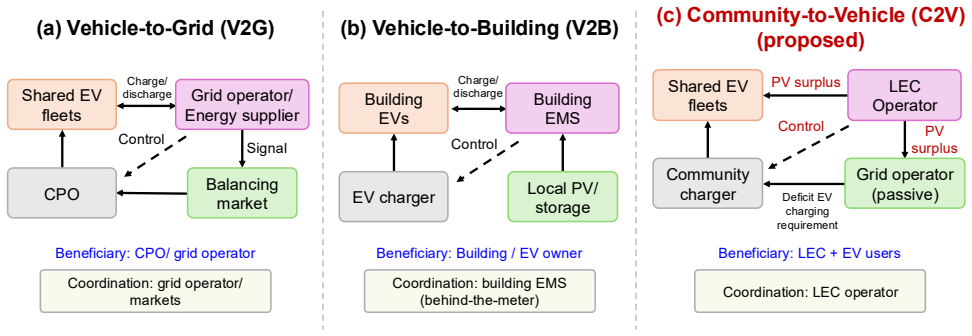
The community-to-vehicle (C2V) institutional design mechanism, which removes the separation between energy communities and public EV charging by allowing surplus PV to be allocated preferentially inside the community boundary or sold to external users at a community charging price.
If this is right
- Local PV self-consumption rises as surplus is directed to EVs instead of being exported or curtailed.
- EV users face lower charging prices than those offered by commercial public stations.
- Communities gain new revenue from offering charging services to both members and external users.
- The integration operates inside the existing Swiss regulatory structure without requiring new legislation.
Where Pith is reading between the lines
- The same coordinated allocation logic could be tested in other countries that already have community energy tariffs or virtual metering rules.
- Wider rollout might change the economics of home versus community charging, potentially shifting where most EVs are plugged in during daylight hours.
- If scaled, C2V could serve as a practical bridge between behind-the-meter solar and fleet or workplace charging without new hardware standards.
- Future work could examine how C2V interacts with dynamic pricing signals or vehicle-to-grid capabilities once those become available.
Load-bearing premise
The designed scenarios accurately capture real-world user behavior and regulatory feasibility when shifting from full separation to coordinated EV charging under the Swiss local electricity community framework.
What would settle it
A field measurement in an implemented Swiss local energy community that records actual PV self-consumption percentages and EV charging bills before and after C2V adoption, then compares those values directly to the paper's modeled outcomes.
Figures


read the original abstract
The institutional separation between local energy communities and public electric vehicle (EV) charging limits the efficient use of locally generated renewable energy. This paper introduces the concept of community-to-vehicle (C2V) as an institutional design mechanism to bridge this gap by enabling EV charging within the community boundary, where locally generated photovoltaic (PV) surplus is preferentially allocated and offered to external users at a community charging price. Building on the recently introduced local electricity community framework in Switzerland, we design scenarios that capture the transition from full separation to coordinated EV charging and evaluate their impacts on EV users and the community. The results show that C2V significantly improves local PV utilization and enhances economic performance, reducing EV charging costs relative to commercial alternatives while generating additional revenue streams for the community. These findings highlight the potential of C2V as a practical, implementable mechanism for integrating EV charging into local energy communities, providing a clear pathway for adopting coordinated community-EV interaction within existing regulatory frameworks.
Editorial analysis
A structured set of objections, weighed in public.
Referee Report
Summary. The manuscript introduces the Community-to-Vehicle (C2V) mechanism to integrate external EV charging into Swiss local electricity communities by preferentially allocating PV surplus to EV users at a community-set price. It constructs transition scenarios from full separation to coordinated charging and reports that C2V yields higher local PV utilization, additional community revenue, and lower EV charging costs relative to commercial tariffs.
Significance. If the modeled gains are robust, the work offers a concrete, regulation-grounded pathway for improving renewable self-consumption and EV economics within existing Swiss local-community rules. The case-study framing supplies quantitative deltas that can inform pilots elsewhere; the emphasis on institutional design rather than new hardware is a practical strength.
major comments (2)
- [Methods] Methods (scenario construction): the transition scenarios presuppose that external EV users will preferentially charge during community PV-surplus windows at the offered price and that the community can allocate surplus without violating Swiss metering and billing rules. No empirical calibration against Swiss EV arrival/charging telemetry or regulatory precedent is shown; if real evening-peak patterns dominate, the reported utilization and cost deltas shrink materially. This assumption is load-bearing for the central claim.
- [Results] Results (economic evaluation): the comparison of C2V charging costs to commercial rates does not specify how the community price is set (e.g., cost-plus, regulatory cap) or whether it remains feasible once network charges and taxes are applied under the local electricity community framework. This directly affects the claimed revenue and savings figures.
minor comments (2)
- [Abstract] Abstract and introduction: the term 'external users' is used without a precise definition of access rights or metering boundaries; a short clarifying sentence would improve readability.
- [Figures] Figures showing utilization and cost deltas: ensure all bars or lines are accompanied by error bars or sensitivity ranges reflecting the behavioral assumptions.
Simulated Author's Rebuttal
We thank the referee for the constructive feedback, which helps strengthen the clarity and robustness of our analysis on the Community-to-Vehicle (C2V) mechanism. We address each major comment below and will incorporate revisions accordingly.
read point-by-point responses
-
Referee: [Methods] Methods (scenario construction): the transition scenarios presuppose that external EV users will preferentially charge during community PV-surplus windows at the offered price and that the community can allocate surplus without violating Swiss metering and billing rules. No empirical calibration against Swiss EV arrival/charging telemetry or regulatory precedent is shown; if real evening-peak patterns dominate, the reported utilization and cost deltas shrink materially. This assumption is load-bearing for the central claim.
Authors: We agree that the scenarios rely on behavioral assumptions about preferential charging during PV surplus periods, which are grounded in the Swiss local electricity community (LEC) regulatory framework allowing surplus allocation to external users. However, the manuscript does not include empirical calibration with Swiss EV telemetry data, as such granular public datasets were not available at the time of modeling. The scenarios are designed as illustrative transition pathways rather than predictive forecasts. In the revision, we will expand the methods section to include a sensitivity analysis on alternative charging patterns (e.g., evening-peak dominance) and add references to existing Swiss regulatory precedents on LEC metering and billing to better substantiate the assumptions. revision: yes
-
Referee: [Results] Results (economic evaluation): the comparison of C2V charging costs to commercial rates does not specify how the community price is set (e.g., cost-plus, regulatory cap) or whether it remains feasible once network charges and taxes are applied under the local electricity community framework. This directly affects the claimed revenue and savings figures.
Authors: We acknowledge the need for greater transparency on the community charging price. The model assumes a community-set price that is a fixed percentage below commercial tariffs (to ensure user uptake) while covering generation costs plus a margin for the community. This is feasible under current Swiss LEC rules, which permit internal pricing with network charges and taxes applied at the point of connection. In the revised manuscript, we will clarify the exact pricing rule in the economic evaluation section, provide the formula used, and add a discussion (with sample calculations) on how network charges and taxes affect net revenue and savings to demonstrate feasibility. revision: yes
Circularity Check
No circularity; scenario-based evaluation grounded in external Swiss regulatory framework
full rationale
The paper defines C2V as an institutional mechanism and evaluates its impacts via designed transition scenarios under the Swiss local electricity community rules. No equations, fitted parameters, or self-citations are shown to reduce outputs to inputs by construction. Claims of improved PV utilization and cost reductions arise from comparative simulation of scenarios, not from renaming or self-referential definitions. The work references an independent external regulatory base, keeping the derivation chain self-contained.
Axiom & Free-Parameter Ledger
axioms (1)
- domain assumption The Swiss local electricity community framework permits coordinated EV charging with preferential allocation of PV surplus.
invented entities (1)
-
Community-to-Vehicle (C2V) mechanism
no independent evidence
Reference graph
Works this paper leans on
-
[1]
Energetic communities for community energy: A review of key issues and trends shaping integrated community energy systems,
B. P. Koirala, E. Koliou, J. Friege, R. A. Hakvoort, and P. M. Herder, “Energetic communities for community energy: A review of key issues and trends shaping integrated community energy systems,”Renewable and Sustainable Energy Reviews, vol. 56, pp. 722–744, 2016
2016
-
[2]
Economic analysis of energy communities: Investment options and cost allocation,
N. Li and ¨O. Okur, “Economic analysis of energy communities: Investment options and cost allocation,”Applied Energy, vol. 336, p. 120706, 2023
2023
-
[3]
Federal law on electricity supply (electricity supply act, stromvg),
“Federal law on electricity supply (electricity supply act, stromvg),” The Swiss Federal Council, 2007. [Online]. Available: https: //www.fedlex.admin.ch/eli/cc/2007/418/de
2007
-
[4]
Electricity supply ordinance (stromvv),
“Electricity supply ordinance (stromvv),” The Swiss Federal Council,
-
[5]
Available: https://www.fedlex.admin.ch/eli/cc/2008/226/ de
[Online]. Available: https://www.fedlex.admin.ch/eli/cc/2008/226/ de
2008
-
[6]
From individual consumers to energy communities: A techno-economic assessment of Swiss local electricity communities,
N. Li and B. Koirala, “From individual consumers to energy communities: A techno-economic assessment of Swiss local electricity communities,”
-
[7]
[Online]. Available: https://arxiv.org/abs/2604.15900
work page internal anchor Pith review Pith/arXiv arXiv
-
[8]
Integration of electric vehicles in smart grid: A review on vehicle to grid technologies and optimization techniques,
K. M. Tan, V . K. Ramachandaramurthy, and J. Y . Yong, “Integration of electric vehicles in smart grid: A review on vehicle to grid technologies and optimization techniques,”Renewable and Sustainable Energy Reviews, vol. 53, pp. 720–732, 2016
2016
-
[9]
Vehicle-to-grid impact on battery degradation and estimation of V2G economic compensation,
S. Sagaria, M. van der Kam, and T. Bostr ¨om, “Vehicle-to-grid impact on battery degradation and estimation of V2G economic compensation,” Applied Energy, vol. 377, p. 124546, 2025
2025
-
[10]
Strategic integration of vehicle-to-home system with home distributed photovoltaic power generation in Shanghai,
J. Chen, Y . Zhang, X. Li, B. Sun, Q. Liao, Y . Tao, and Z. Wang, “Strategic integration of vehicle-to-home system with home distributed photovoltaic power generation in Shanghai,”Applied Energy, vol. 263, p. 114603, 2020
2020
-
[11]
Optimal integration of vehicle to building (V2B) and building to vehicle (B2V) technologies for commercial buildings,
Z. He, J. Khazaei, and J. D. Freihaut, “Optimal integration of vehicle to building (V2B) and building to vehicle (B2V) technologies for commercial buildings,”Sustainable Energy, Grids and Networks, vol. 32, p. 100921, 2022
2022
-
[12]
Combined vehicle to building (V2B) and vehicle to home (V2H) strategy to increase electric vehicle market share,
D. Borge-Diez, D. Icaza, E. Ac ¸ıkkalp, and H. Amaris, “Combined vehicle to building (V2B) and vehicle to home (V2H) strategy to increase electric vehicle market share,”Energy, vol. 237, p. 121608, 2021
2021
-
[13]
Building to vehicle to building concept toward a novel zero energy paradigm: Modelling and case studies,
G. Barone, A. Buonomano, F. Calise, C. Forzano, and A. Palombo, “Building to vehicle to building concept toward a novel zero energy paradigm: Modelling and case studies,”Renewable and Sustainable Energy Reviews, vol. 101, pp. 625–648, 2019
2019
-
[14]
Increasing self-consumption of renewable energy through the building to vehicle to building approach applied to multiple users connected in a virtual micro-grid,
G. Barone, A. Buonomano, C. Forzano, G. F. Giuzio, and A. Palombo, “Increasing self-consumption of renewable energy through the building to vehicle to building approach applied to multiple users connected in a virtual micro-grid,”Renewable energy, vol. 159, pp. 1165–1176, 2020
2020
-
[15]
Electricity peak shaving for commercial buildings using machine learning and vehicle to building (V2B) system,
M. Ghafoori, M. Abdallah, and S. Kim, “Electricity peak shaving for commercial buildings using machine learning and vehicle to building (V2B) system,”Applied Energy, vol. 340, p. 121052, 2023
2023
-
[16]
Community-to-vehicle-to- community (C2V2C) for inter-community electricity delivery and sharing via electric vehicle: Performance evaluation and robustness analysis,
A. Board, Y . Sun, P. Huang, and T. Xu, “Community-to-vehicle-to- community (C2V2C) for inter-community electricity delivery and sharing via electric vehicle: Performance evaluation and robustness analysis,” Applied Energy, vol. 363, p. 123054, 2024
2024
-
[17]
[Online]
“Nest,” Empa, 2026. [Online]. Available: https://www.empa.ch/web/nest/ overview
2026
-
[18]
rudolphsanta/swiss-public-charging-dataset: Electric vehicle charging dataset on public infrastructure usage in switzerland,
R. Santarromana, “rudolphsanta/swiss-public-charging-dataset: Electric vehicle charging dataset on public infrastructure usage in switzerland,” 2026
2026
-
[19]
Ekz standard tariffs for private customers 2025,
“Ekz standard tariffs for private customers 2025,” EKZ, 2026. [Online]. Available: https://www.ekz.ch/dam/ekz/privatkunden/strom/tarife-und- agb/Tarifdokumente/tarife-2026/ekz-tarife-2026-privatkunden.pdf
2025
-
[20]
Ekz feed-in tariffs for private customers 2025,
“Ekz feed-in tariffs for private customers 2025,” EKZ, 2026. [Online]. Available: https://www.ekz.ch/dam/ekz/privatkunden/strom/tarife-und- agb/Tarifdokumente/tarife-2026/ekz-tarifsammlung-2026.pdf
2025
-
[21]
Move light charging prices,
“Move light charging prices,” MOVE, 2026. [Online]. Available: https://www.move.ch/en/professional/subscriptions/move-light.php
2026
discussion (0)
Sign in with ORCID, Apple, or X to comment. Anyone can read and Pith papers without signing in.