Recognition: unknown
Do Melody and Rhythm Coevolve?
Pith reviewed 2026-05-08 04:22 UTC · model grok-4.3
The pith
Melody and rhythm evolve independently rather than as coupled components across cultures.
A machine-rendered reading of the paper's core claim, the machinery that carries it, and where it could break.
Core claim
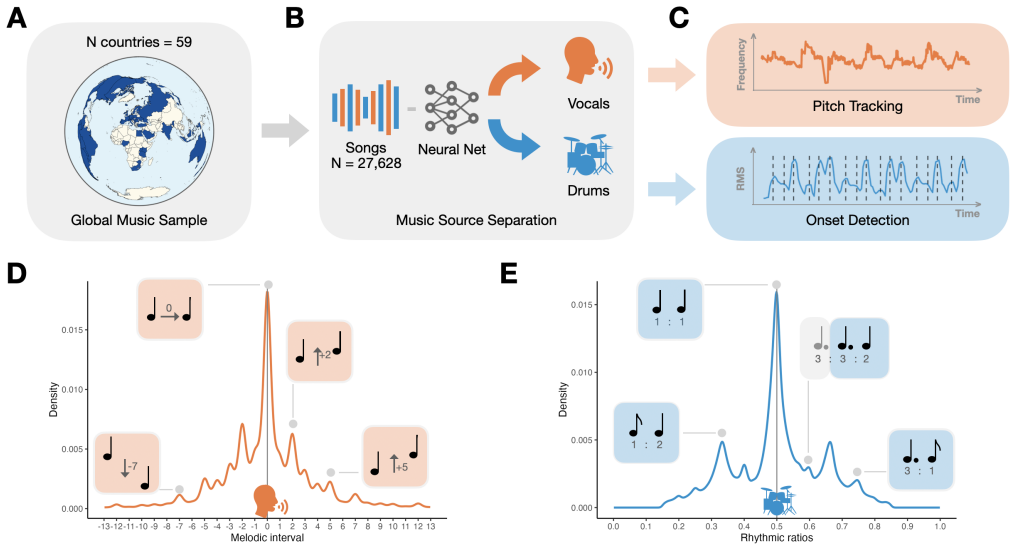
The paper claims that melody and rhythm constitute partially independent systems shaped by distinct cultural and evolutionary pressures. Analysis of pitch-interval distributions from vocals and inter-onset timing distributions from percussion in 27,628 songs across 59 countries reveals substantial variation in both components. Country-level similarities in these structures align with geographic and linguistic relationships. Diversity measures for melody and rhythm are not significantly correlated, and only rhythmic diversity associates with ethnic and linguistic heterogeneity.
What carries the argument
A computational pipeline that derives vocal melodic pitch-interval distributions and percussive inter-onset timing distributions directly from popular song audio without manual annotations.
If this is right
- Musical similarities between countries align with their geographic proximity and shared languages.
- Rhythmic diversity increases with greater ethnic and linguistic heterogeneity.
- Melodic diversity shows no reliable link to ethnic or linguistic heterogeneity.
- Melody and rhythm respond to separate cultural and evolutionary pressures instead of forming one unified style.
Where Pith is reading between the lines
- The pattern suggests researchers could test other musical traits such as harmony or timbre for similar independence using comparable large-scale extraction methods.
- Cultural preservation work might benefit from treating rhythm and melody as distinct traditions rather than parts of a single heritage.
- The result raises the possibility that rhythmic features interact more directly with spoken language diversity than melodic ones do.
Load-bearing premise
The pipeline extracts pitch and timing distributions from commercial popular songs that validly represent each country's broader musical practices without systematic distortion from selection or automation.
What would settle it
Repeating the diversity comparison on a dataset of field recordings or traditional music from the same countries and finding a significant positive correlation between melodic and rhythmic diversity would contradict the independence result.
Figures


read the original abstract
Music comprises two core structural components, melody and rhythm, that vary widely across cultures. Whether these components coevolve in a coupled way or follow independent trajectories remains unclear. We introduce a novel computational pipeline to extract vocal melodic pitch-interval and percussive inter-onset timing distributions from 27,628 popular songs across 59 countries, enabling large-scale cross-cultural comparison that bypasses traditional music annotations. Musical similarities between countries aligned with geographic and linguistic relationships, validating our approach. Substantial variation emerged in both melodic and rhythmic structures across countries, yet the diversity of the two components was not significantly correlated, challenging assumptions of coupled evolution. Only rhythmic diversity was significantly associated with ethnic and linguistic heterogeneity, while melodic diversity showed no such association. These findings suggest that melody and rhythm constitute partially independent systems shaped by distinct cultural and evolutionary pressures, rather than components of a single monolithic musical style.
Editorial analysis
A structured set of objections, weighed in public.
Referee Report
Summary. The paper claims that melody and rhythm do not coevolve in a coupled manner. Using a novel annotation-free pipeline to extract vocal pitch-interval distributions and percussive inter-onset timing distributions from 27,628 popular songs across 59 countries, the authors report substantial cross-country variation in both components, no significant correlation between melodic and rhythmic diversity, and an association of only rhythmic diversity with ethnic and linguistic heterogeneity. Musical similarities between countries align with geographic and linguistic relationships, which they take as validation of the approach.
Significance. If the extraction pipeline and corpus yield unbiased country-level distributions, the work provides large-scale computational evidence that melodic and rhythmic structures follow partially independent trajectories shaped by distinct cultural pressures. The scale (27k tracks, 59 countries) and annotation-free design are strengths that could enable new falsifiable tests in cultural evolution of music.
major comments (3)
- [Methods] Methods (pipeline description): The novel computational pipeline for pitch-interval and inter-onset extraction is presented without reported validation metrics, accuracy benchmarks on non-Western tunings, or robustness checks against annotation-based ground truth. This is load-bearing because the central claim of independence rests on the distributions being unbiased representations of country-level practices.
- [Data collection and Results] Data collection and Results: The corpus is drawn exclusively from popular-song charts with no reported controls for international releases, genre confounds, or song popularity weighting. This risks attenuating observed correlations or producing asymmetric heterogeneity associations as artifacts, directly undermining the claim that only rhythmic diversity links to ethnic/linguistic heterogeneity.
- [Results] Results (correlation analysis): The statement that melodic and rhythmic diversities are 'not significantly correlated' lacks the reported correlation coefficient, exact p-value, sample size per country, and any correction for multiple comparisons or spatial autocorrelation. Without these, the null result cannot be evaluated for power or robustness.
minor comments (2)
- [Introduction] The abstract and introduction could more explicitly cite prior empirical work on melodic vs. rhythmic evolution to clarify the novelty of the independence claim.
- [Figures and Tables] Figure legends and table captions should include error bars or confidence intervals on the diversity metrics to allow readers to assess the reported variation.
Simulated Author's Rebuttal
We thank the referee for their constructive and detailed comments, which help clarify key aspects of our methods, data, and results. We respond point by point below, indicating where we will revise the manuscript to improve transparency and robustness.
read point-by-point responses
-
Referee: [Methods] Methods (pipeline description): The novel computational pipeline for pitch-interval and inter-onset extraction is presented without reported validation metrics, accuracy benchmarks on non-Western tunings, or robustness checks against annotation-based ground truth. This is load-bearing because the central claim of independence rests on the distributions being unbiased representations of country-level practices.
Authors: We agree that additional validation would strengthen confidence in the pipeline. Although the approach is intentionally annotation-free to scale across 59 countries, we will add a dedicated validation subsection in Methods. This will include accuracy tests on synthetic audio with known pitch intervals and inter-onset intervals, parameter sensitivity analyses for the pitch tracker, and direct comparisons against a small set of publicly available annotated tracks. For non-Western tunings, we will report the performance of the general-purpose pitch estimator and discuss its limitations explicitly. These revisions will be incorporated in the next version. revision: yes
-
Referee: [Data collection and Results] Data collection and Results: The corpus is drawn exclusively from popular-song charts with no reported controls for international releases, genre confounds, or song popularity weighting. This risks attenuating observed correlations or producing asymmetric heterogeneity associations as artifacts, directly undermining the claim that only rhythmic diversity links to ethnic/linguistic heterogeneity.
Authors: We selected national chart data precisely to capture locally popular music. In revision we will add explicit discussion of how international releases were minimized (e.g., by artist nationality and chart dominance filters where metadata permit) and will include a sensitivity check removing obvious cross-border hits. Genre confounds are inherent to popular music; we will clarify that our structural measures are genre-agnostic and report that results are stable across broad genre subsets where labels are available. Popularity weighting is already implicit because every track appears on a top chart; we will state this and test whether rank-based weighting alters the heterogeneity associations. These clarifications and checks will be added to the Data and Results sections. revision: partial
-
Referee: [Results] Results (correlation analysis): The statement that melodic and rhythmic diversities are 'not significantly correlated' lacks the reported correlation coefficient, exact p-value, sample size per country, and any correction for multiple comparisons or spatial autocorrelation. Without these, the null result cannot be evaluated for power or robustness.
Authors: We will fully report the statistical details. The revised Results section will include the Pearson correlation coefficient, exact p-value, n = 59 countries, and an assessment of spatial autocorrelation (via Moran’s I and a spatial regression model). We will also add a post-hoc power calculation to quantify the strength of the null finding. These numbers and analyses will be inserted directly into the text and supplementary material. revision: yes
Circularity Check
No significant circularity; claims rest on independent statistical comparisons to external variables
full rationale
The paper extracts pitch-interval and inter-onset distributions via a computational pipeline, computes country-level diversity metrics, and performs direct statistical tests for correlation between melodic/rhythmic diversity and for associations with independently sourced geographic, ethnic, and linguistic heterogeneity measures. No step defines a quantity in terms of itself, renames a fitted parameter as a prediction, or reduces the central result to a self-citation chain. The validation via alignment with geographic/linguistic relationships uses external benchmarks rather than internal fits, keeping the derivation self-contained against outside data.
Axiom & Free-Parameter Ledger
axioms (1)
- domain assumption The computational pipeline accurately extracts vocal melodic pitch-interval and percussive inter-onset timing distributions that reflect underlying cultural musical practices.
Reference graph
Works this paper leans on
-
[1]
Anglada-Tort, M., Harrison, P. M. C., Lee, H., & Jacoby, N. (2023). Large-scale iterated singing experiments reveal oral transmission mechanisms underlying music evolution. Current Biology,0(0). https://doi.org/10.1016/j.cub.2023. 02.070 Anglada-Tort, M., Lee, H., Krause, A. E., & North, A. C. (2023).Herecomesthesun:Musicfeaturesofpopularsongs reflect pre...
-
[2]
https://doi.org/10.1057/ s41599-025-04881-1 Brown, S., Savage, P. E., Ko, A. M.-S., Stoneking, M., Ko, Y.-C.,Loo,J.-H.,&Trejaut,J.A.(2014).Correlationsinthe populationstructureofmusic,genesandlanguage.Proceed- ingsoftheRoyalSocietyB:BiologicalSciences,281(1774), 20132072. https://doi.org/10.1098/rspb.2013.2072 Castellanos,F.J.,Garrido-Munoz,C.,Ríos-Vila,A...
-
[3]
https://doi.org/10. 1038/s41597-025-04692-8 Háden,G.P.,Bouwer,F.L.,Honing,H.,&Winkler,I.(2024). Beat processing in newborn infants cannot be explained by statistical learning based on transition probabilities.Cog- nition,243, 105670. https://doi.org/10.1016/j.cognition. 2023.105670 Hannon,E.E.,Soley,G.,&Ullal,S.(2012).Familiarityover- rides complexity in ...
-
[4]
Savage, P. E., Brown, S., Sakai, E., & Currie, T. E. (2015). Statistical universals reveal the structures and functions of humanmusic.ProceedingsoftheNationalAcademyofSci- ences,112(29), 8987–8992. https://doi.org/10.1073/pnas. 1414495112 Savage, P. E., Loui, P., Tarr, B., Schachner, A., Glowacki, L., Mithen,S.,&Fitch,W.T.(2020).Musicasacoevolvedsys- temf...
discussion (0)
Sign in with ORCID, Apple, or X to comment. Anyone can read and Pith papers without signing in.