Recognition: unknown
Mobile Cold Energy Storage: Coupling Food Distribution and Energy Systems
Pith reviewed 2026-05-08 04:10 UTC · model grok-4.3
The pith
Replacing batteries with PCM and using chilled meat as mobile cold storage lowers annualised costs by up to 23% in Nigerian markets.
A machine-rendered reading of the paper's core claim, the machinery that carries it, and where it could break.
Core claim
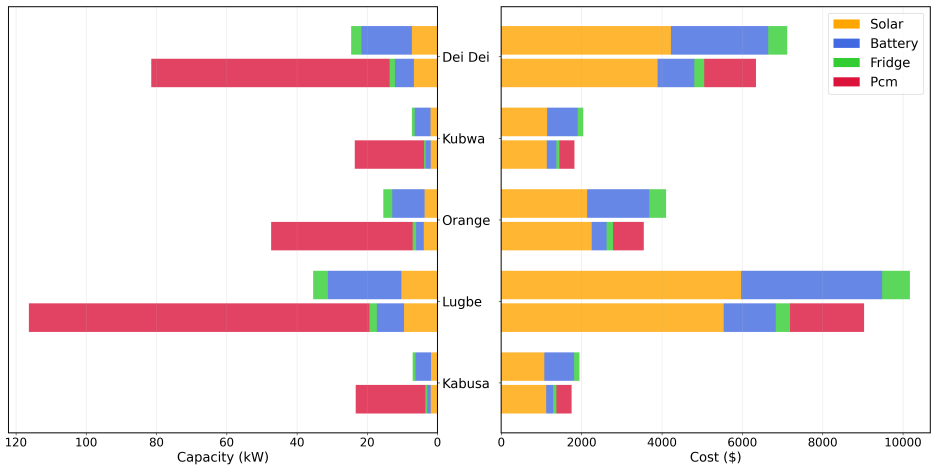
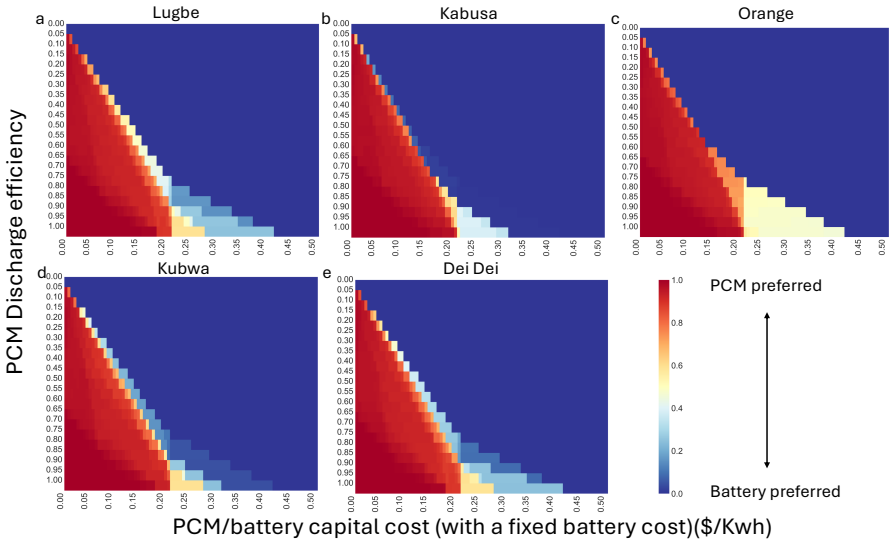
The authors build a techno-economic framework that models PCM as stationary thermal storage at each market and pre-chilled meat as a mobile carrier of cold energy along existing trade routes. Substituting PCM for part of the battery capacity reduces annualized system cost by up to 15 percent, driven by a roughly 67 percent cut in battery size. Allowing inter-market cold exchange through chilled meat delivers an additional 8 percent cost reduction and a 35 percent drop in total PCM capacity. PCM is favored when refrigeration charging windows are long and predictable, while batteries suit short or flexible-response needs. Across scenarios the cost of providing cooling remains a small share of肉
What carries the argument
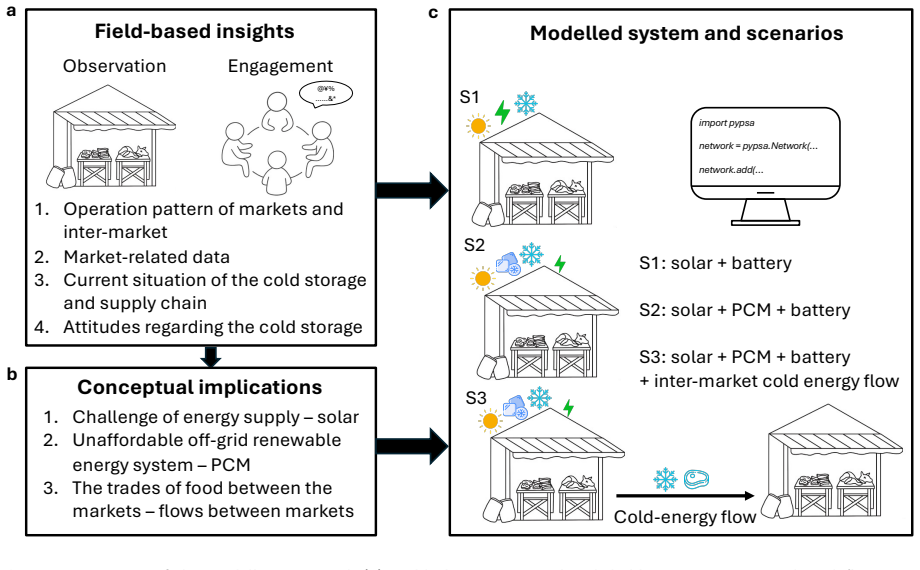
Techno-economic optimization framework that treats pre-chilled meat as a mobile cold-energy vector moving through trade routes while PCM remains fixed at markets.
If this is right
- Battery capacity requirements fall by about two-thirds when PCM handles the bulk of thermal storage.
- Existing meat transport routes can redistribute excess cold capacity between markets without new infrastructure.
- Total PCM capacity across the network shrinks when storage is shared via chilled food flows.
- PCM becomes the lower-cost option whenever solar charging windows are long and predictable.
- Cooling expenses remain a minor fraction of meat value even after adding solar generation and storage.
Where Pith is reading between the lines
- The same mobile-cold logic could apply to vegetables or dairy if transport times preserve product quality.
- Adoption would require confirming that extra handling does not increase spoilage rates or labor costs.
- Similar co-design might cut diesel generator use and emissions in other off-grid food systems.
- The framework could be tested on vaccine or medicine cold chains where temperature control is critical.
Load-bearing premise
The assumed capital costs, discharge efficiencies, refrigeration charging windows, and transport logistics accurately reflect real market conditions and that the optimisation captures all relevant operational constraints without hidden costs or reliability penalties.
What would settle it
A one-year field measurement of installed costs, energy performance, and food waste in one Abuja market using a PCM-battery hybrid with and without inter-market meat exchange, compared directly to the model's predictions.
Figures




read the original abstract
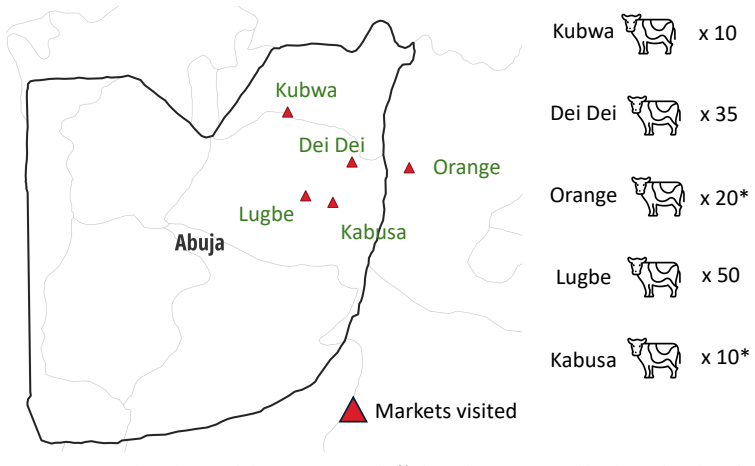
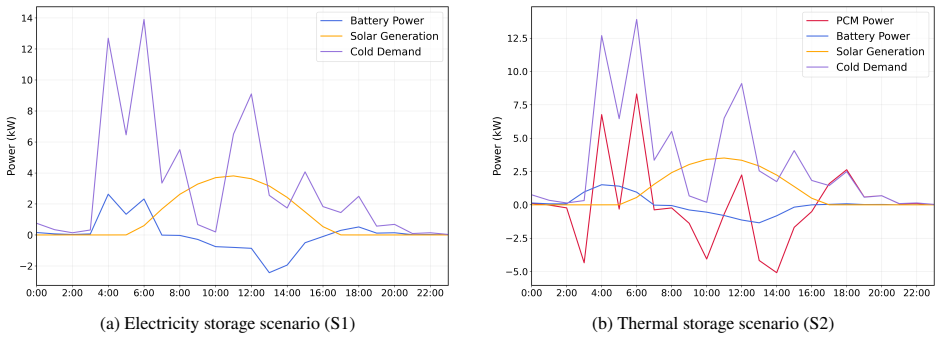
Cold storage is a persistent constraint in sub-Saharan African informal food systems, where perishables are traded in open-air markets with intermittent electricity and grid-tied or battery-heavy cold chains are too costly to scale. We develop a techno-economic optimisation framework that co-designs solar photovoltaics, refrigeration, phase change material (PCM) thermal storage, and inter-market food transport, using five open-air meat markets in Abuja, Nigeria as a case study. The framework treats pre-chilled meat as a mobile carrier of cold energy moving through existing trade routes, while PCM remains stationary at each market. Replacing part of the battery with PCM lowers annualised system cost by up to 15% (mean 11%), driven by a roughly 67% reduction in battery capacity. Allowing inter-market cold exchange via chilled meat further cuts total cost by 8% and aggregate PCM capacity by 35% by reallocating storage across markets without additional generation. PCM competitiveness depends on its relative capital cost, discharge efficiency, and the refrigeration charging window: long predictable charging windows favour PCM, short flexible-response needs favour batteries. Across all scenarios the cost of cooling stays a small share of meat value. The framework shows how treating cold as a mobile energy vector embedded in food flows can inform cold-chain design in other infrastructure-constrained food networks.
Editorial analysis
A structured set of objections, weighed in public.
Referee Report
Summary. The manuscript develops a techno-economic optimisation framework that co-designs solar PV, refrigeration, stationary PCM thermal storage, and mobile cold storage via pre-chilled meat transport across five open-air markets in Abuja, Nigeria. It reports that partial replacement of battery capacity with PCM reduces annualised system costs by up to 15% (mean 11%), driven by a ~67% drop in required battery capacity; allowing inter-market cold exchange via chilled meat yields a further 8% cost reduction and 35% lower aggregate PCM capacity. PCM is shown to be competitive when capital cost, discharge efficiency, and refrigeration charging windows favour long predictable periods over short flexible response.
Significance. If the optimisation results prove robust, the work offers a novel way to treat cold as a mobile energy vector embedded in existing food flows, which could lower barriers to cold-chain scaling in infrastructure-constrained regions. The use of real market locations and trade routes as a case study adds practical grounding, and the finding that cooling remains a small share of meat value supports feasibility. The scenario analysis on PCM vs. battery trade-offs provides actionable design insights.
major comments (3)
- [§3.2] §3.2 (Optimisation formulation): the reported 11% mean cost reduction and 67% battery-capacity reduction are conditioned on the three free parameters (PCM capital cost relative to battery, PCM discharge efficiency, refrigeration charging window duration); without an explicit sensitivity table or Monte-Carlo propagation of these parameters through the objective function, it is impossible to judge whether the savings survive realistic uncertainty ranges.
- [§4.3] §4.3 (Scenario results): the additional 8% cost cut and 35% PCM-capacity reduction from inter-market exchange rest on the assumption that transport logistics impose no hidden reliability penalties or extra refrigeration losses; the manuscript must demonstrate that these constraints are enforced in the model (e.g., via explicit flow-balance equations) rather than assumed away.
- [Table 2] Table 2 (or equivalent results table): the 11–23% savings range is presented without error bars or confidence intervals derived from parameter uncertainty or operational variability; this undermines the claim that the savings are generalisable beyond the specific Abuja data set.
minor comments (3)
- [Abstract / §2] The abstract and introduction use “annualised system cost” without defining the discount rate or lifetime assumptions; add a short methods paragraph or appendix entry.
- [Figures] Figure captions should explicitly state the number of markets, time horizon, and whether results are for a single representative day or full year.
- [§3.1] A brief comparison table of PCM vs. battery capital costs drawn from Nigerian or regional market data would strengthen the parameter choices.
Simulated Author's Rebuttal
We thank the referee for their thorough review and valuable suggestions. We have carefully considered each major comment and provide point-by-point responses below. Where appropriate, we will revise the manuscript to incorporate additional analyses and clarifications to enhance the robustness and transparency of our findings.
read point-by-point responses
-
Referee: [§3.2] §3.2 (Optimisation formulation): the reported 11% mean cost reduction and 67% battery-capacity reduction are conditioned on the three free parameters (PCM capital cost relative to battery, PCM discharge efficiency, refrigeration charging window duration); without an explicit sensitivity table or Monte-Carlo propagation of these parameters through the objective function, it is impossible to judge whether the savings survive realistic uncertainty ranges.
Authors: We acknowledge the referee's concern regarding the robustness of the reported cost savings to the three key parameters. In the revised manuscript, we will add an explicit sensitivity analysis table that varies each parameter independently across realistic ranges (PCM cost ratio from 0.5 to 1.5 times battery cost, discharge efficiency from 75% to 95%, charging window from 3 to 12 hours) and report the resulting cost reductions and battery capacity changes. Additionally, we will perform a Monte Carlo analysis with 500 samples drawn from uniform distributions within these ranges to propagate uncertainty and show the distribution of savings, confirming that the mean reduction remains positive in over 90% of cases. revision: yes
-
Referee: [§4.3] §4.3 (Scenario results): the additional 8% cost cut and 35% PCM-capacity reduction from inter-market exchange rest on the assumption that transport logistics impose no hidden reliability penalties or extra refrigeration losses; the manuscript must demonstrate that these constraints are enforced in the model (e.g., via explicit flow-balance equations) rather than assumed away.
Authors: We agree with the referee that the model must explicitly enforce the transport constraints to avoid assuming away losses. In the revised version of the manuscript, we will include detailed flow-balance equations in §3.2 for the mobile cold storage via meat transport. These will consist of mass-balance constraints on meat quantities moved between markets and energy-balance constraints on the cold energy, incorporating transport duration and refrigeration losses during transit. We will parameterize the losses conservatively and demonstrate through the equations that the 8% cost reduction and 35% PCM reduction account for these factors. revision: yes
-
Referee: [Table 2] Table 2 (or equivalent results table): the 11–23% savings range is presented without error bars or confidence intervals derived from parameter uncertainty or operational variability; this undermines the claim that the savings are generalisable beyond the specific Abuja data set.
Authors: We agree that presenting the savings range without uncertainty measures limits the assessment of generalisability. The 11–23% range arises from the scenario analysis in Table 2, which already explores variations in system configurations. However, as the model is deterministic for the fixed Abuja dataset, traditional error bars from operational variability are not applicable. In revision, we will incorporate the sensitivity results from our response to §3.2 into Table 2 or a new table, providing ranges and standard deviations from the Monte Carlo runs to better indicate robustness beyond the specific case study. We will also revise the discussion to emphasize that results are for the Abuja markets but the framework is general. revision: partial
Circularity Check
No significant circularity in the derivation chain
full rationale
The paper develops a techno-economic optimisation framework that co-designs PV, refrigeration, stationary PCM, and mobile cold storage via pre-chilled meat transport across Abuja markets. Reported savings (15% mean annualised cost reduction from partial battery replacement by PCM, plus 8% from inter-market reallocation) are presented as outputs of scenario optimisation runs conditioned on explicit input assumptions for capital costs, discharge efficiencies, and charging windows. No load-bearing equation or claim reduces by construction to its own inputs, fitted parameters renamed as predictions, or self-citation chains; the framework remains self-contained as standard optimisation results against external case-study data and benchmarks.
Axiom & Free-Parameter Ledger
free parameters (3)
- PCM capital cost relative to battery
- PCM discharge efficiency
- Refrigeration charging window duration
axioms (2)
- domain assumption Optimisation framework accurately captures real capital, operating, and transport costs without omitted constraints
- domain assumption Pre-chilled meat can be transported between markets without quality loss or extra refrigeration cost
Reference graph
Works this paper leans on
-
[1]
Onwude, T
D. Onwude, T. Motmans, K. Shoji, R. Evangelista, J. Gajardo, D. Odion, N. Ikegwuonu, O. Adekanmbi, S. Hourri, T. Defraeye, Bottlenecks in nigeria’s fresh food supply chain: What is the way forward?, Trends in Food Science & Technology 137 (2023) 55–62
2023
-
[2]
N. W. Smith, A. J. Fletcher, J. P. Hill, W. C. McNabb, Modeling the contribution of meat to global nutrient availability, Frontiers in Nutrition 9 (2022) 766796
2022
-
[3]
Roesel, D
K. Roesel, D. Grace, Food safety and informal markets: Animal products in sub-Saharan Africa, Routledge, 2014
2014
-
[4]
Grace, K
D. Grace, K. Makita, E. Kang’ethe, B. Bonfoh, K. Roesel, Taking food safety to informal markets, in: Food Safety and Informal Markets, Routledge, 2014, pp. 11–22
2014
-
[5]
Hannah, J
C. Hannah, J. Davies, R. Green, A. Zimmer, P. Anderson, J. Battersby, K. Baylis, N. Joshi, T. P. Evans, Persistence of open-air markets in the food systems of africa’s secondary cities, Cities 124 (2022) 103608
2022
-
[6]
R.O.Adesola,D.Hossain,O.A.Ogundijo,I.Idris,A.Hamzat,B.H.Gulumbe,A.A.Bakre,O.G.Banwo,D.E.Lucero-PrisnoIII,Challenges, health risks and recommendations on meat handling practices in africa: A comprehensive review, Environmental health insights 18 (2024) 11786302241301991
2024
-
[7]
G. Seth, Nigeria: Food smart country diagnostic, https://documents1.worldbank.org/curated/en/703791601302657183/pdf/Nigeria-Food- Smart-Country-Diagnostic.pdf (2020)
-
[8]
H. K. Adesokan, O. C. Obimdike, V. O. Adetunji, Informal and formal meat marketing in ibadan, nigeria: public health implications from microbial assessment, PAMJ-One Health 5 (15) (2021)
2021
-
[9]
W.Amjad,A.Munir,F.Akram,A.Parmar,M.Precoppe,F.Asghar,F.Mahmood,Decentralizedsolar-poweredcoolingsystemsforfreshfruit and vegetables to reduce post-harvest losses in developing regions: a review, Clean Energy 7 (3) (2023) 635–653
2023
-
[10]
Yamauchi, H
F. Yamauchi, H. Takeshima, J. Estudillo, Y. Kijima, T. Sonobe, Solar power to transform food systems and rural livelihoods: evidence from a solar-powered cold storage intervention in nigeria, Agricultural Development in Asia and Africa: Emerging-economy State and International Policy Studies. Singapore: Springer (2023) 329–341
2023
-
[11]
M. Xue, J. Zhang, W. Tang, Optimal temperature control for quality of perishable foods, ISA transactions 53 (2) (2014) 542–546
2014
-
[12]
IEA, Africa energy outlook 2022, https://www.iea.org/reports/africa-energy-outlook-2022 (2022)
2022
-
[13]
Shaaban, J
M. Shaaban, J. Petinrin, Renewable energy potentials in nigeria: Meeting rural energy needs, Renewable and sustainable energy reviews 29 (2014) 72–84
2014
-
[14]
H.AminiToosi,Lifecyclecostoptimizationofbatteryenergystoragesystemsforbipv-supportedsmartbuildings:Atechno-economicanalysis, Sustainability 17 (13) (2025) 5820
2025
-
[15]
Mehta, B
K. Mehta, B. Lwakatare, W. Zörner, M. Ehrenwirth, Mini-grid performance in sub-saharan africa: case studies from tsumkwe and gam, namibia, Sustainable Energy Research 12 (1) (2025) 30
2025
-
[16]
J.Meyer,S.vonSolms,Designconsiderationsforreducingbatterystorageinoff-grid,stand-alone,photovoltaic-poweredcoldstorageinrural applications, Energies 15 (9) (2022) 3468
2022
-
[17]
Ayodele, T
T. Ayodele, T. Mosetlhe, A. Yusuff, A. Ogunjuyigbe, Off-grid hybrid renewable energy system with hydrogen storage for south african rural community health clinic, International Journal of Hydrogen Energy 46 (38) (2021) 19871–19885
2021
-
[18]
H.Selvnes,Y.Allouche,R.I.Manescu,A.Hafner,Reviewoncoldthermalenergystorageappliedtorefrigerationsystemsusingphasechange materials, Thermal Science and Engineering Progress 22 (2021) 100807
2021
-
[19]
Bista, S
S. Bista, S. E. Hosseini, E. Owens, G. Phillips, Performance improvement and energy consumption reduction in refrigeration systems using phase change material (pcm), Applied Thermal Engineering 142 (2018) 723–735
2018
-
[20]
P. Iyer, D. Robb, Cold chain optimisation models: A systematic literature review, Computers & Industrial Engineering 204 (2025) 110972
2025
-
[21]
T. Brown, J. Hörsch, D. Schlachtberger, PyPSA: Python for Power System Analysis, Journal of Open Research Software 6 (4) (2018). arXiv:1707.09913,doi:10.5334/jors.188. URLhttps://doi.org/10.5334/jors.188
-
[22]
Pfenninger, I
S. Pfenninger, I. Staffell, Long-term patterns of european pv output using 30 years of validated hourly reanalysis and satellite data, Energy 114 (2016) 1251–1265
2016
-
[23]
Takeshima, F
H. Takeshima, F. Yamauchi, H. O. Edeh, M. A. Hernandez, Solar-powered cold-storage and agrifood market modernization in nigeria, Agricultural Economics 54 (2) (2023) 234–255
2023
-
[24]
Brown, D
T. Brown, D. Schlachtberger, A. Kies, S. Schramm, M. Greiner, Synergies of sector coupling and transmission reinforcement in a cost- optimised, highly renewable european energy system, Energy 160 (2018) 720–739
2018
-
[25]
S.Tong,B.Nie,Z.Li,C.Li,B.Zou,L.Jiang,Y.Jin,Y.Ding,Aphasechangematerial(pcm)basedpassivelycooledcontainerforintegrated road-rail cold chain transportation–an experimental study, Applied Thermal Engineering 195 (2021) 117204
2021
-
[26]
A. R. Razmi, A. Arabkoohsar, H. Nami, Thermoeconomic analysis and multi-objective optimization of a novel hybrid absorp- tion/recompression refrigeration system, Energy 210 (2020) 118559
2020
-
[27]
Vaskó, I
Á. Vaskó, I. Vida, L. Vasa, F. Adzitey, Opportunities within the meat supply chain in africa—the case of beef production in northern ghana, PloS one 17 (1) (2022) e0260668. H. Lao et al.:Preprint submitted to ElsevierPage 13 of 13
2022
discussion (0)
Sign in with ORCID, Apple, or X to comment. Anyone can read and Pith papers without signing in.