Distortion-minimized de-homogenization for optimization of cell-size distribution in TPMS structures
Pith reviewed 2026-05-08 08:24 UTC · model grok-4.3
The pith
A wavenumber-matching de-homogenization method lets topology-optimized TPMS cell-size distributions retain nearly all their predicted stiffness after realization.
A machine-rendered reading of the paper's core claim, the machinery that carries it, and where it could break.
Core claim
The central claim is that directly minimizing the difference between target and realized wavenumbers, formulated as a Poisson equation and solved via discrete cosine transform, produces de-homogenized TPMS geometries whose mechanical response deviates by less than one percent from the homogenized prediction, in contrast to the large distortions introduced by periodic modulation.
What carries the argument
The Poisson-equation formulation of wavenumber-difference minimization, solved with the discrete cosine transform, that directly prescribes local cell size in the de-homogenized TPMS lattice.
Load-bearing premise
That forcing the local wavenumbers of the realized structure to match those implied by the target cell-size field is enough to keep the mechanical properties close to the homogenized prediction without other geometric or connectivity errors dominating.
What would settle it
A high-resolution finite-element analysis or physical compression test on the de-homogenized geometry that shows the strain energy deviates by more than a few percent from the homogenized value even when the wavenumber mismatch is small.
Figures







read the original abstract
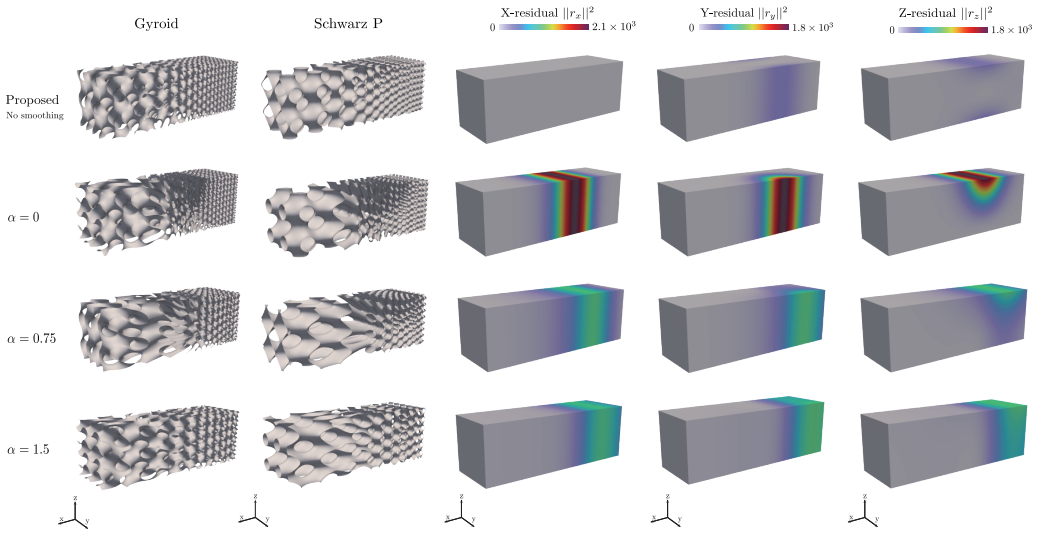
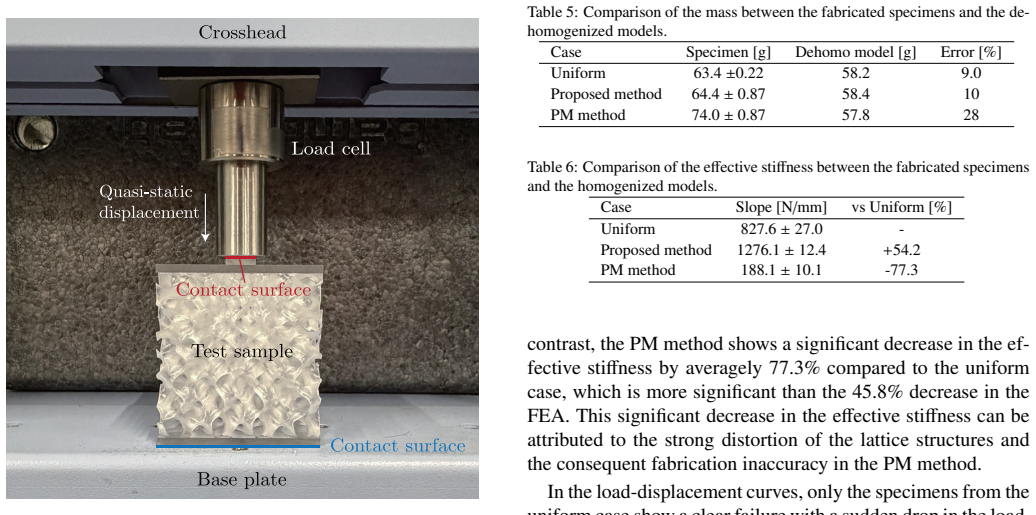
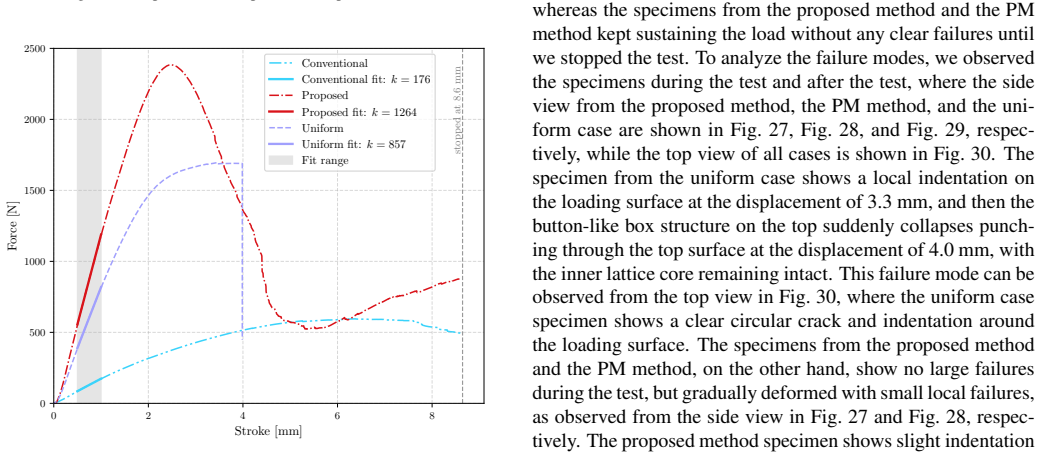
This paper presents a homogenized topology optimization (TO) method for spatially optimizing cell-size distribution of triply-periodic minimal surface (TPMS) structures, with high accuracy in the optimized structural response after de-homogenization. To achieve this, we introduce a novel de-homogenization technique that directly minimizes the difference between the wavenumbers obtained from the target and actual size distributions. This minimization problem is efficiently solved as a typical Poisson's equation utilizing the discrete cosine transform. We first verify the proposed de-homogenization method through numerical examples, showcasing its capability in significantly reducing the known distortion of the de-homogenized TPMS structures from the conventional periodic modulation (PM) method. Then, we apply the proposed method to a stiffness maximization problem, to demonstrate its effectiveness in improving the structural response compared to the PM method. The proposed method successfully reduced the distortion of the de-homogenized structures compared to the PM method, leading to 0.8% difference in the strain energy compared to the homogenized model, as opposed to 63.6% difference in the PM method. The optimized structure from the proposed method shows a significant improvement in the strain energy by 50.1% compared to the uniform case in the FE analysis on the de-homogenized models, while the PM method results in a significant decrease of 45.8%. The experimental validation shows that the effective stiffness of the optimized structure from the proposed method is 54.2% higher than that of the uniform case, while the PM method results in a significant decrease by 77.3%. These results exhibit the proposed method effectively increases the accuracy of the de-homogenization, thereby maximizing the potential of the homogenized TO for the spatial cell-size optimization of TPMS structures.
Editorial analysis
A structured set of objections, weighed in public.
Referee Report
Summary. The paper proposes a de-homogenization method for TPMS structures in homogenized topology optimization that minimizes the difference between target and realized cell-size wavenumbers by recasting the problem as a Poisson equation solved via the discrete cosine transform. Numerical verification and a stiffness-maximization example are used to show that the approach reduces distortion relative to the periodic modulation (PM) baseline, yielding a strain-energy difference of only 0.8% from the homogenized prediction (versus 63.6% for PM), a 50.1% strain-energy gain over the uniform case in FE analysis, and a 54.2% experimental stiffness increase.
Significance. If the reported mechanical fidelity holds, the method would meaningfully improve the reliability of cell-size optimization for TPMS lattices, closing the gap between homogenized predictions and realizable geometries. The DCT-based Poisson solver provides an efficient, parameter-light implementation, and the concrete error reductions together with both FE and experimental validation constitute a tangible advance for practical use of homogenization-based design of cellular structures.
major comments (2)
- [§3.2] §3.2 (Poisson formulation and DCT solve): the wavenumber-minimization objective does not explicitly constrain local surface curvature, wall-thickness continuity, or triple-line connectivity; because TPMS effective stiffness depends on these geometric features in addition to local period, the manuscript must demonstrate (via a direct comparison or error map) that the resulting implicit surfaces remain valid minimal surfaces without introducing necks or intersections that would otherwise affect global strain energy.
- [§4.3] §4.3 (FE analysis on de-homogenized models): the central 0.8% strain-energy agreement is load-bearing for the claim of improved accuracy, yet the text provides no mesh-convergence study or description of how the implicit surface is discretized into a volume mesh; without these, it remains possible that the reported agreement is partly an artifact of discretization rather than a consequence of wavenumber matching.
minor comments (2)
- [§3] The definition of wavenumber and its relation to the cell-size field should be stated explicitly with an equation in the method section to prevent ambiguity when comparing target and realized distributions.
- [Figures 4-7] Figure captions in the numerical and experimental sections would benefit from explicit mention of the error metric (strain-energy difference) and the number of realizations used for the PM baseline.
Simulated Author's Rebuttal
We thank the referee for the constructive comments, which help clarify important validation aspects of the de-homogenization approach. We address each major comment below and will incorporate the requested demonstrations and studies in the revised manuscript.
read point-by-point responses
-
Referee: [§3.2] §3.2 (Poisson formulation and DCT solve): the wavenumber-minimization objective does not explicitly constrain local surface curvature, wall-thickness continuity, or triple-line connectivity; because TPMS effective stiffness depends on these geometric features in addition to local period, the manuscript must demonstrate (via a direct comparison or error map) that the resulting implicit surfaces remain valid minimal surfaces without introducing necks or intersections that would otherwise affect global strain energy.
Authors: We agree that the wavenumber objective does not explicitly enforce curvature or connectivity constraints, and that these geometric features influence TPMS stiffness. Our numerical examples already indicate that the resulting implicit surfaces preserve minimal-surface character without necks or intersections, as reflected in the 0.8% strain-energy agreement. To provide the requested direct evidence, we will add to §3.2 a side-by-side comparison of mean-curvature distributions, wall-thickness continuity metrics, and triple-line connectivity checks between the proposed method and the PM baseline, together with localized error maps. These additions will confirm that wavenumber matching also yields geometrically valid surfaces. revision: yes
-
Referee: [§4.3] §4.3 (FE analysis on de-homogenized models): the central 0.8% strain-energy agreement is load-bearing for the claim of improved accuracy, yet the text provides no mesh-convergence study or description of how the implicit surface is discretized into a volume mesh; without these, it remains possible that the reported agreement is partly an artifact of discretization rather than a consequence of wavenumber matching.
Authors: We concur that mesh convergence and a clear discretization description are necessary to rule out numerical artifacts. The implicit surfaces are converted to volume meshes via marching-cubes isosurfacing followed by tetrahedral refinement; however, these steps are not detailed in the current text. In the revision we will expand §4.3 with an explicit description of the meshing pipeline and a mesh-convergence study (reporting strain-energy values at successively refined element sizes) for both the proposed and PM models. The study will demonstrate that the 0.8% difference remains stable across converged meshes. revision: yes
Circularity Check
No significant circularity; de-homogenization objective is independent of reported mechanical metrics
full rationale
The paper defines its de-homogenization step as the solution of a Poisson equation (via DCT) that minimizes the L2 difference between target and realized wavenumber fields. This objective is not mathematically identical to the strain-energy or stiffness values later measured by separate FE analysis and physical experiments on the de-homogenized geometries. The reported performance deltas (0.8 % vs. 63.6 % strain-energy error, 50.1 % improvement vs. uniform) are therefore external benchmarks, not quantities forced by the wavenumber objective itself. No self-citation is invoked to justify uniqueness or to close the derivation loop, and no fitted parameter is relabeled as a prediction. The chain from homogenized TO to de-homogenized FE validation remains self-contained.
Axiom & Free-Parameter Ledger
axioms (1)
- domain assumption Homogenization theory remains valid for TPMS structures whose cell size varies smoothly in space
Reference graph
Works this paper leans on
-
[1]
M. Benedetti, A. du Plessis, R. Ritchie, M. Dallago, N. Razavi, F. Berto, Architected cellular materials: A review on their mechanical properties towards fatigue-tolerant design and fabrication, Materials Science and Engineering: R: Reports 144 (2021) 100606
work page 2021
-
[2]
C. Pan, Y . Han, J. Lu, Design and optimization of lattice structures: A review, Applied Sciences 10 (18) (2020). 23 Figure 29: Side view of the specimens from the uniform case during the compression test. The bottom length value indicates the applied displacement for each image
work page 2020
-
[3]
C. Qi, F. Jiang, S. Yang, Advanced honeycomb designs for improving mechanical properties: A review, Composites Part B: Engineering 227 (2021) 109393
work page 2021
-
[4]
N. Khan, A. Riccio, A systematic review of design for additive manufac- turing of aerospace lattice structures: Current trends and future directions, Progress in Aerospace Sciences 149 (2024) 101021
work page 2024
-
[5]
L. Yuan, S. Ding, C. Wen, Additive manufacturing technology for porous metal implant applications and triple minimal surface structures: A re- view, Bioactive Materials 4 (2019) 56–70
work page 2019
- [6]
-
[7]
M. Zhao, D. Z. Zhang, Z. Li, T. Zhang, H. Zhou, Z. Ren, Design, me- chanical properties, and optimization of bcc lattice structures with taper struts, Composite Structures 295 (2022) 115830
work page 2022
-
[8]
A. E.-M. A. Mohamed, M. Jeong, R. S. Sheridan, M. M. Attallah, En- abling high efficiency magnetic refrigeration using laser powder bed fu- sion of porous lace(fe,mn,si)13 structures, Additive Manufacturing 51 (2022) 102620
work page 2022
-
[9]
M. Shimoda, M. Hikasa, M. A. Ali, Micropore shape optimization of porous laminated shell structures, Additive Manufacturing 69 (2023) 103530
work page 2023
-
[10]
O. Al-Ketan, R. K. Abu Al-Rub, Multifunctional mechanical metamateri- als based on triply periodic minimal surface lattices, Advanced Engineer- ing Materials 21 (10) (2019) 1900524
work page 2019
-
[11]
J. Feng, J. Fu, X. Yao, Y . He, Triply periodic minimal surface (tpms) porous structures: from multi-scale design, precise additive manufactur- ing to multidisciplinary applications, International Journal of Extreme Manufacturing 4 (2) (2022) 022001
work page 2022
-
[12]
N. Qiu, J. Zhang, C. Li, Y . Shen, J. Fang, Mechanical properties of three- dimensional functionally graded triply periodic minimum surface struc- tures, International Journal of Mechanical Sciences 246 (2023) 108118
work page 2023
-
[13]
H. Jia, H. Lei, P. Wang, J. Meng, C. Li, H. Zhou, X. Zhang, D. Fang, An experimental and numerical investigation of compressive response of designed schwarz primitive triply periodic minimal surface with non- uniform shell thickness, Extreme Mechanics Letters 37 (2020) 100671
work page 2020
-
[14]
X. Yan, C. Rao, L. Lu, A. Sharf, H. Zhao, B. Chen, Strong 3d printing by tpms injection, IEEE Transactions on Visualization and Computer Graph- ics 26 (10) (2020) 3037–3050
work page 2020
-
[15]
J. Hu, S. Wang, Y . Wang, F. Li, Z. Luo, A lightweight methodology of 3d printed objects utilizing multi-scale porous structures, The Visual Com- puter 35 (6) (2019) 949–959
work page 2019
- [16]
-
[17]
I. Maskery, A. Aremu, L. Parry, R. Wildman, C. Tuck, I. Ashcroft, Ef- fective design and simulation of surface-based lattice structures featuring volume fraction and cell type grading, Materials & Design 155 (2018) 220–232
work page 2018
- [18]
-
[19]
F. P. Melchels, K. Bertoldi, R. Gabbrielli, A. H. Velders, J. Feijen, D. W. Grijpma, Mathematically defined tissue engineering sca ffold architec- tures prepared by stereolithography, Biomaterials 31 (27) (2010) 6909– 6916
work page 2010
-
[20]
F. Chen, X. Jiang, C. Lu, Y . Wang, P. Wen, Q. Shen, Heat transfer ef- ficiency enhancement of gyroid heat exchanger based on multidimen- sional gradient structure design, International Communications in Heat and Mass Transfer 149 (2023) 107127
work page 2023
-
[21]
S. Yu, J. Sun, J. Bai, Investigation of functionally graded tpms structures fabricated by additive manufacturing, Materials & Design 182 (2019) 108021
work page 2019
-
[22]
O. Al-Ketan, D.-W. Lee, R. Rowshan, R. K. Abu Al-Rub, Functionally graded and multi-morphology sheet tpms lattices: Design, manufactur- ing, and mechanical properties, Journal of the Mechanical Behavior of Biomedical Materials 102 (2020) 103520
work page 2020
-
[23]
H. Wang, D. Tan, Z. Liu, H. Yin, G. Wen, On crashworthiness of novel porous structure based on composite tpms structures, Engineering Struc- tures 252 (2022) 113640
work page 2022
-
[24]
H. Xi, Z. Zhou, H. Zhang, S. Huang, H. Xiao, Multi-morphology tpms structures with multi-stage yield stress platform and multi-level energy absorption: Design, manufacturing, and mechanical properties, Engineer- ing Structures 294 (2023) 116733
work page 2023
-
[25]
H. Ning, W. Huang, G. Tang, High-e fficiency multi-scale strategy for tpms-based conformal heterogeneous structures, Additive Manufacturing 106 (2025) 104808
work page 2025
-
[26]
F. Ren, C. Zhang, W. Liao, T. Liu, D. Li, X. Shi, W. Jiang, C. Wang, J. Qi, Y . Chen, Z. Wang, Transition boundaries and stiffness optimal design for multi-tpms lattices, Materials & Design 210 (2021) 110062
work page 2021
-
[27]
F. Liu, Q. Ran, M. Zhao, T. Zhang, D. Z. Zhang, Z. Su, Additively man- ufactured continuous cell-size gradient porous sca ffolds: Pore character- istics, mechanical properties and biological responses in vitro, Materials 13 (11) (2020)
work page 2020
-
[28]
S. Gao, S. Qu, J. Ding, H. Liu, X. Song, Influence of cell size and its gradi- ent on thermo-hydraulic characteristics of triply periodic minimal surface 24 Figure 30: Top view of the test specimens before and 20 days after the compression test. Figure A.31: Thickness specification for the solid wall. Light blue regions rep- resent the solid wall, and the...
work page 2023
-
[29]
F. Caiazzo, V . Alfieri, D. G. Guillen, A. Fabbricatore, Metal function- ally graded gyroids: additive manufacturing, mechanical properties, and simulation, The International Journal of Advanced Manufacturing Tech- nology 123 (7) (2022)
work page 2022
-
[30]
M. P. Bendsøe, O. Sigmund, Topology optimization: Theory, Methods and Applications, Springer, 2003
work page 2003
-
[31]
J. Hu, S. Wang, B. Li, F. Li, Z. Luo, L. Liu, E fficient representation and optimization for tpms-based porous structures, IEEE Transactions on Vi- sualization and Computer Graphics 28 (7) (2022) 2615–2627
work page 2022
-
[32]
T. H. Nguyen, G. H. Paulino, J. Song, C. H. Le, A computational paradigm for multiresolution topology optimization (mtop), Structural and Multidisciplinary Optimization 41 (4) (2010) 525–539
work page 2010
-
[33]
S. Wang, Y . Jiang, J. Hu, X. Fan, Z. Luo, Y . Liu, L. Liu, E fficient rep- resentation and optimization of tpms-based porous structures for 3d heat dissipation, Computer-Aided Design 142 (2022) 103123
work page 2022
-
[34]
H. Ning, W. Huang, G. Tang, Data-driven lightweight and robust design of hybrid tpms structures, Additive Manufacturing 118 (2026) 105106
work page 2026
-
[35]
M. P. Bendsøe, N. Kikuchi, Generating optimal topologies in structural design using a homogenization method, Computer Methods in Applied Mechanics and Engineering 71 (2) (1988) 197–224
work page 1988
-
[36]
D. Li, N. Dai, Y . Tang, G. Dong, Y . F. Zhao, Design and optimization of graded cellular structures with triply periodic level surface-based topo- logical shapes, Journal of Mechanical Design 141 (7) (2019) 071402
work page 2019
-
[37]
N. Str ¨omberg, Optimal grading of tpms-based lattice structures with transversely isotropic elastic bulk properties, Engineering Optimization 53 (11) (2021) 1871–1883
work page 2021
-
[38]
Y . Feng, T. Huang, Y . Gong, P. Jia, Stiffness optimization design for tpms architected cellular materials, Materials & Design 222 (2022) 111078
work page 2022
-
[39]
M. Zhao, X. Li, D. Z. Zhang, W. Zhai, Tpms-based interpenetrating lattice structures: Design, mechanical properties and multiscale optimization, International Journal of Mechanical Sciences 244 (2023) 108092
work page 2023
-
[40]
N. Str ¨omberg, A new multi-scale topology optimization framework for optimal combinations of macro-layouts and local gradings of tpms-based lattice structures, Mechanics Based Design of Structures and Machines 52 (1) (2024) 257–274
work page 2024
-
[41]
Z. Men, W. Chen, Q. Li, S. Liu, Topology optimization of the iwp triply periodic minimal surfaces (tpms) heat sink based on porous media e ffec- tive model, International Journal of Heat and Mass Transfer 240 (2025) 126657
work page 2025
-
[42]
F. Liu, Z. Mao, P. Zhang, D. Z. Zhang, J. Jiang, Z. Ma, Functionally graded porous scaffolds in multiple patterns: New design method, physi- cal and mechanical properties, Materials & Design 160 (2018) 849–860
work page 2018
-
[43]
L. Tian, B. Sun, X. Yan, A. Sharf, C. Tu, L. Lu, Continuous transitions of triply periodic minimal surfaces, Additive Manufacturing 84 (2024) 104105
work page 2024
-
[44]
X. Wang, Y . Zhong, Optimization design method of variable-period tpms structures based on jacobian matrix, SSRN preprint SSRN:5802042 (2025)
work page 2025
-
[45]
A. Drago, M.-J. Pindera, Micro-macromechanical analysis of heteroge- neous materials: Macroscopically homogeneous vs periodic microstruc- tures, Composites Science and Technology 67 (6) (2007) 1243–1263
work page 2007
-
[46]
B. Bourdin, Filters in topology optimization, International Journal for Nu- merical Methods in Engineering 50 (9) (2001) 2143–2158
work page 2001
-
[47]
N. Mitsuhashi, K. Fujieda, T. Tamura, S. Kawamoto, T. Takagi, K. Okubo, Bodyparts3d: 3d structure database for anatomical concepts, Nucleic Acids Research 37 (2008) D782–D785
work page 2008
-
[48]
G. Turk, M. Levoy, Zippered polygon meshes from range images, in: Pro- ceedings of the 21st Annual Conference on Computer Graphics and Inter- 25 active Techniques, SIGGRAPH ’94, Association for Computing Machin- ery, New York, NY , USA, 1994, pp. 311–318
work page 1994
-
[49]
W. E. Lorensen, H. E. Cline, Marching cubes: A high resolution 3d sur- face construction algorithm, SIGGRAPH Comput. Graph. 21 (4) (1987) 163–169
work page 1987
-
[50]
K. Svanberg, The method of moving asymptotes-—a new method for structural optimization, International Journal for Numerical Methods in Engineering 24 (2) (1987) 359–373
work page 1987
-
[51]
D. C. Ghiglia, L. A. Romero, Robust two-dimensional weighted and un- weighted phase unwrapping that uses fast transforms and iterative meth- ods, J. Opt. Soc. Am. A 11 (1) (1994) 107–117
work page 1994
- [52]
discussion (0)
Sign in with ORCID, Apple, or X to comment. Anyone can read and Pith papers without signing in.