Topology optimization of two-fluid turbulent heat exchangers: A Darcy flow-based multifidelity approach
Pith reviewed 2026-05-08 05:58 UTC · model grok-4.3
The pith
A calibrated Darcy low-fidelity model enables topology optimization of turbulent two-fluid heat exchangers that reach up to 22 percent higher performance.
A machine-rendered reading of the paper's core claim, the machinery that carries it, and where it could break.
Core claim
The central claim is that a multifidelity topology optimization framework, built around a Darcy flow-based low-fidelity model calibrated to Reynolds-averaged Navier-Stokes high-fidelity results, successfully generates high-performance double-pipe heat exchanger topologies under turbulent conditions. The resulting designs promote enhanced fluid mixing and greater heat-exchange surface area while preserving streamlined flow paths that limit pressure losses, yielding up to 22 percent higher performance evaluation criterion than a reference design enhanced by twisted tape insertion.
What carries the argument
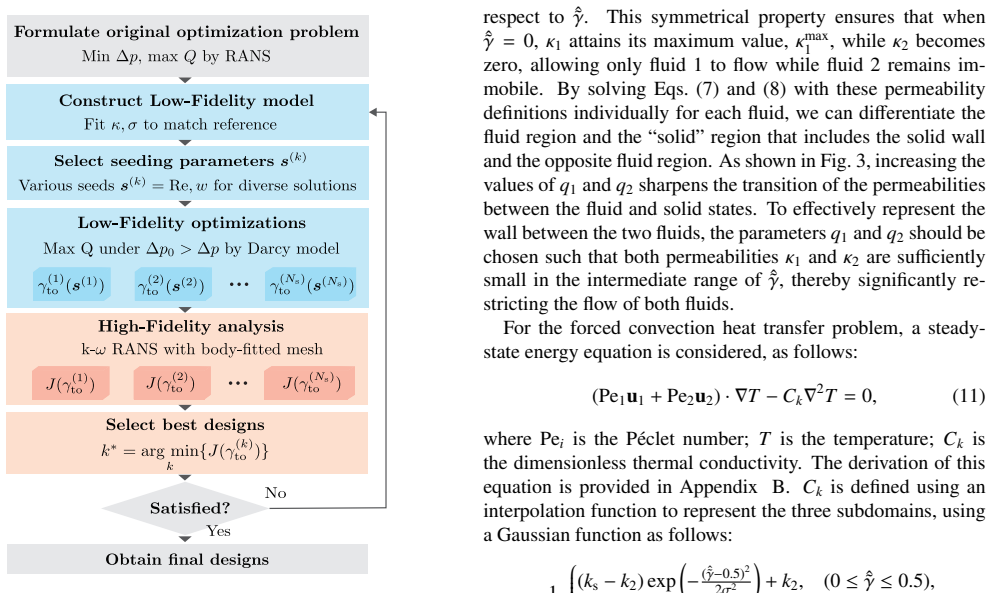
The multifidelity topology optimization framework that runs design search on a calibrated Darcy flow low-fidelity model and performs final performance assessment on the high-fidelity RANS model.
If this is right
- Optimized designs improve overall heat transfer coefficients while keeping pressure drops manageable.
- Performance reaches up to 22 percent higher PEC than the conventional twisted-tape reference.
- Improvements arise from topologies that increase fluid mixing and heat-exchange surface area without creating excessive flow resistance.
- Varying inlet velocities and objective trade-off weights produces a range of distinct, high-performing geometries.
Where Pith is reading between the lines
- The method could cut the computational expense of heat-exchanger design by confining expensive high-fidelity runs to the final verification step.
- Similar calibrated low-fidelity models might accelerate topology optimization in other turbulent-flow problems such as duct flows or mixing devices.
- The discovered topologies indicate that non-intuitive flow paths found by optimization can outperform traditional insert-based enhancements.
Load-bearing premise
The calibrated low-fidelity Darcy model correctly ranks the relative performance of different topologies even when its absolute pressure-drop predictions differ substantially from the high-fidelity model.
What would settle it
High-fidelity re-evaluation of the optimized topologies that shows no improvement, or a decline, in performance evaluation criterion relative to the twisted-tape reference design would falsify the central claim.
Figures


read the original abstract
This paper presents a topology optimization method for designing two-fluid heat exchangers under turbulent conditions using a Darcy flow-based low-fidelity (LF) model. The LF model is calibrated against a high-fidelity (HF) model based on the Reynolds-averaged Navier-Stokes (RANS) equations to increase the accuracy of predictions for fluid flow and heat transfer characteristics. Since the discrepancies between the LF and HF models can be significant, particularly for pressure drops, a multifidelity topology optimization framework is adopted to leverage the strengths of both models. Using the calibrated LF model, we perform topology optimization for various inlet velocities in the boundary conditions and trade-off parameters in the objective function to obtain diverse optimized designs. The optimized designs are then evaluated using the HF model to assess their performance with higher accuracy. The results demonstrate that the optimized designs significantly improve overall heat transfer coefficients while maintaining manageable pressure drops, achieving up to a 22% higher performance evaluation criterion (PEC) compared to a reference design enhanced by conventional twisted tape insertion. The improvements are attributed to the optimized configurations that promote enhanced fluid mixing and increased surface area for heat exchange, yet maintain streamlined flow paths to minimize pressure losses. Overall, the proposed topology optimization method using the Darcy flow-based LF model proves effective in designing high-performance double pipe heat exchangers, showcasing the potential of the multifidelity approach in overcoming the challenges of optimizing heat exchangers under turbulent flow conditions.
Editorial analysis
A structured set of objections, weighed in public.
Referee Report
Summary. The manuscript presents a multifidelity topology optimization framework for two-fluid turbulent heat exchangers. A Darcy flow-based low-fidelity model is calibrated against a high-fidelity RANS model. Topology optimization is performed with the calibrated LF model for varying inlet velocities and objective trade-off parameters; the resulting designs are re-evaluated with the HF model. The abstract reports that the optimized topologies achieve up to 22% higher performance evaluation criterion (PEC) than a reference design using conventional twisted-tape insertion, attributing gains to enhanced mixing and surface area while controlling pressure losses.
Significance. If the HF re-evaluations are shown to be robust and the LF-to-HF ranking preservation is demonstrated, the approach could provide a practical route to high-performance turbulent heat-exchanger designs at reduced computational cost, with relevance to energy and thermal systems engineering.
major comments (2)
- [Abstract] Abstract: the central performance claim of a 22% PEC gain is stated without any quantitative calibration metrics, error bars, validation plots, or description of the post-optimization HF evaluation protocol (e.g., mesh resolution, turbulence model settings, or convergence criteria for the RANS solves). This absence makes it impossible to judge whether the reported improvement is statistically meaningful or reproducible.
- [Method / Results] The multifidelity procedure (LF optimization followed by HF verification) rests on the unverified assumption that LF calibration preserves the relative ordering of candidate topologies under the HF pressure-drop metric. Because the abstract explicitly notes significant LF-HF discrepancies in pressure drop and the optimizer never sees HF pressure-drop values, it is possible that the reported PEC gains would shrink or reverse if a true HF-optimal design were used as the comparator; no evidence (e.g., correlation plots or rank-preservation statistics across the design ensemble) is supplied to rule this out.
minor comments (1)
- [Abstract] The abstract would be clearer if it briefly indicated the calibration procedure (e.g., which quantities were matched and over what range of Reynolds numbers).
Simulated Author's Rebuttal
We thank the referee for the constructive comments, which highlight important aspects of validation and robustness in our multifidelity framework. We address each major comment point by point below, with revisions to the manuscript where appropriate to strengthen the presentation of calibration details and rank preservation evidence.
read point-by-point responses
-
Referee: [Abstract] Abstract: the central performance claim of a 22% PEC gain is stated without any quantitative calibration metrics, error bars, validation plots, or description of the post-optimization HF evaluation protocol (e.g., mesh resolution, turbulence model settings, or convergence criteria for the RANS solves). This absence makes it impossible to judge whether the reported improvement is statistically meaningful or reproducible.
Authors: We agree that the abstract, as a concise summary, does not include quantitative calibration metrics, error bars, or HF protocol details. These are provided in the main text: calibration metrics (relative L2 errors for pressure drop and heat transfer) and validation plots appear in Section 3, while the HF RANS evaluation protocol (mesh resolution of 2.5 million cells, k-epsilon turbulence model, and convergence to 10^-6 residuals) is described in Section 2.3. To address the concern directly, we have revised the abstract to include a brief clause noting the LF calibration against HF data and that all performance claims are based on HF re-evaluations, with full quantitative details and protocols referenced in the manuscript body. revision: yes
-
Referee: [Method / Results] The multifidelity procedure (LF optimization followed by HF verification) rests on the unverified assumption that LF calibration preserves the relative ordering of candidate topologies under the HF pressure-drop metric. Because the abstract explicitly notes significant LF-HF discrepancies in pressure drop and the optimizer never sees HF pressure-drop values, it is possible that the reported PEC gains would shrink or reverse if a true HF-optimal design were used as the comparator; no evidence (e.g., correlation plots or rank-preservation statistics across the design ensemble) is supplied to rule this out.
Authors: We acknowledge the significant LF-HF discrepancies in pressure drop noted in the manuscript and the resulting need to verify rank preservation. The optimization uses the calibrated LF model for efficiency, but every candidate topology is re-evaluated with the HF RANS model, and the reported 22% PEC gain is computed exclusively from these HF results relative to the HF-evaluated twisted-tape reference (not an HF-optimized design). To directly address the concern, we have added correlation plots of LF vs. HF pressure drop and heat transfer predictions, along with rank-preservation statistics (Spearman's rho > 0.85) across the full ensemble of optimized designs and intermediate topologies. These confirm that the LF model sufficiently preserves ordering for identifying high-performing candidates under HF metrics. A full HF topology optimization remains computationally infeasible and is outside the scope of the multifidelity method, but the HF-verified improvements over the conventional reference are robust and reproducible as presented. revision: partial
Circularity Check
No significant circularity; HF verification step is independent of LF calibration
full rationale
The paper calibrates the Darcy LF model to HF RANS data, optimizes topologies using the calibrated LF model, and then directly evaluates the resulting designs in the HF model to report PEC improvements. The central performance claims (e.g., 22% PEC gain) are measured in the HF model rather than being outputs of the LF equations or calibration parameters by construction. No self-definitional relations, fitted inputs presented as predictions, or load-bearing self-citation chains appear in the derivation. The framework is self-contained against the external HF benchmark.
Axiom & Free-Parameter Ledger
free parameters (2)
- trade-off parameters in objective function
- calibration parameters for LF-to-HF matching
axioms (2)
- domain assumption Darcy flow approximation can represent turbulent flow and heat transfer after calibration
- standard math RANS equations provide sufficiently accurate reference data for calibration and final evaluation
Reference graph
Works this paper leans on
- [1]
-
[2]
S. A. Marzouk, M. M. Abou Al-Sood, E. M. S. El-Said, M. M. Younes, M. K. El-Fakharany, A comprehensive review of methods of heat trans- fer enhancement in shell and tube heat exchangers, Journal of Thermal Analysis and Calorimetry 148 (15) (2023)
work page 2023
-
[3]
E. Tavousi, N. Perera, D. Flynn, R. Hasan, Heat transfer and fluid flow characteristics of the passive method in double tube heat exchangers: A critical review, International Journal of Thermofluids 17 (2023) 100282
work page 2023
-
[4]
B. K. Dandoutiya, A. Kumar, W-cut twisted tape’s e ffect on the thermal performance of a double pipe heat exchanger: A numerical study, Case Studies in Thermal Engineering 34 (2022) 102031
work page 2022
-
[5]
M. Hazbehian, H. Maddah, H. Mohammadiun, M. Alizadeh, Experimen- tal investigation of heat transfer augmentation inside double pipe heat ex- changer equipped with reduced width twisted tapes inserts using poly- meric nanofluid, Heat and Mass Transfer 52 (11) (2016) 2515–2529
work page 2016
-
[6]
A. Barzegar, D. J. Vahid, Numerical study on heat transfer enhancement and flow characteristics of double pipe heat exchanger fitted with rectan- gular cut twisted tape, Heat and Mass Transfer 55 (12) (2019)
work page 2019
-
[7]
A. El Maakoul, M. El Metoui, A. Ben Abdellah, S. Saadeddine, M. Meziane, Numerical investigation of thermohydraulic performance of air to water double-pipe heat exchanger with helical fins, Applied Ther- mal Engineering 127 (2017) 127–139
work page 2017
-
[8]
J. Moya-Rico, A. Molina, J. C ´orcoles, J. Almendros-Ib´a˜nez, Experimen- tal characterization of a double tube heat exchanger with di fferent cor- rugated tubes and shells, International Journal of Thermal Sciences 179 (2022) 107640
work page 2022
- [9]
-
[10]
M. P. Bendsøe, N. Kikuchi, Generating optimal topologies in structural design using a homogenization method, Computer Methods in Applied Mechanics and Engineering 71 (2) (1988) 197–224
work page 1988
-
[11]
M. P. Bendsøe, O. Sigmund, Topology optimization: Theory, Methods and Applications, Springer, 2003
work page 2003
-
[12]
T. Borrvall, J. Petersson, Topology optimization of fluids in Stokes flow, International Journal for Numerical Methods in Fluids 41 (1) (2003) 77– 107
work page 2003
-
[13]
A. Gersborg-Hansen, O. Sigmund, R. B. Haber, Topology optimization of channel flow problems, Structural and Multidisciplinary Optimization 30 (3) (2005) 181–192
work page 2005
-
[14]
S. Lin, L. Zhao, J. K. Guest, T. P. Weihs, Z. Liu, Topology optimiza- tion of fixed-geometry fluid diodes, Journal of Mechanical Design 137 (8) (2015)
work page 2015
-
[15]
T. Matsumori, T. Kondoh, A. Kawamoto, T. Nomura, Topology optimiza- tion for fluid-thermal interaction problems under constant input power, Structural and Multidisciplinary Optimization 47 (4) (2013) 571–581
work page 2013
-
[16]
J. Alexandersen, N. Aage, C. S. Andreasen, O. Sigmund, Topology op- timisation for natural convection problems, International Journal for Nu- merical Methods in Fluids 76 (10) (2014) 699–721
work page 2014
-
[17]
S. B. Dilgen, C. B. Dilgen, D. R. Fuhrman, O. Sigmund, B. S. Lazarov, Density based topology optimization of turbulent flow heat transfer sys- tems, Structural and Multidisciplinary Optimization 57 (5) (2018) 1905– 1918
work page 2018
-
[18]
H. Li, X. Ding, F. Meng, D. Jing, M. Xiong, Optimal design and thermal modelling for liquid-cooled heat sink based on multi-objective topology optimization: An experimental and numerical study, International Journal of Heat and Mass Transfer 144 (2019) 118638
work page 2019
-
[19]
J. Alexandersen, C. S. Andreasen, A review of topology optimisation for fluid-based problems, Fluids 5 (1) (2020) 29
work page 2020
-
[20]
P. Papazoglou, Topology optimization of heat exchangers, Master’s the- sis, Delft University of Technology (2015)
work page 2015
-
[21]
R. Tawk, B. Ghannam, M. Nemer, Topology optimization of heat and mass transfer problems in two fluids—one solid domains, Numerical Heat Transfer, Part B: Fundamentals 76 (3) (2019) 130–151
work page 2019
-
[22]
H. Kobayashi, K. Yaji, S. Yamasaki, K. Fujita, Topology design of two-fluid heat exchange, Structural and Multidisciplinary Optimization (2020). doi:10.1007/s00158-020-02736-8
-
[23]
L. C. Høghøj, D. R. Nørhave, J. Alexandersen, O. Sigmund, C. S. An- dreasen, Topology optimization of two fluid heat exchangers, Interna- tional Journal of Heat and Mass Transfer 163 (2020) 120543
work page 2020
-
[24]
A. Clausen, E. Andreassen, O. Sigmund, Topology optimization of 3D shell structures with porous infill, Acta Mechanica Sinica 33 (4) (2017) 778–791
work page 2017
- [25]
-
[26]
N. Galanos, E. M. Papoutsis-Kiachagias, K. C. Giannakoglou, Y . Kondo, K. Tanimoto, Synergistic use of adjoint-based topology and shape opti- mization for the design of bi-fluid heat exchangers, Structural and Multi- disciplinary Optimization 65 (245) (2022)
work page 2022
-
[27]
N. Galanos, E. Papoutsis-Kiachagias, K. Giannakoglou, A continuous ad- joint cut-cell formulation for topology optimization of bi-fluid heat ex- changers, International Journal of Numerical Methods for Heat & Fluid Flow 35 (6) (2025) 2045–2083
work page 2025
-
[28]
S. Sun, B. Rankouhi, D. J. Thoma, I. W. Jentz, M. H. Anderson, X. Qian, 3D topology optimization and additive manufacturability of two-fluid heat exchangers, International Journal of Heat and Mass Transfer 236 (2025) 126299
work page 2025
-
[29]
S. Sun, T. A. Moreira, B. Rankouhi, X. Yu, I. W. Jentz, D. J. Thoma, M. H. Anderson, X. Qian, Topology optimization, additive manufacturing and thermohydraulic testing of high-temperature heat exchangers, Inter- national Journal of Heat and Mass Transfer 242 (2025) 126809
work page 2025
-
[30]
V . Pimanov, A. T. R. Guibert, J.-P. Sabino, M. Stoia, H. A. Kim, Sparse narrow-band topology optimization for large-scale thermal-fluid appli- cations, Computer Methods in Applied Mechanics and Engineering 450 (2026) 118655
work page 2026
-
[31]
M. Noorbakhsh, M. Zaboli, S. S. M. Ajarostaghi, Numerical evaluation of the effect of using twisted tapes as turbulator with various geometries in both sides of a double-pipe heat exchanger, Journal of Thermal Analysis and Calorimetry 140 (3) (2020) 1341–1353
work page 2020
-
[32]
X. Zhao, M. Zhou, O. Sigmund, C. S. Andreasen, A “poor man’s ap- proach” to topology optimization of cooling channels based on a Darcy flow model, International Journal of Heat and Mass Transfer 116 (2018) 1108–1123
work page 2018
-
[33]
S. Kambampati, H. A. Kim, Level set topology optimization of cooling channels using the Darcy flow model, Structural and Multidisciplinary Optimization 61 (2020) 1345–1361
work page 2020
-
[34]
J. Asmussen, J. Alexandersen, O. Sigmund, C. S. Andreasen, A “poor man’s” approach to topology optimization of natural convection prob- lems, Structural and Multidisciplinary Optimization 59 (4) (2019) 1105– 1124
work page 2019
-
[35]
N. Pollini, O. Sigmund, C. S. Andreasen, J. Alexandersen, A “poor man’s” approach for high-resolution three-dimensional topology design for natural convection problems, Advances in Engineering Software 140 (2020) 102736
work page 2020
-
[36]
K. Yaji, S. Yamasaki, K. Fujita, Multifidelity design guided by topology optimization, Structural and Multidisciplinary Optimization 61 (3) (2020) 20 1071–1085
work page 2020
- [37]
-
[38]
Y . Yuan, Q. Yang, H. Ke, W.-Q. Tao, L. Chen, Multi-fidelity flow boiling heat transfer topology optimization for arbitrary design domain, Interna- tional Journal of Heat and Mass Transfer 257 (2026) 128205
work page 2026
-
[39]
B. Bourdin, Filters in topology optimization, International Journal for Nu- merical Methods in Engineering 50 (9) (2001) 2143–2158
work page 2001
-
[40]
A. Kawamoto, T. Matsumori, S. Yamasaki, T. Nomura, T. Kondoh, S. Nishiwaki, Heaviside projection based topology optimization by a PDE-filtered scalar function, Structural and Multidisciplinary Optimiza- tion 44 (1) (2011) 19–24
work page 2011
- [41]
-
[42]
J. Alexandersen, A detailed introduction to density-based topology opti- misation of fluid flow problems with implementation in MATLAB, Struc- tural and Multidisciplinary Optimization 66 (1) (2023) 12
work page 2023
-
[43]
P. A. Davidson, Turbulence: An Introduction for Scientists and Engineers, Oxford University Press, 2004
work page 2004
-
[44]
M. Langelaar, An additive manufacturing filter for topology optimiza- tion of print-ready designs, Structural and Multidisciplinary Optimization 55 (3) (2017) 871–883
work page 2017
-
[45]
K. Svanberg, The method of moving asymptotes-—a new method for structural optimization, International Journal for Numerical Methods in Engineering 24 (2) (1987) 359–373
work page 1987
-
[46]
R. M. Manglik, A. E. Bergles, Heat transfer and pressure drop correla- tions for twisted-tape inserts in isothermal tubes: Part II—transition and turbulent flows, Journal of Heat Transfer 115 (4) (1993) 890–896
work page 1993
-
[47]
F. R. Menter, Two-equation eddy-viscosity turbulence models for engi- neering applications, AIAA Journal 32 (8) (1994) 1598–1605
work page 1994
-
[48]
B. E. Launder, G. J. Reece, W. Rodi, Progress in the development of a reynolds-stress turbulence closure, Journal of Fluid Mechanics 68 (3) (1975) 537–566
work page 1975
-
[49]
K. Yaji, S. Yamasaki, K. Fujita, Data-driven multifidelity topology de- sign using a deep generative model: Application to forced convection heat transfer problems, Computer methods in applied mechanics and en- gineering 388 (114284) (2022). 21
work page 2022
discussion (0)
Sign in with ORCID, Apple, or X to comment. Anyone can read and Pith papers without signing in.