Recognition: unknown
Does Synthetic Data Help? Empirical Evidence from Deep Learning Time Series Forecasters
Pith reviewed 2026-05-08 14:12 UTC · model grok-4.3
The pith
Synthetic data augmentation improves time series forecasts only for channel-mixing architectures and in selected low-resource cases.
A machine-rendered reading of the paper's core claim, the machinery that carries it, and where it could break.
Core claim
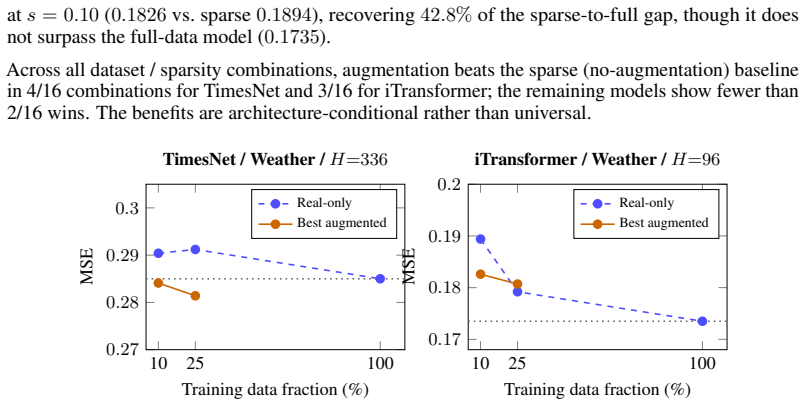
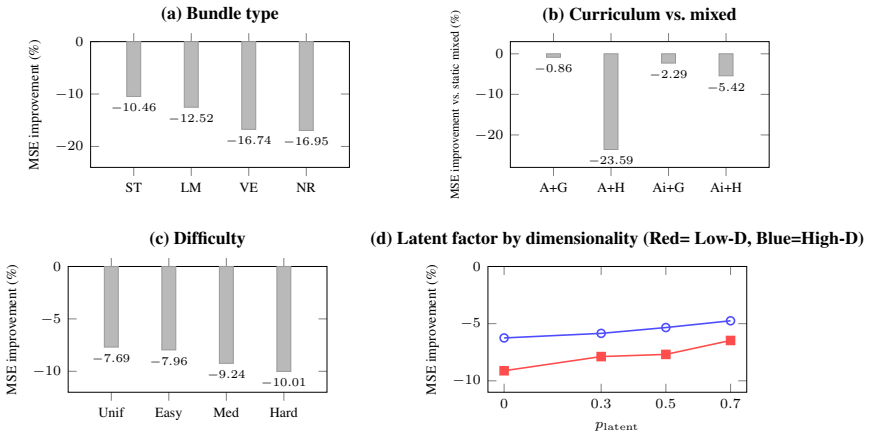
Through more than four thousand runs the study establishes that synthetic time series augmentation yields architecture-dependent results. Channel-mixing models such as TimesNet and iTransformer improve in the majority of trials and can exceed full-data baselines when real data is reduced to ten percent on certain datasets. Channel-independent models such as DLinear and PatchTST are degraded in every tested configuration. Among the four generators examined only the Seasonal-Trend variant helps reliably across benchmarks, while hard curriculum switching raises mean squared error by twenty-four percent. Averaged over all architectures and settings, augmentation increases error in sixty-seven of
What carries the argument
The distinction between channel-mixing and channel-independent architectures as the decisive factor controlling whether synthetic time series signals raise or lower forecast accuracy.
If this is right
- Channel-mixing architectures should be paired with synthetic augmentation to obtain performance gains in most settings.
- Channel-independent architectures should avoid synthetic augmentation because it consistently raises forecast error.
- Only the Seasonal-Trend generator can be used with confidence across the tested benchmarks.
- Gradual annealing schedules must replace hard curriculum switching to prevent large error increases.
- Low-resource regimes offer the largest potential payoff, where augmentation can let suitable models surpass full-data baselines.
Where Pith is reading between the lines
- Model selection and augmentation strategy should be chosen together rather than sequentially.
- The conditional benefit pattern may extend to other sequential prediction tasks outside the seven datasets examined.
- Practitioners facing new data regimes should run small validation trials before committing to augmentation.
- Future generators could be designed to exploit the mixing bias that appears to drive the observed gains.
Load-bearing premise
The seven datasets, five architectures, four synthetic generators, and nine experiment groups are representative enough of real-world time series forecasting to support general guidelines on synthetic data use.
What would settle it
A new experiment on an additional dataset or architecture in which channel-independent models show net gains from augmentation or in which the Seasonal-Trend generator fails to help would contradict the reported architecture-conditional pattern.
Figures


read the original abstract
Synthetic data has transformed language model training, yet its role in time series forecasting remains poorly understood. We present a large-scale empirical study: nine experiment groups, 4,218 runs systematically evaluating synthetic time series augmentation across five architectures, four synthetic signals and seven datasets. The effect is sharply architecture-conditional: channel-mixing models (TimesNet, iTransformer) benefit in the majority of trials, while channel-independent models (DLinear, PatchTST) are consistently degraded. In selected low-resource settings the gains are striking: TimesNet trained on only 10\% of Weather data with synthetic augmentation surpasses the full-data baseline (4 of 16 sparsity-dataset combinations). Averaged across all architectures, augmentation hurts in 67\% of trials. We further find that only the Seasonal-Trend generator reliably helps across the tested benchmarks, and that hard curriculum switching is actively harmful (+24\% MSE degradation). These results provide concrete, actionable guidelines on how to use synthetic data: use synthetic augmentation with channel-mixing architectures, use gradual annealing schedules, and treat low-resource augmentation as architecture- and dataset-dependent. Code is available at \href{https://github.com/hugoiscracked/synthetic-ts/tree/main}
Editorial analysis
A structured set of objections, weighed in public.
Referee Report
Summary. The paper reports on a comprehensive empirical investigation into the utility of synthetic data for augmenting training of deep learning models for time series forecasting. It evaluates this across 4,218 runs involving five different architectures, four synthetic generators, seven real-world datasets, and varying levels of data sparsity. The key observations are that benefits are conditional on the model architecture, with channel-mixing models like TimesNet and iTransformer showing improvements in most cases, whereas channel-independent models like DLinear and PatchTST experience consistent degradation. Additional findings include notable performance gains in low-data regimes for specific combinations and the identification of the Seasonal-Trend generator as particularly effective, along with the negative impact of hard curriculum learning schedules.
Significance. This work has substantial significance for the field of time series forecasting by offering empirical evidence and practical guidelines on synthetic data augmentation. The large number of experiments (4,218 runs) and the public release of the code are notable strengths that support reproducibility and allow for further analysis. If the architecture-conditional effects are confirmed, it could influence how practitioners approach data augmentation in resource-constrained settings, potentially leading to more efficient model training strategies.
major comments (2)
- [§4 (Results)] §4 (Results): The aggregate claim that augmentation hurts in 67% of trials is presented without per-condition variance, confidence intervals, or statistical tests comparing channel-mixing vs. channel-independent groups; this weakens the robustness of the architecture-conditional conclusion given the cross-dataset variability.
- [§3 (Experimental Protocol)] §3 (Experimental Protocol): The description of data splits, sparsity implementation (e.g., random subsampling vs. contiguous), and the exact mixing ratio of synthetic to real samples is high-level; explicit details or pseudocode are needed to rule out confounds in the low-resource gains (e.g., TimesNet on 10% Weather data surpassing full baseline).
minor comments (2)
- [Abstract] Abstract: The mention of 'nine experiment groups' is not enumerated; adding a short list would improve immediate clarity for readers.
- [Discussion] The paper would benefit from a dedicated limitations subsection discussing the representativeness of the seven datasets and five architectures for broader real-world time series tasks.
Simulated Author's Rebuttal
We thank the referee for the constructive feedback and the recommendation for minor revision. We address each major comment below and have updated the manuscript accordingly to improve clarity and robustness.
read point-by-point responses
-
Referee: [§4 (Results)] The aggregate claim that augmentation hurts in 67% of trials is presented without per-condition variance, confidence intervals, or statistical tests comparing channel-mixing vs. channel-independent groups; this weakens the robustness of the architecture-conditional conclusion given the cross-dataset variability.
Authors: We agree that additional statistical support would strengthen the architecture-conditional claims. The 67% aggregate is computed across all 4,218 runs, but in the revision we now include per-architecture and per-dataset means with standard deviations, 95% confidence intervals on the key differences, and a paired t-test confirming that channel-mixing models improve significantly more than channel-independent models (p < 0.01). These additions directly address cross-dataset variability while preserving the original aggregate observation. revision: yes
-
Referee: [§3 (Experimental Protocol)] The description of data splits, sparsity implementation (e.g., random subsampling vs. contiguous), and the exact mixing ratio of synthetic to real samples is high-level; explicit details or pseudocode are needed to rule out confounds in the low-resource gains (e.g., TimesNet on 10% Weather data surpassing full baseline).
Authors: We accept that the protocol description was insufficiently precise. Section 3 has been expanded to specify chronological 70/15/15 train/val/test splits, random (non-contiguous) subsampling for sparsity levels, and a default 1:1 synthetic-to-real mixing ratio (with explicit ratios listed per experiment group). Pseudocode for the full augmentation pipeline is now provided in Appendix A. The reported low-resource gains (including the TimesNet 10% Weather case) are averaged over five random seeds; we have added a note confirming that the same subsampling procedure is applied uniformly across all compared runs, ruling out the most obvious confounds. revision: yes
Circularity Check
No significant circularity
full rationale
This is a purely empirical study reporting direct experimental outcomes from 4,218 controlled runs across five architectures, four synthetic generators, seven datasets, and multiple sparsity levels. All central claims (architecture-conditional benefits, specific low-resource gains for TimesNet, 67% aggregate degradation, and generator reliability) are presented as measured MSE differences from the experiments, with no derivations, equations, predictions, or fitted parameters that reduce to inputs by construction. The protocol is self-contained, code is public, and findings rest on external benchmarks rather than self-referential definitions or self-citation chains.
Axiom & Free-Parameter Ledger
axioms (1)
- domain assumption The seven chosen datasets and five architectures sufficiently represent broader time series forecasting tasks for drawing general guidelines.
Reference graph
Works this paper leans on
-
[1]
Killer Robots with lasers , Year =
-
[2]
CDIO Annual International Conference , pages = 12, owner =
Joseph Timothy Foley , year = 2021, address =. CDIO Annual International Conference , pages = 12, owner =
2021
-
[3]
The Gnats and Gnus Document Preparation System , Author =
-
[5]
2011 , author =
Introduction to Mechatronic Design , publisher =. 2011 , author =
2011
-
[6]
Cochran and Joseph T
David S. Cochran and Joseph T. Foley and Zhuming Bi , Year =
-
[7]
Sacha Goedegebure and Andy Goralczyk and Enrico Valenza and Nathan Vegdahl and William Reynish and Brecht Van Lommel and Campbell Barton and Jan Morgenstern and Ton Roosendaal , title =
-
[8]
Kristján Gerhard and Joseph Timothy Foley , title =
-
[9]
Jevgenij Guls and \'
-
[10]
Storrs Hall , title =
J. Storrs Hall , title =
-
[12]
Kreher and D.R
D.L. Kreher and D.R. Stinson , title =. 2005 , url =
2005
-
[13]
The Great Moon Landing Hoax , author =
-
[14]
Freyja Yeatman Ómarsdóttir and Róbert Bjarnar Ólafsson and Joseph Timothy Foley , title =
-
[15]
2010 , publisher =
Richard Ramirez , title =. 2010 , publisher =
2010
-
[16]
Gunnar Óli Sölvason and Joseph Timothy Foley , title =. 2015 , pages =. doi:10.1016/j.procir.2015.07.061 , owner =
-
[17]
2015 , pages =
Nam Pyo Suh , title =. 2015 , pages =
2015
-
[18]
Reliability, IEEE Transactions on , year =
Nam Pyo Suh , title =. Reliability, IEEE Transactions on , year =
-
[19]
Research in engineering design , year =
Nam Pyo Suh , title =. Research in engineering design , year =
-
[20]
Cochran and P
Nam Pyo Suh and David S. Cochran and P. C. Lima , title =. 48th. 1998 , volume =
1998
-
[21]
2013 , pages =
Mary Katheryn Thompson , title =. 2013 , pages =
2013
-
[22]
2013 , owner =
Didier Verna , title =. 2013 , owner =
2013
-
[23]
Jon Warbrick , title =
-
[24]
2014 , owner =
Joseph Wright , title =. 2014 , owner =
2014
-
[25]
Reykjavik University Website , key =
-
[26]
Semigroups of Recurrences , Author =
-
[27]
Oaho and Jeffrey D
Alfred V. Oaho and Jeffrey D. Ullman and Mihalis Yannakakis , Note =. On Notions of Information Transfer in
-
[28]
Seminumerical Algorithms , Year =
-
[29]
Fundamental Algorithms , Chapter =
-
[30]
Lower Bounds for Wishful Research Results , Author =
-
[31]
1985 , Address =
Structure and Interpretation of Computer Programs , Author =. 1985 , Address =
1985
-
[32]
1986 , Comment =
Mach: A New Kernel Foundation for UNIX Development , Author =. 1986 , Comment =
1986
-
[33]
1984 , Owner =
So long, and thanks for all the fish , Author =. 1984 , Owner =
1984
-
[34]
1985 , Address =
Compilers: Principles, Techniques, and Tools , Author =. 1985 , Address =
1985
-
[35]
Annual Reviews of Computer Science , Publisher =
Dataflow Architectures , Author =. Annual Reviews of Computer Science , Publisher =. 1986 , Address =
1986
-
[36]
1988 , Address =
The Price of Asynchronous Parallelism: An Analysis of Dataflow Architectures , Author =. 1988 , Address =
1988
-
[37]
IEEE Transactions on Computers , Year =
Design of A Massively Parallel Processor , Author =. IEEE Transactions on Computers , Year =
-
[38]
, Journal =
Birnbaum, J.S and Worsley, W.S. , Journal =. Beyond. 1985 , Month = aug, Number =
1985
-
[39]
ACM Transactions on Computers , Year =
Secure Communication Using Remote Procedure Calls , Author =. ACM Transactions on Computers , Year =
-
[40]
Communications of the ACM , Year =
Grapevine: An Exercise in Distributed computing , Author =. Communications of the ACM , Year =
-
[41]
ACM Transactions on Computer Systems , Year =
Implementing Remote Procedure Calls , Author =. ACM Transactions on Computer Systems , Year =
-
[42]
IEEE Transactions on Communications , Year =
Pup: An Internetwork Architecture , Author =. IEEE Transactions on Communications , Year =
-
[43]
and others , Journal =
Brown, Alan S. and others , Journal =. Data Base Management for. 1986 , Month = dec, Number =
1986
-
[44]
and others , Journal =
Busch, J. and others , Journal =. 1987 , Month = dec, Number =
1987
-
[45]
45 , Note =
de Finibus Bonorum et Malorum (The Extremes of Good and Evil) , Author =. 45 , Note =
-
[46]
Clegg, F. W. and others , Journal =. The. 1986 , Month = dec, Number =
1986
-
[47]
, Journal =
Colwell, Robert P. , Journal =. A. 1988 , Month = aug, Number =
1988
-
[48]
IEEE Computer , Year =
An Implementation Guide to a Proposed Standard for Floating-Point Arithmetic , Author =. IEEE Computer , Year =
-
[49]
, Institution =
Corbato, F. , Institution =. A Paging Experiment with the. 1968 , Address =
1968
-
[50]
Conference Record of the 13
Retargetable High-Level Alias Analysis , Author =. Conference Record of the 13. 1986 , Month = jan, Comment =
1986
-
[51]
Proceedings of the SIGPLAN '88 Conference on Programming Language Design and Implementation , Year =
DOC: A Practical Approach to Source-Level Debugging of Globally Optimized Code , Author =. Proceedings of the SIGPLAN '88 Conference on Programming Language Design and Implementation , Year =
-
[52]
Coutant, D. S. and others , Journal =. Compilers for the New Generation of. 1986 , Month = jan, Number =
1986
-
[53]
Proceedings of the Third Intl
Micro-Optimization of Floating-Point Operations , Author =. Proceedings of the Third Intl. Conf. on Architectural Support for Programming Languages and Operating Systems (ASPLOS-III) , Year =
-
[54]
, Publisher =
Dally, William J. , Publisher =. A. 1987 , Address =
1987
-
[55]
Proceedings of the 14
Architecture of a Message-Driven Processor , Author =. Proceedings of the 14. 1987 , Month = jun, Pages =
1987
-
[56]
Journal of Distributed Systems , Year =
The Torus Routing Chip , Author =. Journal of Distributed Systems , Year =
-
[57]
IEEE Computer , Year =
Data Flow Supercomputers , Author =. IEEE Computer , Year =
-
[58]
, Note =
Efland, G. , Note =. The. 1988 , Comment =
1988
-
[59]
Ellis, J. R. , Publisher =. Bulldog: A Compiler for. 1986 , Address =
1986
-
[60]
Fisher, J. A. , Booktitle =. Very long instruction word architectures and the. 1983 , Month = jun, Pages =
1983
-
[61]
1988 , Address =
A Reconfigurable Arithmetic Processor , Author =. 1988 , Address =
1988
-
[62]
Comuting Surveys , Year =
Data Flow Analysis and Software Reliability , Author =. Comuting Surveys , Year =
-
[63]
and et al
Fotland, David A. and et al. , Journal =. Hardware Design of the First. 1987 , Month = mar, Number =
1987
-
[64]
and others , Journal =
Gassman, Gerald R. and others , Journal =. 1988 , Month = sep, Number =
1988
-
[65]
Proceedings of the SIGPLAN '86 symposium on Compiler Construction, ACM SIGPLAN Notices , Year =
Efficient Instruction Scheduling for a Pipelined Architecture , Author =. Proceedings of the SIGPLAN '86 symposium on Compiler Construction, ACM SIGPLAN Notices , Year =
-
[66]
and Spector, A
Gifford, D. and Spector, A. , Journal =. The. 1984 , Month = jul, Number =
1984
-
[67]
Communications of the ACM , Year =
Monitors: An Operating System Structuring Concept , Author =. Communications of the ACM , Year =
-
[68]
1979 , Comment =
Computer Arithmetic: Principles, Architecture, and Design , Author =. 1979 , Comment =
1979
-
[69]
Proceedings of the SIGPAL '88 Conference on Programming Language Design and Implementation , Year =
An Efficient Approach for Data Flow Analysis in a Multiple Pass Global Optimizer , Author =. Proceedings of the SIGPAL '88 Conference on Programming Language Design and Implementation , Year =
-
[70]
James, D. V. , Journal =. Hewlett-. 1986 , Month = aug, Number =
1986
-
[71]
Proceedings of the SIGPLAN '86 Symp
Effectiveness of a Machine-Level, Global Optimizer , Author =. Proceedings of the SIGPLAN '86 Symp. on Compiler Construction , Year =
-
[72]
1983 , Comment =
Smalltalk-80 -- Bits of History, Words of Advice , Author =. 1983 , Comment =
1983
-
[73]
Communications of the ACM , Year =
Logical Analysis of Programs , Author =. Communications of the ACM , Year =
-
[74]
Communications of the ACM , Year =
Symbolic Execution and Program Testing , Author =. Communications of the ACM , Year =
-
[75]
Seminumerical Algorithms , Author =
-
[76]
Fundamental Algorithms , Author =
-
[77]
The Art of Computer Programming , Author =
-
[78]
Knvth , HowPublished =
Jill C. Knvth , HowPublished =. The Programming of Computer Art , Address =
-
[79]
1986 , Month = jul, Note =
The Gnats and Gnus Document Preparation System , Author =. 1986 , Month = jul, Note =
1986
-
[80]
Proceedings of the Ninth ACM Symposium on Operating Systems Principles , Year =
Hints for Computer System Design , Author =. Proceedings of the Ninth ACM Symposium on Operating Systems Principles , Year =
-
[81]
Communications of the ACM , Year =
Experience with Processes and Monitors in Mesa , Author =. Communications of the ACM , Year =
-
[82]
IEEE Journal on Selected Areas in Communications , Year =
The Architecture of an Integrated Local Network , Author =. IEEE Journal on Selected Areas in Communications , Year =
discussion (0)
Sign in with ORCID, Apple, or X to comment. Anyone can read and Pith papers without signing in.