Recognition: unknown
Quantum Optimization for Electromagnetics: Physics-Informed QAOA for Reconfigurable Intelligent Surfaces
Pith reviewed 2026-05-08 03:51 UTC · model grok-4.3
The pith
Sparse distance-penalized models are required for feasible physics-informed QAOA on reconfigurable intelligent surfaces despite accuracy gains from denser coupling.
A machine-rendered reading of the paper's core claim, the machinery that carries it, and where it could break.
Core claim
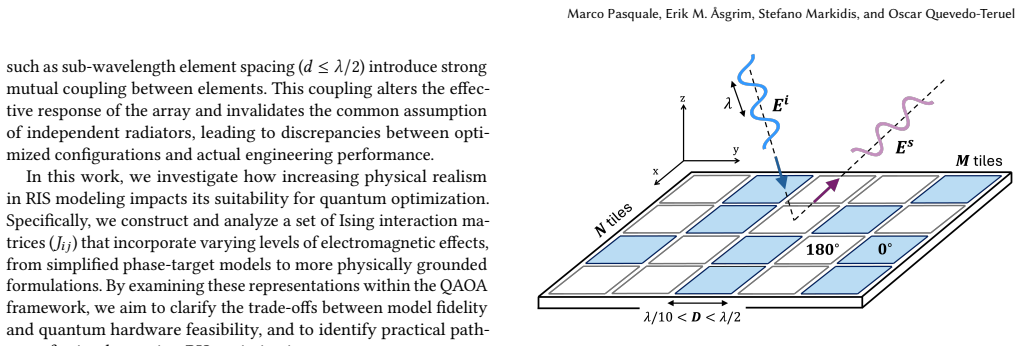
Embedding four progressively physics-informed Ising interaction models into QAOA shows that complete global coupling delivers the highest beamforming precision for a 5 by 5 RIS, but the resulting dense Hamiltonians impose prohibitive routing overhead and hinder convergence, whereas sparse distance-penalized models remain executable on current noisy intermediate-scale quantum processors.
What carries the argument
Four Ising interaction models (J_ij) of increasing physical fidelity, cast as QUBO Hamiltonians and solved with QAOA, that encode mutual coupling between RIS elements.
Load-bearing premise
The four chosen Ising interaction strengths are sufficient to capture the essential electromagnetic mutual coupling that determines real-world accuracy versus feasibility.
What would settle it
A full-wave simulation or laboratory measurement of a physical 5 by 5 RIS configured according to the sparse versus dense QAOA outputs, checking whether the predicted pointing accuracy difference actually appears and whether the sparse solution still meets performance targets.
Figures



read the original abstract
Optimizing Reconfigurable Intelligent Surfaces (RIS) is a high-dimensional combinatorial challenge. Current quantum algorithms often simplify this problem by ignoring physical constraints like mutual coupling, which significantly degrades real-world performance. Rather than targeting a fully realistic RIS description, we embed progressively more physics-informed models of mutual coupling into Quadratic Unconstrained Binary Optimization (QUBO) formulations. We evaluate four Ising interaction models ($J_{ij}$) for the Quantum Approximate Optimization Algorithm (QAOA), ranging from idealized phase-only to fully dense physical models. Analyzing a $5 \times 5$ grid, our results expose a critical trade-off between spatial pointing accuracy and quantum hardware feasibility. While complete global coupling maximizes beamforming precision, dense Hamiltonians introduce prohibitive routing overhead and complicate convergence on near-term processors. Ultimately, we demonstrate that while physics-informed quantum optimization is mathematically viable, sparse, distance-penalized models remain a necessary compromise for execution on current noisy intermediate-scale quantum (NISQ) devices.
Editorial analysis
A structured set of objections, weighed in public.
Referee Report
Summary. The paper proposes embedding progressively more physics-informed models of mutual coupling into QUBO formulations for QAOA-based optimization of RIS phase configurations. On a 5×5 grid it evaluates four Ising interaction models (J_ij) ranging from idealized phase-only to fully dense physical coupling, reports a trade-off between beamforming accuracy and NISQ feasibility, and concludes that sparse distance-penalized models are required for practical execution on current hardware.
Significance. If the quantitative results and scaling claims hold, the work demonstrates a concrete route for incorporating electromagnetic physics into quantum combinatorial optimization and identifies a practical sparsity requirement for NISQ devices. The explicit construction of multiple J_ij Hamiltonians and the focus on routing overhead constitute a useful contribution at the quantum-EM interface.
major comments (2)
- [Abstract and §4] Abstract and §4 (results on 5×5 grid): the central accuracy-feasibility trade-off is asserted without any reported quantitative metrics (beam pointing error in degrees, sidelobe levels in dB, QAOA convergence probability, or circuit depth), error bars, or explicit QUBO/QAOA parameter values, preventing verification of the claimed superiority of dense versus sparse models.
- [§3 and §5] §3 (Ising models) and §5 (discussion): the necessity of distance-penalized sparsity is presented as a hardware-driven compromise, yet the four J_ij formulations are not validated against full-wave EM solvers (MoM, FDTD, or HFSS). Without such comparison it is impossible to confirm that the dense model actually encodes the dominant mutual-coupling effects that would justify the reported precision gain.
minor comments (2)
- [§3] Notation for the four J_ij models is introduced without a compact table summarizing their sparsity, range, and physical interpretation; a single summary table would improve readability.
- [Introduction] The manuscript cites standard QAOA and QUBO references but omits recent works on quantum optimization for antenna arrays or RIS-specific classical solvers that would help situate the novelty.
Simulated Author's Rebuttal
We thank the referee for the insightful comments on our manuscript arXiv:2605.06048. We address each major comment below and will make revisions to improve the clarity and rigor of the presented results.
read point-by-point responses
-
Referee: [Abstract and §4] Abstract and §4 (results on 5×5 grid): the central accuracy-feasibility trade-off is asserted without any reported quantitative metrics (beam pointing error in degrees, sidelobe levels in dB, QAOA convergence probability, or circuit depth), error bars, or explicit QUBO/QAOA parameter values, preventing verification of the claimed superiority of dense versus sparse models.
Authors: We agree that quantitative metrics are essential for verifying the claims. The original manuscript focused on qualitative trends in the 5×5 grid results, but we will revise §4 to report specific values: beam pointing errors in degrees, sidelobe levels in dB, QAOA convergence probabilities, and circuit depths for each of the four models. Error bars will be included based on 10 independent QAOA executions per model, and we will specify the QUBO formulation parameters (e.g., penalty weights) and QAOA settings (p=1, optimizer details). This will substantiate the accuracy-feasibility trade-off. revision: yes
-
Referee: [§3 and §5] §3 (Ising models) and §5 (discussion): the necessity of distance-penalized sparsity is presented as a hardware-driven compromise, yet the four J_ij formulations are not validated against full-wave EM solvers (MoM, FDTD, or HFSS). Without such comparison it is impossible to confirm that the dense model actually encodes the dominant mutual-coupling effects that would justify the reported precision gain.
Authors: We acknowledge that validation against full-wave solvers is important to confirm the physical accuracy of the dense model. Our formulations are based on theoretical mutual coupling coefficients derived from array factor and dipole interaction models in electromagnetics. In the revision, we will add explicit references and derivations in §3 to justify the J_ij terms. However, performing new full-wave simulations (e.g., with HFSS) for validation is beyond the current scope, as the paper emphasizes the quantum algorithm side. We will add a limitations paragraph in §5 discussing this and the potential impact on precision claims. revision: partial
- Full validation of the J_ij models using full-wave EM solvers such as MoM, FDTD, or HFSS, which would require substantial additional computational effort and expertise outside the primary focus on QAOA optimization.
Circularity Check
No circularity: standard QAOA/QUBO application with external NISQ constraints
full rationale
The paper applies the standard QAOA algorithm to four progressively physics-informed Ising (J_ij) models within QUBO formulations for RIS phase optimization. Results are generated from direct numerical evaluation on a 5x5 grid, and the final claim that sparse distance-penalized models are required for NISQ feasibility rests on known hardware routing and noise limits plus the observed accuracy trade-off, not on any fitted parameter renamed as prediction or self-referential definition. No equations in the abstract or described methods reduce a claimed prediction to an input by construction, and no load-bearing self-citations or uniqueness theorems imported from prior author work are present. The derivation chain is therefore self-contained against external benchmarks.
Axiom & Free-Parameter Ledger
Reference graph
Works this paper leans on
- [1]
-
[2]
Constantine A. Balanis. 2023.Balanis’ Advanced Engineering Electromagnetics(1 ed.). Wiley. doi:10.1002/9781394180042
-
[3]
Fouda, Muhammad Ismail, Mohamed I
Iqra Batool, Mostafa M. Fouda, Muhammad Ismail, Mohamed I. Ibrahem, Zubair Md Fadlullah, and Nei Kato. 2026. Quantum-Enhanced Massive MIMO Beam- forming for 6G IoT Networks: A QAOA-Based Optimization Framework.IEEE Open Journal of the Communications Society7 (2026). doi:10.1109/OJCOMS.2025. 3645207
-
[4]
Jaeho Choi and Joongheon Kim. 2019. A Tutorial on Quantum Approximate Optimization Algorithm (QAOA): Fundamentals and Applications. In2019 Inter- national Conference on Information and Communication Technology Convergence (ICTC). doi:10.1109/ICTC46691.2019.8939749 ISSN: 2162-1233
-
[5]
Emanuel Colella, Luca Bastianelli, Valter Mariani Primiani, Zhen Peng, Franco Moglie, and Gabriele Gradoni. 2024. Quantum Optimization of Reconfigurable Intelligent Surfaces for Mitigating Multipath Fading in Wireless Networks.IEEE Journal on Multiscale and Multiphysics Computational Techniques9 (2024). doi:10. 1109/JMMCT.2024.3494037
-
[6]
Gavin E. Crooks. 2019. Gradients of parameterized quantum gates using the parameter-shift rule and gate decomposition. doi:10.48550/arXiv.1905.13311 arXiv:1905.13311
-
[7]
ElMossallamy, Hongliang Zhang, Lingyang Song, Karim G
Mohamed A. ElMossallamy, Hongliang Zhang, Lingyang Song, Karim G. Seddik, Zhu Han, and Geoffrey Ye Li. 2020. Reconfigurable Intelligent Surfaces for Wireless Communications: Principles, Challenges, and Opportunities.IEEE Transactions on Cognitive Communications and Networking6, 3 (2020). doi:10. 1109/TCCN.2020.2992604
-
[8]
Edward Farhi, Jeffrey Goldstone, and Sam Gutmann. 2014. A Quantum Approxi- mate Optimization Algorithm. doi:10.48550/arXiv.1411.4028 arXiv:1411.4028
work page internal anchor Pith review doi:10.48550/arxiv.1411.4028 2014
-
[9]
Adam: A Method for Stochastic Optimization
Diederik P. Kingma and Jimmy Ba. 2017. Adam: A Method for Stochastic Opti- mization. doi:10.48550/arXiv.1412.6980 arXiv:1412.6980
work page internal anchor Pith review doi:10.48550/arxiv.1412.6980 2017
-
[10]
Sangbin Lee, Qi Jian Lim, Charles Ross, Eungkyu Lee, Soyul Han, Youngmin Kim, Zhen Peng, and Sanghoek Kim. 2025. Quantum Annealing for Electromagnetic Engineers—Part I: A computational method to solve various types of optimization problems.IEEE Antennas and Propagation Magazine67, 6 (2025). doi:10.1109/ MAP.2024.3498695
-
[11]
Sangbin Lee, Qi Jian Lim, Charles Ross, Eungkyu Lee, Soyul Han, Youngmin Kim, Zhen Peng, and Sanghoek Kim. 2026. Quantum Annealing for Electromagnetic Engineers—Part II: Examples of electromagnetic problems solved by quantum annealing.IEEE Antennas and Propagation Magazine68, 1 (2026). doi:10.1109/ MAP.2025.3530408
- [12]
-
[13]
Abraham P. Punnen (Ed.). 2022.The Quadratic Unconstrained Binary Optimization Problem: Theory, Algorithms, and Applications. Springer International Publishing, Cham. doi:10.1007/978-3-031-04520-2
- [14]
-
[15]
Charles Ross, Gabriele Gradoni, Qi Jian Lim, and Zhen Peng. 2022. Engineering Reflective Metasurfaces With Ising Hamiltonian and Quantum Annealing.IEEE Transactions on Antennas and Propagation70, 4 (2022). doi:10.1109/TAP.2021. 3137424
-
[16]
Pinjun Zheng, Ruiqi Wang, Atif Shamim, and Tareq Y. Al-Naffouri. 2024. Mu- tual Coupling in RIS-Aided Communication: Model Training and Experimen- tal Validation.IEEE Transactions on Wireless Communications23, 11 (2024). doi:10.1109/TWC.2024.3451548
discussion (0)
Sign in with ORCID, Apple, or X to comment. Anyone can read and Pith papers without signing in.