Recognition: unknown
EventColumn: Integrating Event Sequences into Tabular Visualizations
Pith reviewed 2026-05-08 07:21 UTC · model grok-4.3
The pith
EventColumn adds a specialized column to tables that embeds event sequences alongside numerical, categorical, and temporal attributes for direct comparison at both individual and group levels.
A machine-rendered reading of the paper's core claim, the machinery that carries it, and where it could break.
Core claim
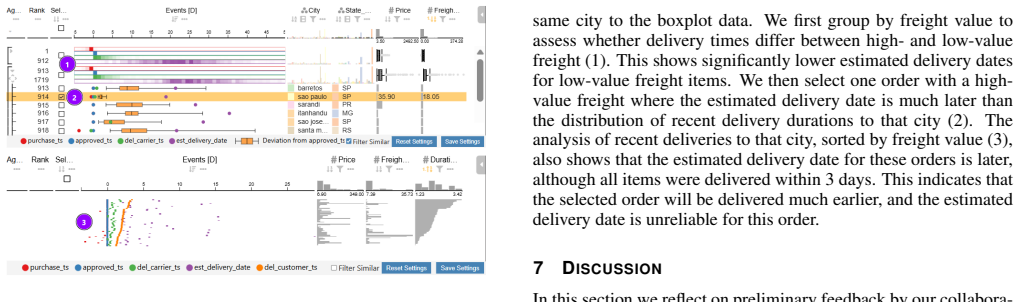
EventColumn is a column type that encodes event sequences using a compressed overview for single instances, heatmap summaries for groups, alignment by event types, and boxplots of similar historical items, all displayed inside a standard table so that event data can be compared directly with numerical, categorical, and temporal attributes.
What carries the argument
EventColumn visual encoding that places a compressed sequence view, heatmap group summary, type-based alignment, and similarity boxplots inside a single table column.
If this is right
- Analysts can inspect an individual row's event sequence next to its other attributes without leaving the table.
- Group summaries appear as heatmaps within the same column, revealing patterns across many sequences.
- Sequences can be aligned by chosen event types to highlight common ordering or timing.
- Boxplots of similar past items appear inline, letting users compare a current sequence against historical matches.
Where Pith is reading between the lines
- The same column approach could be applied to patient timelines in medical records mixed with lab values and demographics.
- Embedding sequence data this way may reduce the need for separate dashboards when analysts already work inside spreadsheet-style tools.
- Because the design was implemented in both a research prototype and a commercial BI product, it suggests the encoding can be added to existing table viewers with modest engineering effort.
Load-bearing premise
The described visual features support effective analysis without overwhelming users or needing further validation beyond the two demonstration cases.
What would settle it
A user study measuring analysis accuracy and time on steel or e-commerce data when using the integrated EventColumn table versus separate sequence and table views would show whether the combined display improves or hinders insight.
Figures

read the original abstract
We introduce EventColumn, a new column type that integrates event-sequence data with heterogeneous tabular attributes into a single unified table. EventColumn lets analysts compare event sequences alongside numerical, categorical, and temporal attributes at both instance and group levels, offering a compressed overview, heatmap group summaries, alignment by event types, and boxplots of similar historical items. We developed EventColumn together with collaborators from the steel industry to facilitate the analysis of production events and warehouse logistics, but the solution generalizes to a wide range of event sequence datasets with additional tabular attributes. Unlike most existing approaches that compare either event sequences or tables, EventColumn supports simultaneous comparison of both. We demonstrate its integration with Taggle and Microsoft Power BI on data from steel production logistics and on a public e-commerce dataset.
Editorial analysis
A structured set of objections, weighed in public.
Referee Report
Summary. The manuscript introduces EventColumn, a new column type for tabular visualizations that integrates event-sequence data with heterogeneous attributes. It supports instance- and group-level comparisons via a compressed overview, heatmap group summaries, alignment by event types, and boxplots of similar historical items. Developed collaboratively with steel-industry partners, the technique is demonstrated on steel production logistics data and a public e-commerce dataset, with integrations shown in Taggle and Microsoft Power BI.
Significance. If the proposed encodings prove effective, EventColumn could advance visual analytics by bridging event sequences and tabular data in a single view, offering practical value in domains with mixed data types. The collaborative development process and demonstrated tool integrations are strengths that enhance applicability. However, the absence of empirical validation currently limits the assessed significance to that of an untested design proposal.
major comments (1)
- [Demonstrations / Case Studies] Demonstrations section (case studies on steel logistics and e-commerce): The central claim that the listed features enable reliable instance- and group-level comparison without overload or misreading is supported only by descriptive illustrations and collaborator feedback. No user studies, task accuracy metrics, workload measures, or comparisons to baselines are reported, leaving potential issues such as visual clutter in dense sequences or alignment artifacts unexamined. This is load-bearing for the usefulness assertion.
minor comments (1)
- [Abstract / Introduction] The abstract and introduction could more explicitly distinguish the novel contribution from prior work on event sequence visualization and tabular aggregation techniques.
Simulated Author's Rebuttal
We thank the referee for their constructive feedback. We address the major comment on the demonstrations below.
read point-by-point responses
-
Referee: [Demonstrations / Case Studies] Demonstrations section (case studies on steel logistics and e-commerce): The central claim that the listed features enable reliable instance- and group-level comparison without overload or misreading is supported only by descriptive illustrations and collaborator feedback. No user studies, task accuracy metrics, workload measures, or comparisons to baselines are reported, leaving potential issues such as visual clutter in dense sequences or alignment artifacts unexamined. This is load-bearing for the usefulness assertion.
Authors: We agree that the demonstrations rely on descriptive case studies from steel logistics and e-commerce data, along with feedback from industry collaborators, rather than controlled user studies or quantitative metrics. The manuscript positions EventColumn as a design contribution developed iteratively with domain experts, where the features were refined based on their practical needs for joint instance- and group-level analysis. We acknowledge that this leaves questions about visual clutter, alignment artifacts, and comparison reliability unexamined through formal evaluation. In the revised manuscript, we have added a dedicated Limitations section that explicitly discusses the absence of task accuracy, workload, or baseline comparisons, and outlines future empirical work to address these. This revision clarifies the scope of our usefulness claims without overstating the current evidence from the demonstrations. revision: partial
Circularity Check
No circularity in derivation chain
full rationale
The manuscript is a visualization design proposal that introduces EventColumn as a new column type for integrating event sequences into tabular views. It contains no equations, derivations, fitted parameters, or predictions that could reduce to inputs by construction. Claims rest on descriptive integration with existing tools (Taggle, Power BI) and two illustrative case studies rather than any self-referential logic or self-citation chains. The contribution is therefore self-contained with no load-bearing steps that qualify as circular under the defined patterns.
Axiom & Free-Parameter Ledger
axioms (1)
- domain assumption Integrating event sequences with tabular attributes in a single column improves analysis at instance and group levels
invented entities (1)
-
EventColumn
no independent evidence
Reference graph
Works this paper leans on
-
[1]
L. Bartram, M. Correll, and M. Tory. Untidy data: The unreason- able effectiveness of tables.IEEE Transactions on Visualization and Computer Graphics, 28(1):686–696, 2022. doi: 10.1109/TVCG.2021 .3114830 2
-
[2]
M. Bostock, V . Ogievetsky, and J. Heer. D³ data-driven docu- ments.IEEE Transactions on Visualization and Computer Graphics, 17(12):2301–2309, 2011. doi: 10.1109/TVCG.2011.185 3
-
[3]
C. A. Brewer, G. W. Hatchard, and M. A. Harrower. ColorBrewer in print: A catalog of color schemes for maps.Cartography and Ge- ographic Information Science, 30(1):5–32, Jan. 2003. doi: 10.1559/ 152304003100010929 3
2003
-
[4]
E. Dimara, A. Bezerianos, and P. Dragicevic. Conceptual and methodological issues in evaluating multidimensional visualizations for decision support.IEEE Transactions on Visualization and Com- puter Graphics, 24(1):749–759, Jan. 2018. doi: 10.1109/TVCG.2017 .2745138 2
-
[5]
J. A. Fails, A. Karlson, L. Shahamat, and B. Shneiderman. A visual interface for multivariate temporal data: Finding patterns of events across multiple histories. In2006 IEEE Symposium On Visual Ana- lytics Science And Technology, pp. 167–174, Oct. 2006. doi: 10.1109/ V AST.2006.261421 2, 3
-
[6]
K. Furmanova, S. Gratzl, H. Stitz, T. Zichner, M. Jaresova, A. Lex, and M. Streit. Taggle: Combining overview and details in tabular data visualizations.Information Visualization, 19(2):114–136, Apr. 2020. doi: 10.1177/1473871619878085 2, 3, 4
-
[7]
S. Gratzl, A. Lex, N. Gehlenborg, H. Pfister, and M. Streit. LineUp: Visual analysis of multi-attribute rankings.IEEE Transactions on Vi- sualization and Computer Graphics, 19(12):2277–2286, Dec. 2013. doi: 10.1109/TVCG.2013.173 2
-
[8]
R. Guo, T. Fujiwara, Y . Li, K. M. Lima, S. Sen, N. K. Tran, and K.-L. Ma. Comparative visual analytics for assessing medical records with sequence embedding.Visual Informatics, 4(2):72–85, June 2020. doi: 10.1016/j.visinf.2020.04.001 2
-
[9]
Y . Guo, S. Guo, Z. Jin, S. Kaul, D. Gotz, and N. Cao. Survey on visual analysis of event sequence data.IEEE Transactions on Visual- ization and Computer Graphics, 28(12):5091–5112, Dec. 2022. doi: 10.1109/TVCG.2021.3100413 2, 3
-
[10]
Zethofer
JKU Visual Data Science Lab and J. Zethofer. EventColumn GitHub repository (Event Table Viewer Power BI Visual).https://github. com/jku-vds-lab/pro2future-event-table-viewer, 2026. Last accessed: 2026/05/01. 4
2026
-
[11]
Zethofer, and Pro2Future GmbH
JKU Visual Data Science Lab, J. Zethofer, and Pro2Future GmbH. Event Table Viewer Power BI Visual, 2024. Last accessed: 2026/05/01. 4
2024
-
[12]
J. Jo, J. Huh, J. Park, B. Kim, and J. Seo. LiveGantt: Interactively visualizing a large manufacturing schedule.IEEE Transactions on Visualization and Computer Graphics, 20(12):2329–2338, Dec. 2014. doi: 10.1109/TVCG.2014.2346454 2
-
[13]
Power BI.https://www.microsoft
Microsoft Corporation. Power BI.https://www.microsoft. com/power-platform/products/power-bi, 2026. Last accessed: 2026/05/01. 2
2026
-
[14]
Monroe, R
M. Monroe, R. Lan, H. Lee, C. Plaisant, and B. Shneiderman. Tem- poral event sequence simplification.IEEE Transactions on Visualiza- tion and Computer Graphics, 19(12):2227–2236, Dec. 2013. doi: 10. 1109/TVCG.2013.200 2, 3
2013
-
[15]
Munzner.Visualization Analysis and Design
T. Munzner.Visualization Analysis and Design. CRC Press, Dec
-
[16]
Olist and A. Sionek. Brazilian e-commerce public dataset by Olist,
-
[17]
doi: 10.34740/KAGGLE/DSV/195341 4
-
[18]
Event Table Viewer at Microsfot Marketplace
Pro2Future GmbH. Event Table Viewer at Microsfot Marketplace. https://marketplace.microsoft.com/en-ca/product/ pro2futuregmbh1670847158359.event_table_viewer, 2024. Last accessed: 2026/05/01. 4
2024
-
[19]
T. Schreck, B. Mutlu, and M. Streit. Visual data science for indus- trial applications. InDigital Transformation: Core Technologies and Emerging Topics from a Computer Science Perspective, pp. 447–471. Springer, 2023. doi: 10.1007/978-3-662-65004-2 18 2
-
[20]
van der Linden, S
S. van der Linden, S. van den Elzen, and A. Vilanova. A survey on visual comparison of event sequence data.Computer Graphics Forum,
-
[21]
doi: 10.1111/cgf.14856 2, 3
-
[22]
M. van Dortmont, S. van den Elzen, and J. van Wijk. ChronoCorre- lator: Enriching events with time series.Computer Graphics Forum, 38(3):387–399, 2019. doi: 10.1111/cgf.13697 2, 3
-
[23]
T. D. Wang, C. Plaisant, A. J. Quinn, R. Stanchak, S. Murphy, and B. Shneiderman. Aligning temporal data by sentinel events: discover- ing patterns in electronic health records. InProceedings of the SIGCHI Conference on Human Factors in Computing Systems, pp. 457–466. ACM, 2008. doi: 10.1145/1357054.1357129 2, 3
-
[24]
K. Wongsuphasawat and B. Shneiderman. Finding comparable tem- poral categorical records: A similarity measure with an interactive visualization. In2009 IEEE Symposium on Visual Analytics Science and Technology, pp. 27–34. IEEE, 2009. doi: 10.1109/V AST.2009. 5332595 2
work page doi:10.1109/v 2009
-
[25]
P. Xu, H. Mei, L. Ren, and W. Chen. ViDX: Visual diagnostics of assembly line performance in smart factories.IEEE Transactions on Visualization and Computer Graphics, 23(1):291–300, Jan. 2017. doi: 10.1109/TVCG.2016.2598664 2
-
[26]
A. Yeshchenko and J. Mendling. A survey of approaches for event se- quence analysis and visualization.Information Systems, 120:102283, Feb. 2024. doi: 10.1016/j.is.2023.102283 2, 3
-
[27]
H. Zeng, X. Wang, A. Wu, Y . Wang, Q. Li, A. Endert, and H. Qu. EmoCo: Visual analysis of emotion coherence in presentation videos.IEEE Transactions on Visualization and Computer Graphics, 26(1):927–937, Jan. 2020. doi: 10.1109/TVCG.2019.2934656 2, 3
-
[28]
F. Zhou, X. Lin, C. Liu, Y . Zhao, P. Xu, L. Ren, T. Xue, and L. Ren. A survey of visualization for smart manufacturing.Journal of Visual- ization, 22(2):419–435, 2019. doi: 10.1007/s12650-018-0530-2 2
discussion (0)
Sign in with ORCID, Apple, or X to comment. Anyone can read and Pith papers without signing in.