Recognition: unknown
Topological spin freezing in frustrated quantum materials
Pith reviewed 2026-05-08 05:52 UTC · model grok-4.3
The pith
Spin freezing in frustrated quantum materials arises from topological features and yields glassy dynamics distinct from conventional disorder effects.
A machine-rendered reading of the paper's core claim, the machinery that carries it, and where it could break.
Core claim
In a broad class of frustrated quantum materials, competing interactions, non-trivial electronic band topology, quantum fluctuations, and the interplay between emergent degrees of freedom give rise to glassy spin dynamics whose signatures appear in both thermodynamic and microscopic measurements; thermodynamic, NMR, μSR, and neutron scattering probes identify characteristic features of topological spin-glass behavior, including short-range spin correlations, emergent low-energy excitations, and glassy freezing of topological origins, while hydrodynamic spin modes govern the dynamics and spin-jam states appear in frustrated lattices, supplying a unified framework that bridges experiment and理论
What carries the argument
Topological spin-glass behavior arising from the interplay of competing interactions, non-trivial band topology, and collective excitations in frustrated lattices.
If this is right
- Unconventional spin dynamics appear with short-range correlations and emergent low-energy modes rather than long-range order.
- Spin-jam states emerge on frustrated lattices as a distinct form of topological freezing.
- Hydrodynamic spin modes control the glassy relaxation times observed across multiple probes.
- The states differ from conventional spin glasses in their response to temperature and field, allowing experimental distinction.
- A single framework links thermodynamic signatures to microscopic scattering data for many frustrated materials.
Where Pith is reading between the lines
- Materials with engineered band topology but minimal disorder could be used to isolate and tune the glassy dynamics for potential quantum devices.
- Similar topological freezing mechanisms may operate in other systems with competing orders, such as certain superconductors or magnets with skyrmion textures.
- Neutron scattering patterns predicted by the hydrodynamic modes could serve as a diagnostic signature in new candidate compounds.
Load-bearing premise
The glassy dynamics and spin freezing stem primarily from topological features and non-trivial band topology rather than from conventional disorder, random impurities, or other non-topological mechanisms.
What would settle it
A material engineered with strong frustration and disorder but trivial band topology that shows no glassy freezing or low-energy excitations in NMR and neutron data would challenge the claim that topology is the dominant origin.
Figures







read the original abstract
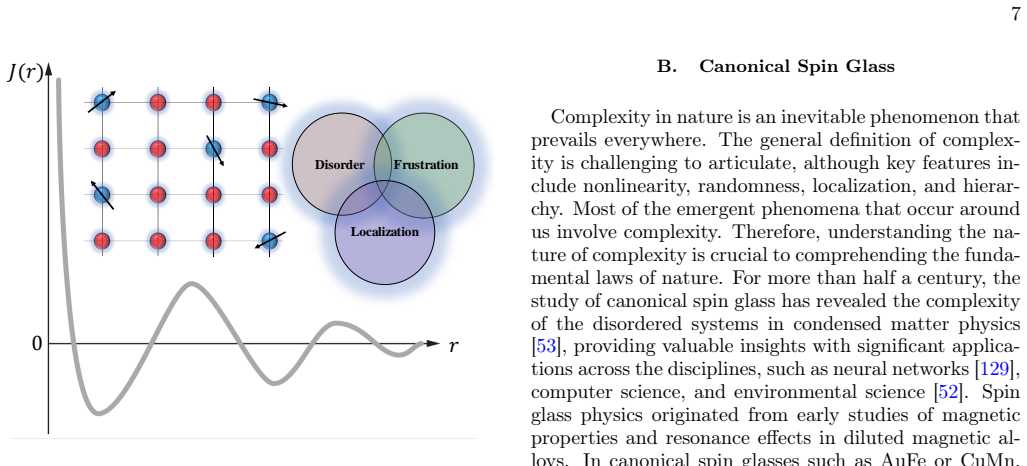
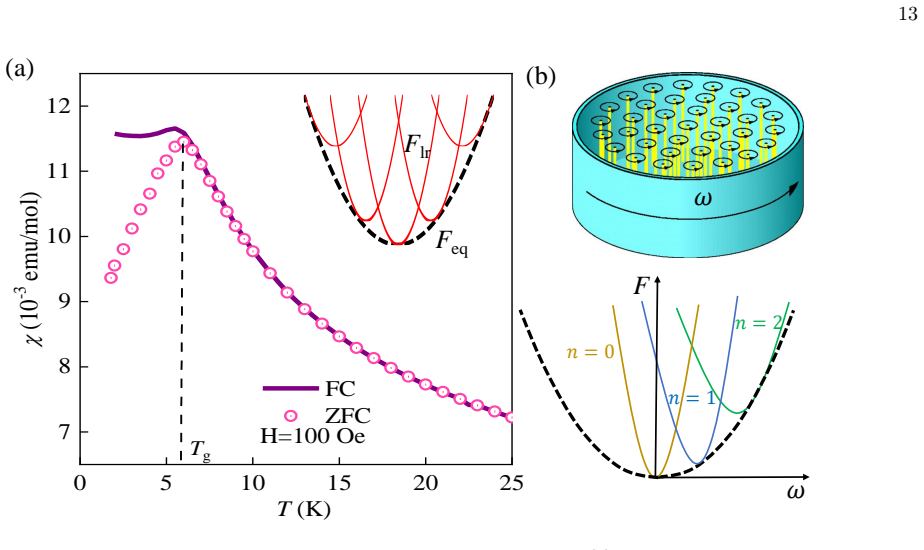
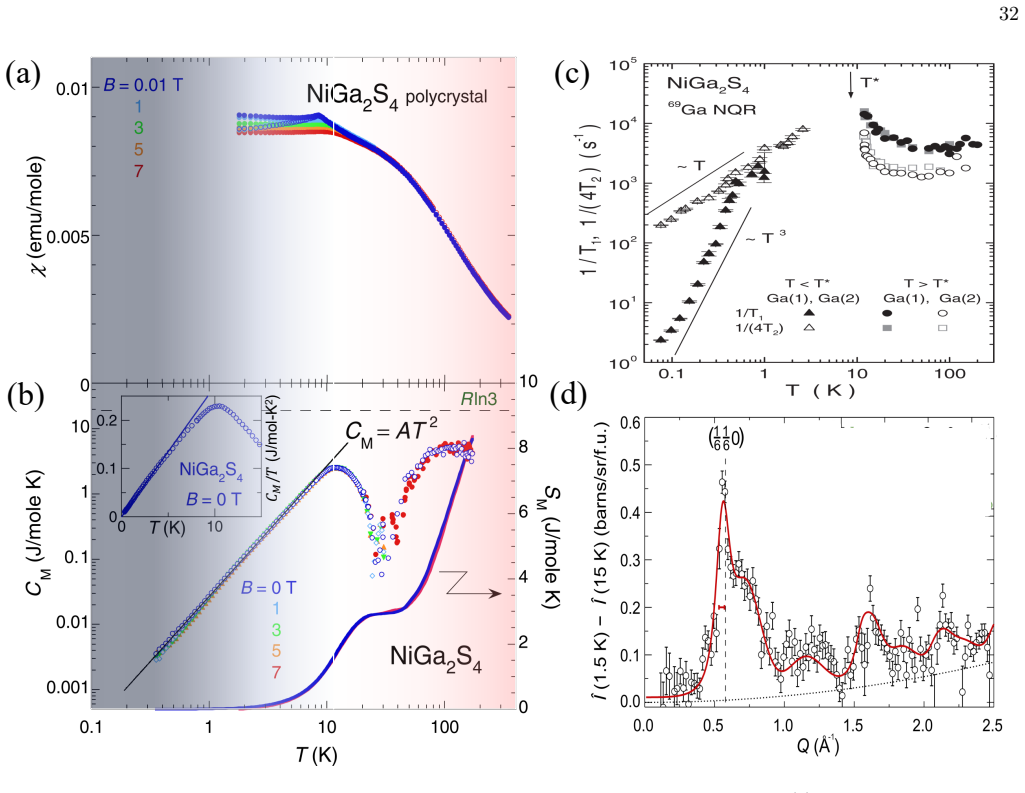
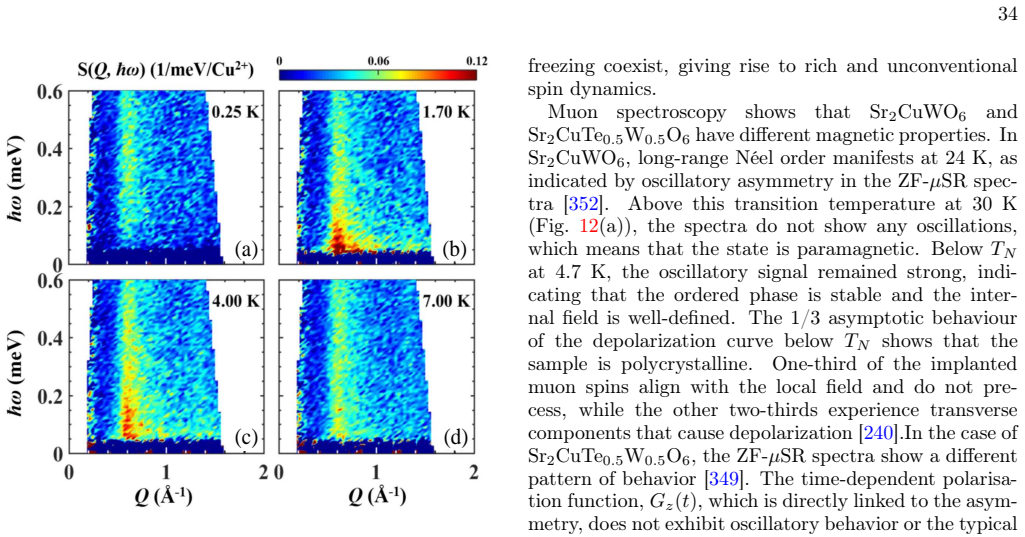
Competing interactions, non-trivial electronic band topology, quantum fluctuations, and the interplay between emergent degrees of freedom in frustrated quantum materials can give rise to a wide range of exotic phenomena. Glassy dynamics, originally studied in amorphous materials and biological systems, has recently attracted considerable interest in quantum condensed matter, particularly in relation to the collective behavior of spins, quasiparticle excitations, and topological spin textures. Here, we investigate the emergence of unconventional glassy spin dynamics in a broad class of frustrated quantum materials, where spin freezing exhibit distinct signatures in both thermodynamic and microscopic measurements. Using a comprehensive set of experimental probes, including thermodynamic, NMR, ($\mu$SR), and neutron scattering, we identify characteristic signatures of topological spin-glass behavior and these complementary techniques reveal unconventional spin dynamics, short-range spin correlations, emergent low-energy excitations, and glassy behavior of topological origins, distinguishing these states from conventional spin glasses and disordered magnets. Furthermore, we discuss the role of hydrodynamic spin modes in governing glassy dynamics and the emergence of spin-jam states in frustrated lattices, providing a unified framework for understanding unconventional spin freezing of topological origin and bridging experimental observations with theoretical models. This review aims to advance our understanding of collective many-body phenomena arising from competing interactions, topological defects, collective excitations, quantum entanglement, and symmetry constraints. Such insights may facilitate the discovery and design of novel quantum materials and help address fundamental questions in contemporary condensed matter physics, with potential implications for future quantum technologies.
Editorial analysis
A structured set of objections, weighed in public.
Referee Report
Summary. This review synthesizes prior experimental and theoretical work on spin dynamics in frustrated quantum materials. It claims that glassy spin freezing in these systems exhibits signatures of topological origin, distinct from conventional disorder-driven spin glasses, as revealed by thermodynamic, NMR, μSR, and neutron scattering probes. The manuscript discusses hydrodynamic spin modes, short-range correlations, emergent excitations, and introduces 'spin-jam states' on frustrated lattices as part of a unified framework bridging observations to theory.
Significance. If the interpretive synthesis holds, the review consolidates multi-probe evidence for unconventional spin dynamics in topologically influenced systems and may guide material design. It explicitly credits complementary experimental techniques and the attempt to connect to theoretical models of collective excitations, though it introduces no new data, derivations, or quantitative predictions.
major comments (1)
- [Abstract and §1] Abstract and §1 (Introduction): The central claim that observed glassy dynamics and spin freezing are 'of topological origins' and distinguishable from conventional spin glasses rests on reinterpretation of cited literature. However, the manuscript provides no explicit, falsifiable criterion (e.g., a predicted scaling or signature unique to topology) that would allow readers to test this against disorder-based alternatives in the referenced experiments; this is load-bearing for the distinction asserted throughout.
minor comments (2)
- [Abstract] Abstract: The sentence 'we identify characteristic signatures of topological spin-glass behavior and these complementary techniques reveal...' is grammatically awkward and should be rephrased for clarity.
- Throughout: 'Spin-jam states' is introduced as a new descriptive term without a precise definition or comparison table to existing spin-glass or spin-liquid terminology; a dedicated paragraph or table would improve readability.
Simulated Author's Rebuttal
We thank the referee for the careful review and constructive feedback. We agree that the distinction between topological and conventional spin-glass behavior requires clearer, more explicit criteria to be fully falsifiable. We address the point below and will revise the manuscript accordingly.
read point-by-point responses
-
Referee: [Abstract and §1] Abstract and §1 (Introduction): The central claim that observed glassy dynamics and spin freezing are 'of topological origins' and distinguishable from conventional spin glasses rests on reinterpretation of cited literature. However, the manuscript provides no explicit, falsifiable criterion (e.g., a predicted scaling or signature unique to topology) that would allow readers to test this against disorder-based alternatives in the referenced experiments; this is load-bearing for the distinction asserted throughout.
Authors: We acknowledge that the review, as currently written, relies on synthesis of prior literature without introducing a single, standalone falsifiable test or new quantitative prediction. The claimed distinction is drawn from the pattern of results across thermodynamic, NMR, μSR, and neutron-scattering data in geometrically frustrated systems (e.g., temperature-independent low-energy excitations, hydrodynamic spin modes, and short-range correlations persisting without conventional disorder-driven freezing). To make this load-bearing claim more rigorous and testable, we will add a dedicated subsection (new §2.4) that explicitly tabulates the key experimental signatures reported in the cited works, together with the corresponding theoretical expectations from hydrodynamic and topological models versus standard spin-glass theory. We will also update the abstract and §1 to reference this subsection and to state the most direct falsifiable predictions (e.g., scaling of relaxation rates with frustration parameter, absence of certain aging signatures). revision: partial
Circularity Check
Review paper with no derivation chain exhibits no circularity
full rationale
This is a review article synthesizing existing experimental and theoretical literature on spin dynamics in frustrated quantum materials. It presents no original equations, derivations, quantitative predictions, or fitted parameters. All claims about topological spin-glass behavior, glassy dynamics, and distinctions from conventional spin glasses rest on citations to independent prior work. No load-bearing steps reduce by construction to self-referential inputs, self-citations, or ansatzes introduced in this manuscript. The content is self-contained against external benchmarks.
Axiom & Free-Parameter Ledger
axioms (1)
- domain assumption Competing interactions, non-trivial electronic band topology, and quantum fluctuations in frustrated lattices produce exotic collective spin phenomena including glassy dynamics.
invented entities (1)
-
spin-jam states
no independent evidence
Reference graph
Works this paper leans on
-
[1]
Khatua, B
J. Khatua, B. Sana, A. Zorko, M. Gomilšek, K. Sethu- pathi, M. R. Rao, M. Baenitz, B. Schmidt, and P. Khuntia, Experimental signatures of quantum and topological states in frustrated magnetism, Physics Re- ports1041, 1 (2023)
2023
-
[2]
Broholm, R
C. Broholm, R. Cava, S. Kivelson, D. Nocera, M. Nor- man,andT.Senthil,Quantumspinliquids,Science367, eaay0668 (2020)
2020
-
[3]
Yosida, Magnetic Properties of Cu-Mn Alloys, Phys- ical Review106, 893 (1957)
K. Yosida, Magnetic Properties of Cu-Mn Alloys, Phys- ical Review106, 893 (1957)
1957
-
[4]
Cannella and J
V. Cannella and J. A. Mydosh, Magnetic Ordering in Gold-Iron Alloys, Physical Review B6, 4220 (1972)
1972
-
[5]
J. A. Mydosh,Spin glasses: an experimental introduc- tion(CRC Press, 1993)
1993
-
[6]
S. F. Edwards and P. W. Anderson, Theory of spin glasses, Journal of Physics F: Metal Physics5, 965 (1975)
1975
-
[7]
D. L. Stein and C. M. Newman,Spin glasses and com- plexity, Vol. 4 (Princeton University Press, 2013)
2013
-
[8]
Binder and A
K. Binder and A. P. Young, Spin glasses: Experimental facts, theoretical concepts, and open questions, Reviews of Modern Physics58, 801 (1986)
1986
-
[9]
Villain, Dynamics of spin glasses, Journal of Mag- netism and Magnetic Materials15-18, 105 (1980)
J. Villain, Dynamics of spin glasses, Journal of Mag- netism and Magnetic Materials15-18, 105 (1980)
1980
-
[10]
B. I. Halperin and W. M. Saslow, Hydrodynamic theory of spin waves in spin glasses and other systems with noncollinear spin orientations, Physical Review B16, 2154 (1977)
1977
-
[11]
Jena and P
U. Jena and P. Khuntia, The nature of low-temperature spin-freezinginfrustratedKitaevmagnets,Communica- tions Materials6, 63 (2025)
2025
-
[12]
Podolsky and Y
D. Podolsky and Y. B. Kim, Halperin-Saslow modes as the origin of the low-temperature anomaly in NiGa2S4, Physical Review B79, 140402 (2009)
2009
-
[13]
T. E. Saunders and J. T. Chalker, Spin freezing in geo- metrically frustrated antiferromagnets with weak disor- der, Physical Review Letters98, 157201 (2007)
2007
-
[14]
H. J. Silverstein, K. Fritsch, F. Flicker, A. M. Hal- las, J. S. Gardner, Y. Qiu, G. Ehlers, A. T. Savici, Z. Yamani, K. A. Ross, B. D. Gaulin, M. J. P. Gin- gras, J. A. M. Paddison, K. Foyevtsova, R. Valenti, F. Hawthorne, C. R. Wiebe, and H. D. Zhou, Liquid- like correlations in single-crystalline Y2Mo2O7: An un- conventional spin glass, Physical Review...
2014
-
[15]
X. Hu, D. M. Pajerowski, D. Zhang, A. A. Podlesnyak, Y. Qiu, Q. Huang, H. Zhou, I. Klich, A. I. Kolesnikov, M. B. Stone, and S.-H. Lee, Freezing of a disorder in- duced spin liquid with strong quantum fluctuations, Physical Review Letters127, 017201 (2021)
2021
-
[16]
S. J. Garratt and J. T. Chalker, Goldstone modes in the emergent gauge fields of a frustrated magnet, Physical 57 Review B101, 024413 (2020)
2020
-
[17]
P.Chandra, P.Coleman,andI.Ritchey,Theanisotropic kagome antiferromagnet: a topological spin glass?, Journal de Physique I3, 591 (1993)
1993
-
[18]
Ritchey, P
I. Ritchey, P. Chandra, and P. Coleman, Spin folding in the two-dimensional heisenberg kagomé antiferromag- net, Physical Review B47, 15342 (1993)
1993
-
[19]
K. B. Yogendra, T. Das, and G. Baskaran, Emer- gent glassiness in the disorder-free Kitaev model: Den- sity matrix renormalization group study on a one- dimensional ladder setting, Physical Review B108, 165118 (2023)
2023
-
[20]
Kawamura and S
H. Kawamura and S. Miyashita, Phase transition of the two-dimensional Heisenberg antiferromagnet on the tri- angular lattice, Journal of the Physical Society of Japan 53, 4138 (1984)
1984
-
[21]
Kawamura, Chirality scenario of the spin-glass order- ing, Journal of the Physical Society of Japan79, 011007 (2010)
H. Kawamura, Chirality scenario of the spin-glass order- ing, Journal of the Physical Society of Japan79, 011007 (2010)
2010
-
[22]
L. D. Jaubert and P. C. Holdsworth, Signature of mag- netic monopole and dirac string dynamics in spin ice, Nature Physics5, 258 (2009)
2009
-
[23]
A. M. Samarakoon, A. Sokolowski, B. Klemke, R. Fey- erherm, M. Meissner, R. A. Borzi, F. Ye, Q. Zhang, Z. Dun, H. Zhou, T. Egami, J. N. Hallén, L. Jaubert, C. Castelnovo, R. Moessner, S. A. Grigera, and D. A. Tennant, Structural magnetic glassiness in the spin ice Dy2Ti2O7, Phys. Rev. Res.4, 033159 (2022)
2022
-
[24]
Sen and R
A. Sen and R. Moessner, Topological Spin Glass in Di- luted Spin Ice, Physical Review Letters114, 247207 (2015)
2015
-
[25]
Syzranov and A
S. Syzranov and A. Ramirez, Eminuscent phase in frus- trated magnets: a challenge to quantum spin liquids, Nature Communications13, 2993 (2022)
2022
-
[26]
A. S. Wills, G. S. Oakley, D. Visser, J. Frunzke, A. Harrison, and K. H. Andersen, Short-range order in the topological spin glass(D3O)Fe3(SO4)2(OD)6 us- ing polarized neutron diffraction, Physical Review B64, 094436 (2001)
2001
-
[27]
Fischer, Ferromagnetic modes in spin glasses and di- lute ferromagnets, Zeitschrift für Physik B Condensed Matter39, 37 (1980)
K. Fischer, Ferromagnetic modes in spin glasses and di- lute ferromagnets, Zeitschrift für Physik B Condensed Matter39, 37 (1980)
1980
-
[28]
Klich, S.-H
I. Klich, S.-H. Lee, and K. Iida, Glassiness and ex- otic entropy scaling induced by quantum fluctuations in a disorder-free frustrated magnet, Nature communi- cations5, 3497 (2014)
2014
-
[29]
Samarakoon, T
A. Samarakoon, T. J. Sato, T. Chen, G.-W. Chern, J. Yang, I. Klich, R. Sinclair, H. Zhou, and S.-H. Lee, Aging, memory, and nonhierarchical energy landscape of spin jam, Proceedings of the National Academy of Sciences113, 11806 (2016)
2016
-
[30]
J. Yang, A. Samarakoon, S. Dissanayake, H. Ueda, I. Klich, K. Iida, D. Pajerowski, N. P. Butch, Q. Huang, J. R. Copley,et al., Spin jam induced by quantum fluc- tuations in a frustrated magnet, Proceedings of the Na- tional Academy of Sciences112, 11519 (2015)
2015
-
[31]
Samarakoon, M
A. Samarakoon, M. Takahashi, D. Zhang, J. Yang, N. Katayama, R. Sinclair, H. Zhou, S. Diallo, G. Ehlers, D. Tennant,et al., Scaling of Memories and Crossover in Glassy Magnets, Scientific reports7, 12053 (2017)
2017
-
[32]
Z. W. Wu, Y. Chen, W.-H. Wang, W. Kob, and L. Xu, Topology of vibrational modes predicts plastic events in glasses, Nature Communications14, 2955 (2023)
2023
-
[33]
Baggioli, Topological defects reveal the plasticity of glasses, Nature Communications14, 2956 (2023)
M. Baggioli, Topological defects reveal the plasticity of glasses, Nature Communications14, 2956 (2023)
2023
-
[34]
Mydosh, Spin glasses—recent experiments and sys- tems, Journal of Magnetism and Magnetic Materials7, 237 (1978)
J. Mydosh, Spin glasses—recent experiments and sys- tems, Journal of Magnetism and Magnetic Materials7, 237 (1978)
1978
-
[35]
P. W. Anderson,Basic notions of condensed matter physics(CRC press, 2018)
2018
-
[36]
Nambu, Axial Vector Current Conservation in Weak Interactions, Physical Review Letters4, 380 (1960)
Y. Nambu, Axial Vector Current Conservation in Weak Interactions, Physical Review Letters4, 380 (1960)
1960
-
[37]
Goldstone, A
J. Goldstone, A. Salam, and S. Weinberg, Broken Sym- metries, Physical Review127, 965 (1962)
1962
-
[38]
Weinberg,The quantum theory of fields, Vol
S. Weinberg,The quantum theory of fields, Vol. 2 (Cam- bridge university press, 1995)
1995
-
[39]
P. W. Anderson, Plasmons, Gauge Invariance, and Mass, Physical Review130, 439 (1963)
1963
-
[40]
P. W. Higgs, Broken Symmetries and the Masses of Gauge Bosons, Physical Review Letters13, 508 (1964)
1964
-
[41]
Sherman, U
D. Sherman, U. S. Pracht, B. Gorshunov, S. Poran, J. Jesudasan, M. Chand, P. Raychaudhuri, M. Swan- son, N. Trivedi, A. Auerbach,et al., The higgs mode in disordered superconductors close to a quantum phase transition, Nature Physics11, 188 (2015)
2015
-
[42]
Shimano and N
R. Shimano and N. Tsuji, Higgs mode in superconduc- tors, Annual Review of Condensed Matter Physics11, 103 (2020)
2020
-
[43]
Pollet and N
L. Pollet and N. Prokof’ev, Higgs Mode in a Two- Dimensional Superfluid, Physical Review Letters109, 010401 (2012)
2012
-
[44]
Méasson, Y
M.-A. Méasson, Y. Gallais, M. Cazayous, B. Clair, P. Rodière, L. Cario, and A. Sacuto, Amplitude Higgs mode in the2H−NbSe 2 superconductor, Physical Re- view B89, 060503 (2014)
2014
-
[45]
Grasset, Y
R. Grasset, Y. Gallais, A. Sacuto, M. Cazayous, S. Mañas Valero, E. Coronado, and M.-A. Méasson, Pressure-Induced Collapse of the Charge Density Wave and Higgs Mode Visibility in2H−TaS 2, Physical Re- view Letters122, 127001 (2019)
2019
-
[46]
Wulferding, J
D. Wulferding, J. Park, T. Tohyama, S. R. Park, and C. Kim, Magnetic field control over the axial charac- ter of higgs modes in charge-density wave compounds, Nature Communications16, 114 (2025)
2025
-
[47]
A. Jain, M. Krautloher, J. Porras, G. Ryu, D. Chen, D. Abernathy, J. Park, A. Ivanov, J. Chaloupka, G. Khaliullin,et al., Higgs mode and its decay in a two- dimensional antiferromagnet, Nature Physics13, 633 (2017)
2017
-
[48]
S.-M.Souliou, J.c.v.Chaloupka, G.Khaliullin, G.Ryu, A. Jain, B. J. Kim, M. Le Tacon, and B. Keimer, Ra- man Scattering from Higgs Mode Oscillations in the Two-Dimensional AntiferromagnetCa 2RuO4, Physical Review Letters119, 067201 (2017)
2017
-
[49]
Puviani, L
M. Puviani, L. Schwarz, X.-X. Zhang, S. Kaiser, and D. Manske, Current-assisted Raman activation of the Higgsmodeinsuperconductors,PhysicalReviewB101, 220507 (2020)
2020
-
[50]
Udina, T
M. Udina, T. Cea, and L. Benfatto, Theory of coherent- oscillations generation in terahertz pump-probe spec- troscopy: From phonons to electronic collective modes, Physical Review B100, 165131 (2019)
2019
-
[51]
T. E. Glier, S. Tian, M. Rerrer, L. Westphal, G. Lüllau, L. Feng, J. Dolgner, R. Haenel, M. Zonno, H. Eisaki, et al., Non-equilibrium anti-Stokes Raman spectroscopy for investigating Higgs modes in superconductors, Na- ture Communications16, 7027 (2025). 58
2025
-
[52]
Grüner, The dynamics of charge-density waves, Re- view of Modern Physics60, 1129 (1988)
G. Grüner, The dynamics of charge-density waves, Re- view of Modern Physics60, 1129 (1988)
1988
-
[53]
Y. Wang, I. Petrides, G. McNamara, M. M. Hosen, S. Lei, Y.-C. Wu, J. L. Hart, H. Lv, J. Yan, D. Xiao, et al., Axial Higgs mode detected by quantum pathway interference in RTe3, Nature606, 896 (2022)
2022
-
[54]
D. F. Agterberg, J. S. Davis, S. D. Edkins, E. Fradkin, D. J. Van Harlingen, S. A. Kivelson, P. A. Lee, L. Radz- ihovsky, J. M. Tranquada, and Y. Wang, The physics of pair-density waves: cuprate superconductors and be- yond, Annual Review of Condensed Matter Physics11, 231 (2020)
2020
-
[55]
Soto-Garrido, Y
R. Soto-Garrido, Y. Wang, E. Fradkin, and S. L. Cooper, Higgs modes in the pair density wave super- conducting state, Physical Review B95, 214502 (2017)
2017
-
[56]
Y. Su, A. Masaki-Kato, W. Zhu, J.-X. Zhu, Y. Kamiya, andS.-Z.Lin,Stablehiggsmodeinanisotropicquantum magnets, Physical Review B102, 125102 (2020)
2020
-
[57]
Chang, S
L.-J. Chang, S. Onoda, Y. Su, Y.-J. Kao, K.-D. Tsuei, Y. Yasui, K. Kakurai, and M. R. Lees, Higgs transition from a magnetic Coulomb liquid to a ferromagnet in Yb2Ti2O7, Nature Communications3, 992 (2012)
2012
-
[58]
J. Xu, O. Benton, A. T. M. N. Islam, T. Guidi, G. Ehlers, and B. Lake, Order out of a Coulomb Phase and Higgs Transition: Frustrated Transverse Interac- tionsofNd 2Zr2O7,PhysicalReviewLetters124,097203 (2020)
2020
-
[59]
Wulferding, J
D. Wulferding, J. Kim, M. K. Kim, Y. Yang, J. H. Lee, D. Song, D. Oh, H.-S. Kim, L. E. Chern, Y. B. Kim,et al., Collective magnetic Higgs excitation in a pyrochlore ruthenate, npj Quantum Materials8, 40 (2023)
2023
-
[60]
Greensite and K
J. Greensite and K. Matsuyama, Higgs phase as a spin glass and the transition between varieties of confine- ment, Phys. Rev. D101, 054508 (2020)
2020
-
[61]
Ward, Higgs phase as a spin glass phase inD= 5 dimensional SU(2) gauge-Higgs theory, Phys
D. Ward, Higgs phase as a spin glass phase inD= 5 dimensional SU(2) gauge-Higgs theory, Phys. Rev. D 105, 034516 (2022)
2022
-
[62]
Casasola, C
H. Casasola, C. A. Hernaski, P. R. S. Gomes, and P. F. Bienzobaz, Spontaneous symmetry breaking and frus- trated phases, Phys. Rev. E104, 034131 (2021)
2021
-
[63]
Takagi, T
H. Takagi, T. Takayama, G. Jackeli, G. Khaliullin, and S.E.Nagler,ConceptandrealizationofKitaevquantum spin liquids, Nature Reviews Physics1, 264 (2019)
2019
-
[64]
Lhotel, L
E. Lhotel, L. D. Jaubert, and P. C. Holdsworth, Frag- mentation in frustrated magnets: A review, Journal of Low Temperature Physics201, 710 (2020)
2020
-
[65]
Juricic, L
V. Juricic, L. Benfatto, A. O. Caldeira, and C. M. Smith, Dissipative dynamics of topological defects in frustrated Heisenberg spin systems, Physical Review B 71, 064421 (2005)
2005
-
[66]
Canals, I.-A
B. Canals, I.-A. Chioar, V.-D. Nguyen, M. Hehn, D. La- cour, F. Montaigne, A. Locatelli, T. O. Menteş, B. S. Burgos, and N. Rougemaille, Fragmentation of mag- netisminartificialkagomedipolarspinice,NatureCom- munications7, 11446 (2016)
2016
-
[67]
Sorokin, Topological defects and critical phenomena in two-dimensional frustrated helimagnets, Journal of Magnetism and Magnetic Materials479, 32 (2019)
A. Sorokin, Topological defects and critical phenomena in two-dimensional frustrated helimagnets, Journal of Magnetism and Magnetic Materials479, 32 (2019)
2019
-
[68]
Castelnovo, R
C. Castelnovo, R. Moessner, and S. L. Sondhi, Magnetic monopoles in spin ice, Nature451, 42 (2008)
2008
-
[69]
Mattis, Solvable spin systems with random interac- tions, Physics Letters A56, 421 (1976)
D. Mattis, Solvable spin systems with random interac- tions, Physics Letters A56, 421 (1976)
1976
-
[70]
P. W. Anderson,Concepts in solids: lectures on the the- ory of solids, Vol. 58 (World Scientific, 1997)
1997
-
[71]
Aleksandr and A
I. Aleksandr and A. Khinchin,Mathematical founda- tions of statistical mechanics(Courier Corporation, 1949)
1949
-
[72]
R. G. Palmer, Broken ergodicity, Advances in Physics 31, 669 (1982)
1982
-
[73]
Mézard, G
M. Mézard, G. Parisi, and M. A. Virasoro,Spin glass theory and beyond: An Introduction to the Replica Method and Its Applications, Vol. 9 (World Scientific Publishing Company, 1987)
1987
-
[74]
D. S. Fisher and D. A. Huse, Nonequilibrium dynamics of spin glasses, Physical Review B38, 373 (1988)
1988
-
[75]
Nandkishore and D
R. Nandkishore and D. A. Huse, Many-Body Localiza- tion and Thermalization in Quantum Statistical Me- chanics, Annu. Rev. Condens. Matter Phys.6, 15 (2015)
2015
-
[76]
D. M. Basko, I. L. Aleiner, and B. L. Altshuler, Metal-insulator transition in a weakly interacting many- electron system with localized single-particle states, An- nals of physics321, 1126 (2006)
2006
-
[77]
Bluvstein, A
D. Bluvstein, A. Omran, H. Levine, A. Keesling, G. Se- meghini, S. Ebadi, T. T. Wang, A. A. Michailidis, N. Maskara, W. W. Ho,et al., Controlling quantum many-body dynamics in driven Rydberg atom arrays, Science371, 1355 (2021)
2021
-
[78]
V. L. Ginzburg and L. D. Landau, On the theory of superconductivity, inOn superconductivity and super- fluidity: a scientific autobiography(Springer, 2009) pp. 113–137
2009
-
[79]
Venkataraman, D
G. Venkataraman, D. Sahoo, and V. Balakrishnan,Be- yond the crystalline state: an emerging perspective, Vol. 84 (Springer Science & Business Media, 2012)
2012
-
[80]
C. J. Turner, A. A. Michailidis, D. A. Abanin, M. Ser- byn, and Z. Papić, Weak ergodicity breaking from quan- tum many-body scars, Nature Physics14, 745 (2018)
2018
discussion (0)
Sign in with ORCID, Apple, or X to comment. Anyone can read and Pith papers without signing in.