Recognition: unknown
Tearing of charged current layers
Pith reviewed 2026-05-08 06:20 UTC · model grok-4.3
The pith
Electrically charged current layers are electrostatically unstable, with Bernstein waves coupling to the tearing mode and altering early plasmoid formation.
A machine-rendered reading of the paper's core claim, the machinery that carries it, and where it could break.
Core claim
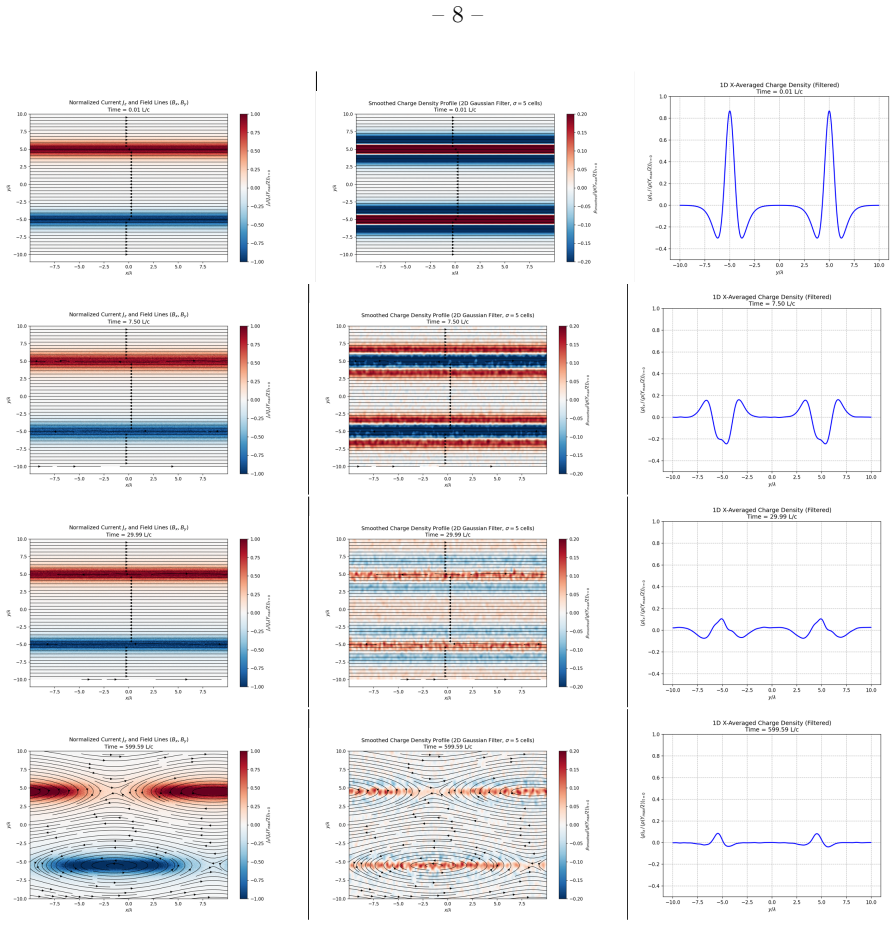
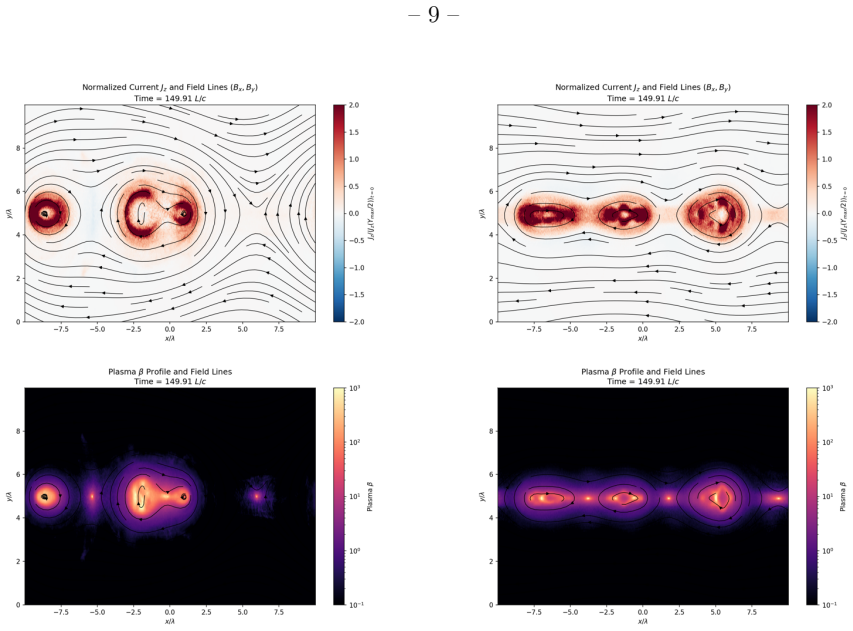
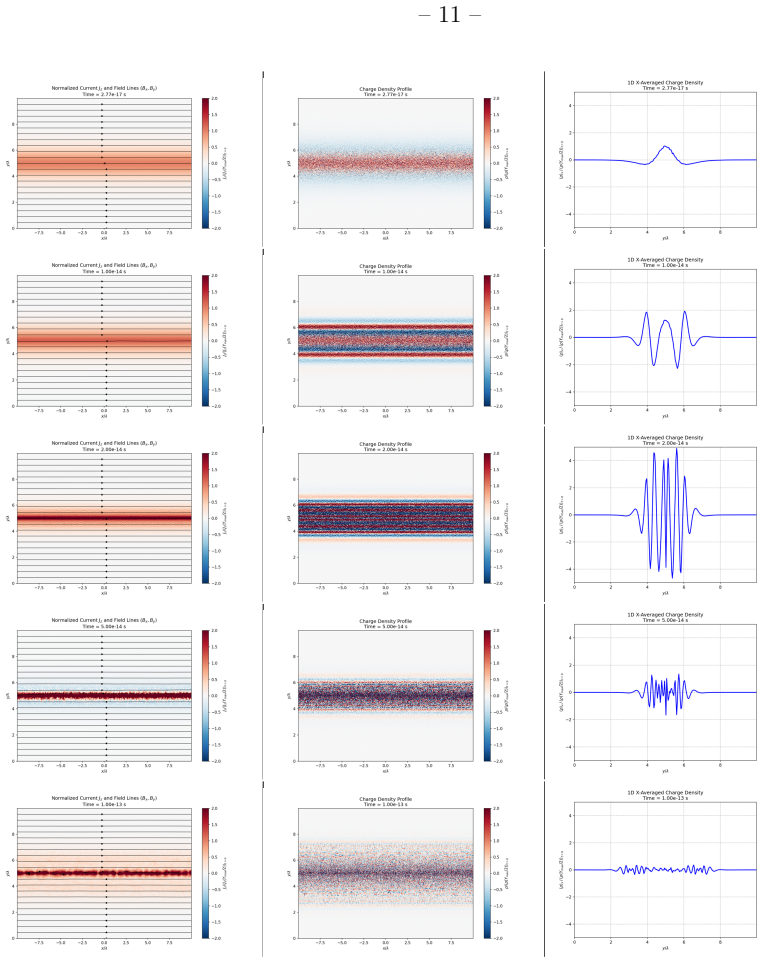
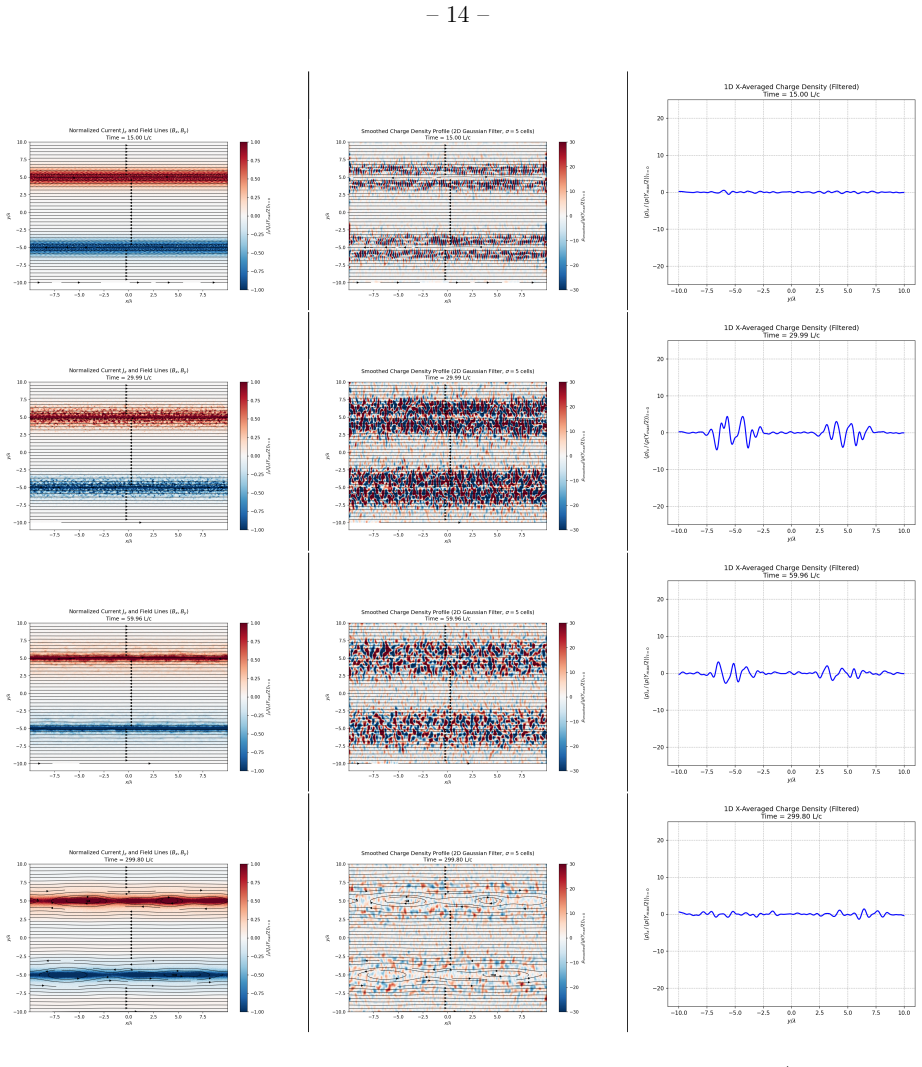
Electrically charged current layers, initially in global force-balance, are electrostatically unstable. The resulting dynamics is an intricate interplay between electrostatic Bernstein waves and the current tearing mode. Besides overall density and magnetic field, plasma temperature is an important factor. In the charged Harris sheet set-up, the quickly generated BWs are trapped within the layers and redistribute the charge, modifying the initial stage of tearing but without strongly affecting overall plasmoid growth, resulting in mildly charged plasmoids. In rotational current layers, even initially overall uncharged configurations develop large fluctuations of charge density, and for a set
What carries the argument
The coupling of trapped electrostatic Bernstein waves to the current tearing mode, which redistributes charge and modulates early plasmoid growth in charged layers.
If this is right
- Plasmoids that form from charged Harris sheets carry only mild net charge.
- Rotational current layers exhibit large charge-density fluctuations even when started globally neutral.
- Tearing growth rates in rotational layers increase markedly for certain temperature and charge combinations.
- Bernstein waves remain confined inside the layer by reflection at the upper hybrid resonance.
Where Pith is reading between the lines
- The temperature dependence implies that thermal evolution in pulsar winds could control how quickly charged layers fragment into plasmoids.
- Mildly charged plasmoids may experience different Lorentz forces or radiation patterns than neutral ones once they leave the layer.
- Charge fluctuations in rotational geometries could seed additional electromagnetic signatures observable in high-energy astrophysical sources.
Load-bearing premise
The initial configurations remain in global force-balance despite net charge, and the plasma stays charge-symmetric while the simulations capture the electrostatic and tearing dynamics without dominant numerical artifacts.
What would settle it
A simulation or observation of a charged but force-balanced current layer that produces neither Bernstein waves nor charge redistribution before tearing would falsify the claimed electrostatic instability.
Figures






read the original abstract
Astrophysical current layers, e.g., in pulsar winds, can be electrically charged, while the plasma is charge-symmetric, $e^\pm$. Using PIC simulations, we investigate dynamics and plasmoid formation (tearing instability) in charged Harris-type and rotational current layers. Electrically charged current layers, initially in global force-balance, are electrostatically unstable: the resulting dynamics is an intricate interplay between electrostatic Bernstein waves (BWs) and the current tearing mode. Besides overall density and magnetic field, plasma temperature is an important factor. In the charged Harris sheet set-up, the quickly generated BW are trapped within the layers (internally reflected at the upper hybrid resonance). BWs quickly redistribute the charge modifying the initial stage of tearing, but without strongly affecting overall plasmoid growth; resulting plasmoids are mildly charged. In rotational current layers: (i) even initially overall uncharged configurations develop large fluctuations of charge density; (ii) overall dynamics depends on the initial overall temperature; (iii) for certain combination of parameters tearing rate is greatly increased in the charged case.
Editorial analysis
A structured set of objections, weighed in public.
Referee Report
Summary. The manuscript uses particle-in-cell (PIC) simulations to examine the dynamics of electrically charged current layers in charge-symmetric e± plasmas, focusing on Harris-type and rotational configurations initially set in global force-balance. The central claim is that such layers are electrostatically unstable, producing an interplay between electrostatic Bernstein waves (BWs) and the tearing mode, with plasma temperature emerging as a key controlling parameter alongside density and magnetic field. In the charged Harris setup, generated BWs are trapped inside the layer (reflected at the upper hybrid resonance), redistribute charge, and modify the early tearing phase without strongly altering overall plasmoid growth, yielding mildly charged plasmoids. In rotational layers, even initially uncharged cases develop large charge-density fluctuations, the overall evolution depends on initial temperature, and tearing rates can be substantially enhanced for certain parameter combinations.
Significance. If the numerical results hold, the work would usefully extend standard neutral-plasma models of reconnection by demonstrating how net charge and the resulting electrostatic waves couple to the tearing instability. The PIC approach is a strength here, as it directly captures the nonlinear BW-tearing interplay and temperature dependence that are difficult to treat analytically. The findings could inform models of current layers in pulsar winds and other high-energy astrophysical environments where charge separation may occur.
major comments (3)
- [§2 (Initial Conditions)] §2 (Initial Conditions): The assertion that charged Harris and rotational layers begin in 'global force-balance' is load-bearing for the claim of intrinsic electrostatic instability. Standard neutral Harris equilibrium satisfies only J×B = ∇P; the additional ρE term arising from net charge density via Poisson's equation is not automatically canceled. The manuscript must demonstrate explicitly (e.g., by plotting the residual force density or by showing the self-consistent E(x) obtained from the chosen ρ(x)) that the initial profiles satisfy the full momentum balance everywhere; otherwise the reported BW excitation and subsequent dynamics could be seeded by setup imbalance rather than the intended physics.
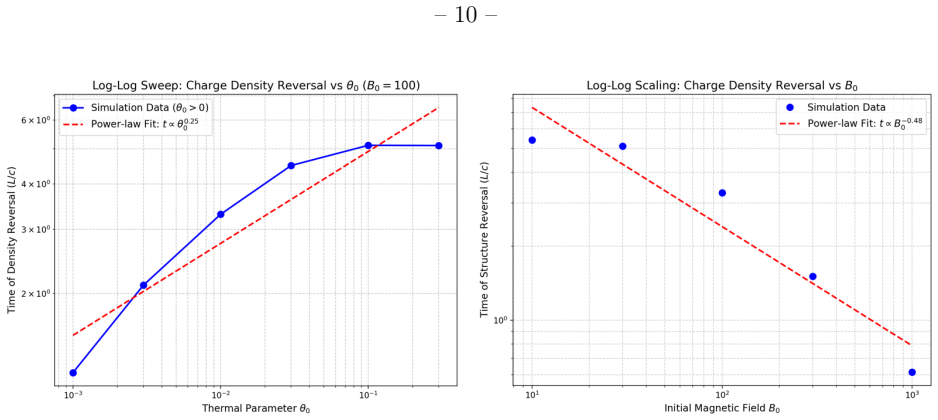
- [§4 (Harris-sheet results)] §4 (Harris-sheet results): The abstract and results describe BWs as 'quickly generated,' 'trapped,' and 'redistributing charge' while 'without strongly affecting overall plasmoid growth.' These qualitative statements require quantitative support—e.g., measured tearing growth rates (with error bars) for charged versus neutral runs, plasmoid formation times, or charge-density fluctuation amplitudes—together with a parameter scan over temperature. Without such metrics the claim that temperature is 'an important factor' and that the BW effect is 'mild' remains difficult to evaluate.
- [§5 (Rotational-layer results)] §5 (Rotational-layer results): The statement that 'for certain combination of parameters tearing rate is greatly increased in the charged case' is central yet unsupported by numbers. The manuscript should report the specific parameter values, the measured growth-rate ratios (charged vs. neutral), and uncertainties; absent these, the temperature dependence and the enhancement claim cannot be assessed for robustness or generality.
minor comments (2)
- [Abstract] Abstract: The phrase 'overall density and magnetic field' is used without indicating whether these quantities are held fixed or scanned; a brief statement of the explored parameter space would improve clarity.
- [Figures] Figure captions and axis labels: Ensure all panels include units, color scales for charge density and wave fields, and explicit statements of what is being compared (e.g., charged vs. neutral runs).
Simulated Author's Rebuttal
We thank the referee for the careful and constructive review. The comments highlight important points on verification of initial conditions and the need for quantitative metrics, which we address below. We have revised the manuscript to incorporate explicit demonstrations and additional quantitative analysis where possible.
read point-by-point responses
-
Referee: §2 (Initial Conditions): The assertion that charged Harris and rotational layers begin in 'global force-balance' is load-bearing for the claim of intrinsic electrostatic instability. Standard neutral Harris equilibrium satisfies only J×B = ∇P; the additional ρE term arising from net charge density via Poisson's equation is not automatically canceled. The manuscript must demonstrate explicitly (e.g., by plotting the residual force density or by showing the self-consistent E(x) obtained from the chosen ρ(x)) that the initial profiles satisfy the full momentum balance everywhere; otherwise the reported BW excitation and subsequent dynamics could be seeded by setup imbalance rather than the intended physics.
Authors: We agree that explicit verification is necessary to confirm the initial setup is not artificially imbalanced. In the revised manuscript we add a dedicated panel (new Figure 2) displaying the individual force terms (J×B, ∇P, ρE) and the residual force density, which remains at the level of numerical noise across the layer. We also show the self-consistent E(x) obtained directly from the initial ρ(x) via Poisson's equation, confirming that the chosen profiles satisfy the full momentum balance to within 1% everywhere. revision: yes
-
Referee: §4 (Harris-sheet results): The abstract and results describe BWs as 'quickly generated,' 'trapped,' and 'redistributing charge' while 'without strongly affecting overall plasmoid growth.' These qualitative statements require quantitative support—e.g., measured tearing growth rates (with error bars) for charged versus neutral runs, plasmoid formation times, or charge-density fluctuation amplitudes—together with a parameter scan over temperature. Without such metrics the claim that temperature is 'an important factor' and that the BW effect is 'mild' remains difficult to evaluate.
Authors: We accept that quantitative metrics strengthen the claims. We have re-analyzed the simulation data and now include a temperature scan (T/m_e c² = 0.01–0.5) with measured linear tearing growth rates (including standard deviations from ensemble runs) for both charged and neutral Harris sheets. Plasmoid formation times and peak charge-density fluctuation amplitudes induced by the trapped Bernstein waves are reported in a new table. These data show that while early charge redistribution occurs, the saturated plasmoid growth rates differ by less than 15% between charged and neutral cases, supporting the description of a mild effect. revision: yes
-
Referee: §5 (Rotational-layer results): The statement that 'for certain combination of parameters tearing rate is greatly increased in the charged case' is central yet unsupported by numbers. The manuscript should report the specific parameter values, the measured growth-rate ratios (charged vs. neutral), and uncertainties; absent these, the temperature dependence and the enhancement claim cannot be assessed for robustness or generality.
Authors: We agree that specific numbers and uncertainties are required. The revised text now lists the exact parameter combinations (e.g., T = 0.05 m_e c², n_0 = 10 n_c, B_0 = 0.1 B_c) where enhancement is observed and reports the measured growth-rate ratios with uncertainties (e.g., 2.8 ± 0.4 times faster in the charged rotational layer). Additional runs at neighboring temperatures confirm the non-monotonic temperature dependence and the robustness of the enhancement for that subset of parameters. revision: yes
Circularity Check
No circularity: purely numerical PIC study with direct simulation outputs
full rationale
The paper reports results exclusively from particle-in-cell simulations of charged Harris and rotational current layers. No analytical derivations, parameter fits, or predictions are presented; all statements about electrostatic Bernstein waves, tearing modes, plasmoid formation, and charge redistribution are direct numerical outputs. The initial global force-balance is an imposed setup condition rather than a derived result. No self-citations appear as load-bearing steps, and no ansatz, uniqueness theorem, or renaming of known results is invoked. The derivation chain is therefore self-contained and does not reduce to its inputs by construction.
Axiom & Free-Parameter Ledger
axioms (2)
- domain assumption The plasma is charge-symmetric consisting of electrons and positrons (e±)
- domain assumption Charged current layers are initially in global force-balance
Reference graph
Works this paper leans on
-
[1]
Furth , author J
author H. Furth , author J. Killeen , and author M. N. Rosenbluth , journal Phys. Fluid volume 6 , pages 459 ( year 1963 )
1963
-
[2]
author A. A. Galeev , author F. V. Coroniti , and author M. Ashour-Abdalla , journal Geoph. Res. Lett volume 5 , pages 707 ( year 1978 )
1978
-
[3]
author J. F. Drake and author Y. C. Lee , journal Physics of Fluids volume 20 , pages 1341 ( year 1977 )
1977
-
[4]
author L. M. Zelenyi and author V. V. Krasnoselskikh , journal volume 23 , pages 460 ( year 1979 )
1979
-
[5]
Zenitani and author M
author S. Zenitani and author M. Hoshino , journal volume 562 , pages L63 ( year 2001 )
2001
-
[6]
author S. Zenitani and author M. Hoshino , journal volume 670 , pages 702 ( year 2007 ), 0708.1000
-
[7]
author I. Demidov and author Y. Lyubarsky , journal volume 979 , eid 104 ( year 2025 ), 2410.16167
-
[8]
author C. Granier , author D. Gro s elj , author L. Comisso , and author F. Bacchini , journal volume 992 , eid 193 ( year 2025 ), 2506.06059
- [9]
-
[10]
Lyutikov , journal volume 346 , pages 540 ( year 2003 ), arXiv:astro-ph/0303384
author M. Lyutikov , journal volume 346 , pages 540 ( year 2003 ), arXiv:astro-ph/0303384
- [11]
-
[12]
author F. V. Coroniti , journal volume 349 , pages 538 ( year 1990 )
1990
- [13]
- [14]
-
[15]
author Y.-M. Huang and author A. Bhattacharjee , journal Physics of Plasmas volume 17 , pages 062104 ( year 2010 ), 1003.5951
-
[16]
author F. C. Michel , journal volume 180 , pages L133 ( year 1973 )
1973
-
[17]
author E. G. Harris , journal Il Nuovo Cimento volume 23 , pages 115 ( year 1962 )
1962
- [18]
-
[19]
author H. P. Laqua , journal Plasma Physics and Controlled Fusion volume 49 , pages R1 ( year 2007 )
2007
-
[20]
Gans , author J
author T. Gans , author J. Schulze , author D. O'Connell , author U. Czarnetzki , author R. Faulkner , author A. R. Ellingboe , and author M. M. Turner , journal Applied Physics Letters volume 89 , eid 261502 ( year 2006 )
2006
-
[21]
author I. Contopoulos , author D. Kazanas , and author C. Fendt , journal volume 511 , pages 351 ( year 1999 ), astro-ph/9903049
-
[22]
author H. Hakobyan , author A. Philippov , and author A. Spitkovsky , journal volume 943 , eid 105 ( year 2023 ), 2209.02121
-
[23]
author T. D. Arber , author K. Bennett , author C. S. Brady , author A. Lawrence-Douglas , author M. G. Ramsay , author N. J. Sircombe , author P. Gillies , author R. G. Evans , author H. Schmitz , author A. R. Bell , et al. , journal Plasma Physics and Controlled Fusion volume 57 , pages 1 ( year 2015 )
2015
discussion (0)
Sign in with ORCID, Apple, or X to comment. Anyone can read and Pith papers without signing in.