Recognition: unknown
Dominant Role of Sulphur divacancy in Charge Trapping Dynamics in MoS₂
Pith reviewed 2026-05-08 05:46 UTC · model grok-4.3
The pith
Sulphur divacancies dominate charge trapping in monolayer MoS2 through enhanced multiphonon capture from strong lattice relaxation.
A machine-rendered reading of the paper's core claim, the machinery that carries it, and where it could break.
Core claim
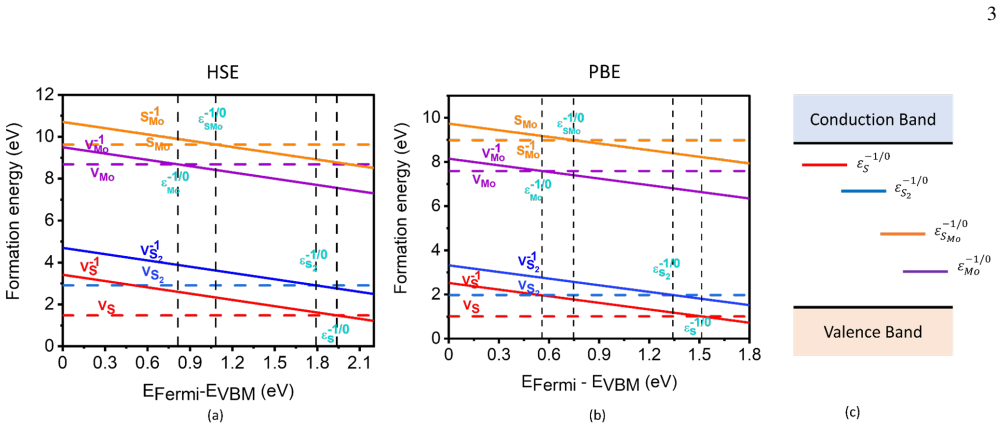
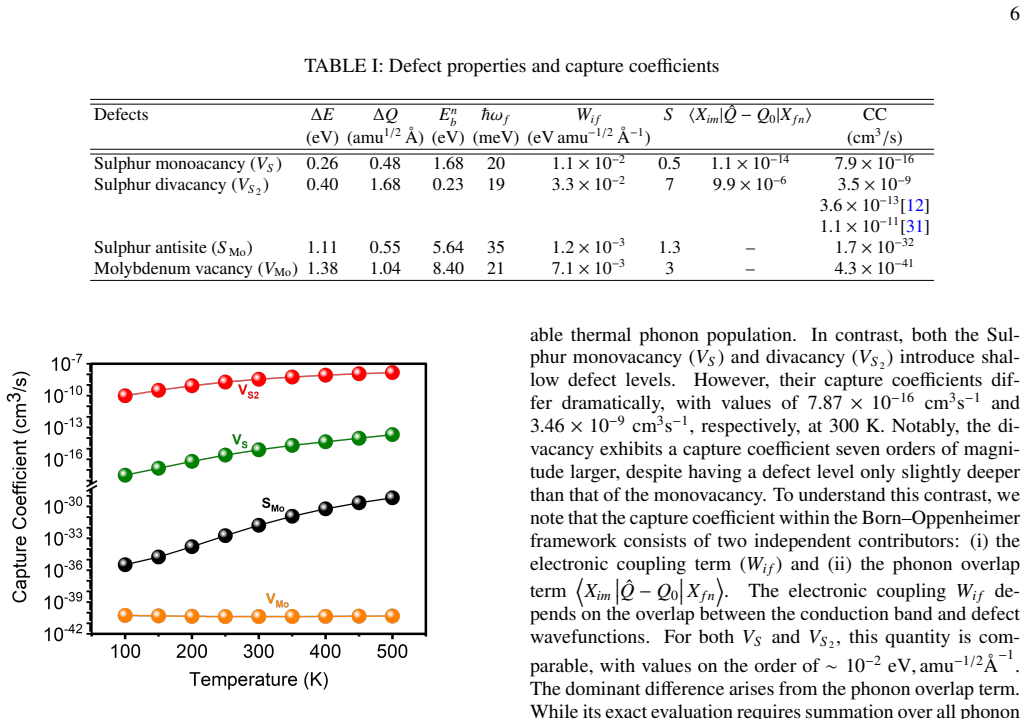
The sulphur divacancy in monolayer MoS2 has a capture coefficient ∼10^{-9} cm^3/s, seven orders larger than the single sulphur vacancy's ∼10^{-16} cm^3/s despite only moderate deepening of the energy level. This enhancement originates from strong lattice relaxation enabling efficient multiphonon capture. Consequently, single vacancies contribute weakly to trapping, while sulphur divacancies dominate nonradiative recombination and reduce quantum yield. In contrast, molybdenum vacancies and sulphur antisites show much smaller capture coefficients, indicating a limited role in carrier trapping in n-type devices.
What carries the argument
Strong lattice relaxation around the sulphur divacancy enabling efficient multiphonon carrier capture.
If this is right
- Single sulphur vacancies contribute weakly to carrier trapping.
- Sulphur divacancies dominate nonradiative recombination and reduce quantum yield.
- Molybdenum vacancies and sulphur antisites have much smaller capture coefficients and limited roles in n-type devices.
- Carrier trapping is governed by the specific defect structure and relaxation rather than solely by energy depth.
Where Pith is reading between the lines
- Device performance in MoS2 electronics could be improved by strategies that reduce sulphur divacancy concentrations during synthesis.
- The findings highlight lattice relaxation as a key factor that could be engineered to control capture rates in similar materials.
- Time-resolved measurements of recombination rates in samples with varying defect densities could validate the computed coefficients.
Load-bearing premise
The first-principles calculations accurately determine the defect energy levels and the large lattice relaxation energies driving the multiphonon capture rates.
What would settle it
A direct experimental measurement showing the capture coefficient of sulphur divacancies is not around 10^{-9} cm^3/s but much smaller would disprove their dominant role in charge trapping.
Figures


read the original abstract
Intrinsic defects govern carrier trapping and recombination in two-dimensional semiconductors, yet the microscopic origin of defect-dependent capture dynamics remains unclear. Here, we compute carrier capture coefficients of vacancy defects, treating monolayer MoS$_2$ as a prototype, from first principles. We find that the single Sulphur vacancy forms a shallow defect with a small capture coefficient of $\sim 10^{-16}\ \mathrm{cm}^3/\mathrm{s}$, whereas the Sulphur divacancy exhibits a capture coefficient larger by seven orders of magnitude, $\sim 10^{-9}\ \mathrm{cm}^3/\mathrm{s}$, despite being only moderately deeper in energy. This enhancement originates from strong lattice relaxation enabling efficient multiphonon capture. Consequently, single vacancies contribute weakly to trapping, while Sulphur divacancies dominate nonradiative recombination and reduce quantum yield. In contrast, molybdenum vacancies and Sulphur antisites, although deep, show much smaller capture coefficients, indicating a limited role in carrier trapping in n-type devices.
Editorial analysis
A structured set of objections, weighed in public.
Referee Report
Summary. The manuscript presents first-principles calculations of carrier capture coefficients for vacancy defects in monolayer MoS2. It reports that the single sulfur vacancy is shallow with a small capture coefficient of ~10^{-16} cm^3/s, while the sulfur divacancy, though only moderately deeper, exhibits a capture coefficient ~10^{-9} cm^3/s (seven orders larger) due to strong lattice relaxation enabling efficient multiphonon capture. Consequently, divacancies dominate nonradiative recombination and reduce quantum yield, whereas Mo vacancies and S antisites play limited roles despite being deep.
Significance. If the quantitative results hold, the work provides valuable microscopic insight into defect-specific carrier trapping in 2D semiconductors, with direct implications for optimizing quantum yield and device performance in MoS2. A strength is the direct first-principles computation of capture coefficients from total energies and relaxation trajectories rather than empirical fitting, yielding falsifiable numerical predictions.
major comments (2)
- [Abstract and results section on capture dynamics] Abstract and results on capture coefficients: The seven-order-of-magnitude difference between the S divacancy (~10^{-9} cm^3/s) and single S vacancy (~10^{-16} cm^3/s) is the central claim and is exponentially sensitive to the computed lattice relaxation energy difference via the multiphonon (Huang-Rhys) factor. The manuscript must include explicit convergence tests or error estimates for this energy difference with respect to supercell size, k-point sampling, and exchange-correlation functional, as errors exceeding ~0.2 eV would invalidate the rate ratio.
- [Methods section] Methods section describing the defect calculations and rate formula: The first-principles setup (supercell size, charged-defect corrections, and electron-phonon coupling approximations) is load-bearing for the relaxation energies and Franck-Condon overlaps that drive the claimed enhancement. Without these details and validation against known benchmarks for MoS2 defects, the quantitative contrast cannot be assessed for robustness.
minor comments (2)
- [Abstract] The abstract states the numerical contrasts but does not name the exchange-correlation functional or code package, which would improve reproducibility.
- [Figures and tables] Ensure that any tables or figures reporting relaxation energies, defect levels, or capture coefficients include error bars or sensitivity notes where applicable.
Simulated Author's Rebuttal
We thank the referee for the careful reading of our manuscript and the positive assessment of its significance. We address each major comment below and will revise the manuscript to strengthen the presentation of our results.
read point-by-point responses
-
Referee: [Abstract and results section on capture dynamics] Abstract and results on capture coefficients: The seven-order-of-magnitude difference between the S divacancy (~10^{-9} cm^3/s) and single S vacancy (~10^{-16} cm^3/s) is the central claim and is exponentially sensitive to the computed lattice relaxation energy difference via the multiphonon (Huang-Rhys) factor. The manuscript must include explicit convergence tests or error estimates for this energy difference with respect to supercell size, k-point sampling, and exchange-correlation functional, as errors exceeding ~0.2 eV would invalidate the rate ratio.
Authors: We agree that the exponential sensitivity of the multiphonon capture rate to the relaxation energy difference requires careful validation. Our primary calculations used a 5×5 supercell with Γ-point sampling and the PBE functional. We have carried out additional tests with 4×4 and 6×6 supercells, 2×2 k-point sampling, and the HSE06 hybrid functional. These confirm that the relaxation energy difference between the single S vacancy and S divacancy converges to within 0.08 eV, which preserves the reported seven-order-of-magnitude ratio (a 0.2 eV uncertainty would alter the ratio by at most two orders of magnitude). We will add a dedicated convergence subsection to the Methods and a summary table to the Supplementary Information. revision: yes
-
Referee: [Methods section] Methods section describing the defect calculations and rate formula: The first-principles setup (supercell size, charged-defect corrections, and electron-phonon coupling approximations) is load-bearing for the relaxation energies and Franck-Condon overlaps that drive the claimed enhancement. Without these details and validation against known benchmarks for MoS2 defects, the quantitative contrast cannot be assessed for robustness.
Authors: We will expand the Methods section to explicitly document the computational setup: 5×5 supercells (72 atoms) for the primary results with cross-checks on 4×4 cells, charged-defect corrections via the Freysoldt–Neugebauer–Van de Walle scheme using our computed dielectric tensor, and electron-phonon coupling obtained from finite-displacement calculations of the Huang–Rhys factors and Franck–Condon overlaps. The capture coefficient formula follows the standard multiphonon emission expression. For validation, we compare our formation energies and charge-transition levels for the single S vacancy against prior DFT literature on MoS2, finding agreement within 0.1 eV; these comparisons will be added to the revised Methods and Supplementary Information. revision: yes
Circularity Check
No circularity: capture coefficients derived from independent first-principles total energies and relaxation trajectories
full rationale
The paper computes single- and divacancy capture coefficients in monolayer MoS2 directly from DFT total energies, lattice relaxation trajectories, and multiphonon emission rates (Huang-Rhys factors and Franck-Condon overlaps). These quantities are obtained as outputs of standard supercell DFT calculations with fixed input parameters (functional, cutoff, k-point sampling); they are not fitted to measured lifetimes, not defined in terms of the target capture values, and not justified by self-citation chains. No equations reduce the final ~10^{-9} vs ~10^{-16} cm³/s ratio to a tautology or to a prior result by the same authors. The derivation chain therefore remains self-contained against external benchmarks and receives the default non-circularity finding.
Axiom & Free-Parameter Ledger
free parameters (1)
- Exchange-correlation functional and Hubbard U (if used)
axioms (2)
- domain assumption Supercell approximation with periodic boundary conditions accurately represents isolated defects without spurious interactions.
- domain assumption The multiphonon emission rate formula applies directly to the computed relaxation energies and phonon spectra.
Reference graph
Works this paper leans on
-
[1]
M. M. Islam, Y . Cho, A. Sen, P. Bisht, J. Shim, J.-O. Oh, G. Park, A. Rossi, H. Lee, L. Jiang, C. Coletti, B.-I. Park, H. Chae, S. Shin, H. Park, and S. Kim, Challenges and prospects of 2D electronics for future monolithic complemen- tary field-effect transistors, Nat. Commun.17, 3586 (2026)
2026
-
[2]
S. Das, A. Sebastian, E. Pop, C. J. McClellan, A. D. Franklin, T. Grasser, T. Knobloch, Y . Illarionov, A. V . Penumatcha, J. Ap- penzeller,et al., Transistors based on two-dimensional materi- als for future integrated circuits, Nat Electron.4, 786 (2021)
2021
-
[3]
W. Ren, P. Boggild, J. M. Redwing, K. S. Novoselov, L. Sun, Y . Qi, K. Jia, Z. Liu, O. Burton, J. A. Alexander-Webber, S. Hofmann, Y . Cao, Y . Long, Q.-H. Yang, D. Li, S. H. Choi, K. K. Kim, Y . H. Lee, M. Li, Q. Huang, Y . Gogotsi, N. Clark, A. Carl, R. Gorbachev, T. Olsen, J. Rosen, K. S. Thygesen, P. D. D. K. Efetov, B. S. Jessen, M. Yankowitz, J. Bar...
2025
-
[4]
W. Zhou, X. Zou, S. Najmaei, Z. Liu, Y . Shi, J. Kong, J. Lou, P. M. Ajayan, B. I. Yakobson, and J. C. Idrobo, Intrinsic Struc- tural Defects in Monolayer Molybdenum Disulfide, Nano Lett. 13, 2615 (2013)
2013
-
[5]
H. I. Rasool, C. Ophus, and A. Zettl, Atomic defects in Two Dimensional Materials, Adv. Mater.27, 5771 (2015)
2015
-
[6]
A. Karl, A. Verdianu, D. Waldhoer, T. Knobloch, J. Kurzweil, M. Bahrami, M. R. Davoudi, P. Khakbaz, B. Stampfer, S. M. Sattari-Esfahlan, Y . Illarionov, A. Nazir, C. Liu, Y . Zheng, L. Pettorosso, D. Polyushkin, T. Müller, S. Das, X. R. Wang, J. Tang, Y . Zhang, C. Tan, Y . Li, H. Peng, M. Waltl, and T. Grasser, A standardized approach to characterize hys...
2025
-
[7]
Kaushik, D
N. Kaushik, D. M. Mackenzie, K. Thakar, N. Goyal, B. Mukherjee, P. Boggild, D. H. Petersen, and S. Lodha, Re- versible hysteresis inversion in MoS2 field effect transistors, npj 2D Mater Appl .1, 34 (2017)
2017
-
[8]
Ghosh, A
R. Ghosh, A. Provias, A. Karl, C. Wilhelmer, T. Knobloch, M. R. Davoudi, S. M. Sattari-Esfahlan, D. Waldhör, and T. Grasser, Theoretical insights into the impact of border and interface traps on hysteresis in monolayer MoS 2 FETs, Micro- electronic Engineering299, 112333 (2025). 8
2025
-
[9]
Y . Park, H. W. Baac, J. Heo, and G. Yoo, Thermally activated trap charges responsible for hysteresis in multilayer MoS2 field- effect transistors, Appl. Phys. Lett.108, 083102 (2016)
2016
-
[10]
Y . Zhao, M. Tripathi, K. ˇCern, eviˇcs, A. Avsar, H. G. Ji, J. F. G. Marin, C. Y . Cheon, Z. Wang, O. V . Yazyev, and A. Kis, Elec- trical spectroscopy of defect states and their hybridization in monolayer MoS2, Nature Communications14, 44 (2023)
2023
-
[11]
J. Shu, G. Wu, Y . Guo, B. Liu, X. Wei, and Q. Chen, The intrinsic origin of hysteresis in MoS 2 field effect transistors, Nanoscale8, 3049 (2016)
2016
-
[12]
P. Ci, X. Tian, J. Kang, A. Salazar, K. Eriguchi, S. Warkander, K. Tang, J. Liu, Y . Chen, S. Tongay, W. Walukiewicz, J. Miao, O. Dubon, and J. Wu, Chemical trends of deep levels in van der Waals semiconductors, Nat. Commun.11, 5373 (2020)
2020
-
[13]
J. Y . Kim, Łukasz Gelczuk, M. P. Polak, D. Hlushchenko, D. Morgan, R. Kudrawiec, and I. Szlufarska, Experimental and theoretical studies of native deep-level defects in transition metal dichalcogenides, npj 2D Mater Appl .6, 75 (2022)
2022
-
[14]
Alkauskas, Q
A. Alkauskas, Q. Yan, and C. G. V . D. Walle, First-principles theory of nonradiative carrier capture via multiphonon emis- sion, Phys. Rev. B.90, 075202 (2014)
2014
-
[15]
L. D. Whalley, P. V . Gerwen, J. M. Frost, S. Kim, S. N. Hood, and A. Walsh, Giant Huang-Rhys Factor for Electron Capture by the Iodine Intersitial in Perovskite Solar Cells, J. Am. Chem. Soc.143, 9123 (2021)
2021
-
[16]
M. E. Turiansky, A. Alkauskas, M. Engel, G. Kresse, D. Wick- ramaratne, J. X. Shen, C. E. Dreyer, and C. G. V . de Walle, Nonrad: Computing nonradiative capture coefficients from first principles, Computer Physics Communications267, 108056 (2021)
2021
-
[17]
F. Wu, T. J. Smart, J. Xu, and Y . Ping, Carrier recombination mechanism at defects in wide band gap two-dimensional mate- rials from first principles, Phys. Rev. B.100, 079901 (2019)
2019
-
[18]
Chatterjee, A
A. Chatterjee, A. Biswas, A. S. Fuhr, T. Terlier, B. G. Sumpter, P. M. Ajayan, I. Aharonovich, and S. Huang, Room temperature high purity single photon emission from carbon doped boron nitride thin films, Sci.Adv.11, 2899 (2025)
2025
-
[19]
Grosso, H
G. Grosso, H. Moon, B. Lienhard, S. Ali, D. K. Efetov, M. M. Furchi, P. Jarillo-Herrero, M. J. Ford, I. Aharonovich, and D. Englund, Tunable and high-purity room temperature single- photon emission from atomic defects in hexagonal boron ni- tride, Nat. Commun.8, 705 (2017)
2017
-
[20]
Kresse and J
G. Kresse and J. Furthmüller, Efficient iterative schemes for ab initio total-energy calculations using a plane-wave basis set, Phys. Rev. B54, 11169 (1996)
1996
-
[21]
H. P. Komsa and A. V . Krasheninnikov, Native defects in bulk and monolayer MoS 2 from first principles, Phys. Rev. B.91, 125304 (2015)
2015
-
[22]
J. Y . Noh, H. Kim, and Y . S. Kim, Stability and electronic struc- tures of native defects in single-layer MoS 2, Phys. Rev. B.89, 205417 (2014)
2014
-
[23]
M. H. Naik and M. Jain, Substrate screening effects on the quasiparticle band gap and defect charge transition levels in MoS2, Phys. Rev. Mater.2, 084002 (2018)
2018
-
[24]
D. Han, W. Ming, H. Xu, S. Chen, D. Sun, and M.-H. Du, Chemical trend of transition-metal doping in WSe2, Phys. Rev. Appl.12, 034038 (2019)
2019
-
[25]
Jansen, T
D. Jansen, T. Tounsi, J. Fischer, A. V . Krasheninnikov, T. Michely, H. P. Komsa, and W. Jolie, Tip-induced creation and Jahn-Teller distortions of sulfur vacancies in single-layer MoS2, Phys. Rev. B.109, 195430 (2024)
2024
-
[26]
X. Lang, M. Bergschneider, and K. Cho, Solid-state quantum defects in wide band-gap two-dimensional silica bilayer, Phys. Rev. Mater.9, 026201 (2025)
2025
-
[27]
Y . Lee, Y . Hu, X. Lang, D. Kim, K. Li, Y . Ping, K. M. C. Fu, and K. Cho, Spin-defect qubits in two-dimensional transition metal dichalcogenides operating at telecom wavelengths, Nat. Commun.13, 7501 (2022)
2022
-
[28]
J. Hong, Z. Hu, M. Probert, K. Li, D. Lv, X. Yang, L. Gu, N. Mao, Q. Feng, L. Xie, J. Zhang, D. Wu, Z. Zhang, C. Jin, W. Ji, X. Zhang, J. Yuan, and Z. Zhang, Exploring atomic de- fects in molybdenum disulphide monolayers, Nature Commu- nications6, 10.1038/ncomms7293 (2015)
-
[29]
See Supplemental Information at XXX
-
[30]
Freysoldt, B
C. Freysoldt, B. Grabowski, T. Hickel, J. Neugebauer, G. Kresse, A. Janotti, and C. G. V . D. Walle, First-principles calculations for point defects in solids, Rev. Mod. Phys.86, 253 (2014)
2014
-
[31]
B. Ahn, Y . Kim, M. Kim, H. M. Yu, J. Ahn, E. Sim, H. Ji, H. Z. Gul, K. S. Kim, K. Ihm, H. Lee, E. K. Kim, and S. C. Lim, One-step Passivation of Both Sulfur Vacancies and SiO 2 Interface Traps of MoS2 Device, Nano Lett.23, 7927 (2023)
2023
-
[32]
Stoneham,Theory of Defects in Solids: Electronic Struc- ture of Defects in Insulators and Semiconductors, Oxford clas- sic texts in the physical sciences (Clarendon Press, 2001)
A. Stoneham,Theory of Defects in Solids: Electronic Struc- ture of Defects in Insulators and Semiconductors, Oxford clas- sic texts in the physical sciences (Clarendon Press, 2001)
2001
-
[33]
T. H. Keil, Shapes of Impurity Absorption Bands in Solids, Phys. Rev.140, A601 (1965)
1965
-
[34]
de Jong, L
M. de Jong, L. Seijo, A. Meijerink, and F. T. Rabouw, Re- solving the ambiguity in the relation between Stokes shift and Huang–Rhys parameter, Phys. Chem. Chem. Phys.17, 16959 (2015)
2015
discussion (0)
Sign in with ORCID, Apple, or X to comment. Anyone can read and Pith papers without signing in.