Recognition: unknown
A comparative study of occurrence rates and nature of Ultraluminous X-ray sources in spiral and elliptical galaxies
Pith reviewed 2026-05-08 06:13 UTC · model grok-4.3
The pith
Galaxies hosting only one ULX show a distinct population with both soft and hard sources, unlike the mostly hard sources in galaxies with multiple ULXs.
A machine-rendered reading of the paper's core claim, the machinery that carries it, and where it could break.
Core claim
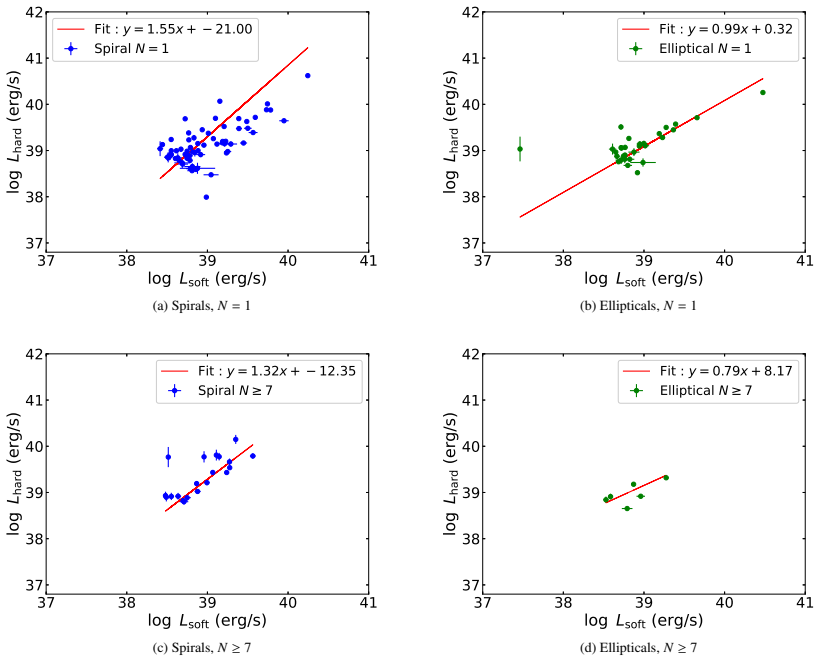
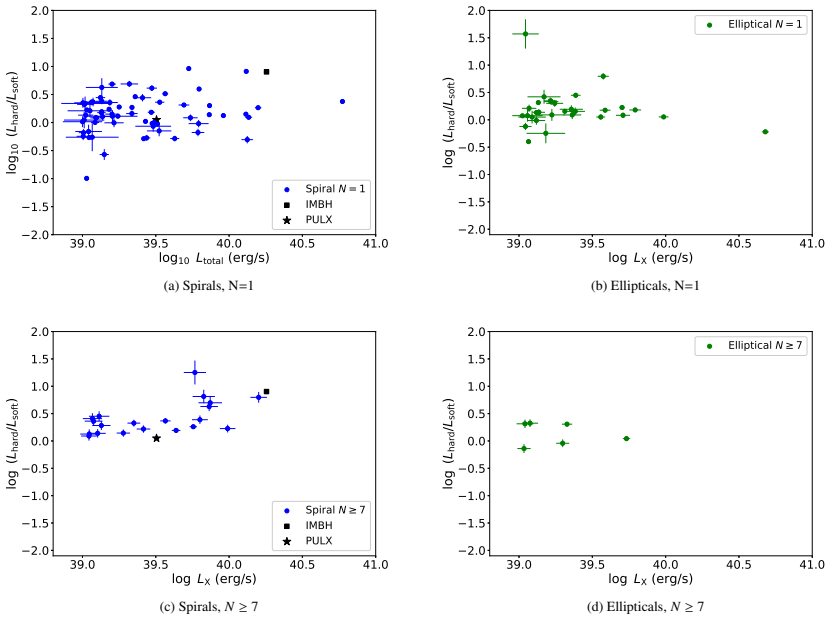
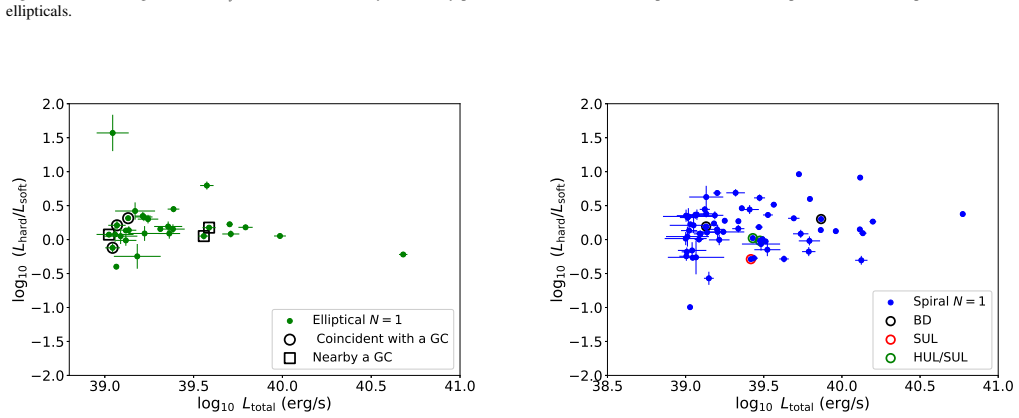
From this study, we infer the presence of a separate population of ULXs in the N=1 spiral group which contains a reasonable fraction of both soft and hard sources, while the remaining categories contain mostly harder sources. We also find six ULXs in N=1 ellipticals with globular cluster association. In addition, we identify few luminous candidates likely hosting massive accretors. This provides crucial hints of a potential link between ULX types and their occurrence rates and host morphology.
What carries the argument
The division of galaxies into N=1 versus higher-occurrence-rate groups in spirals and ellipticals, followed by construction of flux-limited samples and comparison of their X-ray spectral hardness and spatial associations such as globular clusters.
If this is right
- N=1 spiral galaxies host ULXs with a mix of soft and hard spectra.
- All other groups (N>1 spirals and both N=1 and N>1 ellipticals) are dominated by harder sources.
- Six ULXs in N=1 ellipticals are spatially associated with globular clusters.
- A few luminous candidates appear consistent with massive accretors.
- Occurrence rate and host morphology are linked to ULX spectral types.
Where Pith is reading between the lines
- Targeted spectral follow-up of the N=1 spiral sources could distinguish whether the soft component arises from different accretion states or different accretor masses.
- The globular-cluster associations in ellipticals may indicate that dynamical interactions in dense environments contribute to forming some ULXs.
- If the N=1 population proves distinct, single-ULX galaxies could represent systems caught at a particular evolutionary stage with lower overall star-formation or dynamical activity.
Load-bearing premise
That the adopted scheme for generating flux-limited credible samples accurately represents the underlying populations without significant selection biases, so that observed differences between N=1 and higher-rate groups reflect intrinsic properties rather than observational effects.
What would settle it
A deeper X-ray survey of the same galaxies that finds the hardness distributions of sources in N=1 spirals to match those in the multi-ULX groups, or that shows no excess globular-cluster associations in N=1 ellipticals, would undermine the claim of distinct populations.
Figures


read the original abstract
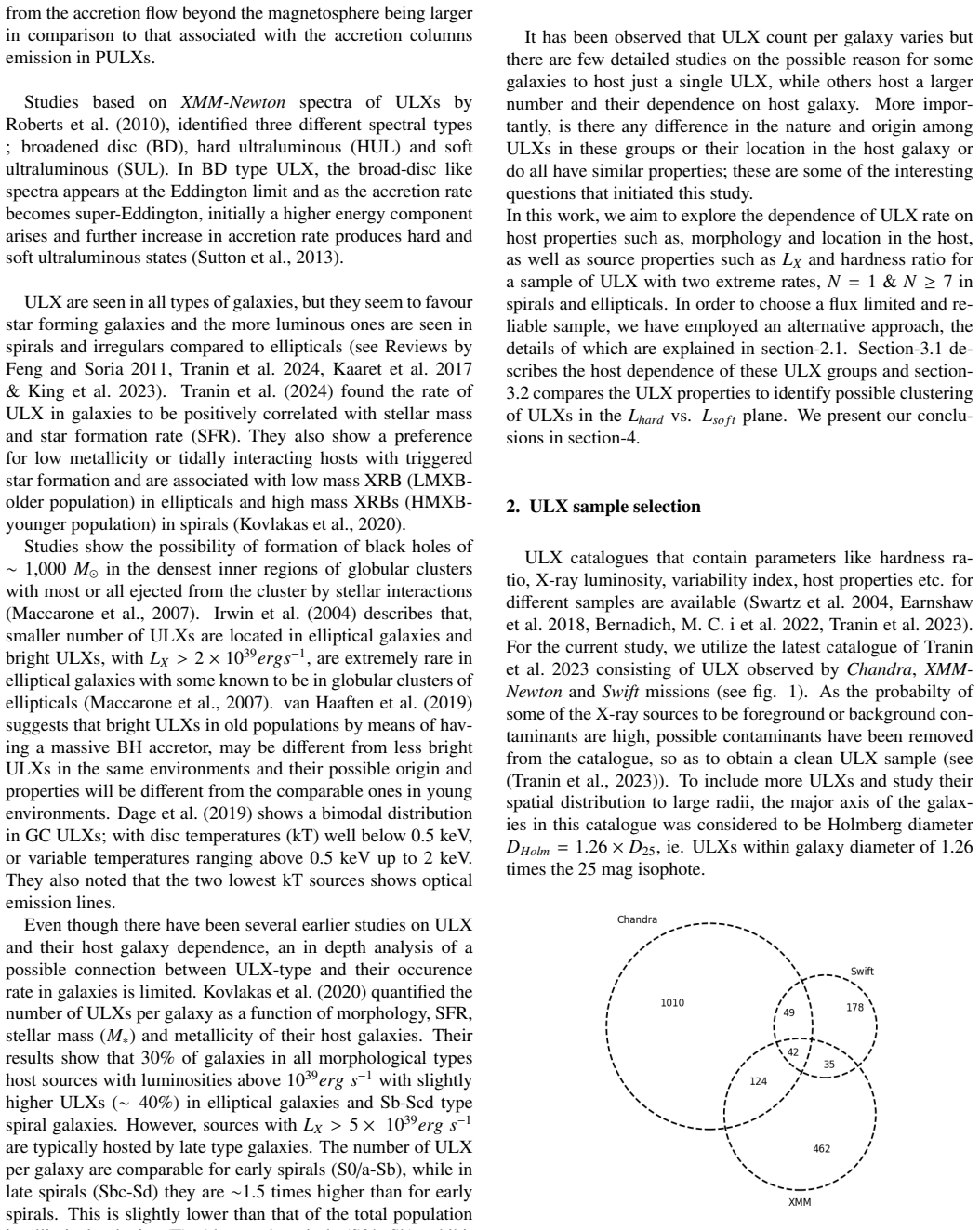
Ultraluminous X-ray sources (ULXs) are mostly extragalactic non-nuclear point sources having X-ray luminosity exceeding the Eddington luminosity of 10 $M_\odot$ black hole i.e., $L_X \geq $ 10$^{39}$ erg ~s$^{-1}$. They are observed in all types of galaxies; spirals, ellipticals and dwarf irregulars. But the rate of occurrence of ULXs per galaxy varies, some might host a single ULX, whereas some host a large number. In this work we attempt to identify possible differences in ULX properties between two extreme categories in spirals and ellipticals, i.e. ULXs occurring at a rate of one per galaxy ($N=1$) and those occurring at larger rate. We adopt an effective scheme to generate flux limited, credible samples corresponding to the two groups in spirals and ellipticals. From this study, we infer the presence of a separate population of ULXs in the $N=1$ spiral group which contains a reasonable fraction of both soft and hard sources, while the remaining categories contain mostly harder sources. We also find six ULXs in $N=1$ ellipticals with globular cluster association. In addition, we identify few luminous candidates likely hosting massive accretors. This study provides crucial hints of a potential link between ULX types and their occurrence rates and host morphology, a finding that warrants validation via targeted observations and detailed spectral analysis of these sources.
Editorial analysis
A structured set of objections, weighed in public.
Referee Report
Summary. The paper conducts a comparative study of ultraluminous X-ray sources (ULXs) in spiral and elliptical galaxies, distinguishing galaxies hosting exactly one ULX (N=1) from those with larger numbers. Using an adopted scheme to construct flux-limited credible samples, the authors infer a distinct ULX population in N=1 spiral galaxies that includes a reasonable fraction of both soft and hard sources, while the remaining categories (N>1 spirals and both N=1 and N>1 ellipticals) contain mostly harder sources. They additionally report six ULXs in N=1 elliptical galaxies associated with globular clusters and identify a few luminous candidates likely hosting massive accretors.
Significance. If the central claims hold after addressing selection effects, the work provides observational evidence for a link between ULX occurrence rate, host morphology, and spectral properties, which could distinguish formation channels (e.g., dynamical vs. primordial binaries) and accretion states. The globular-cluster associations in low-occurrence ellipticals add to the case for dense-environment formation routes. The comparative approach across galaxy types is a strength, though the result remains preliminary without detailed validation.
major comments (2)
- [Abstract] Abstract (and the section describing the sample construction): the claim that the flux-limited credible-sample scheme isolates intrinsic population differences is load-bearing for the main inference, yet no details are given on sample sizes, completeness corrections, or mock-population tests that recover the input soft/hard ratio independently of the N=1 versus multi-ULX grouping. Softer ULXs have lower detection probabilities at larger distances or in higher-background elliptical hosts; without explicit bias quantification, the reported mixed population in N=1 spirals could be produced by selection even if the underlying populations are identical.
- [Abstract] Abstract: the six ULXs reported in N=1 ellipticals with globular-cluster association are presented without stated association criteria, positional matching tolerances, or expected random coincidence rates, which are required to evaluate whether this supports a distinct dynamical channel.
minor comments (2)
- [Abstract] The abstract contains unrendered LaTeX (e.g., '10 $M_odot$') and long compound sentences that reduce readability; these should be cleaned for the final version.
- [Abstract] No references are cited in the abstract to prior ULX occurrence-rate studies in spirals versus ellipticals, which would help place the N=1 versus N>1 distinction in context.
Simulated Author's Rebuttal
We thank the referee for the constructive and detailed report. The comments identify areas where additional transparency will strengthen the manuscript, particularly regarding the sample construction and globular-cluster associations. We address each major comment below and will revise the paper to incorporate the requested details and clarifications.
read point-by-point responses
-
Referee: [Abstract] Abstract (and the section describing the sample construction): the claim that the flux-limited credible-sample scheme isolates intrinsic population differences is load-bearing for the main inference, yet no details are given on sample sizes, completeness corrections, or mock-population tests that recover the input soft/hard ratio independently of the N=1 versus multi-ULX grouping. Softer ULXs have lower detection probabilities at larger distances or in higher-background elliptical hosts; without explicit bias quantification, the reported mixed population in N=1 spirals could be produced by selection even if the underlying populations are identical.
Authors: We agree that the flux-limited credible-sample scheme is central to the main inference and that the current description lacks sufficient quantitative support. In the revised manuscript we will expand the relevant section to report the exact sample sizes in each category (N=1 spirals, N>1 spirals, N=1 ellipticals, N>1 ellipticals), detail the completeness corrections applied, and present mock-population tests that recover the input soft/hard source ratio independently of the N=1 versus multi-ULX grouping. We will also add explicit bias quantification, including estimates of detection probability as a function of distance, background level, and spectral hardness, to demonstrate that the observed mixed population in N=1 spirals is unlikely to arise solely from selection effects. These additions will allow readers to evaluate the robustness of the claimed intrinsic differences. revision: yes
-
Referee: [Abstract] Abstract: the six ULXs reported in N=1 ellipticals with globular-cluster association are presented without stated association criteria, positional matching tolerances, or expected random coincidence rates, which are required to evaluate whether this supports a distinct dynamical channel.
Authors: We acknowledge that the association criteria for the six ULXs in N=1 elliptical galaxies were not stated explicitly. In the revised version we will specify the positional matching tolerances (angular separation threshold), the precise association criteria employed, and the calculation of expected random coincidence rates derived from local source densities and the searched area. These quantitative details will enable a proper statistical assessment of the associations and their implications for a dynamical formation channel. revision: yes
Circularity Check
No significant circularity; observational sample comparison is self-contained
full rationale
This paper performs an observational comparative analysis of ULX occurrence rates and spectral properties across spiral and elliptical galaxies, distinguishing N=1 versus higher-multiplicity groups. It adopts a flux-limited credible-sample construction scheme and reports empirical fractions of soft/hard sources plus GC associations. No mathematical derivation chain, parameter fitting, or predictive model is present that could reduce to self-definition or fitted inputs by construction. Claims rest on direct data classification and inter-category contrasts rather than any self-referential loop. No load-bearing self-citations, uniqueness theorems, or ansatzes are invoked. The analysis is therefore independent of its own outputs and qualifies as a standard empirical study.
Axiom & Free-Parameter Ledger
axioms (1)
- standard math ULXs are defined as non-nuclear sources with L_X >= 10^39 erg/s
Reference graph
Works this paper leans on
-
[6]
American Astronomical Society Meeting Abstracts , year = 2006, series =
Active X-ray States of Black Hole Binaries: Current Overview. American Astronomical Society Meeting Abstracts , year = 2006, series =
2006
-
[12]
and Roberts, Timothy P
Sutton, Andrew D. and Roberts, Timothy P. and Middleton, Matthew J. , title =. Monthly Notices of the Royal Astronomical Society , volume =. 2013 , month =
2013
-
[13]
2024 , eprint=
Ultraluminous X-Ray Binaries , author=. 2024 , eprint=
2024
-
[24]
VizieR Online Data Catalog: Chandra, XMM-Newton and Swift-XRT ULX and HLX (Tranin+ 2024)
2024
-
[30]
2015, MNRAS, 447, 49, doi: 10.1093/mnras/stu2387
Global simulations of axisymmetric radiative black hole accretion discs in general relativity with a mean-field magnetic dynamo. , keywords =. doi:10.1093/mnras/stu2387 , archivePrefix =. 1407.4421 , primaryClass =
-
[33]
Kajava, Jari J. E. and Poutanen, Juri , title =. Monthly Notices of the Royal Astronomical Society , volume =. 2009 , month =. doi:10.1111/j.1365-2966.2009.15215.x , url =
-
[34]
The Formation and Dynamics of Galaxies , year = 1974, editor =
Structure, Dynamics and Statistical Properties of Galaxies (invited Paper). The Formation and Dynamics of Galaxies , year = 1974, editor =
1974
-
[35]
Data reduction and error analysis for the physical sciences
-
[37]
2015, , 579, A101
Aladro, R., Martín, S., Riquelme, D., et al. 2015, , 579, A101
2015
-
[38]
author Abramowicz , M.A. , author Czerny , B. , author Lasota , J.P. , author Szuszkiewicz , E. , year 1988 . title Slim Accretion Disks . journal ApJ volume 332 , pages 646 . :10.1086/166683
-
[39]
author Bachetti , M. , author Harrison , F.A. , author Walton , D.J. , author Grefenstette , B.W. , author Chakrabarty , D. , author F \"u rst , F. , author Barret , D. , author Beloborodov , A. , author Boggs , S.E. , author Christensen , F.E. , author Craig , W.W. , author Fabian , A.C. , author Hailey , C.J. , author Hornschemeier , A. , author Kaspi ,...
-
[40]
author Bernadich, M. C. i , author Schwope, A. D. , author Kovlakas, K. , author Zezas, A. , author Traulsen, I. , year 2022 . title An expanded ultraluminous x-ray source catalogue . journal A&A volume 659 , pages A188 . https://doi.org/10.1051/0004-6361/202141560, :10.1051/0004-6361/202141560
-
[41]
, author Robinson , D.K
author Bevington , P.R. , author Robinson , D.K. , year 2003 . title Data reduction and error analysis for the physical sciences
2003
-
[42]
, author Merrifield , M
author Binney , J. , author Merrifield , M. , year 1998 . title Galactic Astronomy
1998
-
[43]
author Dage, K.C. , author Kovlakas, K. , year 2024 . title Ultraluminous x-ray binaries . https://arxiv.org/abs/2407.01768, http://arxiv.org/abs/2407.01768 arXiv:2407.01768
-
[44]
author Dage , K.C. , author Zepf , S.E. , author Peacock , M.B. , author Bahramian , A. , author Noroozi , O. , author Kundu , A. , author Maccarone , T.J. , year 2019 . title X-ray spectral variability of ultraluminous X-ray sources in extragalactic globular clusters . journal MNRAS volume 485 , pages 1694--1707 . :10.1093/mnras/stz479, http://arxiv.org/...
-
[45]
, year 1974
author de Vaucouleurs , G. , year 1974 . title Structure, Dynamics and Statistical Properties of Galaxies (invited Paper) , in: editor Shakeshaft , J.R. (Ed.), booktitle The Formation and Dynamics of Galaxies , p. pages 1
1974
-
[46]
author Earnshaw, H.P. , author Roberts, T.P. , author Middleton, M.J. , author Walton, D.J. , author Mateos, S. , year 2018 . title A new, clean catalogue of extragalactic non-nuclear x-ray sources in nearby galaxies . journal Monthly Notices of the Royal Astronomical Society volume 483 , pages 5554--5573 . https://doi.org/10.1093/mnras/sty3403, :10.1093/...
-
[47]
author Evans , I.N. , author Primini , F.A. , author Glotfelty , K.J. , author Anderson , C.S. , author Bonaventura , N.R. , author Chen , J.C. , author Davis , J.E. , author Doe , S.M. , author Evans , J.D. , author Fabbiano , G. , author Galle , E.C. , author Gibbs , II, D.G. , author Grier , J.D. , author Hain , R.M. , author Hall , D.M. , author Harbo...
-
[48]
author Fabbiano, G. , year 1989 . title X rays from normal galaxies . journal Annual Review of Astronomy and Astrophysics volume 27 , pages 87--138 . :https://doi.org/10.1146/annurev.aa.27.090189.000511
-
[49]
author Feng , H. , author Soria , R. , year 2011 . title Ultraluminous X-ray sources in the Chandra and XMM-Newton era . journal New Astronomy Reviews volume 55 , pages 166--183 . :10.1016/j.newar.2011.08.002, http://arxiv.org/abs/1109.1610 arXiv:1109.1610
-
[50]
author G \'u rpide , A. , author Godet , O. , author Koliopanos , F. , author Webb , N. , author Olive , J.F. , year 2021 . title Long-term X-ray spectral evolution of ultraluminous X-ray sources: implications on the accretion flow geometry and the nature of the accretor . journal A\ volume 649 , pages A104 . :10.1051/0004-6361/202039572, http://arxiv.org...
-
[51]
author Irwin, J.A. , author Bregman, J.N. , author Athey, A.E. , year 2004 . title The lack of very ultraluminous x-ray sources in early-type galaxies . journal The Astrophysical Journal volume 601 , pages L143 . https://doi.org/10.1086/382026, :10.1086/382026
-
[52]
author Kaaret, P. , author Feng, H. , author Roberts, T.P. , year 2017 . title Ultraluminous x-ray sources . journal Annual Review of Astronomy and Astrophysics volume 55 , pages 303–341 . http://dx.doi.org/10.1146/annurev-astro-091916-055259, :10.1146/annurev-astro-091916-055259
-
[53]
author King , A. , author Lasota , J.P. , author Middleton , M. , year 2023 . title Ultraluminous X-ray sources . journal New Astronomy Reviews volume 96 , pages 101672 . :10.1016/j.newar.2022.101672, http://arxiv.org/abs/2302.10605 arXiv:2302.10605
-
[54]
L., Crittenden, R., Melchiorri, A., Hobson, M
author King , A.R. , year 2002 . title The brightest black holes . journal MNRAS volume 335 , pages L13--L16 . :10.1046/j.1365-8711.2002.05745.x, http://arxiv.org/abs/astro-ph/0206117 arXiv:astro-ph/0206117
-
[55]
author King , A.R. , author Davies , M.B. , author Ward , M.J. , author Fabbiano , G. , author Elvis , M. , year 2001 . title Ultraluminous X-Ray Sources in External Galaxies . journal ApJl volume 552 , pages L109--L112 . :10.1086/320343, http://arxiv.org/abs/astro-ph/0104333 arXiv:astro-ph/0104333
-
[56]
author Kovlakas , K. , author Zezas , A. , author Andrews , J.J. , author Basu-Zych , A. , author Fragos , T. , author Hornschemeier , A. , author Lehmer , B. , author Ptak , A. , year 2020 . title A census of ultraluminous X-ray sources in the local Universe . journal MNRAS volume 498 , pages 4790--4810 . :10.1093/mnras/staa2481, http://arxiv.org/abs/200...
-
[57]
author Maccarone , T.J. , author Kundu , A. , author Zepf , S.E. , author Rhode , K.L. , year 2007 . title A black hole in a globular cluster . i journal Nature volume 445 , pages 183--185 . :10.1038/nature05434, http://arxiv.org/abs/astro-ph/0701310 arXiv:astro-ph/0701310
-
[58]
author Mezcua , M. , author Roberts , T.P. , author Lobanov , A.P. , author Sutton , A.D. , year 2015 . title The powerful jet of an off-nuclear intermediate-mass black hole in the spiral galaxy NGC 2276 . journal MNRAS volume 448 , pages 1893--1899 . :10.1093/mnras/stv143, http://arxiv.org/abs/1501.04897 arXiv:1501.04897
-
[59]
V., Melchior, A.-L., & Zolotukhin, I
author Middleton , M.J. , author Roberts , T.P. , author Done , C. , author Jackson , F.E. , year 2011 . title Challenging times: a re-analysis of NGC 5408 X-1 . journal MNRAS volume 411 , pages 644--652 . :10.1111/j.1365-2966.2010.17712.x, http://arxiv.org/abs/1009.2686 arXiv:1009.2686
-
[60]
author Miller, J.M. , author Fabian, A.C. , author Miller, M.C. , year 2004 . title A comparison of intermediate-mass black hole candidate ultraluminous x-ray sources and stellar-mass black holes . journal The Astrophysical Journal volume 614 , pages L117 . https://dx.doi.org/10.1086/425316, :10.1086/425316
-
[61]
author Pintore , F. , author Zampieri , L. , author Stella , L. , author Wolter , A. , author Mereghetti , S. , author Israel , G.L. , year 2017 . title Pulsator-like Spectra from Ultraluminous X-Ray Sources and the Search for More Ultraluminous Pulsars . journal volume 836 , pages 113 . :10.3847/1538-4357/836/1/113, http://arxiv.org/abs/1701.03595 arXiv:...
-
[62]
author Quintin , E. , author Webb , N.A. , author G \'u rpide , A. , author Bachetti , M. , author F \"u rst , F. , year 2021 . title A new candidate pulsating ULX in NGC 7793 . journal MNRAS volume 503 , pages 5485--5494 . :10.1093/mnras/stab814, http://arxiv.org/abs/2103.11650 arXiv:2103.11650
-
[63]
, author McClintock , J.E
author Remillard , R.A. , author McClintock , J.E. , year 2006 . title Active X-ray States of Black Hole Binaries: Current Overview , in: booktitle American Astronomical Society Meeting Abstracts , p. pages 07.05
2006
-
[64]
author Roberts , T.P. , author Gladstone , J.C. , author Hetf , L.M. , author Done , C. , author Vaughan , S.A. , year 2010 . title The Ultraluminous State , in: editor Comastri , A. , editor Angelini , L. , editor Cappi , M. (Eds.), booktitle X-ray Astronomy 2009; Present Status, Multi-Wavelength Approach and Future Perspectives , publisher AIP . pp. pag...
-
[65]
, author Roberts, T.P
author Sutton, A.D. , author Roberts, T.P. , author Middleton, M.J. , year 2013 . title The ultraluminous state revisited: fractional variability and spectral shape as diagnostics of super-eddington accretion . journal Monthly Notices of the Royal Astronomical Society volume 435 , pages 1758--1775
2013
-
[66]
author Swartz, D.A. , author Ghosh, K.K. , author Tennant, A.F. , author Wu, K. , year 2004 . title The ultraluminous x-ray source population from the chandra archive of galaxies . journal The Astrophysical Journal Supplement Series volume 154 , pages 519 . https://dx.doi.org/10.1086/422842, :10.1086/422842
-
[67]
, author Webb , N
author Tranin , H. , author Webb , N. , author Godet , O. , author Quintin , E. , year 2023 . title VizieR Online Data Catalog: Chandra, XMM-Newton and Swift-XRT ULX and HLX (Tranin+ 2024) . howpublished VizieR On-line Data Catalog: J/A+A/681/A16. Originally published in: 2024A&A...681A..16T
2023
-
[68]
author Tranin, H. , author Webb, N. , author Godet, O. , author Quintin, E. , year 2024 . title Statistical study of a large and cleaned sample of ultraluminous and hyperluminous x-ray sources . journal Astronomy & Astrophysics volume 681 , pages A16 . http://dx.doi.org/10.1051/0004-6361/202244952, :10.1051/0004-6361/202244952
-
[69]
author van Haaften , L.M. , author Maccarone , T.J. , author Rhode , K.L. , author Kundu , A. , author Zepf , S.E. , year 2019 . title Discovery of a transient ultraluminous X-ray source in the elliptical galaxy M86 . journal MNRAS volume 483 , pages 3566--3573 . :10.1093/mnras/sty3221, http://arxiv.org/abs/1811.10595 arXiv:1811.10595
-
[70]
author Walton , D.J. , author F \"u rst , F. , author Heida , M. , author Harrison , F.A. , author Barret , D. , author Stern , D. , author Bachetti , M. , author Brightman , M. , author Fabian , A.C. , author Middleton , M.J. , year 2018 . title Evidence for Pulsar-like Emission Components in the Broadband ULX Sample . journal ApJ volume 856 , pages 128 ...
-
[71]
A., Coriat, M., Traulsen, I., et al
author Webb , N.A. , author Coriat , M. , author Traulsen , I. , author Ballet , J. , author Motch , C. , author Carrera , F.J. , author Koliopanos , F. , author Authier , J. , author de la Calle , I. , author Ceballos , M.T. , author Colomo , E. , author Chuard , D. , author Freyberg , M. , author Garcia , T. , author Kolehmainen , M. , author Lamer , G....
-
[72]
2000, , 143, 9, 10.1051/aas:2000332
author Wenger , M. , author Ochsenbein , F. , author Egret , D. , author Dubois , P. , author Bonnarel , F. , author Borde , S. , author Genova , F. , author Jasniewicz , G. , author Lalo \"e , S. , author Lesteven , S. , author Monier , R. , year 2000 . title The SIMBAD astronomical database. The CDS reference database for astronomical objects . journal ...
-
[73]
Monthly Notices of the Royal Astronomical Society , volume=
Deep learning-based super-resolution and de-noising for XMM-newton images , author=. Monthly Notices of the Royal Astronomical Society , volume=. 2022 , publisher=
2022
-
[74]
Monthly Notices of the Royal Astronomical Society , volume=
Learning to denoise astronomical images with U-nets , author=. Monthly Notices of the Royal Astronomical Society , volume=. 2021 , publisher=
2021
discussion (0)
Sign in with ORCID, Apple, or X to comment. Anyone can read and Pith papers without signing in.