Recognition: unknown
Cosmological Dynamics of a Non-Canonical Generalised Brans-Dicke Theory
Pith reviewed 2026-05-08 07:16 UTC · model grok-4.3
The pith
A non-canonical generalised Brans-Dicke theory produces viable background solutions matching the ΛCDM model for constant, power-law, and exponential potentials.
A machine-rendered reading of the paper's core claim, the machinery that carries it, and where it could break.
Core claim
By recasting the field equations into an autonomous dynamical system, the equilibrium states and their stability are investigated for constant, power-law, and exponential potentials. Viable solutions are found that reproduce the characteristics of the ΛCDM model at background level for each of the three potentials, although the dynamical behaviour differs noticeably from that observed in other scalar-tensor models due to the non-minimal coupling and non-canonical field.
What carries the argument
An autonomous set of dynamical equations derived from the field equations of the non-canonical generalised Brans-Dicke theory, used to locate and classify critical points via phase portraits.
If this is right
- For the constant potential, stable de Sitter points exist that mimic dark energy domination.
- Power-law potentials allow trajectories connecting matter era to accelerated expansion.
- Exponential potentials yield similar viable attractors with ΛCDM-like late-time behavior.
- The non-canonical kinetic term and coupling lead to different stability properties compared to standard models.
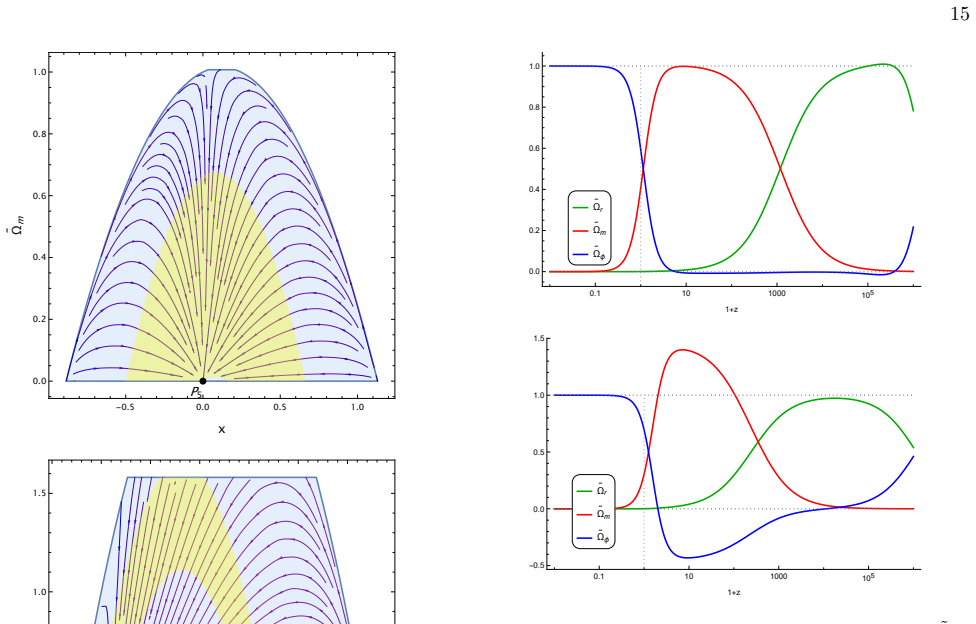
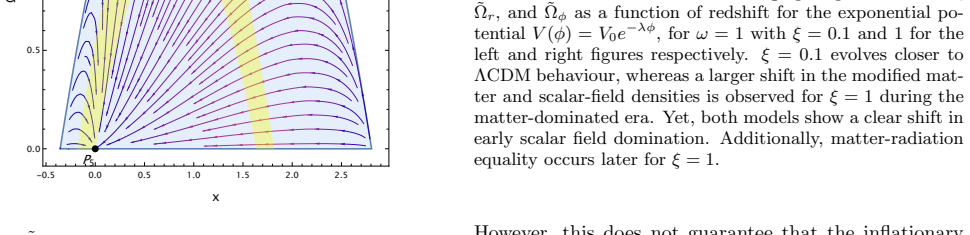
- Bounded phase portraits confirm the physical viability of these cosmological histories.
Where Pith is reading between the lines
- The distinct dynamical behaviour could be tested by examining how the scalar field affects the growth of perturbations beyond the background level.
- Similar analysis applied to other non-canonical forms could uncover additional classes of viable modified gravity cosmologies.
- The approach highlights that background matching does not guarantee the same perturbation evolution as in ΛCDM, opening a route to future observational distinction.
Load-bearing premise
The field equations for the chosen potentials can be expressed as an autonomous system whose critical points correspond directly to physically meaningful cosmological epochs.
What would settle it
Numerical integration of the autonomous equations showing that no stable late-time attractor reaches an effective equation of state near -1 for any of the three potentials would refute the claim of reproducing ΛCDM background characteristics.
Figures
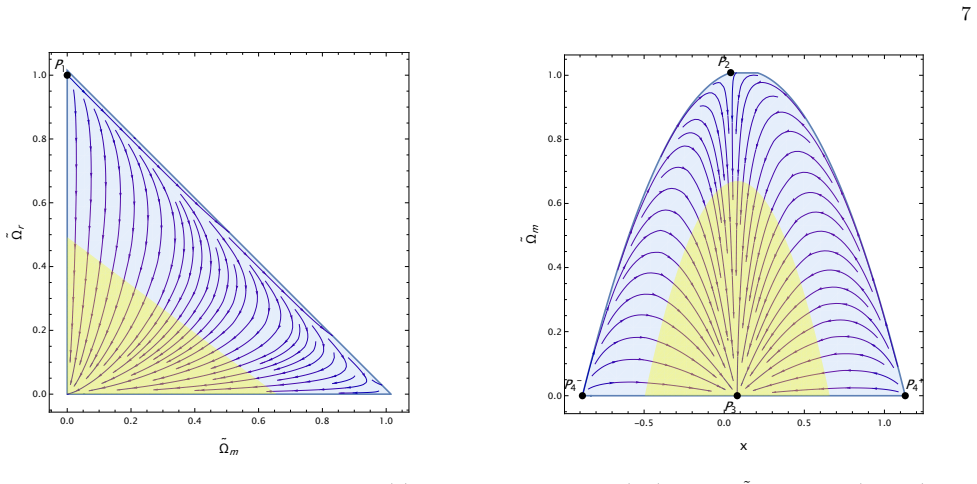


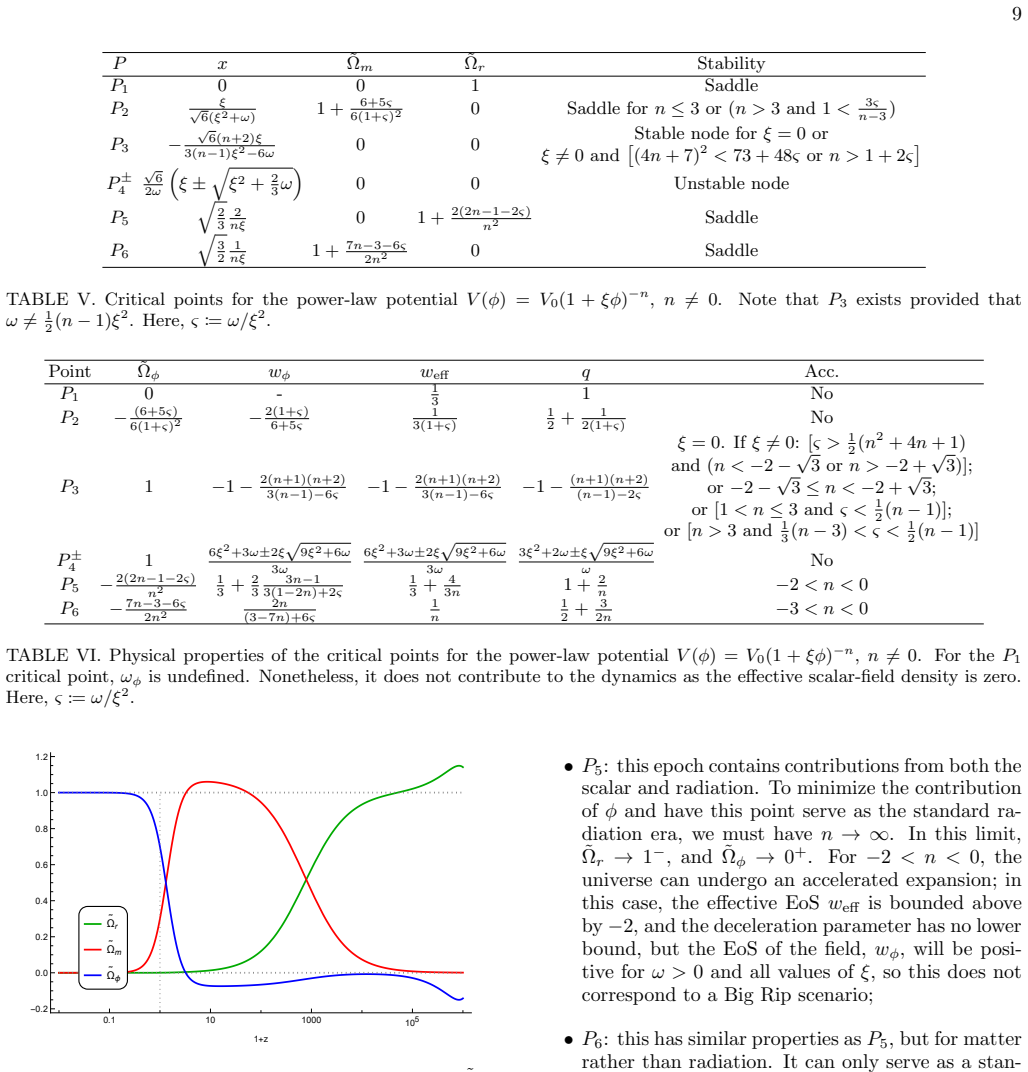


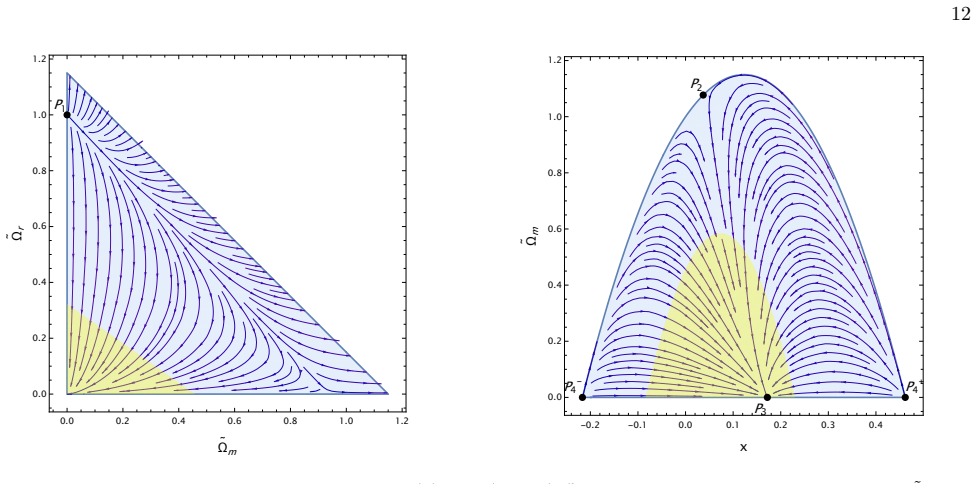
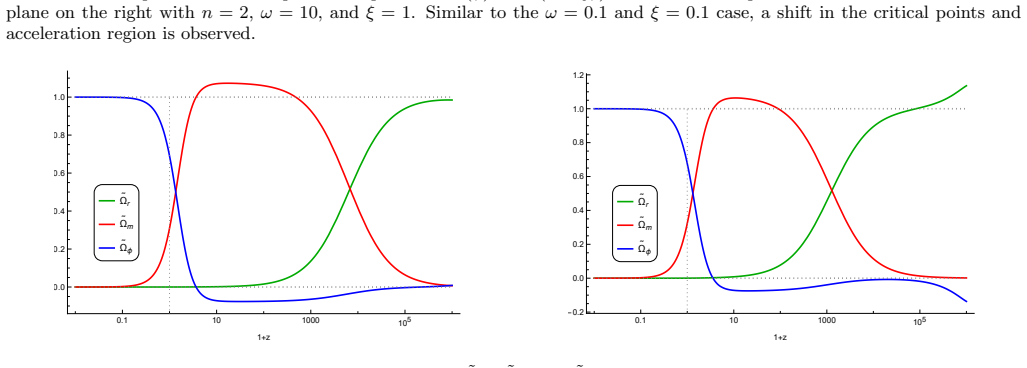

read the original abstract
The LCDM model has been presented with a number of cosmic tensions in the face of precision cosmological data, suggesting the presence of a dynamical dark energy component. In this context, we investigate the cosmology arising from a generalisation of Brans-Dicke theory, with a non-minimally coupled scalar field characterising deviations from standard general relativity, and having a non-canonical kinetic term. By reformulating the field equations into an autonomous set of dynamical equations, we use the methods of dynamical systems to investigate the equilibrium states of the system and their stability for a set of widely-used potentials, namely the constant, power-law, and exponential potentials, with the flow visualized using bounded phase portraits. Furthermore, we investigate the physical meaning of the critical points, and we find viable solutions that can reproduce the characteristics of the $\Lambda$CDM model at background level for each of the three potentials. Furthermore, in each case, we observe that the dynamical behaviour differs noticeably from that observed in other scalar-tensor models due to the non-minimal coupling and non-canonical field, despite using similarly defined dynamical variables.
Editorial analysis
A structured set of objections, weighed in public.
Referee Report
Summary. The paper investigates the background cosmology of a non-canonical generalized Brans-Dicke theory featuring a non-minimally coupled scalar field with a non-canonical kinetic term. The field equations are recast into an autonomous dynamical system whose critical points and stability are analyzed for constant, power-law, and exponential potentials. Phase portraits are used to visualize the flows, and the authors report the existence of stable attractors that reproduce the matter-dominated era followed by late-time acceleration characteristic of ΛCDM for each potential, while noting differences from other scalar-tensor models.
Significance. If the derivations and stability results hold, the work shows that the additional non-canonical and non-minimal terms still permit viable background histories matching ΛCDM, extending dynamical-systems techniques to this class of models. The bounded phase portraits provide a useful visualization tool, and the claim of noticeably different behavior from standard scalar-tensor theories is a potentially interesting distinction if supported by explicit comparisons.
major comments (1)
- [dynamical systems analysis section] The autonomous equations obtained after introducing the dynamical variables are not listed explicitly, nor are the Jacobian matrices or their eigenvalues for the reported critical points. This omission prevents verification of the stability claims and the assertion that the points correspond to physically viable ΛCDM-like histories (see abstract and the dynamical-systems analysis section).
Simulated Author's Rebuttal
We thank the referee for their careful reading of our manuscript and for the constructive feedback. We address the major comment point by point below.
read point-by-point responses
-
Referee: [dynamical systems analysis section] The autonomous equations obtained after introducing the dynamical variables are not listed explicitly, nor are the Jacobian matrices or their eigenvalues for the reported critical points. This omission prevents verification of the stability claims and the assertion that the points correspond to physically viable ΛCDM-like histories (see abstract and the dynamical-systems analysis section).
Authors: We agree that the explicit listing of the autonomous equations, the Jacobian matrices, and the eigenvalues for the critical points would improve the transparency and verifiability of the stability analysis. In the revised version, we will add these details to the dynamical systems analysis section, including the full set of autonomous equations derived from the field equations and the computed eigenvalues used to determine the stability of each critical point. This will directly support our claims regarding the existence of stable attractors reproducing ΛCDM-like behavior for the constant, power-law, and exponential potentials. revision: yes
Circularity Check
No significant circularity; standard dynamical-systems analysis
full rationale
The paper derives an autonomous dynamical system directly from the field equations of the given action by introducing standard dimensionless variables that close the system. Critical points are located by setting the derivatives to zero and solving the resulting algebraic equations; their stability follows from the Jacobian eigenvalues. The observation that certain fixed points reproduce ΛCDM-like expansion histories (matter domination followed by acceleration) is a mathematical consequence of the chosen potentials and the equations, not a fitted input or self-referential definition. No load-bearing self-citations, uniqueness theorems, or ansätze imported from prior work by the same authors are invoked. The derivation chain is therefore self-contained and independent of the target result.
Axiom & Free-Parameter Ledger
free parameters (1)
- potential parameters
axioms (2)
- domain assumption The action of the non-canonical generalized Brans-Dicke theory
- standard math FLRW metric describes the background cosmology
Reference graph
Works this paper leans on
-
[1]
Xjenza Malta
and GRB170817A [42] which appear in the form of limits on the excess speed of gravitational waves as a ra- tio of the speed of light. This limit renders only simpler forms of Horndeski gravity models as being physically viable. On the other hand, this still leaves a wide array of possible realisations for possible Horndeski settings. These include EDE, as...
2024
-
[2]
E. Di Valentinoet al.(CosmoVerse Network), The Cos- moVerse White Paper: Addressing observational tensions in cosmology with systematics and fundamental physics, Phys. Dark Univ.49, 101965 (2025), arXiv:2504.01669 [astro-ph.CO]
-
[3]
Modified Gravity and Cosmology
T. Clifton, P. G. Ferreira, A. Padilla, and C. Skordis, Modified Gravity and Cosmology, Phys. Rept.513, 1 (2012), arXiv:1106.2476 [astro-ph.CO]
work page internal anchor Pith review arXiv 2012
-
[4]
P. J. E. Peebles and B. Ratra, The Cosmological Con- stant and Dark Energy, Rev. Mod. Phys.75, 559 (2003), arXiv:astro-ph/0207347
work page Pith review arXiv 2003
-
[5]
Baudis, Dark matter detection, J
L. Baudis, Dark matter detection, J. Phys. G43, 044001 (2016)
2016
-
[6]
Particle Dark Matter: Evidence, Candidates and Constraints
G. Bertone, D. Hooper, and J. Silk, Particle dark matter: Evidence, candidates and constraints, Phys. Rept.405, 279 (2005), arXiv:hep-ph/0404175. 17
work page Pith review arXiv 2005
-
[7]
E. J. Copeland, M. Sami, and S. Tsujikawa, Dynamics of dark energy, Int. J. Mod. Phys. D15, 1753 (2006), arXiv:hep-th/0603057
work page Pith review arXiv 2006
-
[8]
S. Bahamonde, C. G. B¨ ohmer, S. Carloni, E. J. Copeland, W. Fang, and N. Tamanini, Dynamical systems applied to cosmology: dark energy and modified gravity, Phys. Rept.775-777, 1 (2018), arXiv:1712.03107 [gr-qc]
-
[9]
Weinberg, The Cosmological Constant Problem, Rev
S. Weinberg, The Cosmological Constant Problem, Rev. Mod. Phys.61, 1 (1989)
1989
-
[10]
R. J. Gaitskell, Direct detection of dark matter, Ann. Rev. Nucl. Part. Sci.54, 315 (2004)
2004
-
[11]
E. Di Valentinoet al., Snowmass2021 - Letter of in- terest cosmology intertwined I: Perspectives for the next decade, Astropart. Phys.131, 102606 (2021), arXiv:2008.11283 [astro-ph.CO]
-
[12]
E. Di Valentinoet al., Snowmass2021 - Letter of interest cosmology intertwined II: The hubble constant tension, Astropart. Phys.131, 102605 (2021), arXiv:2008.11284 [astro-ph.CO]
-
[13]
E. Di Valentinoet al., Snowmass2021 - Letter of inter- est cosmology intertwined IV: The age of the universe and its curvature, Astropart. Phys.131, 102607 (2021), arXiv:2008.11286 [astro-ph.CO]
- [14]
-
[15]
E. Abdallaet al., Cosmology intertwined: A review of the particle physics, astrophysics, and cosmology associated with the cosmological tensions and anomalies, JHEAp 34, 49 (2022), arXiv:2203.06142 [astro-ph.CO]
work page internal anchor Pith review arXiv 2022
-
[16]
E. Di Valentinoet al., Cosmology Intertwined III: f σ8 andS 8, Astropart. Phys.131, 102604 (2021), arXiv:2008.11285 [astro-ph.CO]
-
[17]
Capozziello, Curvature quintessence, Int
S. Capozziello, Curvature quintessence, Int. J. Mod. Phys. D11, 483 (2002), arXiv:gr-qc/0201033
-
[18]
S. Capozziello and M. De Laurentis, Extended Theories of Gravity, Phys. Rept.509, 167 (2011), arXiv:1108.6266 [gr-qc]
-
[19]
Unified cosmic history in modified gravity: from F(R) theory to Lorentz non-invariant models,
S. Nojiri and S. D. Odintsov, Unified cosmic history in modified gravity: from F(R) theory to Lorentz non-invariant models, Phys. Rept.505, 59 (2011), arXiv:1011.0544 [gr-qc]
-
[20]
Modified Gravity Theories on a Nutshell: Inflation, Bounce and Late-time Evolution,
S. Nojiri, S. D. Odintsov, and V. K. Oikonomou, Modi- fied Gravity Theories on a Nutshell: Inflation, Bounce and Late-time Evolution, Phys. Rept.692, 1 (2017), arXiv:1705.11098 [gr-qc]
- [21]
-
[22]
S. Dodelson and L. M. Widrow, Sterile-neutrinos as dark matter, Phys. Rev. Lett.72, 17 (1994), arXiv:hep- ph/9303287
- [23]
- [24]
-
[25]
D. Staicova and D. Benisty, Constraining the dark energy models using baryon acoustic oscillations: An approach independent of H0·rd, Astron. Astrophys.668, A135 (2022), arXiv:2107.14129 [astro-ph.CO]
-
[26]
D. Benisty and D. Staicova, Testing late-time cosmic acceleration with uncorrelated baryon acoustic oscil- lation dataset, Astron. Astrophys.647, A38 (2021), arXiv:2009.10701 [astro-ph.CO]
- [27]
-
[28]
Teleparallel gravity: from theory to cosmology,
S. Bahamonde, K. F. Dialektopoulos, C. Escamilla- Rivera, G. Farrugia, V. Gakis, M. Hendry, M. Hohmann, J. Levi Said, J. Mifsud, and E. Di Valentino, Teleparallel gravity: from theory to cosmology, Rept. Prog. Phys.86, 026901 (2023), arXiv:2106.13793 [gr-qc]
-
[29]
R. Alves Batistaet al., EuCAPT White Paper: Op- portunities and Challenges for Theoretical Astroparticle Physics in the Next Decade, (2021), arXiv:2110.10074 [astro-ph.HE]
-
[30]
Addaziet al., Quantum gravity phenomenology at the dawn of the multi-messenger era—A review, Prog
A. Addaziet al., Quantum gravity phenomenology at the dawn of the multi-messenger era—A review, Prog. Part. Nucl. Phys.125, 103948 (2022), arXiv:2111.05659 [hep- ph]
-
[31]
C. Deffayet, S. Deser, and G. Esposito-Farese, Gener- alized Galileons: All scalar models whose curved back- ground extensions maintain second-order field equations and stress-tensors, Phys. Rev. D80, 064015 (2009), arXiv:0906.1967 [gr-qc]
-
[32]
C. Deffayet, G. Esposito-Farese, and A. Vikman, Co- variant Galileon, Phys. Rev. D79, 084003 (2009), arXiv:0901.1314 [hep-th]
-
[33]
G. W. Horndeski, Second-order scalar-tensor field equa- tions in a four-dimensional space, Int. J. Theor. Phys. 10, 363 (1974)
1974
-
[34]
Kobayashi, Horndeski theory and beyond: a review, Rept
T. Kobayashi, Horndeski theory and beyond: a review, Rept. Prog. Phys.82, 086901 (2019), arXiv:1901.07183 [gr-qc]
-
[35]
A. D. Linde, A New Inflationary Universe Scenario: A Possible Solution of the Horizon, Flatness, Homogeneity, Isotropy and Primordial Monopole Problems, Phys. Lett. B108, 389 (1982)
1982
-
[36]
A. H. Guth and S. Y. Pi, Fluctuations in the New Infla- tionary Universe, Phys. Rev. Lett.49, 1110 (1982)
1982
- [37]
-
[38]
S. Bahamonde, K. F. Dialektopoulos, and J. Levi Said, Can Horndeski Theory be recast using Teleparallel Grav- ity?, Phys. Rev. D100, 064018 (2019), arXiv:1904.10791 [gr-qc]
-
[39]
S. Bahamonde, K. F. Dialektopoulos, V. Gakis, and J. Levi Said, Reviving Horndeski theory using telepar- allel gravity after GW170817, Phys. Rev. D101, 084060 (2020), arXiv:1907.10057 [gr-qc]
-
[40]
Exploring gravitational theories beyond Horndeski
J. Gleyzes, D. Langlois, F. Piazza, and F. Vernizzi, Ex- ploring gravitational theories beyond Horndeski, JCAP 02, 018, arXiv:1408.1952 [astro-ph.CO]
work page Pith review arXiv 1952
- [41]
-
[42]
B. P. Abbottet al.(LIGO Scientific, Virgo), GW170817: Observation of Gravitational Waves from a Binary Neu- 18 tron Star Inspiral, Phys. Rev. Lett.119, 161101 (2017), arXiv:1710.05832 [gr-qc]
work page internal anchor Pith review arXiv 2017
-
[43]
A. Goldsteinet al., An Ordinary Short Gamma-Ray Burst with Extraordinary Implications: Fermi-GBM De- tection of GRB 170817A, Astrophys. J. Lett.848, L14 (2017), arXiv:1710.05446 [astro-ph.HE]
work page Pith review arXiv 2017
-
[44]
S. Capozziello, K. F. Dialektopoulos, and S. V. Sushkov, Classification of the Horndeski cosmologies via Noether Symmetries, Eur. Phys. J. C78, 447 (2018), arXiv:1803.01429 [gr-qc]
- [45]
-
[46]
M. Miranda, S. Capozziello, and D. Vernieri, General analysis of Noether symmetries in Horndeski gravity, Eur. Phys. J. C84, 771 (2024), arXiv:2408.09018 [gr-qc]
-
[47]
Ratra and P
B. Ratra and P. J. E. Peebles, Cosmological consequences of a rolling homogeneous scalar field, Phys. Rev. D37, 3406 (1988)
1988
-
[48]
Roy and N
N. Roy and N. Bhadra, Dynamical systems analysis of phantom dark energy models, Journal of Cosmology and Astroparticle Physics2018(06), 002–002
-
[49]
O. Hrycyna and M. Szyd lowski, Brans-dicke theory and the emergence ofλcdm model, Physical Review D88, 10.1103/physrevd.88.064018 (2013)
-
[50]
A. Avilez and C. Skordis, Cosmological constraints on Brans-Dicke theory, Phys. Rev. Lett.113, 011101 (2014), arXiv:1303.4330 [astro-ph.CO]
-
[51]
V. Faraoni, J. Cˆ ot´ e, and A. Giusti, Do solar system ex- periments constrain scalar–tensor gravity?, Eur. Phys. J. C80, 132 (2020), arXiv:1906.05957 [gr-qc]
-
[52]
H. Amirhashchi and A. K. Yadav, Constraining an ex- act Brans–Dicke gravity theory with recent observations, Phys. Dark Univ.30, 100711 (2020), arXiv:1908.04735 [gr-qc]
-
[53]
A. De Felice, T. Kobayashi, and S. Tsujikawa, Effective gravitational couplings for cosmological perturbations in the most general scalar-tensor theories with second- order field equations, Phys. Lett. B706, 123 (2011), arXiv:1108.4242 [gr-qc]
-
[54]
J. Garriga and V. F. Mukhanov, Perturbations in k- inflation, Phys. Lett. B458, 219 (1999), arXiv:hep- th/9904176
-
[55]
Generalized G-inflation: Inflation with the most general second-order field equations
T. Kobayashi, M. Yamaguchi, and J. Yokoyama, General- ized G-inflation: Inflation with the most general second- order field equations, Prog. Theor. Phys.126, 511 (2011), arXiv:1105.5723 [hep-th]
work page Pith review arXiv 2011
- [56]
-
[57]
Hrycyna and M
O. Hrycyna and M. Szyd lowski, Dynamical complexity of the brans-dicke cosmology, Journal of Cosmology and Astroparticle Physics2013(12), 016–016
-
[58]
O. Hrycyna, M. Szyd lowski, and M. Kamionka, Dynam- ics and cosmological constraints on brans-dicke cosmol- ogy, Physical Review D90, 10.1103/physrevd.90.124040 (2014)
-
[59]
Hrycyna and M
O. Hrycyna and M. Szyd lowski, Cosmological dynamics with non-minimally coupled scalar field and a constant potential function, Journal of Cosmology and Astropar- ticle Physics2015(11), 013–013
-
[60]
B. Ahmedov, M. Caruana, K. F. Dialektopoulos, J. Levi Said, A. Nosirov, Z. Oikonomopoulou, and O. Yunusov, Gauge invariant perturbations in teleparallel Horndeski gravity, Phys. Dark Univ.48, 101846 (2025), arXiv:2412.01349 [gr-qc]
- [61]
-
[62]
E. J. Copeland, A. R. Liddle, and D. Wands, Exponen- tial potentials and cosmological scaling solutions, Physi- cal Review D57, 4686–4690 (1998)
1998
-
[63]
P. J. Steinhardt, L. Wang, and I. Zlatev, Cosmological tracking solutions, Physical Review D59, 10.1103/phys- revd.59.123504 (1999)
-
[64]
A. d. l. Macorra and G. Piccinelli, Cosmological evolution of general scalar fields and quintessence, Physical Review D61, 10.1103/physrevd.61.123503 (2000)
-
[65]
Bertotti, L
B. Bertotti, L. Iess, and P. Tortora, A test of general relativity using radio links with the Cassini spacecraft, Nature425, 374 (2003)
2003
-
[66]
N. Sch¨ oneberg, G. Franco Abell´ an, A. P´ erez S´ anchez, S. J. Witte, V. Poulin, and J. Lesgourgues, The H0 Olympics: A fair ranking of proposed models, Phys. Rept.984, 1 (2022), arXiv:2107.10291 [astro-ph.CO]
-
[67]
A. G´ omez-Valent, Z. Zheng, L. Amendola, C. Wetterich, and V. Pettorino, Coupled and uncoupled early dark en- ergy, massive neutrinos, and the cosmological tensions, Phys. Rev. D106, 103522 (2022), arXiv:2207.14487 [astro-ph.CO]
-
[68]
R. D’Agostino, O. Luongo, and M. Muccino, Healing the cosmological constant problem during inflation through a unified quasi-quintessence matter field, Class. Quant. Grav.39, 195014 (2022), arXiv:2204.02190 [gr-qc]
-
[69]
S. Bhattacharya, G. Borghetto, A. Malhotra, S. Parameswaran, G. Tasinato, and I. Zavala, Cos- mological constraints on curved quintessence, JCAP09, 073, arXiv:2405.17396 [astro-ph.CO]
-
[70]
A. Arbey and F. Mahmoudi, Dark matter and the early Universe: a review, Prog. Part. Nucl. Phys.119, 103865 (2021), arXiv:2104.11488 [hep-ph]
-
[71]
Strogatz,Nonlinear Dynamics and Chaos: With Appli- cations to Physics, Biology, Chemistry and Engineering (CRC Press, 2018)
S. Strogatz,Nonlinear Dynamics and Chaos: With Appli- cations to Physics, Biology, Chemistry and Engineering (CRC Press, 2018)
2018
- [72]
-
[73]
T. C. Charters, A. Nunes, and J. P. Mimoso, Stabil- ity analysis of cosmological models through lyapunov’s method, Classical and Quantum Gravity18, 1703–1713 (2001)
2001
- [74]
-
[75]
A. D. Rendall, Cosmological models and centre man- ifold theory, General Relativity and Gravitation34, 1277–1294 (2002)
2002
-
[76]
Wiggins,Introduction to applied nonlinear dynamical systems and chaos, 1st ed
S. Wiggins,Introduction to applied nonlinear dynamical systems and chaos, 1st ed. (Springer, 1990)
1990
-
[77]
Bahamonde, C
S. Bahamonde, C. G. B¨ ohmer, S. Carloni, E. J. Copeland, W. Fang, and N. Tamanini, Dynamical systems applied to cosmology: Dark energy and modified gravity, Physics Reports775–777, 1–122 (2018)
2018
-
[78]
Planck 2018 results. VI. Cosmological parameters
N. Aghanimet al.(Planck), Planck 2018 results. VI. Cosmological parameters, Astron. Astrophys.641, A6 (2020), [Erratum: Astron.Astrophys. 652, C4 (2021)], arXiv:1807.06209 [astro-ph.CO]. 19
work page internal anchor Pith review arXiv 2018
-
[79]
Zlatev, L
I. Zlatev, L. Wang, and P. J. Steinhardt, Quintessence, cosmic coincidence, and the cosmological constant, Phys- ical Review Letters82, 896–899 (1999)
1999
-
[80]
D. Baumann and L. McAllister, Inflation and string the- ory (2014), arXiv:1404.2601 [hep-th]
discussion (0)
Sign in with ORCID, Apple, or X to comment. Anyone can read and Pith papers without signing in.