Recognition: unknown
Vacuum polarization and cyclotron resonance effects on radiative transfer and plasma deceleration in subcritical X-ray pulsars
Pith reviewed 2026-05-08 06:06 UTC · model grok-4.3
The pith
Vacuum polarization dominates over plasma birefringence and governs radiative deceleration in subcritical X-ray pulsars
A machine-rendered reading of the paper's core claim, the machinery that carries it, and where it could break.
Core claim
Self-consistent simulations of polarized radiative transfer in a magnetized accretion channel show that deceleration of accreting matter occurs mainly through resonant scattering. Vacuum polarization dominates plasma birefringence, enhancing both the cyclotron spectral feature and the radiative deceleration. When vacuum polarization is included, the linear polarization degree changes sign at photon energies above the cyclotron resonance. The centroid energy of the cyclotron scattering feature increases with accretion luminosity.
What carries the argument
Polarized radiative transfer simulations for the two normal modes, incorporating resonant Compton scattering and vacuum polarization in a strongly magnetized plasma accretion channel.
Load-bearing premise
The simulations assume specific plasma density, temperature, and magnetic field geometries in the accretion channel that allow vacuum polarization to dominate.
What would settle it
An observed spectrum from a subcritical X-ray pulsar showing no sign change in linear polarization degree above the cyclotron resonance energy.
Figures




read the original abstract
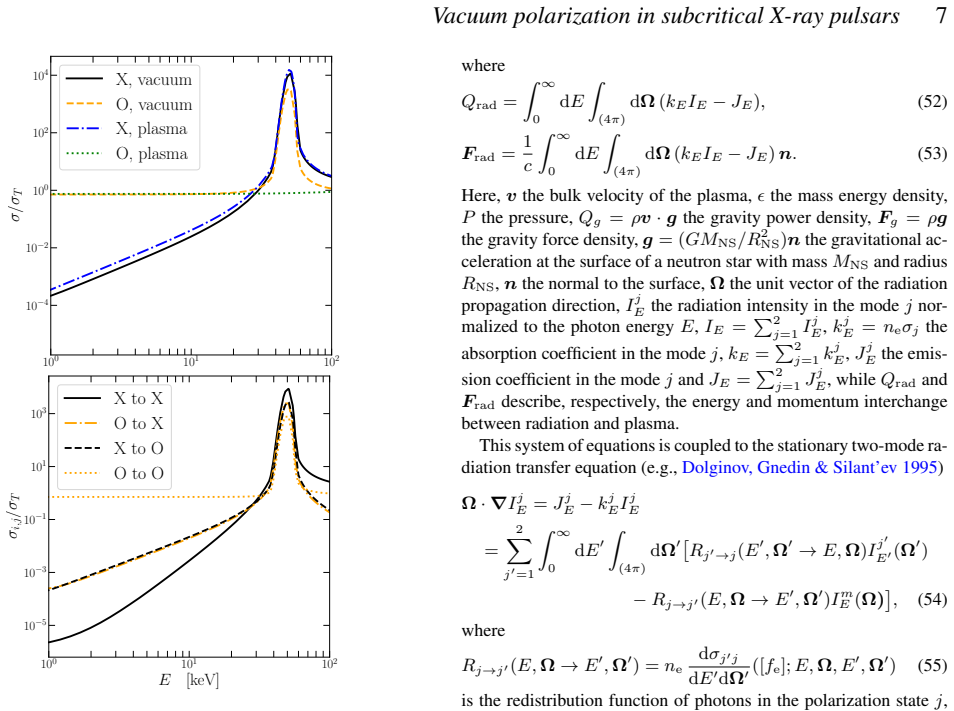
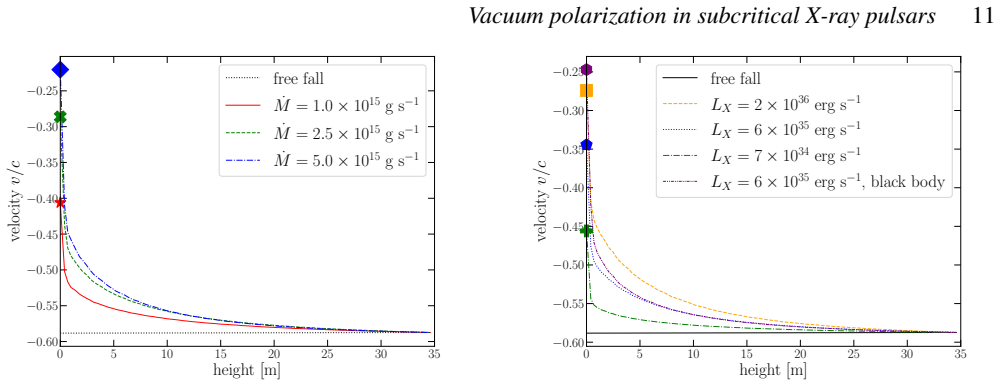
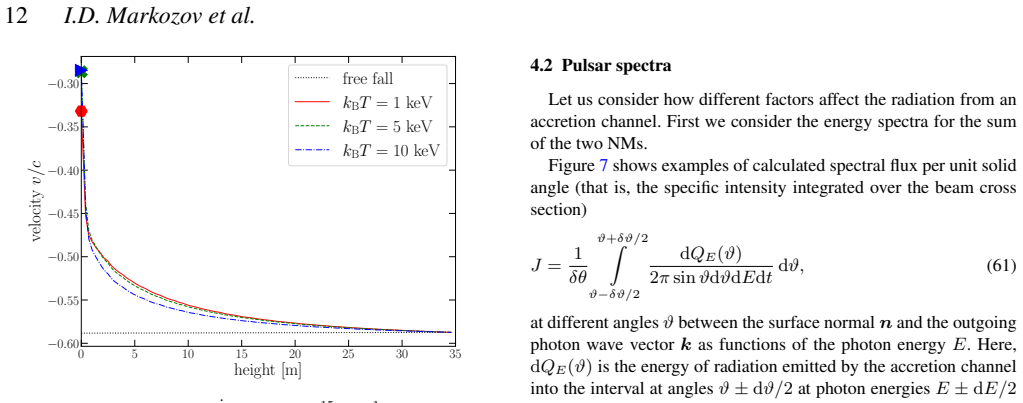
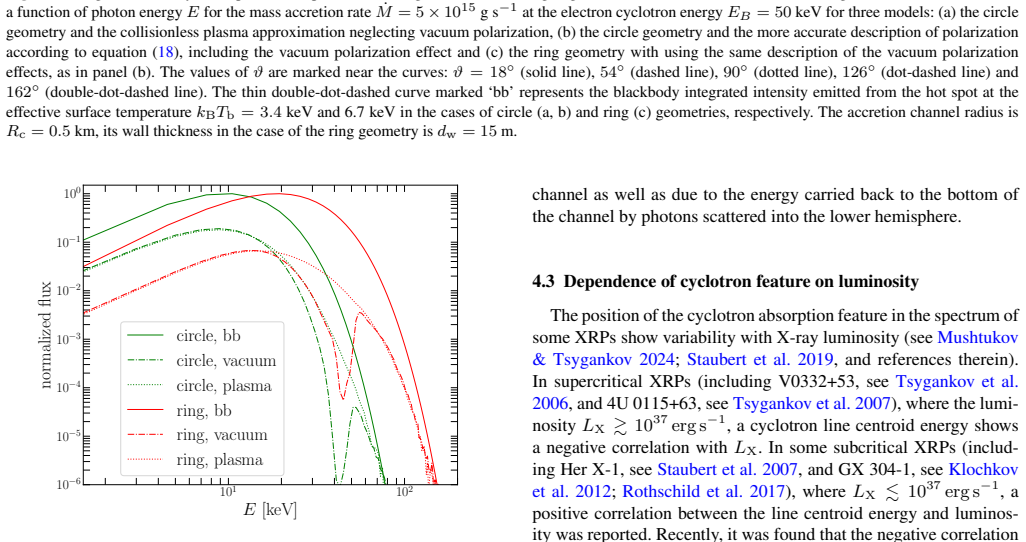
We investigate the spectrum and polarization of radiation emerging from a subcritical X-ray pulsar using self-consistent radiation-hydrodynamic simulations of an accretion channel in a strong magnetic field. The polarized radiative transfer in the channel above the hot spot is simulated for the two normal modes, taking into account resonant Compton scattering in a strongly magnetized plasma and the effects of vacuum polarization. We show that the deceleration of the accreting matter in the subcritical regime is mainly governed by resonant scattering. Our simulations provide the velocity profiles of the plasma flow and demonstrate that vacuum polarization dominates over plasma birefringence, enhancing both the cyclotron spectral feature and the radiative deceleration of the plasma. The linear polarization degree changes sign at photon energies above the cyclotron resonance when vacuum polarization is included. We also find that the centroid energy of the cyclotron scattering feature increases with accretion luminosity, indicating a positive correlation consistent with previous observational results and theoretical interpretation.
Editorial analysis
A structured set of objections, weighed in public.
Referee Report
Summary. The paper presents self-consistent radiation-hydrodynamic simulations of polarized radiative transfer through an accretion channel in a subcritical X-ray pulsar. It solves the coupled equations for plasma flow and radiation in two normal modes, incorporating resonant Compton scattering in a strongly magnetized plasma together with vacuum polarization. The central claims are that resonant scattering dominates the deceleration of accreting matter, vacuum polarization dominates plasma birefringence and thereby enhances both the cyclotron spectral feature and the radiative drag, the degree of linear polarization reverses sign above the cyclotron resonance, and the centroid energy of the cyclotron scattering feature increases with accretion luminosity.
Significance. If the numerical results are robust, the work supplies a concrete link between vacuum polarization, resonant scattering, and observable spectral and polarization signatures in X-ray pulsars. The self-consistent treatment of radiation and hydrodynamics, together with the reported positive correlation between cyclotron centroid energy and luminosity, offers a testable prediction that aligns with existing observations and could guide future polarimetric studies.
major comments (2)
- [Simulation description / Numerical methods] The abstract and simulation description state that self-consistent radiation-hydrodynamic simulations were performed, yet no information is given on the numerical scheme used to solve the polarized transfer equation, the discretization of the resonance, the coupling between radiation and hydrodynamics, or any convergence tests and error estimates. These omissions are load-bearing because the reported dominance of vacuum polarization, the velocity profiles, and the polarization sign change all depend on the accuracy and resolution of the transfer solution.
- [Results and discussion of velocity profiles and spectra] The results are obtained for specific choices of plasma density, temperature, and magnetic-field profiles inside the accretion channel. The manuscript does not present a parameter survey or justification that these profiles are representative rather than tuned to produce vacuum-polarization dominance; if the real stratification differs, the claimed dominance, the polarization reversal, and the luminosity dependence of the cyclotron centroid would not necessarily hold.
minor comments (2)
- [Introduction / Radiative transfer section] Notation for the two normal modes and the definition of the linear polarization degree should be stated explicitly at first use to avoid ambiguity when comparing with earlier literature.
- [Figures] Figure captions for the velocity profiles and emerging spectra should include the exact parameter values (B, accretion rate, column density) used in each run.
Simulated Author's Rebuttal
We thank the referee for the careful and constructive review. The comments highlight important areas for improving the clarity and robustness of the manuscript. We address each major comment below and have revised the paper accordingly.
read point-by-point responses
-
Referee: [Simulation description / Numerical methods] The abstract and simulation description state that self-consistent radiation-hydrodynamic simulations were performed, yet no information is given on the numerical scheme used to solve the polarized transfer equation, the discretization of the resonance, the coupling between radiation and hydrodynamics, or any convergence tests and error estimates. These omissions are load-bearing because the reported dominance of vacuum polarization, the velocity profiles, and the polarization sign change all depend on the accuracy and resolution of the transfer solution.
Authors: We agree that the numerical methods section requires substantial expansion to allow readers to evaluate the reliability of the results. In the revised manuscript we have added a dedicated subsection detailing the numerical scheme employed to solve the polarized radiative transfer equation for the two normal modes, the frequency and spatial discretization of the cyclotron resonance, the iterative coupling procedure between the radiation moments and the hydrodynamic equations, and the outcomes of convergence tests performed by varying grid resolution and frequency binning. We also include quantitative error estimates derived from these tests. revision: yes
-
Referee: [Results and discussion of velocity profiles and spectra] The results are obtained for specific choices of plasma density, temperature, and magnetic-field profiles inside the accretion channel. The manuscript does not present a parameter survey or justification that these profiles are representative rather than tuned to produce vacuum-polarization dominance; if the real stratification differs, the claimed dominance, the polarization reversal, and the luminosity dependence of the cyclotron centroid would not necessarily hold.
Authors: The adopted profiles are taken from standard analytic models of subcritical accretion columns that are widely used in the literature and are consistent with observational constraints on X-ray pulsar spectra. In the revised manuscript we have inserted a new paragraph justifying these choices with references to prior theoretical and observational work. Although a full parameter survey lies outside the scope of the present study, we performed supplementary calculations with modest variations in density and temperature stratification; the qualitative features (vacuum-polarization dominance, polarization sign reversal, and positive correlation of cyclotron centroid energy with luminosity) persist. We now discuss the sensitivity of the results to plausible changes in the stratification. revision: partial
Circularity Check
No circularity: results are numerical outputs from solving coupled radiative-hydrodynamic equations
full rationale
The paper's central claims (resonant scattering governing deceleration, vacuum polarization dominance, polarization sign reversal above cyclotron resonance, and increasing cyclotron centroid energy with luminosity) are obtained from self-consistent numerical simulations of polarized radiative transfer in two normal modes for an accretion channel. These are direct integrations of the standard equations for resonant Compton scattering, vacuum polarization, and plasma hydrodynamics under chosen density/temperature/B-field profiles. No step reduces a claimed prediction to a fitted input by construction, nor does any load-bearing premise rest on a self-citation chain or smuggled ansatz. The simulation outputs are independent of the inputs in the sense required by the circularity criteria; parameter sensitivity is a modeling limitation, not a logical circularity.
Axiom & Free-Parameter Ledger
free parameters (3)
- Magnetic field strength at the surface
- Accretion rate or luminosity
- Plasma density and temperature profiles
axioms (2)
- domain assumption Resonant Compton scattering is the dominant deceleration mechanism in the subcritical regime
- domain assumption Vacuum polarization can be treated within the normal-mode radiative transfer framework
Reference graph
Works this paper leans on
-
[1]
Relation of Cyclotron Resonant Energy and Luminosity in a Strongly Magnetized Neutron Star GRO J1008-57 Observed by Insight-HXMT. , keywords =. doi:10.3847/1538-4357/ac1268 , archivePrefix =. 2107.03267 , primaryClass =
-
[2]
Cyclotron line evolution revealed with pulse-to-pulse analysis in the 2020 outburst of 1A 0535+262. , keywords =. doi:10.1093/mnras/stae352 , archivePrefix =. 2403.11815 , primaryClass =
-
[3]
Discovery and modelling of a flattening of the positive cyclotron line/luminosity relation in GX 304-1 with RXTE. , keywords =. doi:10.1093/mnras/stw3222 , archivePrefix =. 1610.08944 , primaryClass =
-
[4]
Outburst of GX 304-1 monitored with INTEGRAL: positive correlation between the cyclotron line energy and flux. , keywords =. doi:10.1051/0004-6361/201219385 , archivePrefix =. 1205.5475 , primaryClass =
-
[5]
Discovery of a flux-related change of the cyclotron line energy in Hercules X-1. , keywords =. doi:10.1051/0004-6361:20077098 , archivePrefix =. astro-ph/0702490 , primaryClass =
-
[6]
Astronomy Letters , keywords =
4U 0115+63 from RXTE and INTEGRAL data: Pulse profile and cyclotron line energy. Astronomy Letters , keywords =. doi:10.1134/S1063773707060023 , archivePrefix =. 0704.2874 , primaryClass =
-
[7]
V0332+53 in the outburst of 2004-2005: luminosity dependence of the cyclotron line and pulse profile. , keywords =. doi:10.1111/j.1365-2966.2006.10610.x , archivePrefix =. astro-ph/0511237 , primaryClass =
-
[8]
Propeller effect in action: Unveiling quenched accretion in the transient X-ray pulsar 4U 0115+63. , keywords =. doi:10.1051/0004-6361/202556527 , archivePrefix =. 2509.09860 , primaryClass =
-
[9]
, year = 1975, month = feb, volume =
Why the Number of Galactic X-ray Stars Is so Small?. , year = 1975, month = feb, volume =
1975
-
[10]
Stable accretion from a cold disc in highly magnetized neutron stars.Astron
Stable accretion from a cold disc in highly magnetized neutron stars. , keywords =. doi:10.1051/0004-6361/201630248 , archivePrefix =. 1703.04528 , primaryClass =
-
[11]
An accreting pulsar with extreme properties drives an ultraluminous x-ray source in NGC 5907. Science , keywords =. doi:10.1126/science.aai8635 , archivePrefix =. 1609.07375 , primaryClass =
-
[12]
Accreting strongly magnetised neutron stars: X-ray pulsars. arXiv e-prints , keywords =. doi:10.1007/978-981-19-6960-7 , archivePrefix =. 2204.14185 , primaryClass =
-
[13]
X-ray pulsar models. II. Comptonized spectra and pulse shapes. , keywords =. doi:10.1086/163687 , adsurl =
-
[14]
X-ray pulsar models. I. Angle-dependent cyclotron line formation and comptonization. , keywords =. doi:10.1086/163594 , adsurl =
-
[15]
Study of the X-ray pulsar IGR J19294+1816 with NuSTAR: Detection of cyclotron line and transition to accretion from the cold disk. , keywords =. doi:10.1051/0004-6361/201833786 , archivePrefix =. 1811.08912 , primaryClass =
-
[16]
Propeller effect in two brightest transient X-ray pulsars: 4U 0115+63 and V 0332+53. , keywords =. doi:10.1051/0004-6361/201628236 , archivePrefix =. 1602.03177 , primaryClass =
-
[17]
X-ray Polarimetry of X-ray Pulsars. Galaxies , keywords =. doi:10.3390/galaxies12040046 , archivePrefix =. 2408.04431 , primaryClass =
-
[18]
The X-Ray Polarimetry View of the Accreting Pulsar Cen X-3. , keywords =. doi:10.3847/2041-8213/aca486 , archivePrefix =. 2209.02447 , primaryClass =
-
[19]
Determination of X-ray pulsar geometry with IXPE polarimetry. Nature Astronomy , keywords =. doi:10.1038/s41550-022-01799-5 , archivePrefix =. 2206.07138 , primaryClass =
-
[20]
Journal of Astronomical Telescopes, Instruments, and Systems , keywords =
The Imaging X-Ray Polarimetry Explorer (IXPE): Pre-Launch. Journal of Astronomical Telescopes, Instruments, and Systems , keywords =. doi:10.1117/1.JATIS.8.2.026002 , archivePrefix =. 2112.01269 , primaryClass =
-
[21]
Spectrum formation in X-ray pulsars at very low mass accretion rate: Monte Carlo approach.Mon
Spectrum formation in X-ray pulsars at very low mass accretion rate: Monte Carlo approach. , keywords =. doi:10.1093/mnras/stab811 , archivePrefix =. 2006.13596 , primaryClass =
-
[22]
Cyclotron lines in highly magnetized neutron stars.Astron
Cyclotron lines in highly magnetized neutron stars. , keywords =. doi:10.1051/0004-6361/201834479 , archivePrefix =. 1812.03461 , primaryClass =
-
[23]
Spectra of Radiation from a Strongly Magnetized Plasma. , keywords =. doi:10.1007/BF00650222 , adsurl =
-
[24]
Polarization of accreting X-ray pulsars. I. A new model. , keywords =. doi:10.1093/mnras/staa3428 , archivePrefix =. 2009.00631 , primaryClass =
-
[25]
Polarization of accreting X-ray pulsars - II. Hercules X-1. , keywords =. doi:10.1093/mnras/staa3429 , archivePrefix =. 2009.00634 , primaryClass =
-
[26]
Nature Physical Science , year = 1973, month = nov, volume =
Accretion at a Magnetic Pole of a Neutron Star. Nature Physical Science , year = 1973, month = nov, volume =. doi:10.1038/physci246001a0 , adsurl =
-
[27]
The limiting luminosity of accreting neutron stars with magnetic fields.Mon
The limiting luminosity of accreting neutron stars with magnetic fields. , keywords =. doi:10.1093/mnras/175.2.395 , adsurl =
-
[28]
, year = 1969, month = oct, volume =
X-Ray Emission Accompanying the Accretion of Gas by a Neutron Star. , year = 1969, month = oct, volume =
1969
-
[29]
, year = 1969, month = jan, volume =
A Mechanism for Emission of X Rays by a Neutron Star. , year = 1969, month = jan, volume =
1969
-
[30]
Radiation from Relativistic Electrons
-
[31]
High-energy radiation from magnetized neutron stars
-
[32]
Bhabha scattering and trident production in strong uniform magnetic fields
-
[33]
Compton scattering S matrix and cross section in strong magnetic field. , keywords =. doi:10.1103/PhysRevD.93.105003 , archivePrefix =. 1512.06681 , primaryClass =
-
[34]
, keywords =
X-ray emission from a neutron star with a strong magnetic dipole field. , keywords =
-
[35]
, keywords =
Plasma infall and X-ray production in the magnetic funnel of an accretning neutron star. , keywords =
-
[36]
On the mechanism of decelerating the gas infalling onto magnetized neutron stars. , keywords =. doi:10.1086/161799 , adsurl =
-
[37]
Accretion onto magnetized neutron stars. , keywords =. doi:10.1017/S1323358000017288 , adsurl =
-
[38]
, keywords =
2-dimensional low luminosity accretion onto neutron stars. , keywords =
-
[39]
Accretion onto neutron stars under adiabatic shock conditions.Astrophys
Accretion onto neutron stars under adiabatic shock conditions. , keywords =. doi:10.1086/153645 , adsurl =
-
[40]
Low-luminosity accretion onto magnetized neutron stars.Astrophys
Low-luminosity accretion onto magnetized neutron stars. , keywords =. doi:10.1086/160028 , adsurl =
-
[41]
Dynamical Structure of Radiation-dominated Pulsar Accretion Shocks. , keywords =. doi:10.1086/305568 , adsurl =
-
[42]
On the maximum accretion luminosity of magnetized neutron stars: connecting X-ray pulsars and ultraluminous X-ray sources. , keywords =. doi:10.1093/mnras/stv2087 , archivePrefix =. 1506.03600 , primaryClass =
-
[43]
On the dependence of the X-ray continuum variations with luminosity in accreting X-ray pulsars. , keywords =. doi:10.1093/mnras/stv1393 , archivePrefix =. 1506.07082 , primaryClass =
-
[44]
A New Two-fluid Radiation-hydrodynamical Model for X-Ray Pulsar Accretion Columns. , keywords =. doi:10.3847/1538-4357/835/2/129 , archivePrefix =. 1612.02411 , primaryClass =
-
[45]
Three-dimensional modelling of accretion columns: spatial asymmetry and self-consistent simulations. , keywords =. doi:10.1093/mnras/staa3560 , archivePrefix =. 2012.10501 , primaryClass =
-
[46]
Two Topics in X-Ray Astronomy, Volume 1: X Ray Binaries
Time-Dependent Two Dimensional Radiation Hydrodynamics of Accreting Matter onto Highly Magnetised Neutron Stars. Two Topics in X-Ray Astronomy, Volume 1: X Ray Binaries. Volume 2: AGN and the X Ray Background , year = 1989, editor =
1989
-
[47]
Astronomy Letters , keywords =
Dynamics of the Flows Accreting onto a Magnetized Neutron Star. Astronomy Letters , keywords =. doi:10.1134/1.1738153 , archivePrefix =. astro-ph/0412319 , primaryClass =
-
[48]
A radiation-hydrodynamics model of accretion columns for ultra-luminous X-ray pulsars. , keywords =. doi:10.1093/pasj/psw075 , archivePrefix =. 1608.04211 , primaryClass =
-
[49]
Simulating the shock dynamics of a neutron star accretion column. , keywords =. doi:10.1093/mnras/stad1951 , archivePrefix =. 2207.12312 , primaryClass =
-
[50]
Radiative relativistic magnetohydrodynamic simulations of neutron star column accretion in Cartesian geometry. , keywords =. doi:10.1093/mnras/stac1815 , archivePrefix =. 2206.13759 , primaryClass =
-
[51]
Dynamics of neutron star accretion columns in split-monopole magnetic fields. , keywords =. doi:10.1093/mnras/stad063 , archivePrefix =. 2210.06616 , primaryClass =
-
[52]
Dynamical effects of magnetic opacity in neutron star accretion columns. , keywords =. doi:10.1093/mnras/stad2043 , archivePrefix =. 2307.02410 , primaryClass =
-
[53]
Thermal and Bulk Comptonization in Accretion-powered X-Ray Pulsars. , keywords =. doi:10.1086/509108 , archivePrefix =. astro-ph/0609035 , primaryClass =
-
[54]
Astronomy Letters , keywords =
Hydrodynamical Simulation of the Structure of the X-Ray Pulsar Accretion Channel: Accounting for Resonant Scattering. Astronomy Letters , keywords =. doi:10.1134/S1063773723100031 , archivePrefix =. 2311.17488 , primaryClass =
-
[55]
Monte Carlo radiative transfer. Living Reviews in Computational Astrophysics , keywords =. doi:10.1007/s41115-019-0004-9 , archivePrefix =. 1907.09840 , primaryClass =
-
[56]
Formation Mechanism for Broad and Shallow Profiles of Cyclotron Lines in Accreting X-Ray Pulsars. , keywords =. doi:10.1086/523782 , adsurl =
-
[57]
Properties of Cyclotron Lines in a Line-forming Region Injected by an Anisotropic Continuum in Accreting X-ray Pulsars. , keywords =. doi:10.1088/0004-637X/807/2/164 , adsurl =
-
[58]
Cyclotron Line Features from Near-critical Magnetic Fields: The Effect of Optical Depth and Plasma Geometry. , keywords =. doi:10.1086/307157 , adsurl =
-
[59]
Cyclotron resonant scattering feature simulations. I. Thermally averaged cyclotron scattering cross sections, mean free photon-path tables, and electron momentum sampling. , keywords =. doi:10.1051/0004-6361/201629352 , archivePrefix =. 1609.05030 , primaryClass =
-
[60]
Cyclotron resonant scattering feature simulations. II. Description of the CRSF simulation process. , keywords =. doi:10.1051/0004-6361/201630250 , archivePrefix =. 1701.07669 , primaryClass =
-
[61]
A model for cyclotron resonance scattering features. , keywords =. doi:10.1051/0004-6361:20077218 , archivePrefix =. 0707.2105 , primaryClass =
-
[62]
A new Monte Carlo radiative transfer simulation of cyclotron resonant scattering features. , keywords =. doi:10.1093/mnras/stac1871 , archivePrefix =. 2207.00657 , primaryClass =
-
[63]
Dynamical and Radiative Properties of X-Ray Pulsar Accretion Columns: Phase-averaged Spectra. , keywords =. doi:10.3847/1538-4357/835/2/130 , archivePrefix =. 1612.01935 , primaryClass =
-
[64]
Vacuum polarization alters the spectra of accreting X-ray pulsars.Astron
Vacuum polarization alters the spectra of accreting X-ray pulsars. , keywords =. doi:10.1051/0004-6361/202346265 , archivePrefix =. 2305.00475 , primaryClass =
-
[65]
The transfer equations for normal waves and radiation polarization in an anisotropic medium. Sov. Phys. -- JETP , year = 1974, month = may, volume =
1974
-
[66]
Statistical features of multiple Compton scattering in a strong magnetic field.Phys
Statistical features of multiple Compton scattering in a strong magnetic field. , keywords =. doi:10.1103/PhysRevD.105.103027 , archivePrefix =. 2204.12271 , primaryClass =
-
[67]
Radiation from a Strongly Magnetized Plasma: The Case of Predominant Scattering. , keywords =. doi:10.1007/BF00683336 , adsurl =
-
[68]
Electromagnetic Polarization in Partially Ionized Plasmas with Strong Magnetic Fields and Neutron Star Atmosphere Models. , keywords =. doi:10.1086/422679 , archivePrefix =. astro-ph/0405383 , primaryClass =
-
[69]
Transfer of Polarized Radiation in Strongly Magnetized Plasmas and Thermal Emission from Magnetars: Effect of Vacuum Polarization. , keywords =. doi:10.1086/374334 , archivePrefix =. astro-ph/0211315 , primaryClass =
-
[70]
Resonant Conversion of Photon Modes Due to Vacuum Polarization in a Magnetized Plasma: Implications for X-Ray Emission from Magnetars. , keywords =. doi:10.1086/338074 , archivePrefix =. astro-ph/0108127 , primaryClass =
-
[71]
, year = 1979, month = may, volume =
Compton and Thomson scattering in strong magnetic fields. , year = 1979, month = may, volume =. doi:10.1103/PhysRevD.19.2868 , adsurl =
-
[72]
Radiative Widths and Splitting of Cyclotron Lines in Superstrong Magnetic Fields. , keywords =. doi:10.1086/170611 , adsurl =
-
[73]
The critical accretion luminosity for magnetized neutron stars. , keywords =. doi:10.1093/mnras/stu2484 , archivePrefix =. 1409.6457 , primaryClass =
-
[74]
Radiation Hydrodynamics
-
[75]
LeVeque, Randall J. , year=. Finite Volume Methods for Hyperbolic Problems , publisher=
-
[76]
X-ray emission from magnetized neutron star atmospheres at low mass-accretion rates. I. Phase-averaged spectrum. , keywords =. doi:10.1051/0004-6361/202040228 , archivePrefix =. 2104.06802 , primaryClass =
-
[77]
Cyclotron emission, absorption, and the two faces of X-ray pulsar A 0535+262. , keywords =. doi:10.1093/mnrasl/slz079 , archivePrefix =. 1905.09496 , primaryClass =
-
[78]
The anisotropic radiative transfer problem in optically thick, strongly magnetized plasma - A comparison of results. , keywords =. doi:10.1086/163053 , adsurl =
-
[79]
Radiative shock solutions with grey nonequilibrium diffusion. Shock Waves , keywords =. doi:10.1007/s00193-008-0143-0 , adsurl =
-
[80]
Radiative shock solutions in the equilibrium diffusion limit. Shock Waves , keywords =. doi:10.1007/s00193-007-0081-2 , adsurl =
discussion (0)
Sign in with ORCID, Apple, or X to comment. Anyone can read and Pith papers without signing in.