Recognition: unknown
Quantum phase diagrams for bosons in hexagonal optical potentials: A continuous-space quantum Monte Carlo study
Pith reviewed 2026-05-08 03:35 UTC · model grok-4.3
The pith
Continuous-space simulations reveal that bosons in honeycomb lattices deviate from Bose-Hubbard predictions with suppressed Mott lobes and no higher insulators due to density-assisted tunneling.
A machine-rendered reading of the paper's core claim, the machinery that carries it, and where it could break.
Core claim
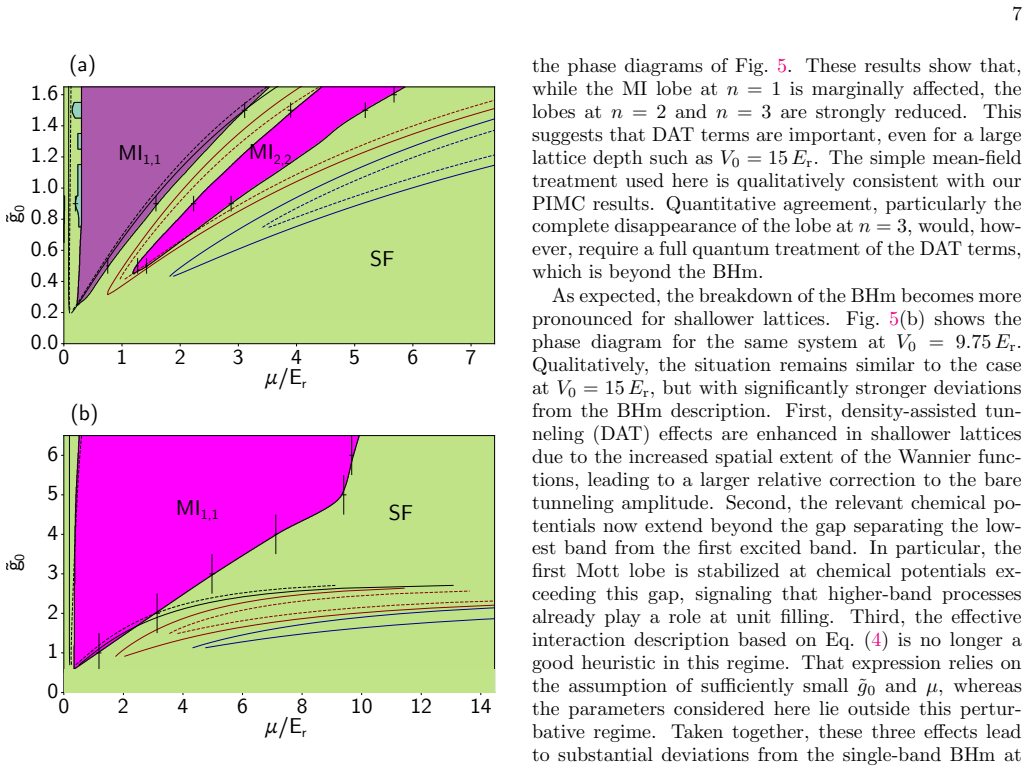
For bosons in honeycomb optical lattices, continuous-space quantum Monte Carlo simulations reveal suppressed Mott insulator lobes and the complete absence of higher-order insulating phases compared to the Bose-Hubbard model, even for strong lattice amplitudes, due to prominent density-assisted tunneling effects. In contrast, the h-BN lattice exhibits a rich phase diagram with multiple Mott lobes characterized by different sublattice occupations arising from the lattice asymmetry.
What carries the argument
Continuous-space quantum Monte Carlo simulations that retain the full optical potential and particle interactions, thereby exposing density-assisted tunneling as the mechanism that alters the phase boundaries.
If this is right
- Experiments with ultracold bosons in honeycomb lattices should observe reduced Mott regions and missing higher insulators compared with simple model forecasts.
- Theoretical modeling of hexagonal geometries must incorporate density-assisted tunneling rather than relying solely on nearest-neighbor hopping.
- Asymmetric h-BN potentials allow multiple distinct Mott phases at different fillings controlled by sublattice imbalance.
- Continuous-space methods are required to obtain reliable phase diagrams whenever lattice symmetry permits strong non-standard tunneling channels.
Where Pith is reading between the lines
- Similar deviations from discrete models may appear in other non-Bravais lattices used for quantum simulation.
- The results suggest experiments could tune lattice asymmetry to access a broader range of correlated bosonic states than previously anticipated.
- These findings could inform design of optical potentials that deliberately enhance or suppress density-assisted terms for specific quantum phases.
Load-bearing premise
The simulations fully capture all relevant physics of the experimental lattice potentials and interactions without missing higher-order effects or suffering from unconverged system sizes.
What would settle it
An experiment that observes higher-order insulating phases or Mott lobe sizes matching standard Bose-Hubbard predictions at strong lattice depths in a honeycomb geometry would falsify the central claim.
Figures




read the original abstract
Hexagonal optical lattices, emulating graphene and hexagonal boron nitride (h-BN) structures, provide a versatile platform for exploring strongly correlated quantum matter. Using continuous-space exact diagonalization and quantum Monte Carlo simulations, we investigate the phase diagrams of ultracold bosons in honeycomb and h-BN lattices. For the honeycomb lattice, we find significant deviations from the standard Bose-Hubbard model even for strong lattice amplitudes. We observe suppressed Mott insulator lobes and the absence of higher-order insulating phases, attributed to strong density-assisted tunneling effects. In the h-BN case, a rich phase diagram emerges, featuring multiple Mott lobes with various sublattice occupations, driven by the interplay of lattice asymmetry, interactions, and particle filling. Our results highlight the necessity of continuous-space treatments for capturing the full complexity of bosonic quantum phases in hexagonal geometries, paving the way for experimental realizations with ultracold atoms and further theoretical work.
Editorial analysis
A structured set of objections, weighed in public.
Referee Report
Summary. The manuscript uses continuous-space exact diagonalization and quantum Monte Carlo simulations to map the phase diagrams of ultracold bosons in honeycomb and h-BN optical lattices. For the honeycomb case it reports significant deviations from the Bose-Hubbard model even at strong lattice depths, specifically suppressed Mott lobes and the complete absence of higher-order insulating phases, which are attributed to density-assisted tunneling. For the h-BN lattice it finds a richer diagram containing multiple Mott lobes with distinct sublattice occupations arising from the broken inversion symmetry.
Significance. If the numerical results are robust, the work demonstrates that continuous-space treatments are required to capture non-standard tunneling processes in hexagonal geometries, thereby limiting the applicability of the conventional Bose-Hubbard model for current experimental lattice depths. The combination of QMC and ED is a positive methodological choice that allows both large-system thermodynamics and exact small-system benchmarks.
major comments (3)
- [Results on honeycomb lattice] The headline claim of suppressed Mott lobes and missing higher-order insulators in the honeycomb lattice (even for strong lattice amplitudes) rests on the QMC phase boundaries, yet the manuscript provides no systematic finite-size scaling, error bars on the lobe tips, or explicit checks that the observed suppression survives the thermodynamic limit (see the honeycomb phase-diagram figures and associated text).
- [Discussion of effective parameters] The attribution of the deviations to “strong density-assisted tunneling” is plausible but not quantitatively verified; the paper does not extract the effective density-dependent tunneling amplitudes from the continuous-space simulations and compare them directly to the observed lobe suppression (see the discussion following the honeycomb phase diagram).
- [Methods and simulation details] Convergence with respect to higher-band mixing and the representation of the continuous optical potential is not demonstrated; without these checks it remains possible that uncontrolled band effects or interaction renormalizations contribute to the reported absence of higher-order Mott phases.
minor comments (2)
- [Abstract] The abstract would be strengthened by quoting the specific ranges of lattice depth V0, interaction strength U, and filling factors employed, together with a brief statement on the system sizes used.
- [h-BN phase diagram] Notation for sublattice occupations in the h-BN case should be defined explicitly (e.g., (nA,nB) pairs) when the multiple Mott lobes are introduced.
Simulated Author's Rebuttal
We thank the referee for the careful reading and constructive comments on our manuscript. We address each major comment below and describe the revisions that will be incorporated to strengthen the presentation and robustness of our results.
read point-by-point responses
-
Referee: [Results on honeycomb lattice] The headline claim of suppressed Mott lobes and missing higher-order insulators in the honeycomb lattice (even for strong lattice amplitudes) rests on the QMC phase boundaries, yet the manuscript provides no systematic finite-size scaling, error bars on the lobe tips, or explicit checks that the observed suppression survives the thermodynamic limit (see the honeycomb phase-diagram figures and associated text).
Authors: We agree that systematic finite-size scaling and error bars are necessary to firmly establish the thermodynamic-limit behavior. In the revised manuscript we will add QMC data for larger system sizes and perform explicit finite-size extrapolations of the Mott lobe tips, together with statistical error bars derived from the Monte Carlo sampling. Our existing runs already indicate that the suppression of higher-order lobes remains stable, but the new analysis will make this quantitative and explicit. revision: yes
-
Referee: [Discussion of effective parameters] The attribution of the deviations to “strong density-assisted tunneling” is plausible but not quantitatively verified; the paper does not extract the effective density-dependent tunneling amplitudes from the continuous-space simulations and compare them directly to the observed lobe suppression (see the discussion following the honeycomb phase diagram).
Authors: We acknowledge the value of a direct quantitative link. In the revision we will extract the effective density-dependent tunneling amplitudes by projecting the continuous-space Hamiltonian onto the lowest band and fitting the resulting density-dependent terms; these amplitudes will then be compared quantitatively with the observed suppression of the Mott lobes. The new analysis and comparison will be added to the discussion section. revision: yes
-
Referee: [Methods and simulation details] Convergence with respect to higher-band mixing and the representation of the continuous optical potential is not demonstrated; without these checks it remains possible that uncontrolled band effects or interaction renormalizations contribute to the reported absence of higher-order Mott phases.
Authors: We have performed internal convergence tests with respect to the number of bands retained and the spatial discretization of the optical potential. To address the referee’s concern we will add a dedicated subsection to the Methods section that presents these convergence checks explicitly, demonstrating that the reported phase boundaries are stable within the parameter regime used in the manuscript. revision: yes
Circularity Check
No circularity: phase diagrams obtained from independent continuous-space QMC simulations
full rationale
The paper computes bosonic phase diagrams directly via continuous-space exact diagonalization and quantum Monte Carlo on the full lattice potential. No derivation chain, fitted parameters, or predictions are claimed; the reported suppression of Mott lobes and absence of higher-order insulators in the honeycomb case are outputs of the numerical method, not inputs redefined as results. Self-citations (if any) are not load-bearing for the central claims, and no ansatz, uniqueness theorem, or renaming of known results is used to force conclusions. The work is self-contained against external benchmarks as a direct simulation study.
Axiom & Free-Parameter Ledger
free parameters (3)
- lattice amplitude
- interaction strength
- particle filling factor
axioms (2)
- standard math Bosons follow Bose-Einstein statistics and the standard many-body Hamiltonian applies
- domain assumption The optical potential can be accurately represented in continuous space without additional corrections
Reference graph
Works this paper leans on
-
[1]
(A4) Subtracting the two equations gives sin(θ1 +ϕ g/3) = sin(θ2 +ϕ g/3),(A5) which yields two branches of stationary points: ( Branch A:θ 1 =θ 2 Branch B:θ 2 =π−θ 1
Stationary points and classification The potential extrema satisfy ( ∂θ1 V∝sin(θ 1 +ϕ g/3) + sin(θ1 +θ 2 −ϕ g/3) = 0, ∂θ2 V∝sin(θ 2 +ϕ g/3) + sin(θ1 +θ 2 −ϕ g/3) = 0. (A4) Subtracting the two equations gives sin(θ1 +ϕ g/3) = sin(θ2 +ϕ g/3),(A5) which yields two branches of stationary points: ( Branch A:θ 1 =θ 2 Branch B:θ 2 =π−θ 1. (A6) For Branch A, sett...
-
[2]
•For|ϕ g|< π/2, bothn= 1 andn= 2 are min- ima
Number and position of the minima The sign of cn = cos ϕg 3 + 2πn 3 (A14) determines how many minima are present. •For|ϕ g|< π/2, bothn= 1 andn= 2 are min- ima. The lattice therefore contains two potential minima (lattice sites) per unit cell. Forϕ g = 0, the two sites are degenerate in energy and form the balanced honeycomb lattice. Forϕ g ̸= 0, the dege...
-
[3]
The offset ∆ AB between the two sublattices has two contributions
Energy splitting and sublattice offset We now focus on the regime|ϕ g|< π/2, where the both extreman= 1,2 are local minima. The offset ∆ AB between the two sublattices has two contributions. The first one comes from the different values of the poten- tial at the two minima. The second one comes from the different local curvatures of the wells, which yield...
-
[4]
1(b), are δ1 = −a1+2a2 3 = 4a 3 ey, δ2 = 2a1−a2 3 = 2a √ 3 3 ex − 2a 3 ey, δ3 =− a1+a2 3 =− 2a √ 3 3 ex − 2a 3 ey
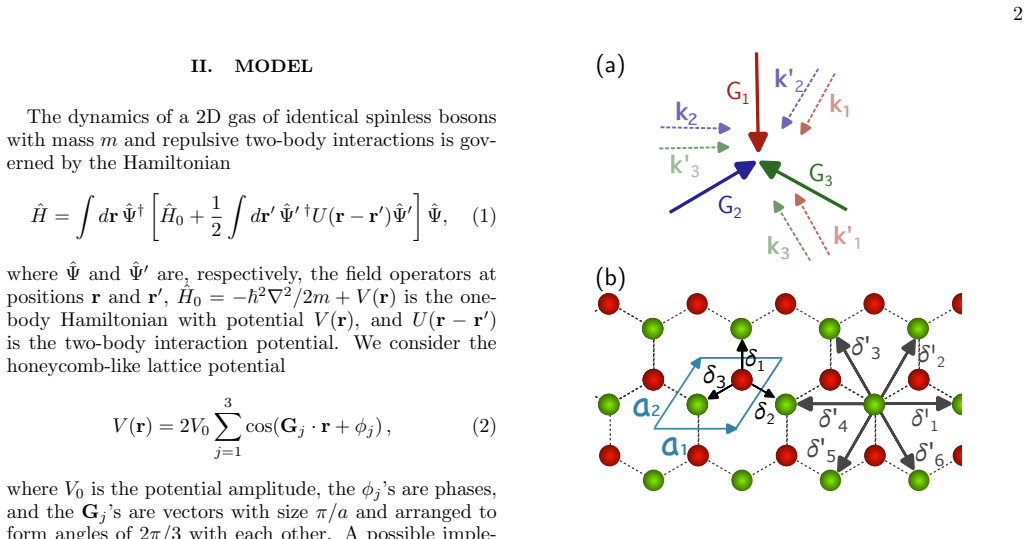
Lattice vectors and hopping geometry We recall the Bravais vectors used in the main text, a1 = 4a√ 3 ex,a 2 = 2a√ 3 ex + 2ae y.(B1) The nearest-neighbor vectors connecting an A site to the three neighboring B sites, see Fig. 1(b), are δ1 = −a1+2a2 3 = 4a 3 ey, δ2 = 2a1−a2 3 = 2a √ 3 3 ex − 2a 3 ey, δ3 =− a1+a2 3 =− 2a √ 3 3 ex − 2a 3 ey. (B2) The ...
-
[5]
Single-particle tight-binding Hamiltonian Neglecting interactions, the tight-binding Hamiltonian associated with Eq. (6) reads as ˆHsp =−J X ⟨j,ℓ⟩ ˆa† jˆaℓ − ∆AB 2 X j∈A ˆa† jˆaj + ∆AB 2 X j∈B ˆa† jˆaj −J ′ A X ⟨⟨j,ℓ⟩⟩∈A ˆa† jˆaℓ −J ′ B X ⟨⟨j,ℓ⟩⟩∈B ˆa† jˆaℓ ,(B4) corresponding to the frist two lines of of Eq. (6) in the main text. After Fourier transforma...
-
[6]
Nearest neighbor model.The nearest-neighbor (nn) model is obtained by settingJ ′ A =J ′ B = 0
Limiting models: nearest neighbor and triangular a. Nearest neighbor model.The nearest-neighbor (nn) model is obtained by settingJ ′ A =J ′ B = 0. Eq. (B6) then reduces to εnn ± (k) =± 1 2 q ∆2 AB + 4J2|f(k)|2.(B7) In this regime, for ∆ AB = 0, one recovers the balanced honeycomb dispersion relation ε1,±(k) =±J|f(k)|.(B8) b. Triangular model.For a large e...
-
[7]
The tight-binding dispersions introduced in Appendix B are then fitted to the resulting two lowest subbands
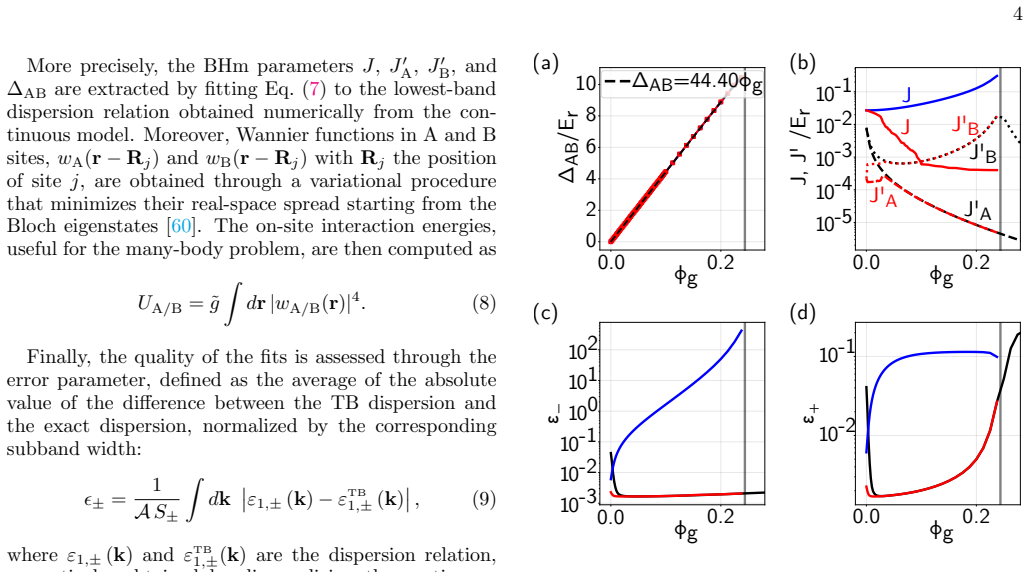
Fitting the tunneling parameters For each value ofV 0 andϕ g, we diagonalize the continuous-space single-particle Hamiltonian ˆH0 on a uniform grid of quasimomenta in the first Brillouin zone. The tight-binding dispersions introduced in Appendix B are then fitted to the resulting two lowest subbands. For the nearest-neighbor and triangular models, the num...
-
[8]
(6), are computed from maximally localized Wan- nier functions associated with the lowest band manifold, which contains two subbands corresponding to the two sites of the unit cell
Obtaining interaction energies The onsite interaction energies,U A andU B of the BHm of Eq. (6), are computed from maximally localized Wan- nier functions associated with the lowest band manifold, which contains two subbands corresponding to the two sites of the unit cell. Starting from the Bloch eigenstates obtained by exact diagonalization of ˆH0, we co...
-
[9]
Kittel,Introduction to Solid State Physics, 8th ed
C. Kittel,Introduction to Solid State Physics, 8th ed. (Wiley, 2004)
2004
-
[10]
Janot,Quasicrystals: A Primer, 2nd ed
C. Janot,Quasicrystals: A Primer, 2nd ed. (Oxford Uni- versity Press, 1994)
1994
-
[11]
A. H. Castro Neto, F. Guinea, N. M. R. Peres, K. S. Novoselov, and A. K. Geim, The electronic properties of graphene, Rev. Mod. Phys.81, 109 (2009)
2009
-
[12]
Bistritzer and A
R. Bistritzer and A. H. MacDonald, Moir´ e bands in twisted double-layer graphene, Proc. Nat. Acad. Sci.108, 12233 (2011)
2011
-
[13]
E. Y. Andrei, D. K. Efetov, P. Jarillo-Herrero, A. H. MacDonald, K. F. Mak, T. Senthil, E. Tutuc, A. Yazdani, and A. F. Young, The marvels of moir´ e materials, Nat. Rev. Mater.6, 201 (2021)
2021
-
[14]
parity anomaly
F. D. M. Haldane, Model for a Quantum Hall effect with- out Landau levels: Condensed-matter realization of the “parity anomaly”, Phys. Rev. Lett.61, 2015 (1988)
2015
-
[15]
M. Z. Hasan and C. L. Kane, Colloquium: Topological insulators, Rev. Mod. Phys.82, 3045 (2010)
2010
-
[16]
Kamiya, T
K. Kamiya, T. Takeuchi, N. Kabeya, N. Wada, T. Ishi- masa, A. Ochiai, K. Deguchi, K. Imura, and N. Sato, Dis- covery of superconductivity in quasicrystal, Nat. Comm. 9, 1 (2018)
2018
-
[17]
A. Uri, S. C. de la Barrera, M. T. Randeria, D. Rodan- Legrain, T. Devakul, P. J. D. Crowley, N. Paul, K. Watanabe, T. Taniguchi, R. Lifshitz, L. Fu, R. C. Ashoori, and P. Jarillo-Herrero, Superconductivity and strong interactions in a tunable moir´ e quasicrystal, Na- ture (London)620, 762 (2023)
2023
-
[18]
Rolof, S
S. Rolof, S. Thiem, and M. Schreiber, Electronic wave functions of quasiperiodic systems in momentum space, Eur. Phys. J. B86, 372 (2013)
2013
-
[19]
Evers and A
F. Evers and A. D. Mirlin, Anderson transitions, Rev. Mod. Phys.80, 1355 (2008)
2008
-
[20]
Huang and F
H. Huang and F. Liu, Quantum spin Hall effect and spin Bott index in a quasicrystal lattice, Phys. Rev. Lett.121, 126401 (2018)
2018
-
[21]
Lewenstein, A
M. Lewenstein, A. Sanpera, V. Ahufinger, B. Damski, A. Sen, and U. Sen, Ultracold atomic gases in optical lat- tices: Mimicking condensed matter physics and beyond, Adv. Phys.56, 243 (2007)
2007
-
[22]
Bloch, J
I. Bloch, J. Dalibard, and W. Zwerger, Many-body physics with ultracold gases, Rev. Mod. Phys.80, 885 (2008)
2008
-
[23]
Bloch, J
I. Bloch, J. Dalibard, and S. Nascimb` ene, Quantum sim- ulations with ultracold quantum gases, Nat. Phys.8, 267 (2012)
2012
-
[24]
Gross and I
C. Gross and I. Bloch, Quantum simulations with ultra- cold atoms in optical lattices, Science357, 995 (2017)
2017
-
[25]
Esslinger, Fermi-Hubbard physics with atoms in an optical lattice, Annual Rev
T. Esslinger, Fermi-Hubbard physics with atoms in an optical lattice, Annual Rev. Cond. Mat. Phys.1, 129 (2010)
2010
-
[26]
Tarruell and L
L. Tarruell and L. Sanchez-Palencia, Quantum simula- tion of the Hubbard model with ultracold fermions in optical lattices, C. R. Phys.19, 365 (2018); L. Sanchez- Palencia, Quantum simulation: From basic principles to applications,ibid.19, 357 (2018)
2018
-
[27]
Modugno, Anderson localization in Bose-Einstein con- densates, Rep
G. Modugno, Anderson localization in Bose-Einstein con- densates, Rep. Prog. Phys.73, 102401 (2010)
2010
-
[28]
Sanchez-Palencia and M
L. Sanchez-Palencia and M. Lewenstein, Disordered quantum gases under control, Nat. Phys.6, 87 (2010)
2010
-
[29]
Jaksch, C
D. Jaksch, C. Bruder, J. I. Cirac, C. W. Gardiner, and P. Zoller, Cold bosonic atoms in optical lattices, Phys. Rev. Lett.81, 3108 (1998)
1998
-
[30]
Windpassinger and K
P. Windpassinger and K. Sengstock, Engineering novel optical lattices, Rep. Prog. Phys.76, 086401 (2013)
2013
-
[31]
Wirth, M
G. Wirth, M. ¨Olschl¨ ager, and A. Hemmerich, Evidence for orbital superfluidity in the p-band of a bipartite op- tical square lattice, Nat. Phys.7, 147 (2011)
2011
-
[32]
Becker, P
C. Becker, P. Soltan-Panahi, J. Kronj¨ ager, S. D¨ orscher, K. Bongs, and K. Sengstock, Ultracold quantum gases in triangular optical lattices, New J. Phys.12, 065025 (2010)
2010
-
[33]
Struck, C
J. Struck, C. ¨Olschl¨ ager, R. Le Targat, P. Soltan- Panahi, A. Eckardt, M. Lewenstein, P. Windpassinger, and K. Sengstock, Quantum simulation of frustrated clas- sical magnetism in triangular optical lattices, Science 333, 996 (2011)
2011
-
[34]
Tarruell, D
L. Tarruell, D. Greif, T. Uehlinger, G. Jotzu, and T. Esslinger, Creating, moving and merging Dirac points with a Fermi gas in a tunable honeycomb lattice, Nature (London)483, 302 (2012)
2012
-
[35]
Fl¨ aschner, B
N. Fl¨ aschner, B. Rem, M. Tarnowski, D. Vogel, D.-S. L¨ uhmann, K. Sengstock, and C. Weitenberg, Experimen- tal reconstruction of the Berry curvature in a Floquet Bloch band, Science352, 1091 (2016)
2016
-
[36]
S. Taie, H. Ozawa, T. Ichinose, T. Nishio, S. Naka- jima, and Y. Takahashi, Coherent driving and freezing of bosonic matter wave in an optical Lieb lattice, Science Advances1, e1500854 (2015)
2015
-
[37]
Santos, M
L. Santos, M. A. Baranov, J. I. Cirac, H.-U. Everts, H. Fehrmann, and M. Lewenstein, Atomic quantum gases in Kagom´ e lattices, Phys. Rev. Lett.93, 030601 (2004)
2004
-
[38]
G.-B. Jo, J. Guzman, C. K. Thomas, P. Hosur, A. Vish- wanath, and D. M. Stamper-Kurn, Ultracold atoms in a tunable optical kagome lattice, Phys. Rev. Lett.108, 045305 (2012)
2012
-
[39]
Anderlini, P
M. Anderlini, P. J. Lee, B. L. Brown, J. Sebby-Strabley, W. D. Phillips, and J. V. Porto, Controlled exchange in- teraction between pairs of neutral atoms in an optical lattice, Nature (London)448, 452 (2007)
2007
-
[40]
Trotzky, P
S. Trotzky, P. Cheinet, S. F¨ olling, M. Feld, U. Schnor- rberger, A. M. Rey, A. Polkovnikov, E. A. Demler, M. D. Lukin, and I. Bloch, Time-resolved observation and con- trol of superexchange interactions with ultracold atoms in optical lattices, Science319, 295 (2008)
2008
-
[41]
Sanchez-Palencia and L
L. Sanchez-Palencia and L. Santos, Bose-Einstein con- densates in optical quasicrystal lattices, Phys. Rev. A 72, 053607 (2005)
2005
-
[42]
Jagannathan and M
A. Jagannathan and M. Duneau, An eightfold optical quasicrystal with cold atoms, Europhys. Lett.104, 66003 (2013)
2013
-
[43]
Viebahn, M
K. Viebahn, M. Sbroscia, E. Carter, J.-C. Yu, and U. Schneider, Matter-wave diffraction from a quasicrys- talline optical lattice, Phys. Rev. Lett.122, 110404 (2019)
2019
-
[44]
M. N. Kosch, L. Asteria, H. P. Zahn, K. Sengstock, and C. Weitenberg, Multifrequency optical lattice for dy- namic lattice-geometry control, Phys. Rev. Research4, 043083 (2022)
2022
-
[45]
C. D. Brown, S.-W. Chang, M. N. Schwarz, T.-H. Le- ung, V. Kozii, A. Avdoshkin, J. E. Moore, and D. M. 14 Stamper-Kurn, Direct geometric probe of singularities in band structure, Science377, 1319 (2022)
2022
-
[46]
Shimasaki, Y
T. Shimasaki, Y. Bai, H. E. Kondakci, P. Dotti, J. E. Pagett, A. R. Dardia, M. Prichard, A. Eckardt, and D. M. Weld, Reversible phasonic control of a quantum phase transition in a quasicrystal, Phys. Rev. Lett.133, 083405 (2024)
2024
-
[47]
A. O. Neely, C. C. Wilson, R. Everly, Y. Yao, R. F. Zanetti, and C. D. Brown, Programmable dy- namic phase control of a quasiperiodic optical lattice, arXiv:2604.07631 (2026)
work page internal anchor Pith review Pith/arXiv arXiv 2026
-
[48]
K. S. Novoselov, A. K. Geim, S. V. Morozov, D.-e. Jiang, Y. Zhang, S. V. Dubonos, I. V. Grigorieva, and A. A. Firsov, Electric field effect in atomically thin carbon films, Science306, 666 (2004)
2004
-
[49]
A. K. Geim and K. S. Novoselov, The rise of graphene, Nat. Mater.6, 183 (2007)
2007
-
[50]
S. Miao, Z. Zhang, Y. Zhao, Z. Zhao, H. Wang, and J. Hu, Bosonic fractional quantum Hall conductance in shaken honeycomb optical lattices without flat bands, Phys. Rev. B106, 054310 (2022)
2022
-
[51]
Hirata, A
M. Hirata, A. Kobayashi, C. Berthier, and K. Kanoda, Interacting chiral electrons at the 2D Dirac points: A review, Rep. Prog. Phys.84, 036502 (2021)
2021
-
[52]
Soltan-Panahi, D.-S
P. Soltan-Panahi, D.-S. L¨ uhmann, J. Struck, P. Wind- passinger, and K. Sengstock, Quantum phase transition to unconventional multi-orbital superfluidity in optical lattices, Nat. Phys.8, 71 (2012)
2012
-
[53]
Soltan-Panahi, J
P. Soltan-Panahi, J. Struck, P. Hauke, A. Bick, W. Plenkers, G. Meineke, C. Becker, P. Windpassinger, M. Lewenstein, and K. Sengstock, Multi-component quantum gases in spin-dependent hexagonal lattices, Nat. Phys.7, 434 (2011)
2011
-
[54]
St-Jean, A
P. St-Jean, A. Dauphin, P. Massignan, B. Real, O. Jamadi, M. Mili´ cevi´ c, A. Lemaˆ ıtre, A. Harouri, L. Le Gratiet, I. Sagnes, S. Ravets, J. Bloch, and A. Amo, Measuring topological invariants in a polaritonic analog of graphene, Phys. Rev. Lett.126, 127403 (2021)
2021
-
[55]
B. Real, O. Jamadi, M. Mili´ cevi´ c, A. Lemaˆ ıtre, L. Le Gratiet, A. Harouri, I. Sagnes, J. Bloch, and A. Amo, Semi-Dirac transport and anisotropic localiza- tion in polariton honeycomb lattices, Phys. Rev. Lett. 125, 186601 (2020)
2020
-
[56]
P. R. Wallace, The band theory of graphite, Phys. Rev. 71, 622 (1947)
1947
-
[57]
Anisimovas, F
E. Anisimovas, F. Gerbier, T. Andrijauskas, and N. Gold- man, Design of laser-coupled honeycomb optical lattices supporting Chern insulators, Phys. Rev. A89, 013632 (2014)
2014
-
[58]
Kusk Block and N
J. Kusk Block and N. Nygaard, Honeycomb optical lattices with harmonic confinement, Phys. Rev. A81, 053421 (2010)
2010
-
[59]
Teichmann, D
N. Teichmann, D. Hinrichs, and M. Holthaus, Refer- ence data for phase diagrams of triangular and hexagonal bosonic lattices, Europhys. Lett.91, 10004 (2010)
2010
-
[60]
Z. Lin, J. Zhang, and Y. Jiang, Quantum phase transi- tions of ultracold Bose systems in nonrectangular optical lattices, Phys. Rev. A85, 023619 (2012)
2012
-
[61]
W.-W. Wang, J. Yang, J.-P. Lv, and C. Zhang, Bose– Hubbard model on a honeycomb superlattice: Quantum phase transitions and lattice effects, Phys. Rev. A112, 043320 (2025)
2025
-
[62]
D. S. Petrov, M. Holzmann, and G. V. Shlyapnikov, Bose–Einstein condensation in quasi-2D trapped gases, Phys. Rev. Lett.84, 2551 (2000)
2000
-
[63]
Petrov and G
D. Petrov and G. Shlyapnikov, Interatomic collisions in a tightly confined Bose gas, Phys. Rev. A64, 012706 (2001)
2001
-
[64]
Pricoupenko and M
L. Pricoupenko and M. Olshanii, Stability of two- dimensional Bose gases in the resonant regime, J. Phys. B: At. Mol. Opt. Phys.40, 2065 (2007)
2065
-
[65]
Gautier, H
R. Gautier, H. Yao, and L. Sanchez-Palencia, Strongly interacting bosons in a two-dimensional quasicrystal lat- tice, Phys. Rev. Lett.126, 110401 (2021)
2021
-
[66]
Javvaji, F
S. Javvaji, F. Li, and J. Jung, Ab initio tight-binding models for mono- and bilayer hexagonal boron nitride (h-BN), Phys. Rev. Mater.9, 024004 (2025)
2025
-
[67]
Kishigi, R
K. Kishigi, R. Takeda, and Y. Hasegawa, Energy gap of tight-binding electrons on generalized honeycomb lattice, J. Phys. Conf. Ser.132, 012005 (2008)
2008
-
[68]
Pizzi, V
G. Pizzi, V. Vitale, R. Arita, S. Bl¨ ugel, F. Freimuth, G. G´ eranton, M. Gibertini, D. Gresch, C. Johnson, T. Koretsune, J. Iba˜ nez-Azpiroz, H. Lee, J.-M. Lihm, D. Marchand, A. Marrazzo, Y. Mokrousov, J. I. Mustafa, Y. Nohara, Y. Nomura, L. Paulatto, S. Ponc´ e, T. Pon- weiser, J. Qiao, F. Th¨ ole, S. S. Tsirkin, M. Wierzbowska, N. Marzari, D. Vanderbi...
2020
-
[69]
C. L. Fefferman and M. I. Weinstein, Honeycomb lattice potentials and Dirac points, J. Am. Math. Soc.25, 1169 (2012)
2012
-
[70]
Wu and S
C. Wu and S. Das Sarma,p x,y-orbital counterpart of graphene: Cold atoms in the honeycomb optical lattice, Phys. Rev. B77, 235107 (2008)
2008
-
[71]
Boninsegni, N
M. Boninsegni, N. Prokof’ev, and B. Svistunov, Worm algorithm for continuous-space path integral Monte Carlo simulations, Phys. Rev. Lett.96, 070601 (2006)
2006
-
[72]
D. M. Ceperley, Path integrals in the theory of condensed helium, Rev. Mod. Phys.67, 279 (1995)
1995
-
[73]
V. L. Berezinskii, Destruction of long range order in one- dimensional and two-dimensional systems having a con- tinuous symmetry group. 1. classical systems, Sov. Phys. JETP32, 493 (1971)
1971
-
[74]
J. M. Kosterlitz and D. J. Thouless, Ordering, metasta- bility and phase transitions in two-dimensional systems, J. Phys. C: Solid State Phys.6, 1181 (1973)
1973
-
[75]
D. R. Nelson and J. M. Kosterlitz, Universal jump in the superfluid density of two-dimensional superfluids, Phys. Rev. Lett.39, 1201 (1977)
1977
-
[76]
Ciardi, T
M. Ciardi, T. Macr` ı, and F. Cinti, Finite-temperature phases of trapped bosons in a two-dimensional quasiperi- odic potential, Phys. Rev. A105, L011301 (2022)
2022
-
[77]
Z. Zhu, H. Yao, and L. Sanchez-Palencia, Thermody- namic phase diagram of two-dimensional bosons in a qua- sicrystal potential, Phys. Rev. Lett.130, 220402 (2023)
2023
-
[78]
Johnstone, S
D. Johnstone, S. Mishra, Z. Zhu, H. Yao, and L. Sanchez- Palencia, Weak superfluidity in twisted optical poten- tials, Phys. Rev. Research6, L042066 (2024)
2024
discussion (0)
Sign in with ORCID, Apple, or X to comment. Anyone can read and Pith papers without signing in.