Recognition: unknown
Programmable Dynamic Phase Control of a Quasiperiodic Optical Lattice
Pith reviewed 2026-05-10 16:48 UTC · model grok-4.3
The pith
Experimental scheme creates programmable dynamic 2D quasiperiodic optical lattice with phase noise suppressed by over 70 dB.
A machine-rendered reading of the paper's core claim, the machinery that carries it, and where it could break.
Core claim
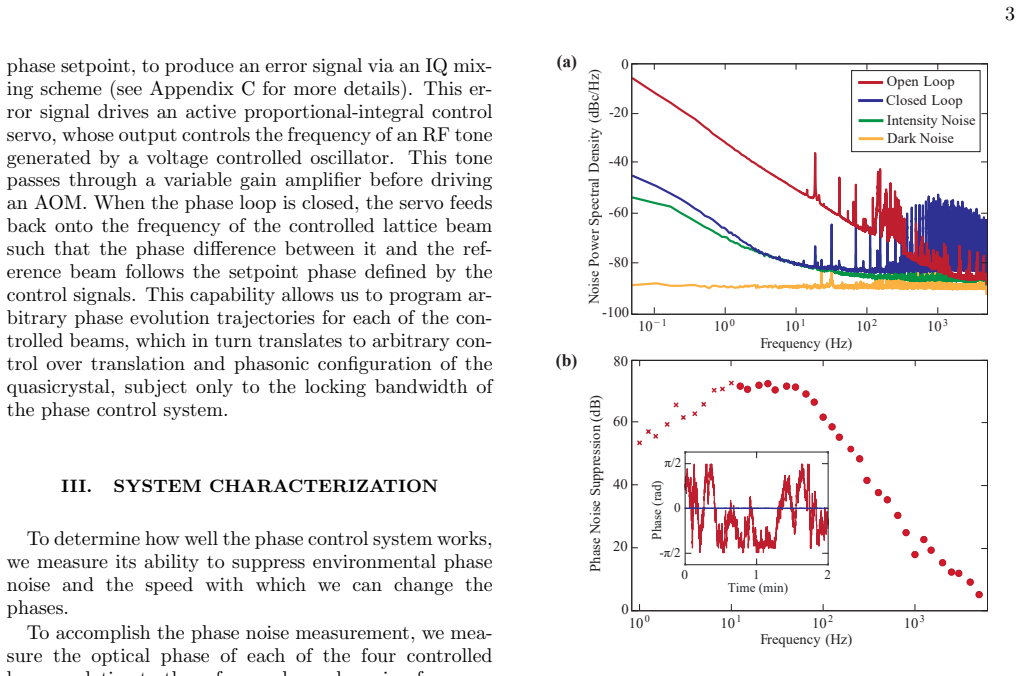
We describe an experimental scheme for creating a programmable, dynamic, two-dimensional quasiperiodic optical lattice with heavily suppressed phase noise. We observe suppression of phase noise for frequency components up to 5 kHz, and report phase noise suppression of over 70 dB over the DC-60 Hz frequency band. We further demonstrate a phase modulation bandwidth of 350 kHz. This scheme allows for full translational and phasonic control of the lattice, including changes to the rotational symmetry of the potential, at speeds exceeding the lattice recoil velocity, which paves a path towards direct observation and control of quantum dynamics in quasicrystals.
What carries the argument
Phase-locking feedback loop on the relative phases of the laser beams that form the lattice potential.
If this is right
- Full translational and phasonic control becomes available at speeds exceeding the recoil velocity.
- Rotational symmetry of the lattice can be altered dynamically.
- Floquet engineering of quasiperiodic systems is enabled with the reported purity.
- Direct experimental access to quantum dynamics in quasicrystals is opened.
Where Pith is reading between the lines
- The same locking approach could be adapted to three-dimensional or higher-order quasiperiodic patterns to test whether noise suppression scales.
- It might connect quasiperiodic atom simulators to existing periodic-lattice platforms, allowing side-by-side comparison of localization or transport properties.
- Rapid symmetry changes could be used to quench across different quasicrystal classes and measure the resulting nonequilibrium dynamics in a single apparatus.
Load-bearing premise
The phase-locking and feedback scheme maintains stability across the full range of desired lattice symmetries and modulation speeds without introducing new decoherence channels for the atoms.
What would settle it
Direct measurement of the phase-noise spectrum during 350 kHz modulation that shows no suppression, or observation of atom heating rates that rise when the lattice symmetry or phason is changed rapidly.
Figures



read the original abstract
The quantum dynamics of quasiperiodic systems display a rich variety of physical behaviors due to the combination of rotational symmetry that is mathematically forbidden in periodic systems, and long-range order despite the lack of translation symmetry. New experimental probes into these dynamics with a quantum simulator, consisting of ultracold atoms in an optical lattice potential, will yield new insights into the physics of quasiperiodic systems. This potential is imbued with the flexibility, tunability, and purity of the individual laser beams that constitute it, allowing for exquisite control over a rich system. Programmable dynamic control over the lattice beam phases opens up an even richer space of achievable systems via Floquet engineering. We thus describe an experimental scheme for creating a programmable, dynamic, two-dimensional (2D) quasiperiodic optical lattice with heavily suppressed phase noise. We observe suppression of phase noise for frequency components up to 5 kHz, and report phase noise suppression of over 70 dB over the DC-60 Hz frequency band. We further demonstrate a phase modulation bandwidth of 350 kHz. This scheme allows for full translational and phasonic control of the lattice, including changes to the rotational symmetry of the potential, at speeds exceeding the lattice recoil velocity, which paves a path towards direct observation and control of quantum dynamics in quasicrystals.
Editorial analysis
A structured set of objections, weighed in public.
Referee Report
Summary. The paper describes an experimental scheme for a programmable, dynamic 2D quasiperiodic optical lattice using phase control of multiple laser beams. It reports optical measurements showing phase-noise suppression for frequencies up to 5 kHz, >70 dB suppression in the DC-60 Hz band, and a modulation bandwidth of 350 kHz, enabling translational, phasonic, and symmetry control at speeds exceeding the recoil velocity for potential Floquet engineering of quasicrystal dynamics with ultracold atoms.
Significance. If the central performance metrics are validated and the scheme preserves atomic coherence under dynamic operation, the work would enable new probes of quasicrystal physics and Floquet-driven phenomena in quantum simulators. The reported bandwidth and suppression levels exceed typical requirements for recoil-velocity-scale control, which is a concrete technical advance for the field.
major comments (2)
- [Abstract and Results] The abstract and results claim that the scheme 'paves a path towards direct observation and control of quantum dynamics in quasicrystals' without introducing new decoherence channels, yet the reported data consist solely of beam-level phase-noise spectra and servo performance; no atomic coherence times, lifetimes, or in-situ measurements under simultaneous multi-beam modulation at > recoil speeds are presented. This leaves the weakest assumption (stability across lattice symmetries without new decoherence) untested and load-bearing for the central claim.
- [Results] The manuscript states concrete performance numbers (70 dB suppression, 350 kHz bandwidth) but provides no error bars, statistical analysis, or full methods description for how these were extracted from the phase-noise measurements. Without these, it is impossible to assess whether the suppression holds under the full range of desired lattice symmetries and modulation protocols.
minor comments (2)
- [Figures] Figure captions and axis labels should explicitly state the measurement bandwidth and averaging used for the phase-noise spectra to allow direct comparison with the quoted 70 dB and 5 kHz figures.
- [Introduction] The introduction would benefit from a brief comparison table of prior phase-locking schemes in optical lattices versus the present approach, highlighting the achieved bandwidth and suppression.
Simulated Author's Rebuttal
We thank the referee for their careful reading and constructive comments on our manuscript. We address each major comment point by point below, indicating the revisions we will incorporate.
read point-by-point responses
-
Referee: [Abstract and Results] The abstract and results claim that the scheme 'paves a path towards direct observation and control of quantum dynamics in quasicrystals' without introducing new decoherence channels, yet the reported data consist solely of beam-level phase-noise spectra and servo performance; no atomic coherence times, lifetimes, or in-situ measurements under simultaneous multi-beam modulation at > recoil speeds are presented. This leaves the weakest assumption (stability across lattice symmetries without new decoherence) untested and load-bearing for the central claim.
Authors: The manuscript presents a technical characterization of an optical phase-control scheme for a dynamic 2D quasiperiodic lattice, with all data consisting of beam-level measurements. The abstract uses the forward-looking phrase 'paves a path towards' to indicate that the demonstrated bandwidth (350 kHz) and noise suppression (>70 dB below 60 Hz) satisfy the speed and stability requirements for recoil-velocity-scale control, which is a prerequisite for Floquet engineering without phase-noise-induced decoherence. We agree that the manuscript does not contain atomic coherence or in-situ data under simultaneous multi-beam modulation, as the work is scoped to the optical implementation and servo performance. To clarify the distinction between demonstrated performance and prospective applications, we will revise the abstract and discussion sections to emphasize that atomic coherence studies remain future work. revision: partial
-
Referee: [Results] The manuscript states concrete performance numbers (70 dB suppression, 350 kHz bandwidth) but provides no error bars, statistical analysis, or full methods description for how these were extracted from the phase-noise measurements. Without these, it is impossible to assess whether the suppression holds under the full range of desired lattice symmetries and modulation protocols.
Authors: We agree that the extraction of the reported metrics requires additional detail for reproducibility. The values were obtained from heterodyne phase-noise spectra and closed-loop servo analysis, but the manuscript lacks explicit error bars, statistical treatment, and a complete methods description. In the revised version we will add a dedicated methods subsection that specifies the measurement protocol, data processing steps, uncertainty estimation, and any assumptions regarding applicability to different lattice symmetries and modulation waveforms. revision: yes
Circularity Check
No circularity: experimental hardware demonstration without derivations or fitted predictions
full rationale
The manuscript describes an experimental apparatus and reports direct measurements of phase-noise suppression (up to 5 kHz, >70 dB in DC-60 Hz) and modulation bandwidth (350 kHz) for a programmable 2D quasiperiodic lattice. No equations, ansatzes, or parameter fits are presented as predictions; the central results are raw hardware performance data benchmarked against external references such as recoil velocity. The work contains no self-citation chains, uniqueness theorems, or renamings that reduce the claimed outcomes to their own inputs. The derivation chain is therefore empty and the paper is self-contained against external benchmarks.
Axiom & Free-Parameter Ledger
Forward citations
Cited by 1 Pith paper
-
Quantum phase diagrams for bosons in hexagonal optical potentials: A continuous-space quantum Monte Carlo study
Continuous-space simulations of bosons in hexagonal lattices reveal suppressed Mott insulator phases in honeycomb geometries due to density-assisted tunneling and multiple sublattice Mott lobes in asymmetric h-BN lattices.
Reference graph
Works this paper leans on
-
[1]
controlled
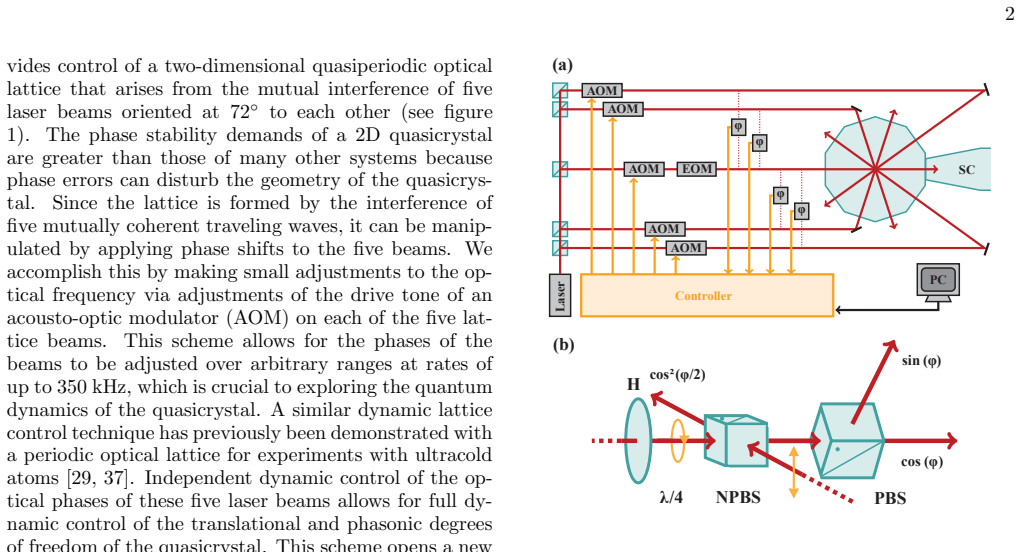
standing waves formed from the interference of each unique pair of the five laser beams. As such, the phases of the beams only enter the potential as differences, al- lowing us to, without loss of generality, define one beam to haveφ 5 = 0, and define the other four phases relative to this one. This scheme maps well onto the experimen- tal setup, where we...
-
[2]
Shechtman, I
D. Shechtman, I. Blech, D. Gratias, and J. W. Cahn, Metallic Phase with Long-Range Orientational Order and No Translational Symmetry, Physical Review Let- ters53, 1951 (1984)
1951
-
[3]
Ghadimi, T
R. Ghadimi, T. Sugimoto, and T. Tohyama, Mean-field study of the Bose-Hubbard model in the Penrose lattice, Physical Review B102, 224201 (2020)
2020
-
[4]
Rolof, S
S. Rolof, S. Thiem, and M. Schreiber, Electronic wave functions of quasiperiodic systems in momentum space, The European Physical Journal B86, 372 (2013)
2013
-
[5]
Sbroscia, K
M. Sbroscia, K. Viebahn, E. Carter, J.-C. Yu, A. Gaunt, and U. Schneider, Observing Localization in a 2D Qua- sicrystalline Optical Lattice, Physical Review Letters 125, 200604 (2020)
2020
-
[6]
W. Yao, E. Wang, C. Bao, Y. Zhang, K. Zhang, K. Bao, C. K. Chan, C. Chen, J. Avila, M. C. Asen- sio, J. Zhu, and S. Zhou, Quasicrystalline 30°twisted bi- layer graphene as an incommensurate superlattice with strong interlayer coupling, Proceedings of the National Academy of Sciences115, 6928 (2018)
2018
-
[7]
On the origin of energy gaps in quasicrystalline potentials
E. Gottlob, D. Gr¨ oters, and U. Schneider, On the ori- gin of energy gaps in quasicrystalline potentials (2025), arXiv:2512.18328 [cond-mat]
work page internal anchor Pith review Pith/arXiv arXiv 2025
-
[8]
Gottlob, D
E. Gottlob, D. S. Borgnia, R.-J. Slager, and U. Schnei- der, Quasiperiodicity Protects Quantized Transport in Disordered Systems Without Gaps, PRX Quantum6, 020359 (2025)
2025
-
[9]
Huang and F
H. Huang and F. Liu, Quantum Spin Hall Effect and Spin Bott Index in a Quasicrystal Lattice, Physical Review Letters121, 126401 (2018)
2018
-
[10]
Dareau, E
A. Dareau, E. Levy, M. B. Aguilera, R. Bouganne, E. Akkermans, F. Gerbier, and J. Beugnon, Revealing the Topology of Quasicrystals with a Diffraction Exper- iment, Physical Review Letters119, 215304 (2017)
2017
-
[11]
M. A. Bandres, M. C. Rechtsman, and M. Segev, Topological Photonic Quasicrystals: Fractal Topologi- cal Spectrum and Protected Transport, Physical Review X6, 011016 (2016)
2016
-
[12]
Matsuda, M
F. Matsuda, M. Tezuka, and N. Kawakami, Topologi- cal Properties of Ultracold Bosons in One-Dimensional Quasiperiodic Optical Lattice, Journal of the Physical Society of Japan83, 083707 (2014)
2014
-
[13]
D.-T. Tran, A. Dauphin, N. Goldman, and P. Gaspard, Topological Hofstadter insulators in a two-dimensional quasicrystal, Physical Review B91, 085125 (2015)
2015
-
[14]
C. W. Duncan, S. Manna, and A. E. B. Nielsen, Topo- logical models in rotationally symmetric quasicrystals, Physical Review B101, 115413 (2020)
2020
-
[15]
B. Burgess and N. Cooper, Quasicrystalline Analogue of the Haldane Model (2026), arXiv:2601.17963 [cond-mat]
-
[16]
Singh, K
K. Singh, K. Saha, S. A. Parameswaran, and D. M. Weld, Fibonacci optical lattices for tunable quantum quasicrys- tals, Physical Review A92, 063426 (2015)
2015
-
[17]
Kamiya, T
K. Kamiya, T. Takeuchi, N. Kabeya, N. Wada, T. Ishi- masa, A. Ochiai, K. Deguchi, K. Imura, and N. K. Sato, Discovery of superconductivity in quasicrystal, Nature Communications9, 154 (2018)
2018
-
[18]
R. N. Ara´ ujo and E. C. Andrade, Conventional super- conductivity in quasicrystals, Physical Review B100, 014510 (2019). 10
2019
-
[19]
Sakai and R
S. Sakai and R. Arita, Exotic pairing state in quasicrys- talline superconductors under a magnetic field, Physical Review Research1, 022002 (2019)
2019
-
[20]
Sakai, N
S. Sakai, N. Takemori, A. Koga, and R. Arita, Super- conductivity on a quasiperiodic lattice: Extended-to- localized crossover of Cooper pairs, Physical Review B 95, 024509 (2017)
2017
-
[21]
A. Uri, S. C. de la Barrera, M. T. Randeria, D. Rodan- Legrain, T. Devakul, P. J. D. Crowley, N. Paul, K. Watanabe, T. Taniguchi, R. Lifshitz, L. Fu, R. C. Ashoori, and P. Jarillo-Herrero, Superconductivity and strong interactions in a tunable moir´ e quasicrystal, Na- ture620, 762 (2023)
2023
-
[22]
Tarruell, D
L. Tarruell, D. Greif, T. Uehlinger, G. Jotzu, and T. Esslinger, Creating, moving and merging Dirac points with a Fermi gas in a tunable honeycomb lattice, Nature 483, 302 (2012)
2012
-
[23]
J. Hou, H. Hu, K. Sun, and C. Zhang, Superfluid- Quasicrystal in a Bose-Einstein Condensate, Physical Review Letters120, 060407 (2018)
2018
-
[24]
Spurrier and N
S. Spurrier and N. R. Cooper, Semiclassical dynamics, Berry curvature, and spiral holonomy in optical qua- sicrystals, Physical Review A97, 043603 (2018)
2018
-
[25]
Gross and I
C. Gross and I. Bloch, Quantum simulations with ultra- cold atoms in optical lattices, Science357, 995 (2017)
2017
-
[26]
Shimasaki, Y
T. Shimasaki, Y. Bai, H. E. Kondakci, P. Dotti, J. E. Pagett, A. R. Dardia, M. Prichard, A. Eckardt, and D. M. Weld, Reversible Phasonic Control of a Quantum Phase Transition in a Quasicrystal, Physical Review Let- ters133, 083405 (2024)
2024
-
[27]
Grass, D
T. Grass, D. Bercioux, U. Bhattacharya, M. Lewenstein, H. S. Nguyen, and C. Weitenberg,Colloquium: Syn- thetic quantum matter in nonstandard geometries, Re- views of Modern Physics97, 011001 (2025)
2025
-
[28]
Viebahn, M
K. Viebahn, M. Sbroscia, E. Carter, J.-C. Yu, and U. Schneider, Matter-Wave Diffraction from a Quasicrys- talline Optical Lattice, Physical Review Letters122, 110404 (2019)
2019
-
[29]
J.-C. Yu, S. Bhave, L. Reeve, B. Song, and U. Schneider, Observing the two-dimensional Bose glass in an optical quasicrystal, Nature633, 338 (2024)
2024
-
[30]
C. D. Brown, S.-W. Chang, M. N. Schwarz, T.-H. Leung, V. Kozii, A. Avdoshkin, J. E. Moore, and D. Stamper- Kurn, Direct geometric probe of singularities in band structure, Science377, 1319 (2022)
2022
-
[31]
L.-J. Lang, X. Cai, and S. Chen, Edge States and Topo- logical Phases in One-Dimensional Optical Superlattices, Physical Review Letters108, 220401 (2012)
2012
-
[32]
M. N. Kosch, L. Asteria, H. P. Zahn, K. Sengstock, and C. Weitenberg, Multifrequency optical lattice for dynamic lattice-geometry control, Physical Review Re- search4, 043083 (2022)
2022
-
[33]
Y. Li, W. Han, Z. Meng, W. Yang, C. Chin, and J. Zhang, Observation of quantized vortex in atomic Bose–Einstein condensate at Dirac point with emergent spin–orbit coupling, Nature Photonics19, 1264 (2025)
2025
-
[34]
T. Li, L. Duca, M. Reitter, F. Grusdt, E. Demler, M. En- dres, M. Schleier-Smith, I. Bloch, and U. Schneider, Bloch state tomography using Wilson lines, Science352, 1094 (2016)
2016
-
[35]
Mehling, M
K. Mehling, M. Holland, and C. LeDesma, High- precision phase control of an optical lattice with up to 50 dB noise suppression, Physical Review Applied25, 024008 (2026)
2026
-
[36]
Sanchez-Palencia and L
L. Sanchez-Palencia and L. Santos, Bose-Einstein con- densates in optical quasicrystal lattices, Physical Review A72, 053607 (2005)
2005
-
[37]
T. A. Corcovilos and J. Mittal, Two-dimensional optical quasicrystal potentials for ultracold atom experiments, Applied Optics58, 2256 (2019)
2019
-
[38]
Leung,Interacting Ultracold Bosonic Atoms in Ge- ometrically Frustrated Lattices, Ph.D
T.-H. Leung,Interacting Ultracold Bosonic Atoms in Ge- ometrically Frustrated Lattices, Ph.D. thesis, University of California, Berkeley (2020)
2020
-
[39]
J. P. Lu and J. L. Birman, Electronic structure of a quasiperiodic system, Physical Review B36, 4471 (1987)
1987
-
[40]
Freedman, R
B. Freedman, R. Lifshitz, J. W. Fleischer, and M. Segev, Phason dynamics in nonlinear photonic quasicrystals, Nature Materials6, 776 (2007)
2007
-
[41]
Y. E. Kraus, Y. Lahini, Z. Ringel, M. Verbin, and O. Zil- berberg, Topological States and Adiabatic Pumping in Quasicrystals, Physical Review Letters109, 106402 (2012)
2012
-
[42]
W. Steurer, Quasicrystals. A primer by C. Janot, Acta Crystallographica Section A53, 10.1107/S0108767397099868 (1997)
-
[43]
Szab´ o and U
A. Szab´ o and U. Schneider, Mixed spectra and par- tially extended states in a two-dimensional quasiperiodic model, Physical Review B101, 014205 (2020)
2020
-
[44]
ˇStrkalj, E
A. ˇStrkalj, E. V. H. Doggen, and C. Castelnovo, Coexis- tence of localization and transport in many-body two- dimensional Aubry-Andr´ e models, Physical Review B 106, 184209 (2022)
2022
discussion (0)
Sign in with ORCID, Apple, or X to comment. Anyone can read and Pith papers without signing in.