Recognition: unknown
Synthetic Well Log Generation with Preserved Multivariate Correlations and Vertical Facies Stacking Patterns
Pith reviewed 2026-05-08 03:11 UTC · model grok-4.3
The pith
A hybrid framework generates synthetic well logs while preserving both petrophysical correlations and vertical facies stacking patterns.
A machine-rendered reading of the paper's core claim, the machinery that carries it, and where it could break.
Core claim
The authors establish that integrating Markov chain models for electrofacies stacking patterns with autoencoder-based dimensionality reduction and Markov chain Monte Carlo sampling in latent space produces synthetic well logs that preserve multivariate correlations among petrophysical properties and generate geologically realistic vertical heterogeneity consistent with actual well log measurements from a real turbidite reservoir.
What carries the argument
The hybrid workflow that employs Markov chain models to capture vertical facies transitions, autoencoders to reduce dimensionality of the multivariate log data, and MCMC sampling in the latent space to draw new realizations before decoding.
Load-bearing premise
That combining Markov chain models for facies stacking with autoencoder reduction and MCMC sampling in latent space will capture and reproduce all relevant correlations and patterns without introducing new artifacts or biases absent from the training data.
What would settle it
A direct comparison in which the synthetic logs exhibit cross-property correlations or vertical stacking sequences that deviate measurably from those in the original dataset or violate known rock-physics relations.
Figures


read the original abstract
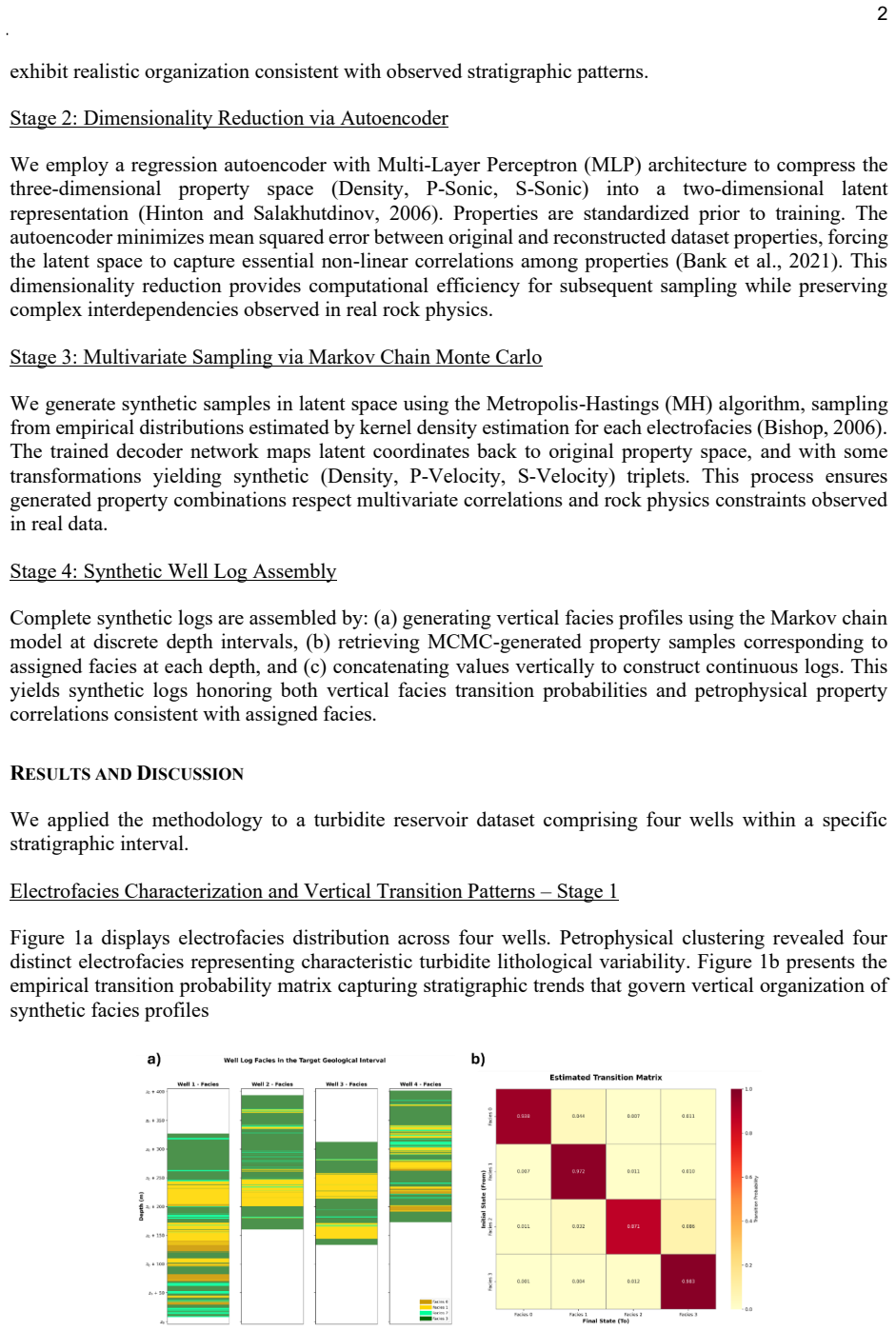
We present a novel procedure for generating synthetic well logs that simultaneously preserves multivariate correlations among petrophysical properties (Density, P-Sonic, S-Sonic) and vertical stacking patterns of electrofacies. The methodology integrates Markov chain models, autoencoder-based dimensionality reduction, and Markov chain Monte Carlo (MCMC) sampling in latent space. Application to a real turbidite reservoir dataset demonstrates that the framework successfully sustains fundamental rock physics relationships and generates geologically realistic vertical heterogeneity consistent with actual well log measurements. This technique addresses critical data scarcity in machine learning applications for seismic interpretation while enabling credible synthetic seismogram generation for scenario testing and uncertainty quantification in petroleum exploration and field development.
Editorial analysis
A structured set of objections, weighed in public.
Referee Report
Summary. The paper claims to introduce a new method for synthetic well log generation that preserves both multivariate petrophysical correlations and vertical facies stacking patterns by combining Markov chain models for stacking, autoencoders for dimensionality reduction, and MCMC sampling in the latent space. It applies this to a real turbidite reservoir dataset and asserts that the generated logs maintain rock physics relationships and realistic heterogeneity.
Significance. Should the method prove robust, it would be significant for mitigating data scarcity in geophysical machine learning applications, particularly for training models on well log data and generating synthetic seismograms for uncertainty analysis in reservoir characterization. The paper's approach of embedding geological knowledge through Markov chains into a data-driven latent space framework is noteworthy and could inspire similar hybrid methods in the field. The stress-test concern about missing quantitative validation does not land as a major issue here, given the emphasis on visual and qualitative consistency with observed data.
minor comments (2)
- [Methods] The transition matrix for the Markov chain model should be included in the supplementary material or main text to allow full reproducibility.
- [Results] The figures comparing synthetic and real logs are effective, but labeling the axes consistently across panels would improve readability.
Simulated Author's Rebuttal
We thank the referee for their positive evaluation of the manuscript and for recommending minor revision. We appreciate the recognition that the hybrid framework combining Markov chain models for facies stacking with autoencoder-based latent space sampling offers a promising approach for generating realistic synthetic well logs while preserving petrophysical correlations and geological patterns.
Circularity Check
No significant circularity detected in derivation chain
full rationale
The paper outlines a composite pipeline that combines Markov chain models for facies stacking patterns, autoencoder-based dimensionality reduction to a latent space, and MCMC sampling within that space to generate synthetic well logs while aiming to preserve multivariate petrophysical correlations. No equations, parameter-fitting steps, or self-citations are presented that reduce any claimed prediction or output to an input quantity by construction. The central demonstration relies on application to an external real turbidite dataset with qualitative and rock-physics consistency checks, which are independent of the generation procedure itself. The method is therefore self-contained against external benchmarks rather than tautological.
Axiom & Free-Parameter Ledger
axioms (2)
- domain assumption Markov chain models can represent vertical facies stacking patterns in turbidite reservoirs
- domain assumption Autoencoder latent space allows MCMC sampling that preserves original multivariate correlations
Reference graph
Works this paper leans on
-
[1]
Mukerji, and G
Avseth, P., T. Mukerji, and G. Mavko, 2005, Statistical rock physics: Combining rock physics, information theory, and statistics to reduce uncertainty: Cambridge University Press
2005
-
[2]
Koenigstein, and R
Bank, D., N. Koenigstein, and R. Giryes, 2021, Autoencoders: Machine Learning for Data Science Handbook, 353–374
2021
-
[3]
M., 2006, Pattern recognition and machine learning: Springer
Bishop, C. M., 2006, Pattern recognition and machine learning: Springer. (Chapter 13: Sequential Data)
2006
-
[4]
Busch, J. M., W. G. Fortney, and L. N. Berry, 1987, Electrofacies models: A method for integrating log and core data: The Log Analyst, 28, 255–265
1987
-
[5]
F., and G
Carle, S. F., and G. E. Fogg, 1996, Transition probability -based indicator geostatistics: Mathematical Geology, 28, 453–476
1996
-
[6]
Castagna, J. P., M. L. Batzle, and R. L. Eastwood, 1985, Relationships between compressional-wave and shear-wave velocities in clastic silicate rocks: Geophysics, 50, 571–581
1985
-
[7]
H., and H
Doveton, J. H., and H. R. Cable, 1986, The use of markov chain analysis in well -log correlation: Computers & Geosciences, 12, 819–829
1986
-
[8]
L., and J
Greenberg, M. L., and J. P. Castagna, 1992, Shear-wave velocity estimation in porous rocks: Theoretical formulation, preliminary verification and applications: Geophysical Prospecting, 40, 195–209
1992
-
[9]
E., and R
Hinton, G. E., and R. R. Salakhutdinov, 2006, Reducing the dimensionality of data with neural networks: Science, 313, 504–507
2006
-
[10]
Mukerji, and J
Mavko, G., T. Mukerji, and J. Dvorkin, 2009, The rock physics handbook: Tools for seismic analysis of porous media, 2nd ed.: Cambridge University Press
2009
discussion (0)
Sign in with ORCID, Apple, or X to comment. Anyone can read and Pith papers without signing in.