Recognition: unknown
ZScribbleSeg: A comprehensive segmentation framework with modeling of efficient annotation and maximization of scribble supervision
Pith reviewed 2026-05-08 13:30 UTC · model grok-4.3
The pith
Scribble annotations alone reach competitive accuracy in medical image segmentation by optimizing their placement and adding spatial shape constraints.
A machine-rendered reading of the paper's core claim, the machinery that carries it, and where it could break.
Core claim
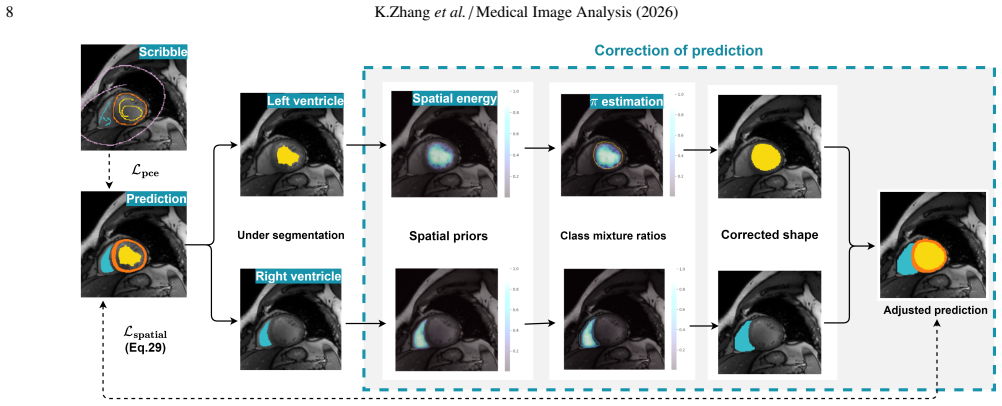
We propose ZScribbleSeg that first derives efficient scribble forms through supervision maximization and randomness simulation. We add regularization terms that encode spatial relationships and shape constraints, using the EM algorithm to estimate mixture ratios of label classes. These ratios identify unlabeled pixels for each class and correct erroneous predictions, allowing the integrated framework to deliver competitive segmentation on six medical datasets using only scribble supervision.
What carries the argument
ZScribbleSeg framework that combines maximized scribble supervision with EM-estimated class mixture ratios to apply spatial and shape regularization.
If this is right
- Segmentation training becomes feasible with only sparse scribble strokes instead of dense pixel labels across cardiac, abdominal, and tumor datasets.
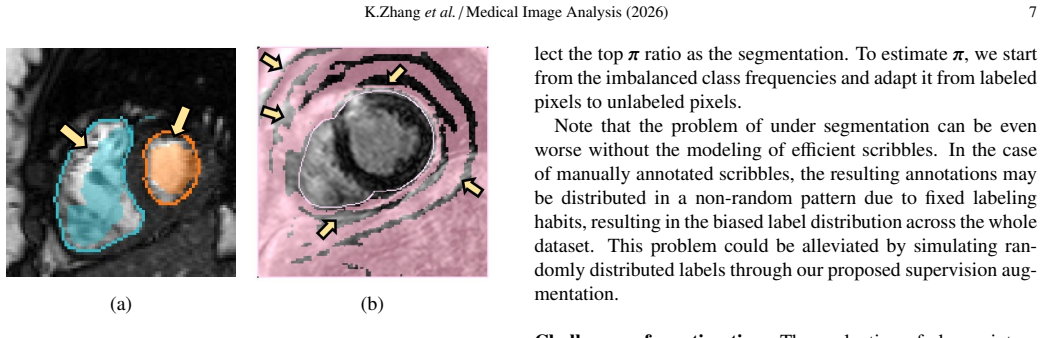
- Unlabeled regions receive class assignments based on estimated mixture ratios, which reduces errors that arise from incomplete supervision.
- Shape and spatial regularization produces segmentations that respect anatomical continuity rather than isolated pixel decisions.
- The same pipeline applies without modification to six distinct segmentation challenges including ACDC, BTCV, and Decathlon tasks.
Where Pith is reading between the lines
- Annotation budgets in radiology departments could shrink dramatically if models need only a few strokes per image.
- The same mixture-ratio correction idea might improve other weak-supervision settings where partial labels must be propagated.
- An active-learning loop could be built on top by letting the model suggest the most informative scribble locations for the next human annotation round.
Load-bearing premise
The regularization terms accurately reflect true spatial relationships and shape constraints, and the EM algorithm reliably estimates class mixture ratios without any full ground-truth labels available.
What would settle it
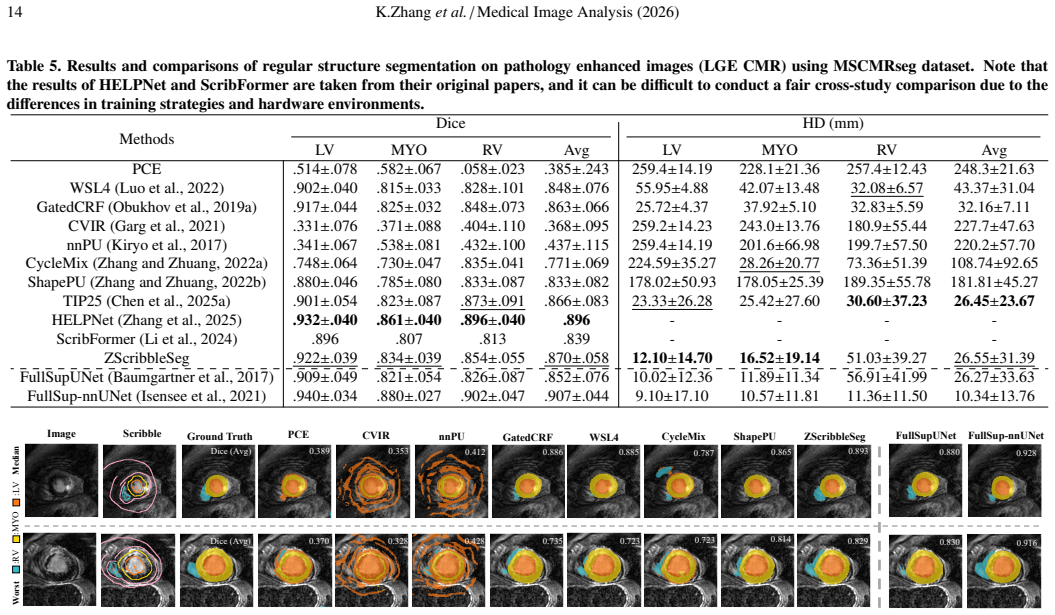
On the ACDC dataset, the Dice scores produced by ZScribbleSeg trained only on scribbles fall more than a few percentage points below the scores of a standard fully supervised model trained on complete labels.
Figures






read the original abstract
Curating fully annotated datasets for medical image segmentation is labour-intensive and expertise-demanding. To alleviate this problem, prior studies have explored scribble annotations for weakly supervised segmentation. Existing solutions mainly compute losses on annotated areas and generate pseudo labels by propagating annotations to adjacent regions. However, these methods often suffer from inaccurate and unrealistic segmentations due to insufficient supervision and incomplete shape information. In contrast, we first investigate the principle of good scribble annotations, which leads to efficient scribble forms via supervision maximization and randomness simulation. We further introduce regularization terms to encode the spatial relationship and the shape constraints, where the EM algorithm is utilized to estimate the mixture ratios of label classes. These ratios are critical in identifying the unlabeled pixels for each class and correcting erroneous predictions, thus the accurate estimation lays the foundation for the incorporation of spatial prior. Finally, we integrate the efficient scribble supervision with the prior into a framework, referred to as ZScribbleSeg, and apply it to multiple scenarios. Leveraging only scribble annotations, ZScribbleSeg achieves competitive performance on six segmentation tasks including ACDC, MSCMRseg, BTCV, MyoPS, Decathlon-BrainTumor and Decathlon-Prostate. Our code will be released via https://github.com/DLwbm123/ZScribbleSeg.
Editorial analysis
A structured set of objections, weighed in public.
Referee Report
Summary. The paper introduces ZScribbleSeg, a weakly supervised segmentation framework for medical images that relies solely on scribble annotations. It first derives principles for efficient scribble forms via supervision maximization and randomness simulation, then adds regularization terms encoding spatial relationships and shape constraints. An EM algorithm estimates class mixture ratios to identify and correct unlabeled pixels, which are incorporated as spatial priors. The framework is evaluated on six tasks (ACDC, MSCMRseg, BTCV, MyoPS, Decathlon-BrainTumor, Decathlon-Prostate), claiming competitive performance.
Significance. If the results hold, the work addresses a practical bottleneck in medical imaging by minimizing annotation effort while maintaining segmentation quality through principled regularization and EM-based pseudo-labeling. The explicit modeling of scribble efficiency and the promised code release would support reproducibility and adoption in data-scarce clinical settings.
major comments (2)
- [Abstract] Abstract: The central claim that ZScribbleSeg 'achieves competitive performance' on the six listed datasets is unsupported by any quantitative metrics, baseline comparisons, error bars, or ablation results. This absence prevents verification of whether the regularization and EM steps deliver the asserted gains over prior scribble methods.
- [Method (regularization and EM steps)] The EM-based estimation of mixture ratios (in the regularization and EM steps): Because training uses only scribbles, the EM step has no access to ground-truth class proportions. No direct validation of estimation accuracy (e.g., comparison to oracle ratios, sensitivity analysis, or ablation removing the EM correction) is provided, yet this estimation is load-bearing for the pseudo-label correction and spatial-prior incorporation that underpin the competitive-performance claim.
minor comments (1)
- [Abstract] The abstract would be strengthened by including at least one key quantitative result (e.g., Dice score on ACDC) to allow readers to gauge the claimed competitiveness immediately.
Simulated Author's Rebuttal
We are grateful for the referee's insightful comments, which have helped us identify areas for improvement in our manuscript. Below, we provide point-by-point responses to the major comments and outline the revisions we plan to make.
read point-by-point responses
-
Referee: [Abstract] Abstract: The central claim that ZScribbleSeg 'achieves competitive performance' on the six listed datasets is unsupported by any quantitative metrics, baseline comparisons, error bars, or ablation results. This absence prevents verification of whether the regularization and EM steps deliver the asserted gains over prior scribble methods.
Authors: We agree that the abstract would be strengthened by including quantitative support for the performance claims. In the revised manuscript, we will update the abstract to report key metrics such as mean Dice scores on the six datasets (ACDC, MSCMRseg, BTCV, MyoPS, Decathlon-BrainTumor, Decathlon-Prostate), along with brief comparisons to prior scribble-supervised baselines. This will allow readers to directly assess the contributions of the regularization and EM components. revision: yes
-
Referee: [Method (regularization and EM steps)] The EM-based estimation of mixture ratios (in the regularization and EM steps): Because training uses only scribbles, the EM step has no access to ground-truth class proportions. No direct validation of estimation accuracy (e.g., comparison to oracle ratios, sensitivity analysis, or ablation removing the EM correction) is provided, yet this estimation is load-bearing for the pseudo-label correction and spatial-prior incorporation that underpin the competitive-performance claim.
Authors: The EM procedure iteratively estimates class mixture ratios by treating the model's soft predictions on unlabeled pixels as observations, conditioned on the scribble annotations and spatial constraints; it does not require ground-truth proportions. While the paper demonstrates the value of this step through overall results and indirect ablations, we acknowledge the absence of direct validation such as oracle comparisons or explicit sensitivity analysis. In the revision, we will add a dedicated ablation removing the EM correction and a sensitivity study on the estimated ratios to substantiate its role. revision: yes
Circularity Check
No significant circularity detected
full rationale
The paper describes a framework that first studies principles of good scribble annotations to derive efficient forms via supervision maximization, then adds regularization terms encoding spatial relationships and shape constraints with an EM algorithm to estimate class mixture ratios for pseudo-label correction. These steps are presented as applications of standard EM and regularization principles to scribble data rather than self-definitional loops. No equations equate a prediction directly to a fitted input by construction, no load-bearing self-citations are invoked to justify uniqueness, and no known results are merely renamed. Performance claims rest on empirical results across six external datasets, rendering the chain self-contained.
Axiom & Free-Parameter Ledger
axioms (3)
- domain assumption Efficient scribble forms can be derived from principles of supervision maximization and randomness simulation
- domain assumption Regularization terms can encode spatial relationships and shape constraints sufficiently to correct predictions on unlabeled pixels
- domain assumption The EM algorithm can accurately estimate mixture ratios of label classes from scribble data
Reference graph
Works this paper leans on
-
[1]
2020 , journal=
ACCL: Adversarial constrained-CNN loss for weakly supervised medical image segmentation , author=. 2020 , journal=
2020
-
[2]
Advances in neural information processing systems , volume=
A probabilistic u-net for segmentation of ambiguous images , author=. Advances in neural information processing systems , volume=
-
[3]
2019 , pages=
Fong, Ruth and Patrick, Mandela and Vedaldi, Andrea , booktitle= ICCV, title =. 2019 , pages=
2019
-
[4]
2017 , pages=
Fong Ruth, Patrick M, Vedaldi A , booktitle= ICCV, title =. 2017 , pages=
2017
-
[5]
Neural computation , volume=
Training with noise is equivalent to Tikhonov regularization , author=. Neural computation , volume=. 1995 , publisher=
1995
-
[6]
2006 , publisher=
Pattern Recognition and machine learning , author=. 2006 , publisher=
2006
-
[7]
International Conference on Machine learning , pages=
Semi-supervised classification based on classification from positive and unlabeled data , author=. International Conference on Machine learning , pages=. 2017 , publisher=
2017
-
[8]
IEEE Transactions on Pattern Analysis and Machine Intelligence , volume=
Minimizing estimated risks on unlabeled data: A new formulation for semi-supervised medical image segmentation , author=. IEEE Transactions on Pattern Analysis and Machine Intelligence , volume=. 2022 , publisher=
2022
-
[9]
International Conference on Machine learning , volume=
Adjusting the outputs of a classifier to new a priori probabilities may significantly improve classification accuracy: evidence from a multi-class problem in remote sensing , author=. International Conference on Machine learning , volume=
-
[10]
2007 , publisher=
The EM algorithm and extensions , author=. 2007 , publisher=
2007
-
[11]
Computing , volume=
A shortest augmenting path algorithm for dense and sparse linear assignment problems , author=. Computing , volume=. 1987 , publisher=
1987
-
[12]
Journal of the society for industrial and applied mathematics , volume=
Algorithms for the assignment and transportation problems , author=. Journal of the society for industrial and applied mathematics , volume=. 1957 , publisher=
1957
-
[13]
IEEE Transactions on pattern analysis and machine intelligence , volume=
Fast approximate energy minimization via graph cuts , author=. IEEE Transactions on pattern analysis and machine intelligence , volume=. 2001 , publisher=
2001
-
[14]
nature , volume=
Deep learning , author=. nature , volume=. 2015 , publisher=
2015
-
[15]
arXiv preprint arXiv:1904.08128 , year=
Automated design of deep learning methods for biomedical image segmentation , author=. arXiv preprint arXiv:1904.08128 , year=
-
[16]
Nature Methods , volume=
nnU-Net: a self-configuring method for deep learning-based biomedical image segmentation , author=. Nature Methods , volume=. 2021 , publisher=
2021
-
[17]
Medical Image Analysis , volume=
Multi-scale patch and multi-modality atlases for whole heart segmentation of MRI , author=. Medical Image Analysis , volume=. 2016 , publisher=
2016
-
[18]
Medical Image Analysis , volume=
HELPNet: Hierarchical perturbations consistency and entropy-guided ensemble for scribble supervised medical image segmentation , author=. Medical Image Analysis , volume=. 2025 , publisher=
2025
-
[19]
Machine Vision and Applications , volume=
Volumetric medical image segmentation via scribble annotations and shape priors , author=. Machine Vision and Applications , volume=
-
[20]
International conference on machine learning , pages=
Puzzle mix: Exploiting saliency and local statistics for optimal mixup , author=. International conference on machine learning , pages=
-
[21]
International Conference on Learning Representations , year=
Co-Mixup: Saliency Guided Joint Mixup with Supermodular Diversity , author=. International Conference on Learning Representations , year=
-
[22]
Improved Regularization of Convolutional Neural Networks with Cutout
Improved Regularization of Convolutional Neural Networks with Cutout , author=. arXiv preprint arXiv:1708.04552 , year=
work page internal anchor Pith review arXiv
-
[23]
International Conference on Computer Vision , pages=
CutMix: Regularization Strategy to Train Strong Classifiers with Localizable Features , author=. International Conference on Computer Vision , pages=
-
[24]
International Conference on Learning Representations , year=
mixup: Beyond Empirical Risk Minimization , author=. International Conference on Learning Representations , year=
-
[25]
Exploring simple siamese representation learning
Xinlei Chen and Kaiming He , title =. arXiv preprint arXiv:2011.10566 , year =
-
[26]
Bootstrap Your Own Latent: A New Approach to Self-Supervised Learning
Bootstrap Your Own Latent: A New Approach to Self-Supervised Learning , author =. arXiv preprint arXiv:2006.07733 , year =
-
[27]
International Conference on Medical Image Computing and Computer-Assisted Intervention , pages=
Cardiac segmentation from LGE MRI using deep neural network incorporating shape and spatial priors , author=. International Conference on Medical Image Computing and Computer-Assisted Intervention , pages=. 2019 , publisher=
2019
-
[28]
Medical Image Analysis , volume=
Segmentation only uses sparse annotations: Unified weakly and semi-supervised learning in medical images , author=. Medical Image Analysis , volume=. 2022 , publisher=
2022
-
[29]
IEEE Transactions on Medical Imaging , volume=
Learning to segment from scribbles using multi-scale adversarial attention gates , author=. IEEE Transactions on Medical Imaging , volume=. 2021 , publisher=
2021
-
[30]
Nature communications , volume=
The medical segmentation decathlon , author=. Nature communications , volume=. 2022 , publisher=
2022
-
[31]
and Full, Peter M
Bernard, Olivier and Lalande, Alain and Zotti, Clement and Cervenansky, Frederick and Yang, Xin and Heng, Pheng-Ann and Cetin, Irem and Lekadir, Karim and Camara, Oscar and Gonzalez Ballester, Miguel Angel and Sanroma, Gerard and Napel, Sandy and Petersen, Steffen and Tziritas, Georgios and Grinias, Elias and Khened, Mahendra and Kollerathu, Varghese Alex...
-
[32]
Computers in biology and medicine , volume=
Data augmentation for medical imaging: A systematic literature review , author=. Computers in biology and medicine , volume=. 2023 , publisher=
2023
-
[33]
European Conference on Computer Vision , pages=
Sumix: Mixup with semantic and uncertain information , author=. European Conference on Computer Vision , pages=
-
[34]
Medical Image Analysis , volume=
Nuclei segmentation with point annotations from pathology images via self-supervised learning and co-training , author=. Medical Image Analysis , volume=. 2023 , publisher=
2023
-
[35]
IEEE transactions on pattern analysis and machine intelligence , volume=
Multivariate mixture model for myocardial segmentation combining multi-source images , author=. IEEE transactions on pattern analysis and machine intelligence , volume=. 2019 , publisher=
2019
-
[36]
International Conference on Machine Learning , pages=
The benefits of mixup for feature learning , author=. International Conference on Machine Learning , pages=
-
[37]
IEEE Transactions on Medical Imaging , volume=
Scribformer: Transformer makes cnn work better for scribble-based medical image segmentation , author=. IEEE Transactions on Medical Imaging , volume=. 2024 , publisher=
2024
-
[38]
International Conference on Medical Image Computing and Computer-Assisted Intervention , pages=
Weakly supervised medical image segmentation via superpixel-guided scribble walking and class-wise contrastive regularization , author=. International Conference on Medical Image Computing and Computer-Assisted Intervention , pages=
-
[39]
Miccai multi-atlas labeling beyond the cranial vault--workshop and challenge , author=. Proc. MICCAI Multi-Atlas Labeling Beyond Cranial Vault—Workshop Challenge , volume=
-
[40]
International Conference on Medical Image Computing and Computer-Assisted Intervention , pages=
EFFDNet: A Scribble-Supervised Medical Image Segmentation Method with Enhanced Foreground Feature Discrimination , author=. International Conference on Medical Image Computing and Computer-Assisted Intervention , pages=
-
[41]
Multivariate Mixture Model for Myocardial Segmentation Combining Multi-Source Images , year=
Zhuang, Xiahai , journal=. Multivariate Mixture Model for Myocardial Segmentation Combining Multi-Source Images , year=
-
[42]
Medical Image Analysis , volume=
Weakly supervised segmentation of retinal layers on OCT images with AMD using uncertainty prototype and boundary regression , author=. Medical Image Analysis , volume=. 2025 , publisher=
2025
-
[43]
Medical Image Analysis , volume=
The Medical Segmentation Decathlon , author=. Medical Image Analysis , volume=. 2025 , publisher=
2025
-
[44]
Medical image analysis , volume=
Anomaly-guided weakly supervised lesion segmentation on retinal OCT images , author=. Medical image analysis , volume=. 2024 , publisher=
2024
-
[45]
IEEE Transactions on Medical Imaging , year=
FedLPPA: Learning personalized prompt and aggregation for federated weakly-supervised medical image segmentation , author=. IEEE Transactions on Medical Imaging , year=
-
[46]
Medical Image Computing and Computer Assisted Intervention , pages=
Multivariate Mixture Model for Cardiac Segmentation from Multi-Sequence MRI , author=. Medical Image Computing and Computer Assisted Intervention , pages=
-
[47]
Dice , journal =
Lee R. Dice , journal =. Measures of the Amount of Ecologic Association Between Species , volume =
-
[48]
International Workshop on Statistical Atlases and Computational Models of the Heart , pages=
An exploration of 2D and 3D deep learning techniques for cardiac MR image segmentation , author=. International Workshop on Statistical Atlases and Computational Models of the Heart , pages=. 2017 , publisher=
2017
-
[49]
European Conference on Computer Vision , pages=
On regularized losses for weakly-supervised cnn segmentation , author=. European Conference on Computer Vision , pages=
-
[50]
Deep Learning in Medical Image Analysis and Multimodal Learning for Clinical Decision Support Workshop , year=
Learning to Segment Medical Images with Scribble-Supervision Alone , author=. Deep Learning in Medical Image Analysis and Multimodal Learning for Clinical Decision Support Workshop , year=
-
[51]
IEEE Transactions on Medical Imaging , year=
Post-DAE: Anatomically Plausible Segmentation via Post-Processing With Denoising Autoencoders , author=. IEEE Transactions on Medical Imaging , year=
-
[52]
IEEE transactions on pattern analysis and machine intelligence , volume=
Deeplab: Semantic image segmentation with deep convolutional nets, atrous convolution, and fully connected crfs , author=. IEEE transactions on pattern analysis and machine intelligence , volume=. 2017 , publisher=
2017
-
[53]
IEEE International Conference on Computer Vision , pages=
Conditional random fields as recurrent neural networks , author=. IEEE International Conference on Computer Vision , pages=
-
[54]
International Conference on Machine learning , pages=
Manifold mixup: Better representations by interpolating hidden states , author=. International Conference on Machine learning , pages=. 2019 , publisher=
2019
-
[55]
International Conference on Information Processing in Medical Imaging , pages=
Semi-supervised and task-driven data augmentation , author=. International Conference on Information Processing in Medical Imaging , pages=. 2019 , publisher=
2019
-
[56]
Distilling the Knowledge in a Neural Network
Distilling the knowledge in a neural network , author=. arXiv preprint arXiv:1503.02531 , year=
work page internal anchor Pith review arXiv
-
[57]
IEEE Conference on Computer Vision and Pattern Recognition , pages=
Focalmix: Semi-supervised learning for 3d medical image detection , author=. IEEE Conference on Computer Vision and Pattern Recognition , pages=
-
[58]
International Conference on Medical Image Computing and Computer-Assisted Intervention , pages=
Recurrent neural networks for aortic image sequence segmentation with sparse annotations , author=. International Conference on Medical Image Computing and Computer-Assisted Intervention , pages=. 2018 , publisher=
2018
-
[59]
Pattern Anal
The PASCAL visual object classes challenge 2012 (VOC2012) development kit , author=. Pattern Anal. Stat. Model. Comput. Learn., Tech. Rep , volume=
2012
-
[60]
IEEE International Conference on Computer Vision , pages=
Pedestrian parsing via deep decompositional network , author=. IEEE International Conference on Computer Vision , pages=
-
[61]
IEEE transactions on medical imaging , volume=
Weakly supervised deep nuclei segmentation using partial points annotation in histopathology images , author=. IEEE transactions on medical imaging , volume=. 2020 , publisher=
2020
-
[62]
IEEE Conference on Computer Vision and Pattern Recognition , pages=
Scribblesup: Scribble-supervised convolutional networks for semantic segmentation , author=. IEEE Conference on Computer Vision and Pattern Recognition , pages=
-
[63]
International Conference on Medical Image Computing and Computer-Assisted Intervention , pages=
Scribble-based hierarchical weakly supervised learning for brain tumor segmentation , author=. International Conference on Medical Image Computing and Computer-Assisted Intervention , pages=. 2019 , publisher=
2019
-
[64]
IEEE Conference on Computer Vision and Pattern Recognition , pages=
Semi-supervised semantic segmentation with cross-consistency training , author=. IEEE Conference on Computer Vision and Pattern Recognition , pages=
-
[65]
arXiv preprint arXiv:1610.02242 , year=
Temporal ensembling for semi-supervised learning , author=. arXiv preprint arXiv:1610.02242 , year=
-
[66]
Mean teachers are better role models: Weight-averaged consistency targets improve semi-supervised deep learning results , author=. arXiv preprint arXiv:1703.01780 , year=
-
[67]
IEEE International Conference on Computer Vision , pages=
Unpaired image-to-image translation using cycle-consistent adversarial networks , author=. IEEE International Conference on Computer Vision , pages=
-
[68]
IEEE International Conference on Computer Vision , pages=
Boxsup: Exploiting bounding boxes to supervise convolutional networks for semantic segmentation , author=. IEEE International Conference on Computer Vision , pages=
-
[69]
Medical Image Analysis , volume=
Embracing imperfect datasets: A review of deep learning solutions for medical image segmentation , author=. Medical Image Analysis , volume=. 2020 , publisher=
2020
-
[70]
Neuroimage , volume=
User-guided 3D active contour segmentation of anatomical structures: significantly improved efficiency and reliability , author=. Neuroimage , volume=. 2006 , publisher=
2006
-
[71]
Pattern Recognition , volume=
Weakly supervised segmentation of COVID19 infection with scribble annotation on CT images , author=. Pattern Recognition , volume=. 2022 , publisher=
2022
-
[72]
IEEE International Conference on Computer Vision , pages=
Constrained convolutional neural networks for weakly supervised segmentation , author=. IEEE International Conference on Computer Vision , pages=
-
[73]
Mean teachers are better role models: Weight-averaged consistency targets improve semi-supervised deep learning results , volume =
Tarvainen, Antti and Valpola, Harri , journal =. Mean teachers are better role models: Weight-averaged consistency targets improve semi-supervised deep learning results , volume =
-
[74]
IEEE International Conference on Computer Vision , pages=
Semi supervised semantic segmentation using generative adversarial network , author=. IEEE International Conference on Computer Vision , pages=
-
[75]
IEEE transactions on pattern analysis and machine intelligence , year=
Semi-supervised semantic segmentation with high-and low-level consistency , author=. IEEE transactions on pattern analysis and machine intelligence , year=
-
[76]
IEEE transactions on pattern analysis and machine intelligence , year=
Stc: A simple to complex framework for weakly-supervised semantic segmentation , author=. IEEE transactions on pattern analysis and machine intelligence , year=
-
[77]
IEEE Conference on Computer Vision and Pattern Recognition , pages=
Image-to-image translation with conditional adversarial networks , author=. IEEE Conference on Computer Vision and Pattern Recognition , pages=
-
[78]
IEEE Conference on Computer Vision and Pattern Recognition , pages=
Normalized cut loss for weakly-supervised cnn segmentation , author=. IEEE Conference on Computer Vision and Pattern Recognition , pages=
-
[79]
Advances in Neural Information Processing Systems , volume=
Mixture Proportion Estimation and PU Learning: A Modern Approach , author=. Advances in Neural Information Processing Systems , volume=
-
[80]
Advances in Neural Information Processing Systems , volume=
Positive-Unlabeled Learning with Non-Negative Risk Estimator , author=. Advances in Neural Information Processing Systems , volume=
discussion (0)
Sign in with ORCID, Apple, or X to comment. Anyone can read and Pith papers without signing in.