Recognition: unknown
Elastic and structural anisotropy in silica thin films for gravitational-wave detectors
Pith reviewed 2026-05-08 06:20 UTC · model grok-4.3
The pith
Ion-beam-sputtered silica films show cylindrical elastic symmetry with 6 percent anisotropy perpendicular to the surface.
A machine-rendered reading of the paper's core claim, the machinery that carries it, and where it could break.
Core claim
Ion-beam-sputtered SiO2 thin films exhibit cylindrical elastic symmetry, with in-plane isotropy but a 6% compressive anisotropy along the film normal. This anisotropy persists after the standard 500°C, 10-hour post-deposition heat treatment but is nearly eliminated at 900°C. Infrared reflectivity experiments reveal heterogeneities in bridging and non-bridging oxygen structures along the growth axis, supporting the elastic observations.
What carries the argument
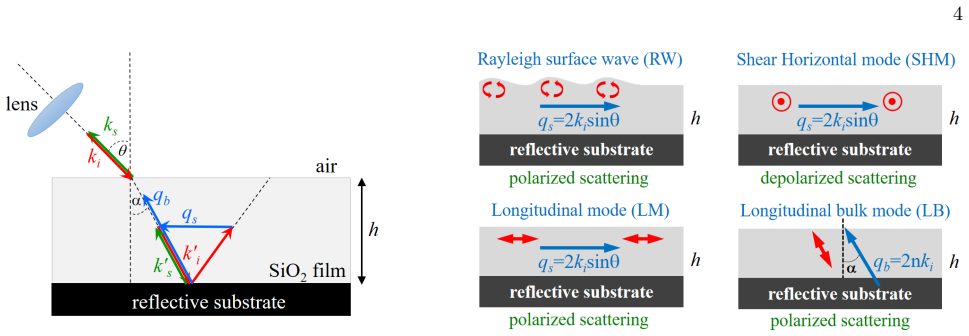
Brillouin light scattering at GHz frequencies that extracts the full elastic tensor and identifies the cylindrical symmetry.
If this is right
- Thermal-noise models must incorporate the out-of-plane anisotropy instead of assuming full isotropy.
- Annealing at 900°C restores near-isotropy, produces more than 7% out-of-plane expansion, and smooths structural heterogeneities.
- Brillouin light scattering supplies reliable elastic constants for the kHz range because relaxations are absent.
- Higher-temperature heat treatment that restores isotropy offers a route to lower coating thermal noise.
Where Pith is reading between the lines
- Deposition conditions for future coatings could be tuned to reduce initial anisotropy without relying on extreme annealing.
- Measurements at intermediate temperatures between 500 and 900°C would locate the threshold where anisotropy vanishes.
- The same structural variations may exist in the multilayer stacks currently used in detectors.
- Direct comparison of BLS results with actual detector noise spectra could test whether the anisotropy contributes measurably to loss.
Load-bearing premise
The elastic properties measured at GHz frequencies match those at the lower frequencies relevant to thermal noise, because mechanical relaxations between kHz and GHz are negligible.
What would settle it
Low-frequency mechanical spectroscopy on identical films that measures a different anisotropy value or shows clear frequency dependence between kHz and GHz.
Figures





read the original abstract
The thermal noise of mirror coatings for gravitational-wave detectors critically depends on the elastic properties of the constituent materials. Data analyses and theoretical models typically assume each material is homogeneous and isotropic, but isotropy has never been explicitly verified. Using Brillouin light scattering (BLS), we demonstrate for the first time that ion-beam-sputtered SiO2 -- a material still viable for future mirror coatings -- exhibits cylindrical elastic symmetry, with in-plane isotropy but a notable 6% compressive anisotropy along the film normal. This anisotropy remains unchanged after the post-deposition heat treatment currently used in ground-based detectors (500 $^\circ$C, 10 h) but is nearly eliminated at 900 $^\circ$C. Infrared reflectivity experiments support these findings by directly revealing heterogeneities in the distribution of bridging and non-bridging oxygen structures along the growth axis. While BLS measures the real part of the elastic constants at GHz frequencies, the data reveal negligible contributions from mechanical relaxations in the kHz-GHz range, making BLS a valid substitute for low-frequency properties obtained from standard anisotropy-insensitive techniques. Our results highlight that restoring isotropy through heat treatment -- by softening the material, enabling more than 7% out-of-plane expansion, and smoothing out structural heterogeneities -- may play a key role in reducing thermal noise. This proof-of-concept study extends beyond silica, providing critical insights for the design of future coatings.
Editorial analysis
A structured set of objections, weighed in public.
Referee Report
Summary. The paper claims that ion-beam-sputtered SiO2 thin films for gravitational-wave detector coatings exhibit cylindrical elastic symmetry (in-plane isotropy but 6% compressive anisotropy along the film normal), as measured by Brillouin light scattering (BLS) at GHz frequencies. This anisotropy persists after the standard 500°C, 10 h post-deposition anneal but is nearly eliminated at 900°C, accompanied by >7% out-of-plane expansion and smoothing of structural heterogeneities (confirmed via infrared reflectivity on bridging/non-bridging oxygen distributions). The authors conclude that mechanical relaxations contribute negligibly between kHz and GHz, allowing BLS to substitute for low-frequency elastic constants in thermal-noise models, and suggest that restoring isotropy via higher-temperature treatment may reduce coating thermal noise.
Significance. If the central results hold, the work is significant for gravitational-wave detector development because it provides the first explicit verification of elastic anisotropy in a key coating material (SiO2) and links it to measurable structural gradients along the growth axis. The temperature-dependent elimination of anisotropy offers a concrete materials-processing route that could lower thermal noise beyond current models that assume isotropy. The combination of BLS for elastic constants and IR for structural confirmation is a strength, as is the focus on a still-viable material. However, the absence of quantitative data, error bars, or explicit supporting analysis for the negligible-relaxation claim in the provided abstract limits immediate assessment of robustness.
major comments (1)
- Abstract: the assertion that 'the data reveal negligible contributions from mechanical relaxations in the kHz-GHz range' is load-bearing for the claim that BLS constants apply to the kHz regime of coating thermal noise, yet the abstract provides no concrete supporting evidence (e.g., BLS frequency dispersion across angles, direct comparison of BLS moduli to independent low-frequency measurements on identical films, or absence of relaxation peaks). Without this, the reported 6% anisotropy and its annealing dependence cannot be confidently transferred to detector-relevant frequencies.
minor comments (1)
- Abstract: quantitative details are missing, including error bars on the 6% anisotropy value, sample thicknesses or deposition parameters, and the exact magnitude of out-of-plane expansion at 900°C.
Simulated Author's Rebuttal
We thank the referee for their careful reading of the manuscript and for acknowledging the potential significance of our results for gravitational-wave detector coatings. We address the major comment below.
read point-by-point responses
-
Referee: Abstract: the assertion that 'the data reveal negligible contributions from mechanical relaxations in the kHz-GHz range' is load-bearing for the claim that BLS constants apply to the kHz regime of coating thermal noise, yet the abstract provides no concrete supporting evidence (e.g., BLS frequency dispersion across angles, direct comparison of BLS moduli to independent low-frequency measurements on identical films, or absence of relaxation peaks). Without this, the reported 6% anisotropy and its annealing dependence cannot be confidently transferred to detector-relevant frequencies.
Authors: We agree that the abstract is too concise to convey the supporting evidence and have revised it to include a brief statement directing readers to the relevant analysis. In the full manuscript, BLS spectra were acquired at multiple scattering angles (corresponding to a range of GHz frequencies and wavevectors), with the extracted elastic constants showing no measurable dispersion within experimental uncertainty (Section 3.2 and Figure 4). This is reinforced by the absence of any relaxation signatures in the spectra, the direct correlation with the IR reflectivity data on structural heterogeneities, and the fact that the anisotropy is removed only by the higher-temperature anneal that also produces >7% out-of-plane expansion. While we have not performed new low-frequency measurements on the identical films (which would require separate techniques insensitive to the same anisotropy), the frequency-independent behavior in the BLS range and consistency with bulk silica literature values support transferability to the kHz regime relevant for thermal-noise models. Quantitative values and error bars have been added or clarified throughout the text. revision: yes
Circularity Check
No circularity; experimental measurements are direct and independent of fitted predictions
full rationale
The paper reports direct BLS measurements of elastic constants in ion-beam-sputtered SiO2 films, revealing cylindrical symmetry and 6% out-of-plane anisotropy, corroborated by IR reflectivity on structural heterogeneities. No mathematical derivation chain exists; claims rest on observed spectral data rather than equations that reduce to self-defined inputs. The statement that 'the data reveal negligible contributions from mechanical relaxations' is an interpretive conclusion from the BLS results themselves, not a fitted parameter renamed as a prediction or a self-citation load-bearing premise. No self-definitional loops, ansatz smuggling, or uniqueness theorems imported from prior author work appear in the provided text. This is a standard experimental study whose central results do not collapse to their own inputs by construction.
Axiom & Free-Parameter Ledger
axioms (2)
- domain assumption The thin films possess cylindrical elastic symmetry due to the deposition process
- domain assumption BLS at GHz frequencies provides elastic constants equivalent to those at lower frequencies relevant for thermal noise
Reference graph
Works this paper leans on
-
[1]
As-deposited material The Brillouin investigation begins with the ∼ 2.5 µm- thick sample S21089 in its as-deposited state. The BLS experiment reveals several peaks, selectively detected in polarized and depolarized spectra, that change differ- ently their frequency position with the incidence angle, as shown in Figs. 4(a) and 4(b). Three peaks whose fre- ...
-
[2]
An example is shown in the spectra of sample S21089 (Fig
Post-deposition annealing effects BLS spectra of samples annealed at 500 °C and 900 °C are qualitatively similar to those in the as-deposited state and allow for the calculation of the same quantities described in the previous section. An example is shown in the spectra of sample S21089 (Fig. 18 in Appendix C). The derived elastic constants c11, c33, c66,...
-
[3]
Comparison with low-frequency elastic properties As anticipated, BLS spectroscopy probes the elastic constants of SiO 2 at frequencies of tens of GHz, which is far above the frequency range between about 10 Hz and a few hundred Hz where mirror coatings represent a limiting noise source for GW detectors. However, a recent study [15] reported the elastic ch...
-
[4]
6(a)] the TO component of the antisymmetric Si-O-Si stretching vi- bration stands out at ∼1100–1120 cm−1 as the most in- tense signal, superimposed on an oscillating background
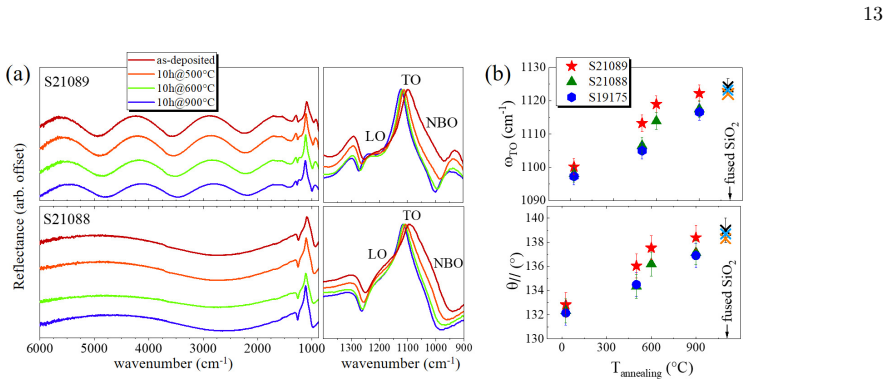
Structure on planes parallel to the surface In the SR-IR spectra of samples S21089 and S21088 at different annealing temperatures [Fig. 6(a)] the TO component of the antisymmetric Si-O-Si stretching vi- bration stands out at ∼1100–1120 cm−1 as the most in- tense signal, superimposed on an oscillating background. As recalled in Sec. III B, this mode serves...
-
[5]
Structure in direction perpendicular to the surface The polarization of IR radiation significantly influences the spectra in the region 1400–900 cm −1. At fixed inci- dence, p-polarized radiation markedly enhances the rel- ative intensity of the TO and LO bands compared to s-polarized radiation, while having a negligible effect on their frequencies (Fig. ...
-
[6]
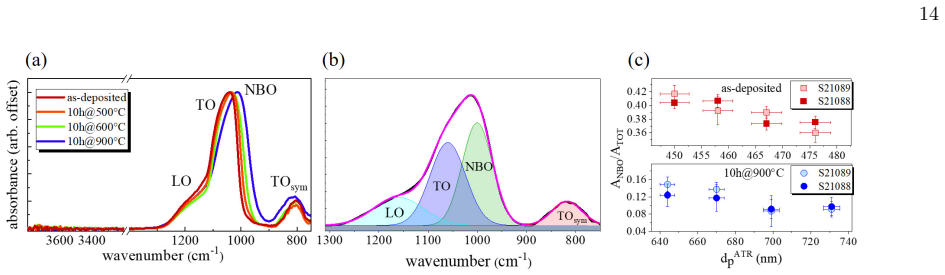
Chemical defects The reduced penetration depth of the IR radiation in ATR configuration accounts for the absence of interfer- ence fringes in the spectra, shown in Fig. 8(a). In the absorption peaks region they exhibit a maximum inten- sity at frequencies where the stretching mode of NBO- containing groups resonates ( ∼1000 cm−1). Thus, ATR- IR spectra en...
-
[7]
With axis x3 per- pendicular to the film surface, and axes x1 and x2 in plane, these constants are c11, c33, c44, c66, c13
Elasticity tensor The elastic behavior of a transversely isotropic medium (cylindrical symmetry; space group: D∞h) is described by five independent elastic constants. With axis x3 per- pendicular to the film surface, and axes x1 and x2 in plane, these constants are c11, c33, c44, c66, c13. The fourth-order elasticity tensor cijkl, symmetric under in- dex ...
-
[8]
(B1), n = ( n1, n2, n3) the unit propagation vector, and ρ the mass density
Relation to bulk and surface wave velocities (i) The phase velocities v of bulk acoustic waves prop- agating in an arbitrary direction within a transversely isotropic half-space is governed by the Christoffel equa- tion det Γik − ρv2δik = 0 (B2) where Γ ik(n) = cijkl njnl is the Christoffel matrix build with the elastic constants in Eq. (B1), n = ( n1, n2...
-
[9]
Procedure for complete determination of elastic moduli According to Eqs. (B3), with the material density known, the elastic constants c11 and c66 are directly de- termined by measuring the velocities vLM and vSHM of longitudinal and shear-horizontal waves propagating par- allel to the surface, while c33 is determined by measuring the velocity vLB(α = 0◦) ...
-
[10]
20), along with data on acoustic velocities obtained from numerical simulations (Fig
and SR-IR spectra (Fig. 20), along with data on acoustic velocities obtained from numerical simulations (Fig. 14) and BLS experiments (Figs. 15,17, and 19), and data of film thickness (Fig. 21) derived from BLS measurements. The figures included here complement the results presented in the main text, providing a more complete representation of the experim...
-
[11]
The LIGO Scientific Collaboration et al., Advanced LIGO, Classical and Quantum Gravity 32, 074001 (2015)
2015
-
[12]
Acernese et al., Advanced Virgo: a second-generation interferometric gravitational wave detector, Classical and Quantum Gravity 32, 024001 (2015)
F. Acernese et al., Advanced Virgo: a second-generation interferometric gravitational wave detector, Classical and Quantum Gravity 32, 024001 (2015)
2015
-
[13]
Akutsu et al., Overview of KAGRA: Detector design and construction history, Progress of Theoretical and Ex- perimental Physics 2021, 05A101 (2020)
T. Akutsu et al., Overview of KAGRA: Detector design and construction history, Progress of Theoretical and Ex- perimental Physics 2021, 05A101 (2020)
2021
-
[14]
Laboratoire des mat´ eriaux avanc´ es; https://lma.in2p3.fr
-
[15]
Pinard, C
L. Pinard, C. Michel, B. Sassolas, L. Balzarini, J. De- gallaix, V. Dolique, R. Flaminio, D. Forest, M. Granata, B. Lagrange, N. Straniero, J. Teillon, and G. Cagnoli, Mirrors used in the ligo interferometers for first detec- tion of gravitational waves, Appl. Opt. 56, C11 (2017)
2017
-
[16]
Granata, A
M. Granata, A. Amato, G. Cagnoli, M. Coulon, J. De- gallaix, D. Forest, L. Mereni, C. Michel, L. Pinard, B. Sassolas, and J. Teillon, Progress in the measure- ment and reduction of thermal noise in optical coatings for gravitational-wave detectors, Appl. Opt. 59, A229 (2020)
2020
-
[17]
Durante, M
O. Durante, M. Magnozzi, V. Fiumara, J. Neilson, M. Canepa, G. Avallone, F. Bobba, G. Carapella, F. Chiadini, R. De Salvo, R. De Simone, C. Di Gior- gio, R. Fittipaldi, A. Micco, I. M. Pinto, A. Vecchione, V. Pierro, and V. Granata, Toward the optimization of SiO 2 and TiO 2-based metamaterials: Morphological, structural, and optical characterization, Opt...
2024
-
[18]
L. Yang, M. Fazio, G. Vajente, A. Ananyeva, G. Billings- ley, A. Markosyan, R. Bassiri, M. M. Fejer, and C. S. Menoni, Structural evolution that affects the room- temperature internal friction of binary oxid: Implications for ultrastable optical cavities, ACS Applied Nano Ma- terials 3, 12308 (2020)
2020
-
[19]
Granata, E
M. Granata, E. Coillet, V. Martinez, V. Dolique, A. Am- ato, M. Canepa, J. Margueritat, C. Martinet, A. Mer- met, C. Michel, L. Pinard, B. Sassolas, and G. Cagnoli, Correlated evolution of structure and mechanical loss of a sputtered silica film, Phys. Rev. Mater. 2, 053607 (2018)
2018
-
[20]
Amato, S
A. Amato, S. Terreni, M. Granata, C. Michel, L. Pinard, G. Gemme, M. Canepa, and G. Cagnoli, Effect of heating treatment and mixture on optical properties of coating materials used in gravitational-wave detectors, Journal of Vacuum Science & Technology B 37, 062913 (2019)
2019
-
[21]
Colace, S
S. Colace, S. Samandari, M. Granata, A. Amato, M. Caminale, C. Michel, G. Gemme, L. Pinard, M. Canepa, and M. Magnozzi, Monitoring the evolution of optical coatings during thermal annealing with real- time, in-situ spectroscopic ellipsometry, Classical and Quantum Gravity 41, 175016 (2024)
2024
-
[22]
Amato, M
A. Amato, M. Bazzan, G. Cagnoli, M. Canepa, M. Coulon, J. Degallaix, N. Demos, A. Di Michele, M. Evans, F. Fabrizi, G. Favaro, D. Forest, S. Gras, D. Hofman, A. Lemaˆ ıtre, G. Maggioni, M. Magnozzi, V. Martinez, L. Mereni, C. Michel, V. Milotti, M. Mon- tani, A. Paolone, A. Pereira, F. Piergiovanni, V. Pierro, L. Pinard, I. M. Pinto, E. Placidi, S. Samand...
2025
-
[23]
Vajente, L
G. Vajente, L. Yang, A. Davenport, M. Fazio, A. Ananyeva, L. Zhang, G. Billingsley, K. Prasai, A. Markosyan, R. Bassiri, M. M. Fejer, M. Chicoine, F. m. c. Schiettekatte, and C. S. Menoni, Low mechani- cal loss TiO2:GeO2 coatings for reduced thermal noise in gravitational wave interferometers, Phys. Rev. Lett.127, 071101 (2021)
2021
-
[24]
G. I. McGhee, V. Spagnuolo, N. Demos, S. C. Tait, P. G. Murray, M. Chicoine, P. Dabadie, S. Gras, J. Hough, G. A. Iandolo, R. Johnston, V. Martinez, O. Patane, S. Rowan, F. m. c. Schiettekatte, J. R. Smith, L. Terkowski, L. Zhang, M. Evans, I. W. Martin, and J. Steinlechner, Titania mixed with silica: A low thermal- noise coating material for gravitationa...
2023
-
[25]
Granata, A
M. Granata, A. Amato, L. Balzarini, M. Canepa, J. De- gallaix, D. Forest, V. Dolique, L. Mereni, C. Michel, L. Pinard, B. Sassolas, J. Teillon, and G. Cagnoli, Amorphous optical coatings of present gravitational- wave interferometers*, Classical and Quantum Gravity 37, 095004 (2020)
2020
-
[26]
Granata, E
M. Granata, E. Saracco, N. Morgado, A. Cajgfinger, G. Cagnoli, J. Degallaix, V. Dolique, D. Forest, J. Franc, C. Michel, L. Pinard, and R. Flaminio, Mechanical loss in state-of-the-art amorphous optical coatings, Phys. Rev. D 93, 012007 (2016)
2016
-
[27]
Malhaire, M
C. Malhaire, M. Granata, D. Hofman, A. Amato, V. Mar- tinez, G. Cagnoli, A. Lemaitre, and N. Shcheblanov, De- termination of stress in thin films using micro-machined buckled membranes, Journal of Vacuum Science & Tech- nology A 41, 043401 (2023)
2023
-
[28]
T. Hong, H. Yang, E. K. Gustafson, R. X. Adhikari, and Y. Chen, Brownian thermal noise in multilayer coated mirrors, Phys. Rev. D 87, 082001 (2013)
2013
-
[29]
W. Yam, S. Gras, and M. Evans, Multimaterial coatings with reduced thermal noise, Phys. Rev. D 91, 042002 (2015)
2015
-
[30]
S. C. Tait, J. Steinlechner, M. M. Kinley-Hanlon, P. G. Murray, J. Hough, G. McGhee, F. Pein, S. Rowan, R. Schnabel, C. Smith, L. Terkowski, and I. W. Mar- tin, Demonstration of the multimaterial coating concept to reduce thermal noise in gravitational-wave detectors, Phys. Rev. Lett. 125, 011102 (2020)
2020
-
[31]
M. M. Fejer, Effective medium description of mul- tilayer coatings, LIGO Document T2100186 (2021), https://dcc.ligo.org/LIGO-T2100186/public
2021
-
[32]
Lovelace, N
G. Lovelace, N. Demos, and H. Khan, Numerically mod- eling brownian thermal noise in amorphous and crys- talline thin coatings, Classical and Quantum Gravity 35, 025017 (2017)
2017
-
[33]
Vignaud and A
G. Vignaud and A. Gibaud, REFLEX: a program for the analysis of specular X-ray and neutron reflectivity data, Journal of Applied Crystallography 52, 201 (2019)
2019
-
[34]
J. A. Woollam, B. D. Johs, C. M. Herzinger, J. N. Hil- fiker, R. A. Synowicki, and C. L. Bungay, Overview of variable-angle spectroscopic ellipsometry (VASE): I. Ba- sic theory and typical applications, in Optical Metrol- ogy: A Critical Review , Vol. 10294, edited by G. A. Al- Jumaily, International Society for Optics and Photonics 24 (SPIE, 1999) p. 1029402
1999
-
[35]
Magnozzi, S
M. Magnozzi, S. Terreni, L. Anghinolfi, S. Uttiya, M. Carnasciali, G. Gemme, M. Neri, M. Principe, I. Pinto, L.-C. Kuo, S. Chao, and M. Canepa, Optical properties of amorphous SiO 2-TiO2 multi-nanolayered coatings for 1064-nm mirror technology, Opt. Mater. 75, 94 (2018)
2018
-
[36]
Amato, M
A. Amato, M. Magnozzi, N. Shcheblanov, A. Lemaˆ ıtre, G. Cagnoli, M. Granata, C. Michel, G. Gemme, L. Pinard, and M. Canepa, Enhancing Titania-Tantala Amorphous Materials as High-Index Layers in Bragg Re- flectors of Gravitational-Wave Detectors, ACS Applied Optical Materials 1, 395 (2023)
2023
-
[37]
Brillouin, L´ eon, Diffusion de la lumi` ere et des rayons x par un corps transparent homog` ene - influence de l’agitation thermique, Ann. Phys. 9, 88 (1922)
1922
-
[38]
Merklein, I
M. Merklein, I. V. Kabakova, A. Zarifi, and B. J. Eggle- ton, 100 years of Brillouin scattering: Historical and fu- ture perspectives, Applied Physics Reviews 9, 041306 (2022)
2022
-
[39]
Kojima, 100th Anniversary of Brillouin scattering: Im- pact on materials science, Materials 15, 3518 (2022)
S. Kojima, 100th Anniversary of Brillouin scattering: Im- pact on materials science, Materials 15, 3518 (2022)
2022
-
[40]
Zhang, R
X. Zhang, R. Sooryakumar, A. G. Every, and M. H. Manghnani, Observation of organ-pipe acoustic excita- tions in supported thin films, Phys. Rev. B 64, 081402 (2001)
2001
-
[41]
Zhang, R
X. Zhang, R. Sooryakumar, and K. Bussmann, Confine- ment and transverse standing acoustic resonances in free- standing membranes, Phys. Rev. B 68, 115430 (2003)
2003
-
[42]
J. R. Sandercock, Structure in the Brillouin spectra of thin films, Phys. Rev. Lett. 29, 1735 (1972)
1972
-
[43]
J. R. Sandercock, Light Scattering in Solids III: Re- cent Results, edited by M. Cardona and G. G¨ untherodt (Springer Berlin Heidelberg, Berlin, Heidelberg, 1982) pp. 173–206
1982
-
[44]
Gomopoulos, W
N. Gomopoulos, W. Cheng, M. Efremov, P. F. Nealey, and G. Fytas, Out-of-Plane Longitudinal Elastic Modu- lus of Supported Polymer Thin Films, Macromolecules 42, 7164 (2009)
2009
-
[45]
O. El Abouti, J. Cuffe, E. H. El Boudouti, C. M. So- tomayor Torres, E. Chavez-Angel, B. Djafari-Rouhani, and F. Alzina, Comparison of brillouin light scattering and density of states in a supported layer: Analytical and experimental study, Crystals 12, 10.3390/cryst12091212 (2022)
-
[46]
Passeri, A
A. Passeri, A. Di Michele, I. Neri, F. Cottone, D. Fioretto, M. Mattarelli, and S. Caponi, Size and en- vironment: The effect of phonon localization on micro- brillouin imaging, Biomaterials Advances 147, 213341 (2023)
2023
-
[47]
Carlotti, Elastic characterization of transparent and opaque films, multilayers and acoustic resonators by sur- face Brillouin scattering: A review, Applied Sciences 8, 124 (2018)
G. Carlotti, Elastic characterization of transparent and opaque films, multilayers and acoustic resonators by sur- face Brillouin scattering: A review, Applied Sciences 8, 124 (2018)
2018
-
[48]
Hosono, Fourier transform infrared attenuated total reflection spectra of ion-implanted silica glasses, Journal of Applied Physics 69, 8079 (1991)
H. Hosono, Fourier transform infrared attenuated total reflection spectra of ion-implanted silica glasses, Journal of Applied Physics 69, 8079 (1991)
1991
-
[49]
de los Arcos, H
T. de los Arcos, H. M¨ uller, F. Wang, V. R. Damerla, C. Hoppe, C. Weinberger, M. Tiemann, and G. Grund- meier, Review of infrared spectroscopy techniques for the determination of internal structure in thin SiO2 films, Vi- brational Spectroscopy 114, 103256 (2021)
2021
-
[50]
Efthimiopoulos, D
I. Efthimiopoulos, D. Palles, S. Richter, U. Hoppe, D. M¨ oncke, L. Wondraczek, S. Nolte, and E. I. Kamitsos, Femtosecond laser-induced transformations in ultra-low expansion glass: Microstructure and local density vari- ations by vibrational spectroscopy, Journal of Applied Physics 123, 233105 (2018)
2018
-
[51]
S. Amma, J. Luo, C. G. Pantano, and S. H. Kim, Spec- ular reflectance (SR) and attenuated total reflectance (ATR) infrared (IR) spectroscopy of transparent flat glass surfaces: A case study for soda lime float glass, Journal of Non-Crystalline Solids 428, 189 (2015)
2015
-
[52]
C. Z. Tan, Determination of surface structure and the depth profile of silica glass by infrared spectroscopy, Op- tics and Precision Engineering 13, 413 (2005)
2005
-
[53]
Vacher, J
R. Vacher, J. Pelous, and E. Courtens, Mean free path of high-frequency acoustic excitations in glasses with appli- cation to vitreous silica, Phys. Rev. B 56, R481 (1997)
1997
-
[54]
Baldi, V
G. Baldi, V. Giordano, G. Monaco, and B. Ruta, High frequency acoustic attenuation of vitreous silica: New insight from inelastic x-ray scattering, Journal of Non- Crystalline Solids 357, 538 (2011)
2011
-
[55]
Paolone, E
A. Paolone, E. Placidi, E. Stellino, M. G. Betti, E. Ma- jorana, C. Mariani, A. Nucara, O. Palumbo, P. Pos- torino, M. Sbroscia, F. Trequattrini, M. Granata, D. Hof- man, C. Michel, L. Pinard, A. Lemaitre, N. Shcheblanov, G. Cagnoli, and F. Ricci, Argon and other defects in amorphous SiO 2 coatings for gravitational-wave detec- tors, Coatings 12, 1001 (2022)
2022
-
[56]
Hirose, K
T. Hirose, K. Saito, and A. J. Ikushima, Structural re- laxation in sputter-deposited silica glass, Journal of Non- Crystalline Solids 352, 2198 (2006)
2006
-
[57]
B. A. Auld, Acoustic fields and waves in solids , edited by John Wiley & Sons (Elsevier, 1973)
1973
-
[58]
KG, Fused Quartz & Fused Silica for Optical Applications, https://www
Heraeus Quarzglas GmbH & Co. KG, Fused Quartz & Fused Silica for Optical Applications, https://www. heraeus-covantics.com, accessed March 2026
2026
-
[59]
Crystran Ltd., Optical Materials, Fused Silica Glass, https://www.crystran.com/optical-materials/ fused-silica-sio2/, accessed March 2026
2026
-
[60]
Corning Inc., HPFS ®Fused Silica Industrial Grade: Technical data sheet, https://www.corning.com, ac- cessed March 2026
2026
-
[61]
K. S. Gilroy and W. A. Phillips, An asymmetric double- well potential model for structural relaxation processes in amorphous materials, Philosophical Magazine B 43, 735 (1981)
1981
-
[62]
Cesarini, M
E. Cesarini, M. Lorenzini, E. Campagna, F. Martelli, F. Piergiovanni, F. Vetrano, G. Losurdo, and G. Cagnoli, A ’gentle’ nodal suspension for measurements of the acoustic attenuation in materials, Review of Scientific In- struments 80, 053904 (2009)
2009
-
[63]
T. B. Wang, Z. G. Liu, and C. Z. Tan, Relationship be- tween the frequency of the main LO mode of silica glass and angle of incidence, The Journal of Chemical Physics 119, 505 (2003)
2003
-
[64]
P. D. T. Huibers and D. O. Shah, Multispectral Deter- mination of Soap Film Thickness, Langmuir 13, 5995 (1997)
1997
-
[65]
einstein-telescope.it/en/home-en/, accessed March 2026
Einstein Telescope Italy, https://www. einstein-telescope.it/en/home-en/, accessed March 2026
2026
-
[66]
Dobrzynski and A
L. Dobrzynski and A. A. Maradudin, Surface contribu- tion to the low-temperature specific heat of a hexagonal crystal, Phys. Rev. B 14, 2200 (1976)
1976
discussion (0)
Sign in with ORCID, Apple, or X to comment. Anyone can read and Pith papers without signing in.