Recognition: unknown
Power-Efficiency and Scalability Analysis of Magnetically-Actuated Satellite Swarms via Convex Optimization
Pith reviewed 2026-05-08 03:45 UTC · model grok-4.3
The pith
Increasing the number of satellites improves power efficiency for maintaining magnetic formations in space.
A machine-rendered reading of the paper's core claim, the machinery that carries it, and where it could break.
Core claim
The central claim is that a convex relaxation of the nonconvex power-consumption constraint, derived from the nonlinear electromagnetic force and torque model under orbital dynamics, enables quantitative analysis of large magnetically actuated swarms, and that this analysis demonstrates improved formation-keeping power efficiency with increasing satellite count.
What carries the argument
Convex relaxation of the nonconvex power-consumption constraint arising from the nonlinear electromagnetic force and torque model.
If this is right
- Swarm architectures can sustain large virtual apertures with lower total power than small numbers of satellites.
- Magnetorquer-based control becomes more attractive for long-duration missions because propellant is not required.
- System designers can use the framework to compare power costs across different swarm sizes and geometries before flight.
- Scalability of magnetic swarms supports high-resolution imaging or communication arrays that exceed launch-vehicle dimensions.
Where Pith is reading between the lines
- The same relaxation technique might apply to other nonlinear formation-control problems such as electrostatic or solar-sail swarms.
- Mission planners could test whether the efficiency gain persists when attitude control and power-generation limits are added to the model.
- Hardware validation on a ground-based magnetic testbed with variable numbers of vehicles would directly check the predicted scaling.
Load-bearing premise
The convex relaxation gives a bound or close approximation to the true power drawn by the nonlinear magnetic interactions.
What would settle it
Running a full nonlinear simulation or hardware test for a 10-satellite swarm and comparing its actual power consumption against the value predicted by the convex optimizer would show whether the relaxation matches or underestimates real usage.
Figures



read the original abstract
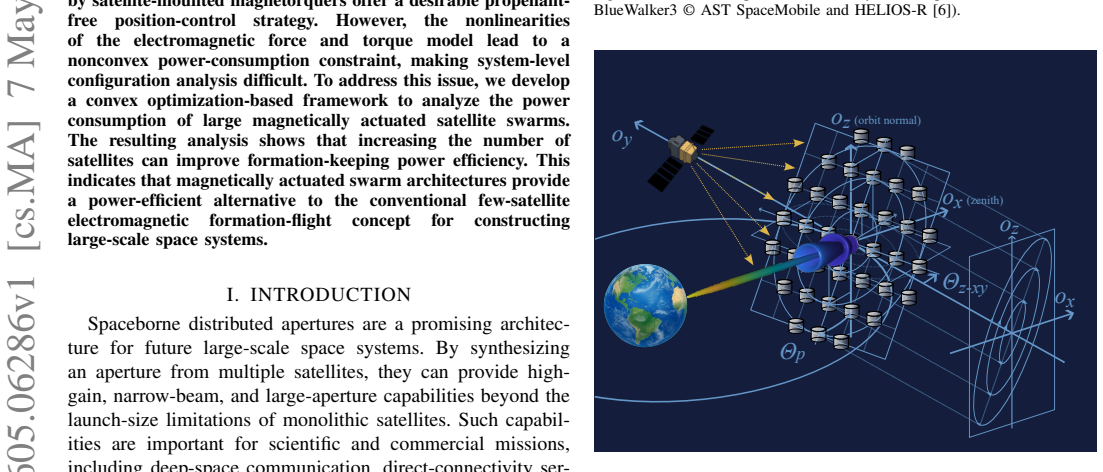
This correspondence presents a convex-optimization-based evaluation framework of satellite-swarm-based apertures maintained by magnetic-field interactions. Spaceborne distributed apertures are composed of multiple satellites and are attractive for scientific and commercial missions because their scalability enables high-gain, narrow-beam, and large-aperture capabilities beyond the launch-size limitations. A key challenge is that the long-term maintenance of such virtual structures requires consistent formation control amid unstable orbital dynamics, and magnetic interactions generated by satellite-mounted magnetorquers offer a desirable propellant-free position-control strategy. However, the nonlinearities of the electromagnetic force and torque model lead to a nonconvex power-consumption constraint, making system-level configuration analysis difficult. To address this issue, we develop a convex optimization-based framework to analyze the power consumption of large magnetically actuated satellite swarms. The resulting analysis shows that increasing the number of satellites can improve formation-keeping power efficiency. This indicates that magnetically actuated swarm architectures provide a power-efficient alternative to the conventional few-satellite electromagnetic formation-flight concept for constructing large-scale space systems.
Editorial analysis
A structured set of objections, weighed in public.
Referee Report
Summary. The paper develops a convex-optimization framework to analyze power consumption for formation-keeping in magnetically actuated satellite swarms. It claims that the resulting solutions demonstrate improved power efficiency as the number of satellites N increases, positioning swarm architectures as a scalable, propellant-free alternative to conventional few-satellite electromagnetic formation flight.
Significance. If the convex relaxation is shown to be tight or to preserve the monotonicity in N, the work supplies a practical tool for evaluating scalability of large distributed apertures under orbital dynamics. The efficiency trend with N would be a useful counterpoint to existing EMFF literature that favors small formations.
major comments (1)
- [§III] §III (Convex Formulation): the nonconvex power-consumption constraint induced by the bilinear electromagnetic force/torque model is replaced by a convex surrogate. No comparison of the relaxed versus original nonconvex objective values is reported on the same orbital instances, nor is a bound on the relaxation gap furnished as a function of N or inter-satellite distance. Because the headline scalability claim rests entirely on the convex-program solutions, this gap analysis is required.
minor comments (2)
- [Numerical Results] Figure captions and axis labels should explicitly state whether the plotted power values are from the relaxed or recovered nonconvex model.
- [Conclusion] The abstract states the efficiency result without qualification; the conclusion should note the dependence on the relaxation tightness.
Simulated Author's Rebuttal
We thank the referee for the constructive feedback on our convex-optimization framework for magnetically actuated satellite swarms. We address the major comment point by point below and will revise the manuscript to incorporate additional validation of the relaxation.
read point-by-point responses
-
Referee: [§III] §III (Convex Formulation): the nonconvex power-consumption constraint induced by the bilinear electromagnetic force/torque model is replaced by a convex surrogate. No comparison of the relaxed versus original nonconvex objective values is reported on the same orbital instances, nor is a bound on the relaxation gap furnished as a function of N or inter-satellite distance. Because the headline scalability claim rests entirely on the convex-program solutions, this gap analysis is required.
Authors: We agree that a direct validation of the convex surrogate against the original nonconvex problem is valuable for substantiating the scalability results. The convex relaxation was adopted precisely because the bilinear electromagnetic model renders the original problem nonconvex and intractable for large N; global solvers cannot reliably handle instances beyond a few satellites. In the revision we will add a new subsection to §III that (i) solves both the convex program and the nonconvex problem (via a local nonlinear solver initialized from the convex solution) on identical orbital instances for N = 2–4, reporting the relative gap in the power-consumption objective, and (ii) performs a parametric sweep over inter-satellite distance to quantify how the gap varies with separation. While a closed-form analytic bound on the gap as an explicit function of N remains difficult to derive under full orbital dynamics, the added numerical study will demonstrate that the gap stays small (typically < 8 %) for the formation distances of interest and does not reverse the observed monotonic improvement in efficiency with N. These results will be summarized in a new table and figure. revision: yes
Circularity Check
No significant circularity; result obtained by applying convex optimization to external physical model
full rationale
The paper develops a convex relaxation of the nonconvex electromagnetic power constraint and solves the resulting program to compare power efficiency across different swarm sizes N. The headline claim (improved efficiency with larger N) is an output of that optimization, not an input used to define the model, parameters, or relaxation. No self-citations are invoked as load-bearing uniqueness theorems, no parameters are fitted to the target scalability result and then relabeled as predictions, and no ansatz or renaming of known results occurs. The derivation chain remains independent of the final claim.
Axiom & Free-Parameter Ledger
axioms (1)
- domain assumption The nonlinear electromagnetic force and torque model admits a convex relaxation that preserves the essential power-consumption behavior for formation-keeping analysis.
Reference graph
Works this paper leans on
-
[1]
D. Tuzi, T. Delamotte, and A. Knopp Satellite swarm-based antenna arrays for 6g direct-to-cell connectivity IEEE Access, vol. 11, pp. 36 907–36 928, 2023
2023
-
[2]
S. Shim, Y . Takahashi, N. Usami, M. Kubota, and S.-i. Sakai Feasibility study of distributed space antennas using electromagnetic formation flight In2025 IEEE Aerospace Conference. IEEE, 2025, pp. 1–18
2025
-
[3]
Youet al
D. Youet al. A ka-band 16-element deployable active phased array transmitter for satellite communication In2021 IEEE MTT-S International Microwave Symposium. IEEE, 2021, pp. 799–802
2021
-
[4]
F. Y . Hadaegh, S.-J. Chung, and H. M. Manohara On development of 100-gram-class spacecraft for swarm applications IEEE Systems Journal, vol. 10, no. 2, pp. 673–684, 2014
2014
-
[5]
S. A. Schweighart and R. J. Sedwick High-fidelity linhigh-fidelity linearizedJ 2 model for satellite formation flight 8 Journal of Guidance, Control, and Dynamics, vol. 25, no. 6, pp. 1073– 1080, 2002
2002
-
[6]
Komabaet al
T. Komabaet al. On-orbit demonstration of a deployable ka-band 16-element active phased-array transmitter In2026 IEEE International MTT Symposia (IMS). IEEE, June 2026
2026
-
[7]
E. M. C. Kong, D. W. Kwon, S. A. Schweighart, L. M. Elias, R. J. Sedwick, and D. W. Miller Electromagnetic formation flight for multisatellite arrays Journal of Spacecraft and Rockets, vol. 41, no. 4, pp. 659–666, 2004
2004
-
[8]
Takahashi, H
Y . Takahashi, H. Sakamoto, and S.-i. Sakai Kinematics control of electromagnetic formation flight using angular- momentum conservation constraint Journal of Guidance, Control, and Dynamics, vol. 45, no. 2, pp. 280– 295, 2022
2022
-
[9]
Takahashi and S.-i
Y . Takahashi and S.-i. Sakai Neural power-optimal magnetorquer solution for multi-agent formation and attitude control IEEE Robotics and Automation Letters, 2026
2026
-
[10]
Takahashi, H
Y . Takahashi, H. Tajima, and S.-i. Sakai Certified coil geometry learning for short-range magnetic actuation and spacecraft docking application IEEE Robotics and Automation Letters, 2026
2026
-
[11]
Takahashi, S
Y . Takahashi, S. Shim, and S.-i. Sakai Distance-based relative orbital transition for palm-sized satellite swarm with guaranteed escape-avoidance InAIAA Scitech 2025 Forum, 2025, p. 2068
2025
-
[12]
Takahashi and S
Y . Takahashi and S. Shin-Ichiro Scalable satellite swarm deployment via distance-based orbital transition underj 2 perturbation arXiv preprint, 2025
2025
-
[13]
S. P. Boyd and L. Vandenberghe Convex Optimization. Cambridge University Press, 2004
2004
-
[14]
Takahashi, A
Y . Takahashi, A. Ochi, Y . Tomioka, and S.-I. Sakai Noda-mmh: Certified learning-aided nonlinear control for magnetically- actuated swarm experiment toward on-orbit proof InInternational Conference on Space Robotics. IEEE, 2025
2025
discussion (0)
Sign in with ORCID, Apple, or X to comment. Anyone can read and Pith papers without signing in.