Recognition: unknown
Gravitational Lensing of Gravitational Waves from Astrophysical Sources: Theory, Detection, and Applications
Pith reviewed 2026-05-08 06:00 UTC · model grok-4.3
The pith
Lensed gravitational waves from merging black holes and other compact objects produce multiple images or frequency-modulated waveforms that can constrain dark matter and the Hubble constant.
A machine-rendered reading of the paper's core claim, the machinery that carries it, and where it could break.
Core claim
Once detected, lensed gravitational wave signals serve as probes of fundamental physics and cosmology because their time delays, magnifications, and waveform features encode information about intervening mass distributions and cosmological distances.
What carries the argument
The split into geometric-optics and wave-optics regimes for gravitational-wave lensing, together with identification methods based on parameter overlap or frequency-dependent modulations, forms the framework for recognizing and interpreting these signals.
If this is right
- Lensed events can place limits on the abundance and clustering properties of dark matter candidates including primordial black holes.
- Time delays between images provide an independent route to measuring the Hubble constant and other cosmological parameters.
- Waveform modulations in the wave-optics regime can reveal the mass and density profiles of individual lenses from stars to galaxy clusters.
- Search pipelines that look for parameter-matched pairs or specific modulations will become standard tools once event rates rise.
Where Pith is reading between the lines
- Wave-optics signatures might allow gravitational waves to resolve smaller lens structures than electromagnetic lensing can access.
- Cross-matching lensed gravitational-wave events with electromagnetic lensing surveys could test consistency of lens models across messengers.
- Non-detection at predicted rates could tighten upper limits on certain dark-matter scenarios even before positive identifications occur.
Load-bearing premise
Current models of the redshift and mass distributions of gravitational-wave sources and lenses are assumed to predict enough detectable lensed events for next-generation detectors without large revisions.
What would settle it
A complete absence of lensed events in the first several years of operation of detectors expected to observe thousands of mergers annually would indicate that either the lensing probability or the underlying population models require major adjustment.
Figures


read the original abstract
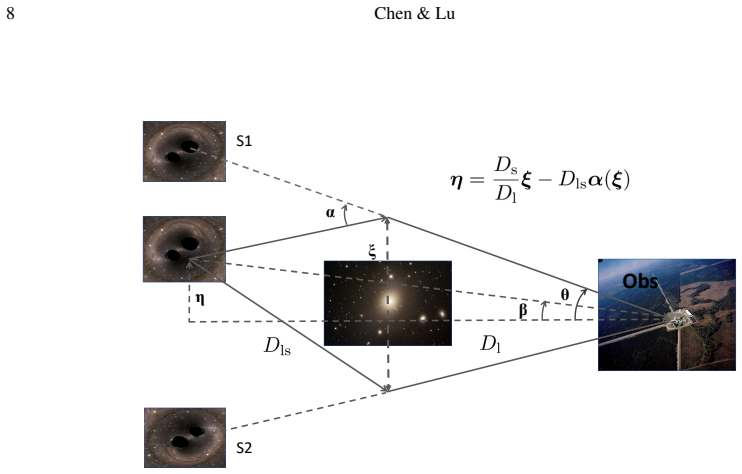
Gravitational waves (GWs) from distant sources such as inspiralling and merging stellar-mass compact binaries, intermediate-mass and supermassive-binary-black-hole can be gravitationally lensed by intervening objects, ranging from stars and primordial black holes to galaxies and clusters. Depending on the GW wavelength relative to the lens scale, lensing occurs in two regimes: geometric optics, producing multiple images with time delays and magnifications, and wave optics, resulting in frequency-dependent waveform modulations. Lensed signals are identified via parameter overlap between event pairs or characteristic frequency-dependent modulations that distinguish them from unlensed signals. Detection rates depend on the redshift and mass distributions of sources and lenses, with promising prospects for future observatories. Once confirmed, lensed GWs will be powerful probes of fundamental physics and cosmology: they can constrain dark matter, lensing structures, the Hubble constant, and other cosmological parameters. In this review, we provide a concise overview of GW lensing, covering the theoretical framework, predicted detection rates, search strategies, and applications. We conclude with prospects and future directions for observing and exploiting lensed astrophysical GW events.
Editorial analysis
A structured set of objections, weighed in public.
Referee Report
Summary. The manuscript is a review paper that summarizes the theory of gravitational lensing of astrophysical gravitational waves, distinguishing geometric-optics (multiple images, time delays, magnifications) from wave-optics (frequency-dependent modulations) regimes, methods for identifying lensed events via parameter overlap or waveform features, dependence of detection rates on source/lens redshift and mass distributions, and prospective applications to constraining dark matter, lens structures, the Hubble constant, and other cosmological parameters. It concludes with prospects for future detectors.
Significance. If the review accurately and comprehensively captures the literature, it offers a concise, accessible synthesis of an emerging area that can help researchers navigate the transition from current non-detections to future multi-messenger constraints on fundamental physics and cosmology. The conditional framing of applications ('once confirmed') and explicit dependence of rates on population models are appropriately cautious and strengthen the paper's utility as a reference.
minor comments (2)
- [Abstract] The abstract states that detection rates 'depend on the redshift and mass distributions' but does not quantify the sensitivity to current uncertainties in those distributions; a brief sentence or reference to the range of predicted rates in the main text would help readers assess robustness.
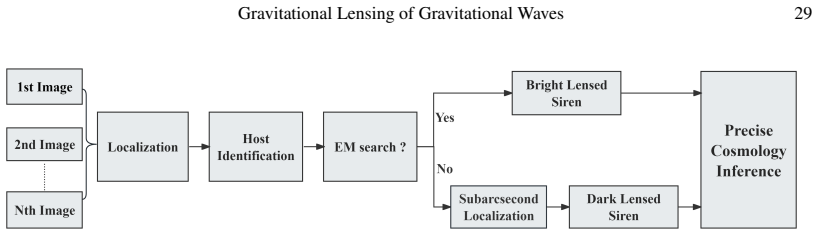
- The distinction between identification via 'parameter overlap' versus 'characteristic frequency-dependent modulations' is stated at high level; a short table or flowchart contrasting the two approaches (with example false-positive rates from the literature) would improve clarity for non-specialist readers.
Simulated Author's Rebuttal
We thank the referee for their positive and constructive review. We are pleased that the manuscript is viewed as an accurate and accessible synthesis of the emerging field of gravitational-wave lensing, and we appreciate the endorsement for acceptance.
Circularity Check
No significant circularity: review paper with no new derivations
full rationale
This is a review summarizing established general relativity results and prior GW lensing literature on theory, identification, rates, and applications. No new derivations, predictions, or fitted parameters are introduced within the paper; all claims are conditional prospects ('once confirmed') drawn from external sources. The content is self-contained against external benchmarks with no load-bearing steps that reduce to self-citation chains or internal definitions.
Axiom & Free-Parameter Ledger
axioms (2)
- standard math General relativity accurately describes both the propagation of gravitational waves and the deflection of null geodesics by intervening masses
- domain assumption Source and lens populations follow redshift and mass distributions that can be modeled from current observations
Reference graph
Works this paper leans on
-
[1]
Abbott, B. P., Abbott, R., Abbott, T. D., et al. 2016a, Phys. Rev. Lett., 116, 131102, doi:10.1103/ PhysRevLett.116.1311022, 7 —. 2016b, Phys. Rev. Lett., 116, 241102, doi:10.1103/PhysRevLett.116.2411024 —. 2017a, ApJ, 848, L12, doi:10.3847/2041-8213/aa91c92 —. 2017b, ApJ, 848, L13, doi:10.3847/2041-8213/aa920c2 —. 2017c, Nature, 551, 85, doi:10.1038/natu...
-
[2]
2024, ApJ, 970, 191, doi:10.3847/1538-4357/ad3e83 32, 33, 34
Abbott, R., Abe, H., Acernese, F., et al. 2024, ApJ, 970, 191, doi:10.3847/1538-4357/ad3e83 32, 33, 34
-
[3]
Abbott, R., Abbott, T. D., Abraham, S., et al. 2020b, arXiv e-prints, arXiv:2010.14527.https:// arxiv.org/abs/2010.145272 —. 2021, ApJ, 923, 14, doi:10.3847/1538-4357/ac23db32, 33, 34
-
[4]
T., Gosenca, M., & Hotchkiss, S
Adamek, J., Byrnes, C. T., Gosenca, M., & Hotchkiss, S. 2019, Phys. Rev. D, 100, 023506, doi:10. 1103/PhysRevD.100.02350621
2019
-
[5]
Adhikari, R. X., Arai, K., Brooks, A. F., et al. 2020, Classical and Quantum Gravity, 37, 165003, doi:10.1088/1361-6382/ab91432
-
[6]
Agazie, G., Anumarlapudi, A., Archibald, A. M., et al. 2023a, ApJ, 951, L8, doi:10.3847/ 2041-8213/acdac62, 7 —. 2023b, Astrophys J, 951, L50, doi:10.3847/2041-8213/ace18a15
-
[7]
Fukushima, Phase diagrams in the three-flavor Nambu-Jona-Lasinio model with the Polyakov loop, Phys
Ajith, P., Babak, S., Chen, Y ., et al. 2008, Phys. Rev. D, 77, 104017, doi:10.1103/PhysRevD.77. 1040175
-
[8]
Alcock, C., Allsman, R. A., Alves, D., et al. 1997, ApJ, 486, 697, doi:10.1086/30453520
-
[9]
Amaro-Seoane, P., Gair, J. R., Freitag, M., et al. 2007, Classical and Quantum Gravity, 24, R113, doi:10.1088/0264-9381/24/17/R012
-
[10]
Laser Interferometer Space Antenna
Amaro-Seoane, P., Audley, H., Babak, S., et al. 2017, arXiv e-prints, arXiv:1702.00786, doi:10. 48550/arXiv.1702.007862, 7
work page internal anchor Pith review arXiv 2017
-
[11]
2023, Living Reviews in Relativity, 26, 2, doi:10.1007/s41114-022-00041-y3
Amaro-Seoane, P., Andrews, J., Arca Sedda, M., et al. 2023, Living Reviews in Relativity, 26, 2, doi:10.1007/s41114-022-00041-y3
-
[12]
2015a, ApJ, 806, L8, doi:10.1088/2041-8205/806/1/L8 17 —
Antonini, F., Barausse, E., & Silk, J. 2015a, ApJ, 806, L8, doi:10.1088/2041-8205/806/1/L8 17 —. 2015b, ApJ, 812, 72, doi:10.1088/0004-637X/812/1/7217
-
[13]
Arnowitt, R., Deser, S., & Misner, C. W. 2008, General Relativity and Gravitation, 40, 1997, doi:10. 1007/s10714-008-0661-15
2008
-
[15]
Spin memory effect for compact binaries in the post-Newtonian approx- imation
Babak, S., Gair, J., Sesana, A., et al. 2017, Phys. Rev. D, 95, 103012, doi:10.1103/PhysRevD.95. 1030122
-
[16]
Bahcall, J. N., & Wolf, R. A. 1976, ApJ, 209, 214, doi:10.1086/15471121
-
[17]
2012, MNRAS, 423, 600, doi: 10.1111/j.1365-2966.2012.20901.x
Barausse, E. 2012, MNRAS, 423, 2533, doi:10.1111/j.1365-2966.2012.21057.x17
-
[18]
2020, ApJ, 904, 16, doi:10
Barausse, E., Dvorkin, I., Tremmel, M., V olonteri, M., & Bonetti, M. 2020, ApJ, 904, 16, doi:10. 3847/1538-4357/abba7f17
2020
-
[19]
Barsode, A., Maity, K. N., & Ajith, P. 2025, arXiv e-prints, arXiv:2510.23238, doi:10.48550/ arXiv.2510.2323826
-
[21]
W., & Shapiro, S
Baumgarte, T. W., & Shapiro, S. L. 2010, Numerical Relativity: Solving Einstein’s Equations on the Computer 5
2010
-
[22]
Beaulieu, J.-P., Bennett, D. P., Fouqu´e, P., et al. 2006, Nature, 439, 437, doi:10.1038/nature04441 20
-
[23]
Nesvorný, D., Vokrouhlický, D., Morbidelli, A.,
Belczynski, K., Repetto, S., Holz, D. E., et al. 2016, ApJ, 819, 108, doi:10.3847/0004-637X/ 819/2/10813, 14
-
[24]
Belczynski, K., Ryu, T., Perna, R., et al. 2017, MNRAS, 471, 4702, doi:10.1093/mnras/stx1759 24
-
[25]
E., Kalogera, V ., Rasio, F
Belczynski, K., Taam, R. E., Kalogera, V ., Rasio, F. A., & Bulik, T. 2007, ApJ, 662, 504, doi:10. 1086/51356213 Gravitational Lensing of Gravitational Waves 37
2007
-
[27]
1985, ApJS, 58, 39, doi:10.1086/19102821
Bertschinger, E. 1985, ApJS, 58, 39, doi:10.1086/19102821
-
[28]
Biesiada, M., Ding, X., Pi ´orkowska, A., & Zhu, Z.-H. 2014, J. Cosmol. Astropart. Phys., 2014, 080, doi:10.1088/1475-7516/2014/10/08018
-
[29]
2018, Physics of the Dark Universe, 22, 189, doi:10.1016/j.dark.2018
Birrer, S., & Amara, A. 2018, Physics of the Dark Universe, 22, 189, doi:10.1016/j.dark.2018. 11.00210
-
[30]
Biwer, C. M., Capano, C. D., De, S., et al. 2019, PASP, 131, 024503, doi:10.1088/1538-3873/ aaef0b5
-
[31]
2014, Living Reviews in Relativity, 17, 2, doi:10.12942/lrr-2014-24
Blanchet, L. 2014, Living Reviews in Relativity, 17, 2, doi:10.12942/lrr-2014-24
-
[32]
1960, Nature, 186, 535, doi:10.1038/186535a03
Bondi, H. 1960, Nature, 186, 535, doi:10.1038/186535a03
-
[33]
Bondi, H., van der Burg, M. G. J., & Metzner, A. W. K. 1962, Proceedings of the Royal Society of London Series A, 269, 21, doi:10.1098/rspa.1962.01613
-
[35]
2019, MNRAS, 486, 4044, doi:10
Bonetti, M., Sesana, A., Haardt, F., Barausse, E., & Colpi, M. 2019, MNRAS, 486, 4044, doi:10. 1093/mnras/stz90317
2019
-
[36]
Bradaschia, C., Del Fabbro, R., Di Virgilio, A., et al. 1990, Nuclear Instruments and Methods in Physics Research A, 289, 518, doi:10.1016/0168-9002(90)91525-G7
-
[37]
Byun, Y . I., Grillmair, C. J., Faber, S. M., et al. 1996, AJ, 111, 1889, doi:10.1086/11792719
-
[38]
Cai, R.-G., Chen, T., Wang, S.-J., & Yang, X.-Y . 2023, J. Cosmol. Astropart. Phys., 2023, 043, doi:10. 1088/1475-7516/2023/03/04321
2023
-
[39]
B., Suyu, S
Caminha, G. B., Suyu, S. H., Grillo, C., & Rosati, P. 2022, A&A, 657, A83, doi:10.1051/ 0004-6361/20214199419
2022
-
[40]
Canevarolo, S., & Chisari, N. E. 2024, MNRAS, 533, 36, doi:10.1093/mnras/stae171317
- [41]
-
[42]
2018, MNRAS, 474, 4997, doi:10.1093/mnras/stx308713, 24
Cao, L., Lu, Y ., & Zhao, Y . 2018, MNRAS, 474, 4997, doi:10.1093/mnras/stx308713, 24
-
[43]
2021, MNRAS, 502, L16, doi:10.1093/mnrasl/slaa20529
Cao, S., Qi, J., Biesiada, M., et al. 2021, MNRAS, 502, L16, doi:10.1093/mnrasl/slaa20529
-
[44]
2022, A&A, 659, L5, doi:10.1051/0004-6361/20214269429
Cao, S., Qi, J., Cao, Z., et al. 2022, A&A, 659, L5, doi:10.1051/0004-6361/20214269429
-
[45]
2025, MNRAS, 540, 3121, doi:10.1093/mnras/staf89118 —
Cao, X., Li, R., Li, N., et al. 2025, MNRAS, 540, 3121, doi:10.1093/mnras/staf89118 —. 2024, MNRAS, 533, 1960, doi:10.1093/mnras/stae186518 C ¸ alıs ¸kan, M., Ezquiaga, J. M., Hannuksela, O. A., & Holz, D. E. 2023, Phys. Rev. D, 107, 063023, doi:10.1103/PhysRevD.107.06302325, 26, 32
-
[46]
2024, ApJ, 961, 206, doi:10.3847/1538-4357/ad0dfd14
Chen, K., & Dai, Z.-G. 2024, ApJ, 961, 206, doi:10.3847/1538-4357/ad0dfd14
-
[47]
2022a, ApJ, 924, 49, doi:10.3847/1538-4357/ac31ad18
Chen, S., Wen, X., Gao, H., et al. 2022a, ApJ, 924, 49, doi:10.3847/1538-4357/ac31ad18
-
[48]
2020, ApJ, 897, 86, doi:10.3847/1538-4357/ab959416, 17 —
Chen, Y ., Yu, Q., & Lu, Y . 2020, ApJ, 897, 86, doi:10.3847/1538-4357/ab959416, 17 —. 2023, ApJ, 955, 132, doi:10.3847/1538-4357/ace59f17 —. 2024a, ApJ, 974, 261, doi:10.3847/1538-4357/ad75822
-
[50]
2023, ApJ, 953, 36, doi:10.3847/1538-4357/ace04523, 24, 26, 29
Chen, Z. 2023, ApJ, 953, 36, doi:10.3847/1538-4357/ace04523, 24, 26, 29
-
[51]
2024b, ApJ, 962, 3, doi:10.3847/1538-4357/ad19d329
Chen, Z., Lu, Y ., & Chen, Y . 2024b, ApJ, 962, 3, doi:10.3847/1538-4357/ad19d329
-
[52]
2024c, ApJ, 973, 159, doi:10.3847/1538-4357/ad6de013
Chen, Z., Lu, Y ., Wang, J., et al. 2024c, ApJ, 973, 159, doi:10.3847/1538-4357/ad6de013
-
[53]
2025, To be submitted 30
Chen, Z., Lu, Y ., & Zeng, C. 2025, To be submitted 30
2025
-
[54]
2022b, ApJ, 940, 17, doi:10.3847/1538-4357/ac98b73, 14, 29
Chen, Z., Lu, Y ., & Zhao, Y . 2022b, ApJ, 940, 17, doi:10.3847/1538-4357/ac98b73, 14, 29
-
[55]
2024d, ApJ, 977, 64, doi:10.3847/1538-4357/ad8b4419, 24
Chen, Z., Xie, Y ., Lu, Y ., et al. 2024d, ApJ, 977, 64, doi:10.3847/1538-4357/ad8b4419, 24
-
[57]
2025b, arXiv e-prints, arXiv:2508.14397, doi:10
Chen, Z., Zhang, J., Lu, Y ., Liu, J., & Zeng, C. 2025b, arXiv e-prints, arXiv:2508.14397, doi:10. 48550/arXiv.2508.1439713 38 Chen & Lu
-
[58]
Cheung, M. H.-Y ., Ng, K. K. Y ., Zumalac´arregui, M., & Berti, E. 2024, Phys. Rev. D, 109, 124020, doi:10.1103/PhysRevD.109.12402022, 29
-
[59]
G., Jung, S., Lu, P., & Takhistov, V
Choi, H. G., Jung, S., Lu, P., & Takhistov, V . 2024, Phys. Rev. Lett., 133, 101002, doi:10.1103/ PhysRevLett.133.10100227
2024
-
[60]
Choi, Y .-Y ., Park, C., & V ogeley, M. S. 2007, ApJ, 658, 884, doi:10.1086/51106018
-
[61]
https://doi.org/10.48550/arXiv.2412
Chu, Q., Lu, Y ., & Yu, S. 2024, arXiv e-prints, arXiv:2412.15464, doi:10.48550/arXiv.2412. 1546413
-
[62]
2022, MNRAS, 509, 1557, doi:10.1093/mnras/stab288213, 24
Chu, Q., Yu, S., & Lu, Y . 2022, MNRAS, 509, 1557, doi:10.1093/mnras/stab288213, 24
-
[63]
Relativistic continuous matrix product states for quantum fields without cutoff.Phys
Chung, A. K.-W., & Li, T. G. F. 2021, Phys. Rev. D, 104, 124060, doi:10.1103/PhysRevD.104. 12406029
-
[64]
Aaijet al.[LHCb Collaboration]
Collett, T. E., & Bacon, D. 2017, Phys. Rev. Lett., 118, 091101, doi:10.1103/PhysRevLett. 118.09110129
-
[65]
W., Dietrich, T., Margalit, B., & Metzger, B
Coughlin, M. W., Dietrich, T., Margalit, B., & Metzger, B. D. 2019, MNRAS, 489, L91, doi:10. 1093/mnrasl/slz1332
2019
-
[66]
A., Foley, R
Coulter, D. A., Foley, R. J., Kilpatrick, C. D., et al. 2017, Science, 358, 1556, doi:10.1126/ science.aap98112
2017
-
[68]
2018, Phys
Dai, L., Li, S.-S., Zackay, B., Mao, S., & Lu, Y . 2018, Phys. Rev. D, 98, 104029, doi:10.1103/ PhysRevD.98.10402923
2018
-
[69]
2000, Phys
Damour, T., Jaranowski, P., & Sch ¨afer, G. 2000, Phys. Rev. D, 62, 084011, doi:10.1103/ PhysRevD.62.0840114
2000
-
[70]
De, S., Finstad, D., Lattimer, J. M., et al. 2018, Phys. Rev. Lett., 121, 091102, doi:10.1103/ PhysRevLett.121.0911022 de Mink, S. E., & Belczynski, K. 2015, ApJ, 814, 58, doi:10.1088/0004-637X/814/1/5813
-
[71]
2022, Research in Astronomy and Astrophysics, 22, 115019, doi:10
Diao, J., Pan, Y ., & Xu, W. 2022, Research in Astronomy and Astrophysics, 22, 115019, doi:10. 1088/1674-4527/ac977f18
2022
-
[72]
Diego, J. M. 2020, Phys. Rev. D, 101, 123512, doi:10.1103/PhysRevD.101.12351229
-
[74]
Ding, X., Biesiada, M., & Zhu, Z.-H. 2015, J. Cosmol. Astropart. Phys., 2015, 006, doi:10.1088/ 1475-7516/2015/12/00623, 24
2015
-
[76]
2012, ApJ, 759, 52, doi:10.1088/0004-637X/759/ 1/5213 —
Dominik, M., Belczynski, K., Fryer, C., et al. 2012, ApJ, 759, 52, doi:10.1088/0004-637X/759/ 1/5213 —. 2013, ApJ, 779, 72, doi:10.1088/0004-637X/779/1/7213, 24
-
[78]
Ellis, J., Fairbairn, M., Franciolini, G., et al. 2024, Phys. Rev. D, 109, 023522, doi:10.1103/ PhysRevD.109.0235227 EPTA Collaboration, InPTA Collaboration, Antoniadis, J., et al. 2023, A&A, 678, A50, doi:10.1051/ 0004-6361/2023468442, 7 EPTA Collaboration, E., Collaboration, I., Antoniadis, J., et al. 2024, Astron Astrophys, 690, A118, doi:10.1051/0004-...
-
[79]
2019, A&A, 631, A175, doi:10.1051/ 0004-6361/20193537520
Erfanianfar, G., Finoguenov, A., Furnell, K., et al. 2019, A&A, 631, A175, doi:10.1051/ 0004-6361/20193537520
2019
-
[80]
Eroshenko, Y . N. 2016, Astronomy Letters, 42, 347, doi:10.1134/S106377371606001321 Euclid Collaboration, Leuzzi, L., Meneghetti, M., et al. 2024, A&A, 681, A68, doi:10.1051/ 0004-6361/20234724418
-
[81]
Fairbairn, M., Urrutia, J., & Vaskonen, V . 2023, J. Cosmol. Astropart. Phys., 2023, 007, doi:10.1088/ 1475-7516/2023/07/0073, 27 Gravitational Lensing of Gravitational Waves 39
2023
-
[82]
Fan, X. 2020, Chin. Sci. Bull., 66, 2516, doi:10.1360/TB-2020-11703
-
[83]
Fan, X.-L., Liao, K., Biesiada, M., Pi ´orkowska-Kurpas, A., & Zhu, Z.-H. 2017, Phys. Rev. Lett., 118, 091102, doi:10.1103/PhysRevLett.118.09110229
-
[84]
Fragione, G., Grishin, E., Leigh, N. W. C., Perets, H. B., & Perna, R. 2019, MNRAS, 488, 47, doi:10. 1093/mnras/stz165114, 15
2019
-
[85]
Abdollahi, et al.,FermiLarge Area Telescope Fourth Source Catalog, Astrophys
Fragos, T., Andrews, J. J., Bavera, S. S., et al. 2023, ApJS, 264, 45, doi:10.3847/1538-4365/ ac90c113
-
[86]
2023, arXiv e-prints, arXiv:2304.13967, doi:10.48550/ arXiv.2304.1396725
Gao, Z., Liao, K., Yang, L., & Zhu, Z.-H. 2023, arXiv e-prints, arXiv:2304.13967, doi:10.48550/ arXiv.2304.1396725
-
[87]
Garofalo, D., Christian, D. J., Hames, C., et al. 2023, The Open Journal of Astrophysics, 6, 27, doi:10. 21105/astro.2304.0258116
-
[88]
Gaudi, B. S. 2012, ARA&A, 50, 411, doi:10.1146/annurev-astro-081811-12551820 Gautham Bhaskar, H., Li, G., & Lin, D. N. C. 2022, arXiv e-prints, arXiv:2204.07282.https:// arxiv.org/abs/2204.0728214
-
[89]
2021, MNRAS, 503, 1319, doi:10.1093/mnras/stab51918
Geng, S., Cao, S., Liu, Y ., et al. 2021, MNRAS, 503, 1319, doi:10.1093/mnras/stab51918
-
[91]
2002, A&A, 390, 821, doi:10.1051/0004-6361:2002063919
Golse, G., & Kneib, J.-P. 2002, A&A, 390, 821, doi:10.1051/0004-6361:2002063919
discussion (0)
Sign in with ORCID, Apple, or X to comment. Anyone can read and Pith papers without signing in.