Recognition: unknown
Stabilization and Operator Preconditioning of Bulk--Surface CutFEM via Harmonic Extension
Pith reviewed 2026-05-08 06:38 UTC · model grok-4.3
The pith
Coupling the surface discretization to a bulk harmonic extension via the lattice Green's function produces a reduced CutFEM operator whose condition number is bounded uniformly in the smallest cut-cell ratio.
A machine-rendered reading of the paper's core claim, the machinery that carries it, and where it could break.
Core claim
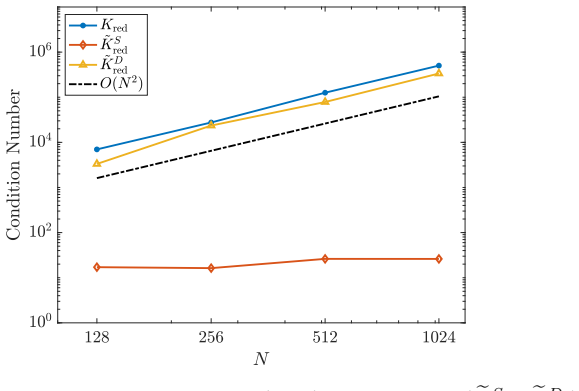
By realizing the discrete bulk harmonic extension through the lattice Green's function on the Cartesian grid, the method rigidly constrains the ill-conditioned degrees of freedom on small-cut elements. The reduced operator obtained by congruence transform of the full CutFEM stiffness inherits symmetry and positive semi-definiteness and possesses a condition number bounded uniformly in the smallest cut-cell ratio. The single-layer density formulation acts as an operator preconditioner that yields O(1) conditioning; the direct reconstruction retains the standard O(h^{-2}) scaling. Optimal O(h) and O(h^2) error estimates hold in H^1(Gamma) and L^2(Gamma).
What carries the argument
The lattice Green's function on the background Cartesian grid, which supplies the discrete harmonic extension that couples bulk and surface degrees of freedom before the congruence reduction of the stiffness matrix.
If this is right
- No explicit stabilization terms such as ghost penalties or cell agglomeration are required.
- The reduced operator remains symmetric and positive semi-definite for any cut configuration.
- The single-layer density formulation preconditions the system to O(1) conditioning suitable for iterative solvers.
- Optimal O(h) convergence in H^1(Gamma) and O(h^2) in L^2(Gamma) hold under the stated regularity.
- The double-layer density version stays cut-independent with the usual O(h^{-2}) mesh scaling.
Where Pith is reading between the lines
- The same harmonic-extension reduction may extend directly to time-dependent or nonlinear bulk-surface problems where cut positions change.
- Avoiding agglomeration simplifies implementation on adaptive or moving meshes.
- The approach suggests a route to combine unfitted surface methods with existing fast multipole or hierarchical-matrix techniques for the bulk extension.
Load-bearing premise
The analysis relies on standard regularity assumptions for the smooth closed curve and the solution together with the known properties of the lattice Green's function on the background grid.
What would settle it
Compute the condition number of the reduced operator on a sequence of successively refined meshes in which the smallest cut-cell area ratio is driven toward zero; if the number grows without bound, the uniform-conditioning claim is false.
Figures


read the original abstract
We present a cut finite element method (CutFEM) for the Laplace--Beltrami equation on a smooth closed curve $\Gamma\subset\mathbb{R}^2$ coupled to a harmonic bulk problem in $\Omega$ that requires \emph{no explicit stabilization}: no ghost penalty, normal-gradient penalty, or cell agglomeration. The classical ill-conditioning of trace finite element spaces on cut cells arises from basis functions with vanishingly small support on $\Gamma$; our observation is that coupling the surface discretization to a discrete bulk harmonic extension, realized through the lattice Green's function (LGF) on the background Cartesian grid, rigidly constrains the degrees of freedom responsible for this ill-conditioning. The reduced operator, obtained by a congruence transform of the full CutFEM stiffness, inherits symmetry and positive semi-definiteness from the variational form and has a condition number bounded uniformly in the smallest cut-cell ratio. The direct reconstruction has the standard $O(h^{-2})$ mesh conditioning; the single-layer density formulation acts as operator preconditioner and yields $O(1)$ conditioning, which is amenable to iterative solvers; the double-layer density formulation remains cut-independent with $O(h^{-2})$ scaling. We prove optimal $O(h)$/$O(h^2)$ error estimates in $H^1(\Gamma)$/$L^2(\Gamma)$ under standard regularity assumptions, establish the cut-independent conditioning rigorously, and demonstrate both the optimal convergence rate and robustness with respect to small cuts in numerical experiments.
Editorial analysis
A structured set of objections, weighed in public.
Referee Report
Summary. The paper introduces a CutFEM discretization for the Laplace-Beltrami equation on a smooth closed curve Γ ⊂ ℝ² that is coupled to a discrete harmonic extension in the bulk domain via the lattice Green's function on a background Cartesian grid. This coupling is realized through a congruence transformation of the full CutFEM stiffness matrix, yielding a reduced operator that inherits symmetry and positive semi-definiteness from the underlying variational form. The central claims are that the method requires no explicit stabilization (ghost penalty, normal-gradient penalty, or agglomeration), that the condition number of the reduced operator is bounded uniformly with respect to the smallest cut-cell ratio, and that optimal O(h) and O(h²) error estimates hold in H¹(Γ) and L²(Γ) under standard regularity assumptions on Γ and the solution. Numerical experiments are presented to confirm both convergence rates and robustness to small cuts. Three variants are discussed: direct reconstruction (O(h^{-2}) conditioning), single-layer density formulation (O(1) conditioning), and double-layer density formulation (O(h^{-2}) conditioning).
Significance. If the claims hold, the work offers a theoretically grounded route to stabilization-free CutFEM for bulk-surface problems by leveraging the lattice Green's function to constrain ill-conditioned degrees of freedom. This could reduce implementation complexity compared with traditional ghost-penalty or agglomeration techniques while preserving symmetry and delivering cut-independent conditioning bounds. The rigorous inheritance of variational properties and the explicit operator-preconditioning analysis via single-layer densities are potentially valuable contributions to the CutFEM literature, particularly for applications where explicit stabilization parameters are undesirable.
minor comments (4)
- [§2.2] §2.2: The precise definition of the discrete harmonic extension operator via the lattice Green's function and its action on the trace space should be stated as an explicit formula or algorithm before the congruence-transform argument is introduced, to make the inheritance of positive semi-definiteness fully transparent.
- [§4] §4: The proof of the uniform conditioning bound relies on properties of the lattice Green's function; a short remark clarifying that these properties are independent of the cut ratio (rather than merely citing the standard LGF literature) would strengthen readability.
- [Figure 3, Table 1] Figure 3 and Table 1: The reported condition numbers for the single-layer formulation appear to be O(1), but the mesh-size range shown is limited; adding one or two finer meshes would better illustrate the claimed independence from h as well as from the cut ratio.
- [Theorem 3.1] The abstract states optimal O(h)/O(h²) estimates, but the precise Sobolev norms and the dependence on the bulk extension regularity are not restated in the theorem statements; a single sentence cross-reference would help.
Simulated Author's Rebuttal
We thank the referee for the careful and accurate summary of our manuscript, for recognizing its potential significance in the CutFEM literature, and for recommending minor revision. No specific major comments were provided in the report.
Circularity Check
No significant circularity; derivation self-contained from variational form and standard LGF properties
full rationale
The paper establishes symmetry, positive semi-definiteness, and uniform conditioning of the reduced operator via a congruence transform applied to the full CutFEM stiffness matrix, inheriting these properties directly from the underlying variational formulation of the coupled bulk-surface problem. Error estimates and cut-independent bounds are derived under standard regularity assumptions on the smooth curve and solution, together with known properties of the lattice Green's function on Cartesian grids. No load-bearing step reduces by construction to a fitted parameter, self-definition, or self-citation chain; the analysis does not rename known results or smuggle ansatzes. This is the most common honest outcome for papers whose central claims rest on external mathematical facts rather than internal redefinitions.
Axiom & Free-Parameter Ledger
axioms (3)
- domain assumption The curve Gamma is smooth and closed
- domain assumption Standard Sobolev regularity of the solution
- standard math Known properties of the lattice Green's function on Cartesian grids
Reference graph
Works this paper leans on
-
[1]
The aggregated unfitted finite ele- ment method for elliptic problems.Computer Methods in Applied Mechanics and Engineering, 336:533–553, 2018
Santiago Badia, Francesc Verdugo, and Alberto F Mart´ ın. The aggregated unfitted finite ele- ment method for elliptic problems.Computer Methods in Applied Mechanics and Engineering, 336:533–553, 2018
2018
-
[2]
Ghost penalty.Comptes Rendus Mathematique, 348(21-22):1217–1220, 2010
Erik Burman. Ghost penalty.Comptes Rendus Mathematique, 348(21-22):1217–1220, 2010
2010
-
[3]
Cutfem: discretizing geometry and partial differential equations.International Journal for Numerical Methods in Engineering, 104(7):472–501, 2015
Erik Burman, Susanne Claus, Peter Hansbo, Mats G Larson, and Andr´ e Massing. Cutfem: discretizing geometry and partial differential equations.International Journal for Numerical Methods in Engineering, 104(7):472–501, 2015
2015
-
[4]
Erik Burman, Peter Hansbo, and Mats G Larson. A stabilized cut finite element method for partial differential equations on surfaces: the laplace–beltrami operator.Computer Methods in Applied Mechanics and Engineering, 285:188–207, 2015
2015
-
[5]
Cutfem based on extended finite element spaces.Numerische Mathematik, 152(2):331–369, 2022
Erik Burman, Peter Hansbo, and Mats G Larson. Cutfem based on extended finite element spaces.Numerische Mathematik, 152(2):331–369, 2022
2022
-
[6]
Cut finite element methods for coupled bulk–surface problems.Numerische Mathematik, 133(2):203–231, 2016
Erik Burman, Peter Hansbo, Mats G Larson, and Sara Zahedi. Cut finite element methods for coupled bulk–surface problems.Numerische Mathematik, 133(2):203–231, 2016
2016
-
[7]
An arbitrarily high order unfitted finite element method for elliptic interface problems with automatic mesh generation.Journal of Computational Physics, 491:112384, 2023
Zhiming Chen and Yong Liu. An arbitrarily high order unfitted finite element method for elliptic interface problems with automatic mesh generation.Journal of Computational Physics, 491:112384, 2023
2023
-
[8]
Stability and conditioning of immersed finite element methods: Analysis and remedies: F
Frits de Prenter, Clemens V Verhoosel, E Harald van Brummelen, Mats G Larson, and Santiago Badia. Stability and conditioning of immersed finite element methods: Analysis and remedies: F. de prenter et al.Archives of Computational Methods in Engineering, 30(6):3617–3656, 2023
2023
-
[9]
Finite element methods for surface pdes.Acta Numerica, 22:289–396, 2013
Gerhard Dziuk and Charles M Elliott. Finite element methods for surface pdes.Acta Numerica, 22:289–396, 2013
2013
-
[10]
Finite element analysis for a coupled bulk–surface partial differential equation.IMA Journal of Numerical Analysis, 33(2):377–402, 2013
Charles M Elliott and Thomas Ranner. Finite element analysis for a coupled bulk–surface partial differential equation.IMA Journal of Numerical Analysis, 33(2):377–402, 2013
2013
-
[11]
Modelling cell motility and chemotaxis with evolving surface finite elements.Journal of The Royal Society Interface, 9(76):3027–3044, 2012
Charles M Elliott, Bj¨ orn Stinner, and Chandrasekhar Venkataraman. Modelling cell motility and chemotaxis with evolving surface finite elements.Journal of The Royal Society Interface, 9(76):3027–3044, 2012
2012
-
[12]
Difference potentials method for models with dynamic boundary conditions and bulk-surface problems.Advances in Computational Mathematics, 46(5):67, 2020
Yekaterina Epshteyn and Qing Xia. Difference potentials method for models with dynamic boundary conditions and bulk-surface problems.Advances in Computational Mathematics, 46(5):67, 2020. 20
2020
-
[13]
Analysis of a high-order trace finite element method for pdes on level set surfaces.SIAM Journal on Numerical Analysis, 56(1):228–255, 2018
Jo¨ org Grande, Christoph Lehrenfeld, and Arnold Reusken. Analysis of a high-order trace finite element method for pdes on level set surfaces.SIAM Journal on Numerical Analysis, 56(1):228–255, 2018
2018
-
[14]
A cut finite element method for coupled bulk-surface problems on time-dependent domains.Computer Methods in Applied Mechanics and Engineering, 307:96–116, 2016
Peter Hansbo, Mats G Larson, and Sara Zahedi. A cut finite element method for coupled bulk-surface problems on time-dependent domains.Computer Methods in Applied Mechanics and Engineering, 307:96–116, 2016
2016
-
[15]
Operator preconditioning.Computers & Mathematics with Applications, 52(5):699–706, 2006
Ralf Hiptmair. Operator preconditioning.Computers & Mathematics with Applications, 52(5):699–706, 2006
2006
-
[16]
A parallel fast multipole method for elliptic difference equations.Journal of Computational Physics, 278:76–91, 2014
Sebastian Liska and Tim Colonius. A parallel fast multipole method for elliptic difference equations.Journal of Computational Physics, 278:76–91, 2014
2014
-
[17]
A fast lattice Green’s function method for solving viscous incompressible flows on unbounded domains.Journal of Computational Physics, 316:360–384, 2016
Sebastian Liska and Tim Colonius. A fast lattice Green’s function method for solving viscous incompressible flows on unbounded domains.Journal of Computational Physics, 316:360–384, 2016
2016
-
[18]
The shifted boundary method for embedded domain com- putations
Alex Main and Guglielmo Scovazzi. The shifted boundary method for embedded domain com- putations. part i: Poisson and stokes problems.Journal of Computational Physics, 372:972– 995, 2018
2018
-
[19]
Boundary algebraic equations for lattice prob- lems.Proceedings of the Royal Society A: Mathematical, Physical and Engineering Sciences, 465(2108):2489–2503, 2009
Per-Gunnar Martinsson and Gregory J Rodin. Boundary algebraic equations for lattice prob- lems.Proceedings of the Royal Society A: Mathematical, Physical and Engineering Sciences, 465(2108):2489–2503, 2009
2009
-
[20]
Trace finite element methods for pdes on surfaces
Maxim A Olshanskii and Arnold Reusken. Trace finite element methods for pdes on surfaces. InGeometrically Unfitted Finite Element Methods and Applications: Proceedings of the UCL Workshop 2016, pages 211–258. Springer, 2018
2016
-
[21]
A finite element method for elliptic equations on surfaces.SIAM journal on numerical analysis, 47(5):3339–3358, 2009
Maxim A Olshanskii, Arnold Reusken, and J¨ org Grande. A finite element method for elliptic equations on surfaces.SIAM journal on numerical analysis, 47(5):3339–3358, 2009
2009
-
[22]
A lubrication model of coating flows over a curved substrate in space.Journal of Fluid Mechanics, 454:235–261, 2002
R Valery Roy, AJ Roberts, and ME Simpson. A lubrication model of coating flows over a curved substrate in space.Journal of Fluid Mechanics, 454:235–261, 2002
2002
-
[23]
The construction of some efficient preconditioners in the boundary element method.Advances in Computational Mathematics, 9(1):191–216, 1998
Olaf Steinbach and Wolfgang L Wendland. The construction of some efficient preconditioners in the boundary element method.Advances in Computational Mathematics, 9(1):191–216, 1998
1998
-
[24]
A geometrically robust unfitted boundary algebraic equation method based on discrete potentials and local basis functions.Journal of Computational Physics, page 114957, 2026
Qing Xia. A geometrically robust unfitted boundary algebraic equation method based on discrete potentials and local basis functions.Journal of Computational Physics, page 114957, 2026. 21
2026
discussion (0)
Sign in with ORCID, Apple, or X to comment. Anyone can read and Pith papers without signing in.