Recognition: unknown
Temporal Spectral Noise-Floor Adaptation for Error-Intolerant Trigger Integrity in IoT Mesh Networks
Pith reviewed 2026-05-08 04:53 UTC · model grok-4.3
The pith
Maintaining a time-evolving spectral noise floor allows IoT sensor nodes to achieve reliable event triggering in non-stationary environments without calibration or external processing.
A machine-rendered reading of the paper's core claim, the machinery that carries it, and where it could break.
Core claim
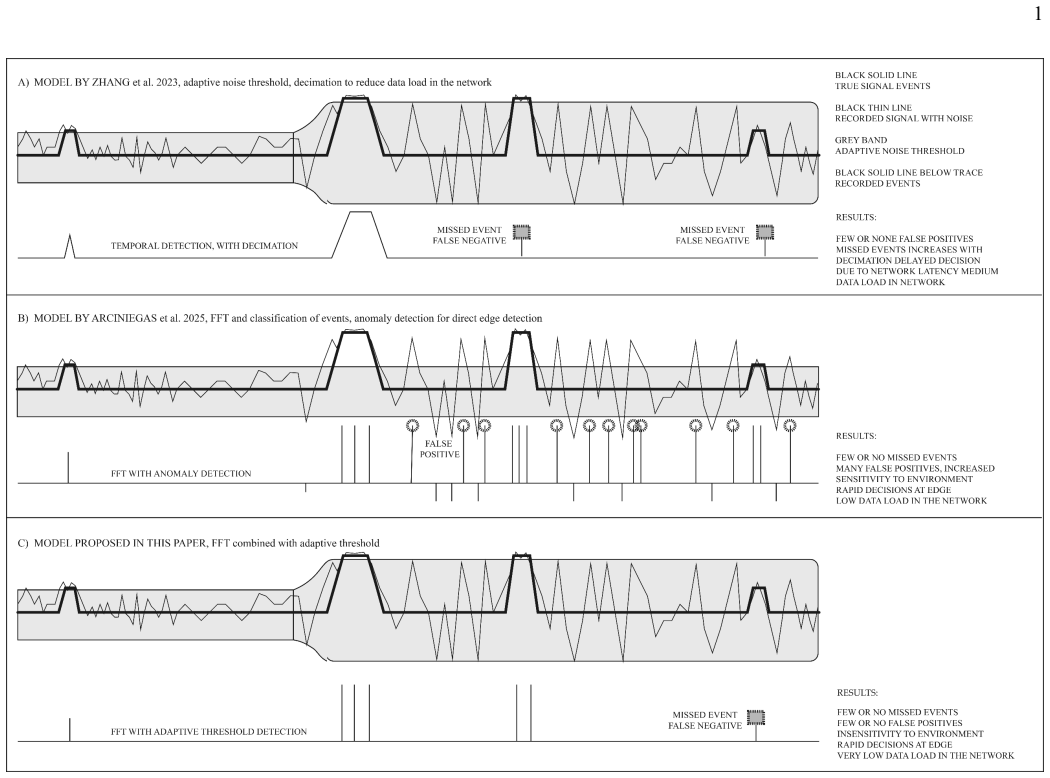
We present a lightweight, embedded algorithm for autonomous edge event triggering in IoT sensor nodes that acquires local sensor data, performs deterministic FFT spectral feature extraction in firmware, and maintains a temporal spectral noise-floor baseline that absorbs non-stationary environmental excitations such as rain, wind, and mechanical vibration while preserving event trigger reliability in dynamic environments, enabling calibration-free deployment of autonomous nodes without shared noise models or cloud-side inference.
What carries the argument
The temporal spectral noise-floor baseline, which evolves locally over time using firmware FFT features to absorb environmental excitations while retaining sensitivity to true spectral signatures.
Load-bearing premise
A time-evolving spectral noise floor can absorb non-stationary environmental excitations such as rain, wind, and mechanical vibration while preserving reliable detection sensitivity to true spectral signatures.
What would settle it
Run the algorithm on a radar proximity sensor in an outdoor location with changing weather, inject known true proximity events at random times, and measure whether false triggers drop substantially while true detections stay consistent.
Figures


read the original abstract
In this paper, we present a lightweight, embedded algorithm for autonomous edge event triggering in IoT sensor nodes suitable for operating in mesh networks. The device acquires local sensor data, performs deterministic FFT spectral feature extraction in firmware, and maintains a temporal spectral noise-floor baseline that absorbs non-stationary environmental excitations such as rain, wind, and mechanical vibration. While adaptive thresholds in IoT sensor nodes are often applied to manage communication load or stabilize long-term metrics, this work focuses on maintaining a time-evolving spectral noise floor to preserve event trigger reliability in dynamic environments. Our method targets trigger integrity under environmental non-stationary conditions, enabling calibration-free deployment of autonomous nodes; without shared noise models or cloud-side inference. Local decision authority preserves node responsiveness when connectivity is intermittent and mitigates security risks inherent in centralized remote-analysis systems. We validate the algorithm in a single node mesh sensor deployed in a dynamic outdoor environment using a radar-class proximity sensor as one example sensor modality. Results demonstrate substantial suppression of nuisance-induced triggers, reduced false-event traffic amplification in the mesh, bounded embedded execution, and reliable detection sensitivity to true spectral signatures.
Editorial analysis
A structured set of objections, weighed in public.
Referee Report
Summary. The manuscript proposes a lightweight embedded algorithm for autonomous edge event triggering in IoT mesh-network sensor nodes. It performs deterministic on-device FFT spectral feature extraction and maintains a time-evolving spectral noise-floor baseline to absorb non-stationary environmental excitations (rain, wind, mechanical vibration) while preserving sensitivity to true spectral signatures. The method is presented as calibration-free, fully local, and connectivity-independent, with validation claimed on a single outdoor node using a radar-class proximity sensor; reported outcomes include nuisance-trigger suppression, reduced false-event mesh traffic, bounded execution, and reliable detection.
Significance. If the quantitative performance claims hold under rigorous testing, the approach could support more reliable, low-maintenance IoT deployments in variable outdoor or industrial settings by cutting unnecessary network traffic and keeping decision logic on-device. The emphasis on error-intolerant triggers and avoidance of shared models or cloud inference addresses practical constraints in intermittent-connectivity meshes.
major comments (3)
- [Abstract] Abstract (validation paragraph): the claims of 'substantial suppression of nuisance-induced triggers' and 'reliable detection sensitivity' are stated without any numerical metrics, baseline comparisons, error bars, statistical tests, or data-set details, leaving the central empirical support for trigger-integrity preservation unquantified.
- [Abstract] Abstract and validation description: the paper asserts suitability for mesh networks and 'reduced false-event traffic amplification in the mesh', yet reports results only from a single-node outdoor deployment; no multi-node experiment, traffic trace, simulation of propagation under intermittent connectivity, or network-load measurement is referenced, rendering the mesh-level benefit an extrapolation.
- [Method] Method description (temporal noise-floor adaptation): the assumption that a time-evolving spectral baseline can absorb non-stationary excitations while retaining sensitivity to true events is load-bearing for the calibration-free claim, but no equations, adaptation-rate derivation, or controlled sensitivity analysis is supplied in the available text to demonstrate that the balance is achieved rather than tuned post hoc.
minor comments (1)
- [Abstract] The abstract would be clearer if it briefly stated the sensor sampling rate, FFT length, and exact outdoor conditions used in the single-node trial.
Simulated Author's Rebuttal
We thank the referee for the constructive feedback and recommendation for major revision. We address each major comment below with clarifications and planned changes to the manuscript.
read point-by-point responses
-
Referee: [Abstract] Abstract (validation paragraph): the claims of 'substantial suppression of nuisance-induced triggers' and 'reliable detection sensitivity' are stated without any numerical metrics, baseline comparisons, error bars, statistical tests, or data-set details, leaving the central empirical support for trigger-integrity preservation unquantified.
Authors: We agree that the abstract would be strengthened by including quantitative support. The results section provides the underlying quantitative evaluation from the outdoor deployment, including trigger rate comparisons and sensitivity measures. We will revise the abstract to incorporate key metrics and dataset details drawn from those results so that the central claims are quantified at the abstract level. revision: yes
-
Referee: [Abstract] Abstract and validation description: the paper asserts suitability for mesh networks and 'reduced false-event traffic amplification in the mesh', yet reports results only from a single-node outdoor deployment; no multi-node experiment, traffic trace, simulation of propagation under intermittent connectivity, or network-load measurement is referenced, rendering the mesh-level benefit an extrapolation.
Authors: The referee is correct that validation is performed on a single node and that the mesh-level traffic reduction is therefore an extrapolation based on the observed per-node reduction in nuisance triggers. Because each node operates independently, fewer false triggers per node directly reduces mesh traffic; however, we acknowledge the absence of direct multi-node or simulated network measurements. In revision we will add an explicit statement in the abstract and a clarifying paragraph in the discussion that identifies this as an inference from the single-node results rather than a measured network outcome. revision: partial
-
Referee: [Method] Method description (temporal noise-floor adaptation): the assumption that a time-evolving spectral baseline can absorb non-stationary excitations while retaining sensitivity to true events is load-bearing for the calibration-free claim, but no equations, adaptation-rate derivation, or controlled sensitivity analysis is supplied in the available text to demonstrate that the balance is achieved rather than tuned post hoc.
Authors: We agree that the method section requires explicit formalization. The adaptation rule is a recursive spectral baseline update whose rate is chosen to track environmental non-stationarity while preserving transient signatures. We will insert the governing equations, the derivation of the adaptation time constant from expected environmental timescales, and a parameter-sensitivity study showing the operating range that maintains detection integrity. These additions will appear in the revised method section. revision: yes
Circularity Check
No derivation chain or equations present; circularity undetectable
full rationale
The abstract and description present a high-level algorithm: deterministic FFT spectral feature extraction followed by maintenance of a temporal spectral noise-floor baseline to absorb non-stationary excitations. No equations, parameter-fitting procedures, uniqueness theorems, or self-citations are quoted or referenced in the provided text. Without any mathematical derivation chain, no step can be shown to reduce by construction to its inputs (e.g., no fitted parameter renamed as prediction, no ansatz smuggled via citation). The single-node validation and mesh-traffic claims are empirical assertions rather than derivations, so they fall outside circularity analysis. This matches the reader's observation that lack of equations prevents assessment; the finding is therefore no significant circularity.
Axiom & Free-Parameter Ledger
Reference graph
Works this paper leans on
-
[1]
L. Pioli, C. Dorneles, D. D. J. de Macedo, and M. Dantas, “An overview of data reduction solutions at the edge of IoT systems: a systematic mapping of the literature,” Computing, vol. 104, pp. 1867–1889, 2022, doi: 10.1007/s00607-022-01073-6. 3
-
[2]
Data reduction in fog computing and internet of things: A systematic literature survey,
A. A. Sadri, A. Rahmani, M. Saberikamarposhti, and M. Hosseinzadeh, “Data reduction in fog computing and internet of things: A systematic literature survey,” Internet Things, vol. 20, p. 100629, 2022, doi: 10.1016/j.iot.2022.100629
-
[3]
Edge Intelligence for Data Handling and Predictive Maintenance in IIOT,
T. Hafeez, L. Xu, and G. Mcardle, “Edge Intelligence for Data Handling and Predictive Maintenance in IIOT,” IEEE Access, vol. 9, pp. 49355–49371, 2021, doi: 10.1109/ACCESS.2021.3069137
-
[4]
On the Use of Intelligent Models towards Meeting the Challenges of the Edge Mesh,
P. Oikonomou, A. Karanika, C. Anagnostopoulos, and K. Kolomvatsos, “On the Use of Intelligent Models towards Meeting the Challenges of the Edge Mesh,” ACM Comput. Surv. CSUR, vol. 54, pp. 1–42, 2021, doi: 10.1145/3456630
-
[6]
A. K. Idrees and A. K. M. Al-Qurabat, “Energy-Efficient Data Transmission and Aggregation Protocol in Periodic Sensor Networks Based Fog Computing,” J. Netw. Syst. Manag., vol. 29, p. null, 2020, doi: 10.1007/s10922-020- 09567-4
-
[7]
Data Prediction-Based Energy-Efficient Architecture for Industrial IoT,
M. A. P. Putra, A. P. Hermawan, D.-S. Kim, and J.-M. Lee, “Data Prediction-Based Energy-Efficient Architecture for Industrial IoT,” IEEE Sens. J., vol. 23, pp. 15856–15866, 2023, doi: 10.1109/JSEN.2023.3280485
-
[8]
Streaming End-to-End Speech Recognition with Transformer Transducer
Y. Wu et al., “To Transmit or Predict: An Efficient Industrial Data Transmission Scheme With Deep Learning and Cloud-Edge Collaboration,” IEEE Trans. Ind. Inform., vol. 19, pp. 11322–11332, 2023, doi: 10.1109/TII.2023.3245673
-
[9]
S. K. Bhoi et al., “Advanced Edge Computing Framework for Grid Power Quality Monitoring of Industrial Motor Drive Applications,” 2022 Int. Symp. Power Electron. Electr. Drives Autom. Motion SPEEDAM, vol. null, pp. 455–459, 2022, doi: 10.1109/speedam53979.2022.9841966
-
[11]
S. Robyns et al., “An intelligent data capturing framework to improve condition monitoring and anomaly detection for industrial machines,” 2023, doi: 10.1016/j.procs.2022.12.267
-
[12]
Improving Predictive Maintenance in Industrial Environments via IIoT and Machine Learning,
S. O. Alhuqayl, A. T. Alenazi, H. A. Alabduljabbar, and M. A. Haq, “Improving Predictive Maintenance in Industrial Environments via IIoT and Machine Learning,” Int. J. Adv. Comput. Sci. Appl., vol. null, p. null, 2024, doi: 10.14569/ijacsa.2024.0150464
-
[13]
Lossy Data Compression for IoT Sensors: A Review,
J. D. A. Correa, A. R. Pinto, and C. Montez, “Lossy Data Compression for IoT Sensors: A Review,” Internet Things, vol. 19, p. 100516, 2022, doi: 10.1016/j.iot.2022.100516
-
[14]
Deep Reinforcement Learning for Efficient IoT Data Compression in Smart Railroad Management,
X. Chen, Q. Yu, S. Dai, P. Sun, H. Tang, and L. Cheng, “Deep Reinforcement Learning for Efficient IoT Data Compression in Smart Railroad Management,” IEEE Internet Things J., vol. 11, pp. 25494–25504, 2024, doi: 10.1109/JIOT.2023.3348487
-
[15]
Towards Enabling IoT Systems with Edge Intelligence,
N. A. GabAllah, I. Farrag, O. Nawawy, R. Khalil, H. Sharara, and T. Elbatt, “Towards Enabling IoT Systems with Edge Intelligence,” 2021 IEEE Int. Conf. Smart Internet Things SmartIoT, vol. null, pp. 271–277, 2021, doi: 10.1109/SmartIoT52359.2021.00050
-
[16]
Edge-Cloud Hybrid Tiny Data Reduction Model for Anomaly Detection,
Y. Zhu and C. Xie, “Edge-Cloud Hybrid Tiny Data Reduction Model for Anomaly Detection,” 2022 IEEE Int. Conf. E-Bus. Eng. ICEBE, vol. null, pp. 51–57, 2022, doi: 10.1109/ICEBE55470.2022.00019
-
[17]
Autonomous Internet of Things (IoT) Data Reduction Based on Adaptive Threshold,
H. Zhang, J. Na, and B. Zhang, “Autonomous Internet of Things (IoT) Data Reduction Based on Adaptive Threshold,” Sensors, vol. 23, no. 23, Nov. 2023, doi: 10.3390/s23239427
-
[18]
A. M. Hussein, A. K. Idrees, and R. Couturier, “Distributed energy‐efficient data reduction approach based on prediction and compression to reduce data transmission in IoT networks,” Int. J. Commun. Syst., vol. 35, p. null, 2022, doi: 10.1002/dac.5282
-
[19]
Fog data management: A vision, challenges, and future directions,
A. A. Sadri, A. Rahmani, M. Saberikamarposhti, and M. Hosseinzadeh, “Fog data management: A vision, challenges, and future directions,” J Netw Comput Appl, vol. 174, p. 102882, 2021, doi: 10.1016/j.jnca.2020.102882
-
[20]
IoT device for detecting abnormal vibrations in motors using TinyML,
S. Arciniegas, D. Rivero, J. Piñan, E. Diaz, and F. Rivas, “IoT device for detecting abnormal vibrations in motors using TinyML,” Discov. Internet Things, vol. 5, Apr. 2025, doi: 10.1007/s43926-025-00142-4
-
[21]
Anomaly detection based on Artificial Intelligence of Things: A Systematic Literature Mapping,
S. Trilles, S. S. Hammad, and D. Iskandaryan, “Anomaly detection based on Artificial Intelligence of Things: A Systematic Literature Mapping,” Internet Things, vol. 25, p. 101063, 2024, doi: 10.1016/j.iot.2024.101063
-
[22]
S. S. Hammad, D. Iskandaryan, and S. Trilles, “An unsupervised TinyML approach applied to the detection of urban noise anomalies under the smart cities environment,” Internet Things, vol. 23, p. 100848, 2023, doi: 10.1016/j.iot.2023.100848
-
[23]
Binary- Convolution Data-Reduction Network for Edge–Cloud IIoT Anomaly Detection,
C. Xie, W. Tao, Z. Zeng, and Y. Dong, “Binary- Convolution Data-Reduction Network for Edge–Cloud IIoT Anomaly Detection,” Electronics, vol. null, p. null, 2023, doi: 10.3390/electronics12153229
-
[24]
Radar CFAR Thresholding in Clutter and Multiple Target Situations,
H. Rohling, “Radar CFAR Thresholding in Clutter and Multiple Target Situations,” IEEE Trans. Aerosp. Electron. Syst., vol. AES-19, no. 4, pp. 608–621, Jul. 1983, doi: 10.1109/TAES.1983.309350
-
[25]
Adaptive detection mode with threshold control as a function of spatially sampled clutter level estimates,
H. M. Finn and R. S. Johnson, “Adaptive detection mode with threshold control as a function of spatially sampled clutter level estimates,” RCA Rev., vol. 29, no. 3, pp. 414–464, Sep. 1968
1968
-
[26]
I. Sittón-Candanedo and J. Corchado, “An Edge Computing Tutorial,” Orient. J. Comput. Sci. Technol., vol. null, p. null, 2019, doi: 10.13005/OJCST12.02.02
-
[27]
An algorithm for the machine calculation of complex Fourier series,
J. W. Cooley and J. W. Tukey, “An algorithm for the machine calculation of complex Fourier series,” Math. Comput., vol. 19, no. 90, pp. 297–301, 1965, doi: 10.1090/S0025-5718-1965-0178586-1
-
[28]
Using the ARM Cortex-M4 and the CMSIS-DSP library for teaching real-time DSP,
M. A. Wickert, “Using the ARM Cortex-M4 and the CMSIS-DSP library for teaching real-time DSP,” in 2015 IEEE Signal Processing and Signal Processing Education 4 Workshop (SP/SPE), Aug. 2015, pp. 283–288. doi: 10.1109/DSP-SPE.2015.7369567
-
[29]
J. W. Tukey, Exploratory Data Analysis. Reading, Mass: Addison Wesley, 1977
1977
-
[30]
A theoretical analysis of the properties of median filters,
N. Gallagher and G. Wise, “A theoretical analysis of the properties of median filters,” IEEE Trans. Acoust. Speech Signal Process., vol. 29, no. 6, pp. 1136–1141, Dec. 1981, doi: 10.1109/TASSP.1981.1163708. Sergii Makovetskyi (photograph not available at publication) received the M.S. degree in radio engineering from Kharkiv National University of Radio E...
-
[31]
Signal Processin g Verification System for the Programmable Digital Matched Filter,
He is currently pursuing the Ph.D. degree in F2 - Software Engineering at the same university. From 2009 to 2025, he was working with EKTOS, Ukraine, where he served as a Senior Embedded Hardware Developer and later as a Technical Leader and IoT Technical Leader. He is the author of several published articles on LoRaWAN and signal processing, including wo...
2009
discussion (0)
Sign in with ORCID, Apple, or X to comment. Anyone can read and Pith papers without signing in.