Recognition: unknown
Flow Matching with Arbitrary Auxiliary Paths
Pith reviewed 2026-05-08 12:53 UTC · model grok-4.3
The pith
Flow matching can use auxiliary variables from any distribution while preserving the continuity equation and consistent training objectives.
A machine-rendered reading of the paper's core claim, the machinery that carries it, and where it could break.
Core claim
We introduce AuxPath-FM which generalizes conditional flow matching by incorporating an auxiliary variable drawn from an arbitrary distribution into the probability path, with trajectories of the form X_t = a(t)X_1 + b(t)X_0 + c(t)η. This construction preserves the continuity equation and maintains a training objective consistent with the marginal formulation, enabling diverse priors and specialized tasks like label-guided generation.
What carries the argument
The generalized probability path X_t = a(t)X_1 + b(t)X_0 + c(t)η with η drawn from an arbitrary distribution, which carries the argument by allowing flexible path design while preserving the flow-matching continuity equation and objective.
Load-bearing premise
An auxiliary variable η from an arbitrary distribution can be linearly combined with the data and noise terms in the path definition without violating the continuity equation or the consistency of the training objective.
What would settle it
Deriving the velocity field from the path X_t = a(t)X_1 + b(t)X_0 + c(t)η and checking whether it satisfies the continuity equation ∂_t p_t + ∇·(u_t p_t) = 0 when η follows a Laplace distribution instead of a Gaussian.
Figures


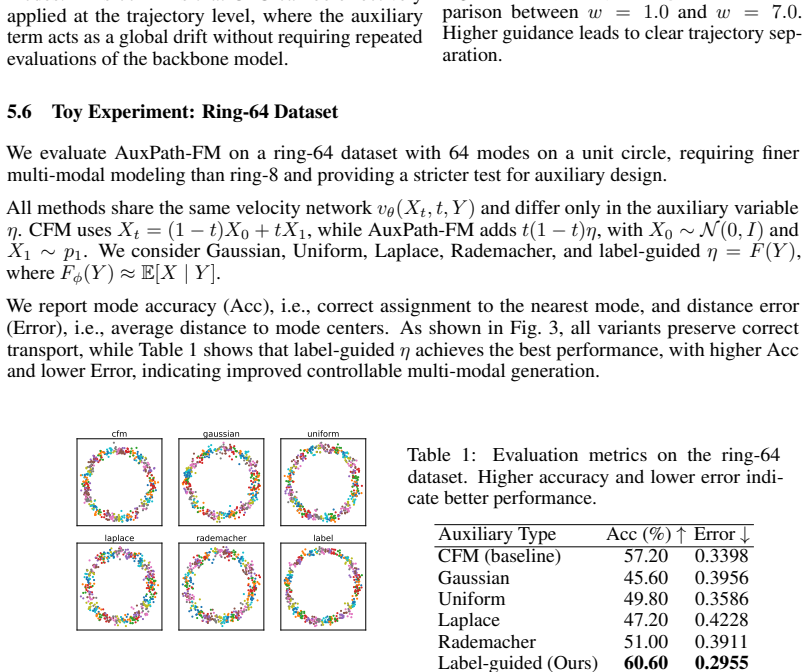


read the original abstract
We introduce a new generative modeling framework, \textbf{Flow Matching with Arbitrary Auxiliary Paths (AuxPath-FM)}, which generalizes conditional flow matching by incorporating an auxiliary variable drawn from an arbitrary distribution into the probability path. Unlike prior methods that restrict auxiliary components to Gaussian noise, AuxPath-FM allows the variable $\eta$ to follow any distribution, producing trajectories of the form $X_t = a(t)X_1 + b(t)X_0 + c(t)\eta$. We theoretically demonstrate that this construction preserves the continuity equation and maintains a training objective consistent with the marginal formulation. This flexibility enables the design of diverse probability paths using various priors, including Gaussian, Uniform, Laplace, and discrete Rademacher distributions, each offering unique geometric properties for generative flows. Furthermore, our framework allows for specialized tasks such as label-guided generation by encoding structured semantic information into the auxiliary distribution. Overall, AuxPath-FM provides a principled and general foundation for probability path design, offering both theoretical generality and practical flexibility for diverse generative modeling tasks.
Editorial analysis
A structured set of objections, weighed in public.
Referee Report
Summary. The paper introduces AuxPath-FM, a generalization of conditional flow matching that incorporates an auxiliary variable η ~ arbitrary distribution (including Gaussian, Uniform, Laplace, and discrete Rademacher) into the linear probability path X_t = a(t)X_1 + b(t)X_0 + c(t)η. It claims to prove that this construction preserves the continuity equation and yields a marginal training objective consistent with standard flow matching, enabling diverse path geometries and applications such as label-guided generation.
Significance. If the theoretical claims hold without restriction on the auxiliary distribution, the framework would meaningfully expand the design space for probability paths in flow matching, allowing structured priors beyond Gaussian noise. The paper's emphasis on parameter-free path coefficients and consistency with the marginal formulation is a potential strength, but the load-bearing generality claim requires substantiation for singular measures.
major comments (2)
- [Theoretical demonstration / continuity equation preservation] Abstract and theoretical section: the claim that the construction 'preserves the continuity equation' for arbitrary η (explicitly including discrete Rademacher) is load-bearing for the central contribution. When η is discrete, the marginal law of X_t is supported on a finite union of lower-dimensional affine subspaces (for c(t) ≠ 0), hence singular w.r.t. Lebesgue measure and without a density p_t. The standard PDE form ∂_t p_t + ∇·(p_t v_t) = 0 therefore cannot be invoked directly; a measure-theoretic statement or explicit derivation of the velocity field under the singular case must be supplied, or the generality claim restricted.
- [Marginal formulation and training objective] § on marginal objective consistency: the training objective is asserted to remain consistent with the marginal formulation. However, when the auxiliary path induces a singular marginal, the usual conditional-expectation or score-based derivations of the velocity field v_t no longer apply in their standard form. The manuscript must show how the objective is obtained without assuming absolute continuity of p_t.
minor comments (2)
- Notation for the time-dependent coefficients a(t), b(t), c(t) is introduced without an explicit table or set of functional forms; providing concrete examples (e.g., the standard linear interpolation case) would improve readability.
- The abstract lists 'discrete Rademacher distributions' as one of the supported priors; a brief remark on how the generative sampling procedure handles the resulting discrete support would clarify practical use.
Simulated Author's Rebuttal
We thank the referee for the detailed and constructive feedback on the theoretical foundations of AuxPath-FM. The points regarding continuity equations and marginal objectives for singular measures are well-taken, and we address them point-by-point below with proposed revisions to strengthen the manuscript.
read point-by-point responses
-
Referee: Abstract and theoretical section: the claim that the construction 'preserves the continuity equation' for arbitrary η (explicitly including discrete Rademacher) is load-bearing for the central contribution. When η is discrete, the marginal law of X_t is supported on a finite union of lower-dimensional affine subspaces (for c(t) ≠ 0), hence singular w.r.t. Lebesgue measure and without a density p_t. The standard PDE form ∂_t p_t + ∇·(p_t v_t) = 0 therefore cannot be invoked directly; a measure-theoretic statement or explicit derivation of the velocity field under the singular case must be supplied, or the generality claim restricted.
Authors: We agree that the standard density-based PDE form does not apply directly when the marginal is singular. Our derivation in the manuscript defines the velocity field via the linear path construction and conditional expectation, which extends to the measure-theoretic setting using the continuity equation in the weak (distributional) sense: for any test function φ, the integral form ∫ (∂_t φ + v_t · ∇φ) dμ_t = 0 holds for the induced measures μ_t. This is independent of absolute continuity. We will add a new subsection (e.g., 3.3) explicitly stating the weak formulation, deriving the velocity field for general (including discrete) auxiliary distributions via disintegration, and verifying it for the Rademacher case with a concrete example. revision: yes
-
Referee: § on marginal objective consistency: the training objective is asserted to remain consistent with the marginal formulation. However, when the auxiliary path induces a singular marginal, the usual conditional-expectation or score-based derivations of the velocity field v_t no longer apply in their standard form. The manuscript must show how the objective is obtained without assuming absolute continuity of p_t.
Authors: The marginal objective is derived by expanding the expectation E[||v_t(X_t) - u_t(X_t | X_0, X_1, η)||^2] and applying the law of total expectation over the joint law of (X_0, X_1, η), which yields the marginal velocity without invoking densities or scores. This step relies only on the existence of regular conditional distributions (guaranteed by Polish spaces) and holds for singular marginals. We will append a short proof in the supplementary material (or new Appendix B) that makes this explicit using measure disintegration, confirming consistency for arbitrary η including discrete cases. revision: yes
Circularity Check
No significant circularity; derivation extends standard flow matching independently
full rationale
The paper defines a new family of paths X_t = a(t)X_1 + b(t)X_0 + c(t)η with η drawn from an arbitrary distribution and claims a direct theoretical verification that the resulting marginals satisfy the continuity equation with a consistent marginal training objective. This verification proceeds from the standard continuity-equation setup of flow matching by explicit construction of the velocity field (or its conditional expectation) for the augmented path; the auxiliary variable is an exogenous modeling choice rather than a quantity defined in terms of the target result or fitted from it. No self-citation is load-bearing for the central claim, no parameter is fitted on a subset and then re-labeled as a prediction, and the derivation does not rename a known empirical pattern. The construction is therefore self-contained against the external benchmark of conditional flow matching.
Axiom & Free-Parameter Ledger
free parameters (1)
- a(t), b(t), c(t)
axioms (1)
- domain assumption The probability path must satisfy the continuity equation.
invented entities (1)
-
Auxiliary variable η from arbitrary distribution
no independent evidence
Reference graph
Works this paper leans on
-
[1]
Stochastic Interpolants: A Unifying Framework for Flows and Diffusions
Michael S Albergo, Nicholas M Boffi, and Eric Vanden-Eijnden. Stochastic interpolants: A unifying framework for flows and diffusions.arXiv preprint arXiv:2303.08797, 2023
work page internal anchor Pith review arXiv 2023
-
[2]
An ensemble of simple convolutional neural network models for mnist digit recognition, 2020
Sanghyeon An, Minjun Lee, Sanglee Park, Heerin Yang, and Jungmin So. An ensemble of simple convolutional neural network models for mnist digit recognition, 2020. URL https://arxiv.org/abs/ 2008.10400
-
[3]
Li, Hamid Kazemi, Furong Huang, Micah Goldblum, Jonas Geiping, and Tom Goldstein
Arpit Bansal, Eitan Borgnia, Hong-Min Chu, Jie S. Li, Hamid Kazemi, Furong Huang, Micah Goldblum, Jonas Geiping, and Tom Goldstein. Cold diffusion: Inverting arbitrary image transforms without noise. In Neural Information Processing Systems (NeurIPS), 2023. URL https://openreview.net/forum?id= XH3ArccntI
2023
-
[4]
Iterative bregman projections for regularized transportation problems.SIAM Journal on Scientific Computing, 2015
Jean-David Benamou, Guillaume Carlier, Marco Cuturi, Lorenzo Nenna, and Gabriel Peyré. Iterative bregman projections for regularized transportation problems.SIAM Journal on Scientific Computing, 2015
2015
-
[5]
Diffusion schrödinger bridge with applications to score-based generative modeling
Valentin De Bortoli, James Thornton, Jeremy Heng, and Arnaud Doucet. Diffusion schrödinger bridge with applications to score-based generative modeling. In A. Beygelzimer, Y . Dauphin, P. Liang, and J. Wortman Vaughan, editors,Neural Information Processing Systems (NeurIPS), 2021. URL https: //openreview.net/forum?id=9BnCwiXB0ty
2021
-
[6]
Valentin De Bortoli, Guan-Horng Liu, Tianrong Chen, Evangelos A. Theodorou, and Weilie Nie. Aug- mented bridge matching.arXiv preprint arXiv:2311.06978, 2023
-
[7]
Generative flows on discrete state-spaces: Enabling multimodal flows with applications to protein co-design
Andrew Campbell, Jason Yim, Regina Barzilay, Tom Rainforth, and Tommi Jaakkola. Generative flows on discrete state-spaces: Enabling multimodal flows with applications to protein co-design. InInterna- tional Conference on Machine Learning (ICML), 2024. URL https://openreview.net/forum?id= kQwSbv0BR4
2024
-
[8]
Ricky T. Q. Chen and Yaron Lipman. Flow matching on general geometries. InInternational Conference on Learning Representations (ICLR), 2024
2024
-
[9]
Flow matching in latent space.arXiv preprint arXiv:2307.08698,
Quan Dao, Hao Phung, Binh Nguyen, and Anh Tran. Flow matching in latent space.arXiv, 2023. URL https://arxiv.org/abs/2307.08698
-
[10]
Bronstein, and Joey Bose
Oscar Davis, Samuel Kessler, Mircea Petrache, Ismail Ilkan Ceylan, Michael M. Bronstein, and Joey Bose. Fisher flow matching for generative modeling over discrete data. InInternational Conference on Learning Representations (ICLR), 2024. URLhttps://openreview.net/forum?id=6jOScqwdHU
2024
-
[11]
Imagenet: A large-scale hierarchical image database
Jia Deng, Wei Dong, Richard Socher, Li-Jia Li, Kai Li, and Li Fei-Fei. Imagenet: A large-scale hierarchical image database. In2009 IEEE Conference on Computer Vision and Pattern Recognition, pages 248–255,
-
[12]
doi: 10.1109/CVPR.2009.5206848
-
[13]
Diffusion models beat gans on image synthesis.Neural Information Processing Systems (NeurIPS), 34, 2021
Prafulla Dhariwal and Alexander Nichol. Diffusion models beat gans on image synthesis.Neural Information Processing Systems (NeurIPS), 34, 2021
2021
-
[14]
Learning with a wasserstein loss.Neural Information Processing Systems (NeurIPS), 2015
Charlie Frogner, Chiyuan Zhang, Hossein Mobahi, Mauricio Araya-Polo, and Tomaso Poggio. Learning with a wasserstein loss.Neural Information Processing Systems (NeurIPS), 2015
2015
-
[15]
Itai Gat, Tal Remez, Neta Shaul, Felix Kreuk, Ricky T. Q. Chen, Gabriel Synnaeve, Yossi Adi, and Yaron Lipman. Discrete flow matching. InNeural Information Processing Systems (NeurIPS), 2024. URL https://openreview.net/forum?id=GTDKo3Sv9p
2024
-
[16]
Marton Havasi, Brian Karrer, Itai Gat, and Ricky T. Q. Chen. Edit flows: Variable length discrete flow matching with sequence-level edit operations. InNeural Information Processing Systems (NeurIPS), 2026. URLhttps://openreview.net/forum?id=FXWwYz1p8a
2026
-
[17]
Deep residual learning for image recognition
Kaiming He, Xiangyu Zhang, Shaoqing Ren, and Jian Sun. Deep residual learning for image recognition. InIEEE Conference on Computer Vision and Pattern Recognition (CVPR), 2016
2016
-
[18]
Gans trained by a two time-scale update rule converge to a local nash equilibrium
Martin Heusel, Hubert Ramsauer, Thomas Unterthiner, Bernhard Nessler, and Sepp Hochreiter. Gans trained by a two time-scale update rule converge to a local nash equilibrium. InNeural Information Processing Systems (NeurIPS), NIPS’17, page 6629–6640, Red Hook, NY , USA, 2017. Curran Associates Inc. ISBN 9781510860964
2017
-
[19]
Classifier-Free Diffusion Guidance
Jonathan Ho and Tim Salimans. Classifier-free diffusion guidance.arXiv preprint arXiv:2207.12598, 2022. 10
work page internal anchor Pith review arXiv 2022
-
[20]
Denoising diffusion probabilistic models.Neural Information Processing Systems (NeurIPS), 2020
Jonathan Ho, Ajay Jain, and Pieter Abbeel. Denoising diffusion probabilistic models.Neural Information Processing Systems (NeurIPS), 2020
2020
-
[21]
Bronstein, Alexander Tong, and Joey Bose
Guillaume Huguet, James Vuckovic, Kilian FATRAS, Eric Thibodeau-Laufer, Pablo Lemos, Riashat Islam, Cheng-Hao Liu, Jarrid Rector-Brooks, Tara Akhound-Sadegh, Michael M. Bronstein, Alexander Tong, and Joey Bose. Sequence-augmented SE(3)-flow matching for conditional protein generation. In The Thirty-eighth Annual Conference on Neural Information Processing...
2024
-
[22]
Multi-marginal f- divergence schrödinger bridges: Towards a unifying framework for generation and distillation
Ishaan Kharbanda, Xuan Ouyang, Rahul Choudhary, Hanbaek Lyu, and Yudi Li. Multi-marginal f- divergence schrödinger bridges: Towards a unifying framework for generation and distillation. InInterna- tional Conference on Learning Representations (ICLR), 2025. URL https://openreview.net/forum? id=7WrMAQ1XDq
2025
-
[23]
Junwan Kim, Jiho Park, Seonghu Jeon, and Seungryong Kim. Better source, better flow: Learning condition-dependent source distribution for flow matching.arXiv preprint arXiv:2602.05951, 2026
-
[24]
On density estimation with diffusion models
Diederik P Kingma, Tim Salimans, Ben Poole, and Jonathan Ho. On density estimation with diffusion models. In A. Beygelzimer, Y . Dauphin, P. Liang, and J. Wortman Vaughan, editors,Neural Information Processing Systems (NeurIPS), 2021. URLhttps://openreview.net/forum?id=2LdBqxc1Yv
2021
-
[25]
Learning multiple layers of features from tiny images
Alex Krizhevsky and Geoffrey Hinton. Learning multiple layers of features from tiny images. Technical Report 0, University of Toronto, Toronto, Ontario, 2009. URL https://www.cs.toronto.edu/~kriz/ learning-features-2009-TR.pdf
2009
-
[26]
Flow Matching is Adaptive to Manifold Structures
Shivam Kumar, Yixin Wang, and Lizhen Lin. Flow matching is adaptive to manifold structures.arXiv preprint arXiv:2602.22486, 2026
work page internal anchor Pith review Pith/arXiv arXiv 2026
-
[27]
Y . Lecun, L. Bottou, Y . Bengio, and P. Haffner. Gradient-based learning applied to document recognition. Proceedings of the IEEE, 86(11):2278–2324, 1998. doi: 10.1109/5.726791
-
[28]
Yaron Lipman, Ricky T. Q. Chen, Heli Ben-Hamu, Maximilian Nickel, and Matthew Le. Flow matching for generative modeling. InInternational Conference on Learning Representations (ICLR), 2023
2023
-
[29]
Flow-GRPO: Training flow matching models via online RL
Jie Liu, Gongye Liu, Jiajun Liang, Yangguang Li, Jiaheng Liu, Xintao Wang, Pengfei Wan, Di ZHANG, and Wanli Ouyang. Flow-GRPO: Training flow matching models via online RL. InThe Thirty-ninth Annual Conference on Neural Information Processing Systems, 2026. URL https://openreview.net/ forum?id=oCBKGw5HNf
2026
-
[30]
Flow straight and fast: Learning to generate and transfer data with rectified flow
Xingchao Liu, Chengyue Gong, and qiang liu. Flow straight and fast: Learning to generate and transfer data with rectified flow. InInternational Conference on Learning Representations (ICLR), 2023. URL https://openreview.net/forum?id=XVjTT1nw5z
2023
-
[31]
Edit-based flow matching for temporal point processes
David Lüdke, Marten Lienen, Marcel Kollovieh, and Stephan Günnemann. Edit-based flow matching for temporal point processes. InInternational Conference on Learning Representations (ICLR), 2026. URL https://openreview.net/forum?id=FNf9IV1P2L
2026
-
[32]
Benjamin Kurt Miller, Ricky T. Q. Chen, Anuroop Sriram, and Brandon M Wood. FlowMM: Generating materials with Riemannian flow matching. InInternational Conference on Machine Learning (ICML), 2024
2024
-
[33]
Conditional Generative Adversarial Nets
Mehdi Mirza and Simon Osindero. Conditional generative adversarial nets. InarXiv preprint arXiv:1411.1784, 2014
work page internal anchor Pith review arXiv 2014
-
[34]
Spectflow: Long-term forecasting using flow matching with 89k parameters
Seyed Mohamad Moghadas and Adrian Munteanu. Spectflow: Long-term forecasting using flow matching with 89k parameters. InNeurIPS 2025 Workshop on Structured Probabilistic Inference & Generative Modeling, 2025. URLhttps://openreview.net/forum?id=NIeZP4a8nq
2025
-
[35]
Scalable diffusion models with transformers
William Peebles and Saining Xie. Scalable diffusion models with transformers. InIEEE Conference on Computer Vision and Pattern Recognition (CVPR), 2023
2023
-
[36]
U-net: Convolutional networks for biomedical image segmentation
Olaf Ronneberger, Philipp Fischer, and Thomas Brox. U-net: Convolutional networks for biomedical image segmentation. In Nassir Navab, Joachim Hornegger, William M. Wells, and Alejandro F. Frangi, editors,Medical Image Computing and Computer-Assisted Intervention – MICCAI 2015, pages 234–241, Cham, 2015. Springer International Publishing. ISBN 978-3-319-24574-4
2015
-
[37]
Improved techniques for training gans
Tim Salimans, Ian Goodfellow, Wojciech Zaremba, Vicki Cheung, Alec Radford, and Xi Chen. Improved techniques for training gans. InNeural Information Processing Systems (NeurIPS), NIPS’16, page 2234–2242, Red Hook, NY , USA, 2016. Curran Associates Inc. ISBN 9781510838819. 11
2016
-
[38]
Transition matching: Scalable and flexible generative modeling
Neta Shaul, Uriel Singer, Itai Gat, and Yaron Lipman. Transition matching: Scalable and flexible generative modeling. InNeural Information Processing Systems (NeurIPS), 2026. URL https://openreview. net/forum?id=An0ePypuOJ
2026
-
[39]
Score-based generative modeling through stochastic differential equations
Yang Song, Jascha Sohl-Dickstein, Diederik P Kingma, Abhishek Kumar, Stefano Ermon, and Ben Poole. Score-based generative modeling through stochastic differential equations. InInternational Conference on Learning Representations (ICLR), 2021
2021
-
[40]
Dirichlet flow matching with applications to DNA sequence design
Hannes Stark, Bowen Jing, Chenyu Wang, Gabriele Corso, Bonnie Berger, Regina Barzilay, and Tommi Jaakkola. Dirichlet flow matching with applications to DNA sequence design. InInternational Conference on Machine Learning (ICML), 2024. URLhttps://openreview.net/forum?id=syXFAVqx85
2024
-
[41]
Contrastive flow matching
George Stoica, Vivek Ramanujan, Xiang Fan, Ali Farhadi, Ranjay Krishna, and Judy Hoffman. Contrastive flow matching. InIEEE International Conference on Computer Vision (ICCV), 2025
2025
-
[42]
Christian Szegedy, Vincent Vanhoucke, Sergey Ioffe, Jon Shlens, and Zbigniew Wojna. Rethinking the inception architecture for computer vision. InIEEE Conference on Computer Vision and Pattern Recognition (CVPR), pages 2818–2826, 2016. doi: 10.1109/CVPR.2016.308
-
[43]
Branched schrödinger bridge matching
Sophia Tang, Yinuo Zhang, Alexander Tong, and Pranam Chatterjee. Branched schrödinger bridge matching. InInternational Conference on Learning Representations (ICLR), 2026. URL https:// openreview.net/forum?id=ctq8BfUXWz
2026
-
[44]
Improving and generalizing flow-based generative models with minibatch optimal transport
Alexander Tong, Nikolay Malkin, Guillaume Huguet, Yanlei Zhang, Jarrid Rector-Brooks, Kilian FATRAS, Guy Wolf, and Yoshua Bengio. Improving and generalizing flow-based generative models with minibatch optimal transport. InICML Workshop on New Frontiers in Learning, Control, and Dynamical Systems,
-
[45]
URLhttps://openreview.net/forum?id=HgDwiZrpVq
-
[46]
Physics-constrained flow matching: Sampling generative models with hard constraints
Utkarsh Utkarsh, Pengfei Cai, Alan Edelman, Rafael Gomez-Bombarelli, and Christopher Vincent Rack- auckas. Physics-constrained flow matching: Sampling generative models with hard constraints. In Neural Information Processing Systems (NeurIPS), 2026. URL https://openreview.net/forum?id= cf4etwjY7n
2026
-
[47]
Stochastic normalizing flows.Neural Information Processing Systems (NeurIPS), 2020
Hao Wu, Jonas Köhler, and Frank Noé. Stochastic normalizing flows.Neural Information Processing Systems (NeurIPS), 2020
2020
-
[48]
Reconstruction vs
Jingfeng Yao, Bin Yang, and Xinggang Wang. Reconstruction vs. generation: Taming optimization dilemma in latent diffusion models. InIEEE Conference on Computer Vision and Pattern Recognition (CVPR), pages 15703–15712, 2025
2025
-
[49]
Lapflow: Laplacian multi-scale flow matching for generative modeling
Zelin Zhao, Petr Molodyk, Haotian Xue, and Yongxin Chen. Lapflow: Laplacian multi-scale flow matching for generative modeling. InInternational Conference on Learning Representations (ICLR), 2026. URL https://openreview.net/forum?id=kdrc4o6okz. 12 A Proof of AuxPath-FM Consistency We present an AuxPath formulation of AuxPath-FM that introduces an auxiliary...
discussion (0)
Sign in with ORCID, Apple, or X to comment. Anyone can read and Pith papers without signing in.