Recognition: unknown
Dynamical cooling driven by self-similar fronts in the 2D nonlinear Schr\"odinger model
Pith reviewed 2026-05-08 04:24 UTC · model grok-4.3
The pith
Self-similar fronts stretch the quasi-thermal region to drive dynamical cooling toward vanishing temperature in the 2D nonlinear Schrödinger model.
A machine-rendered reading of the paper's core claim, the machinery that carries it, and where it could break.
Core claim
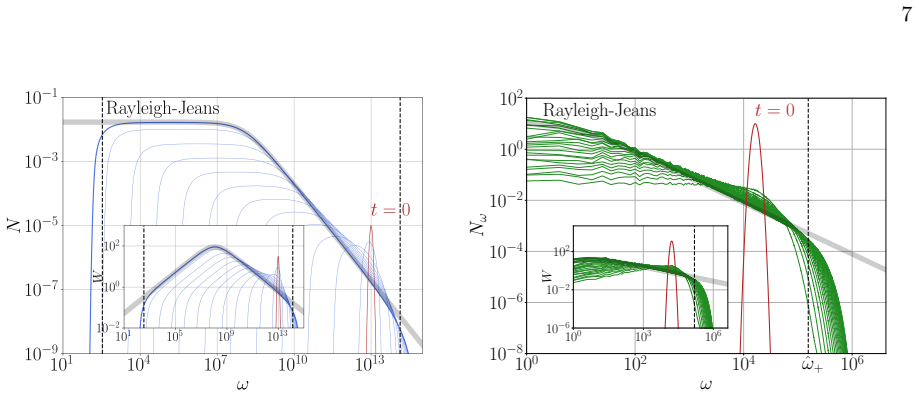
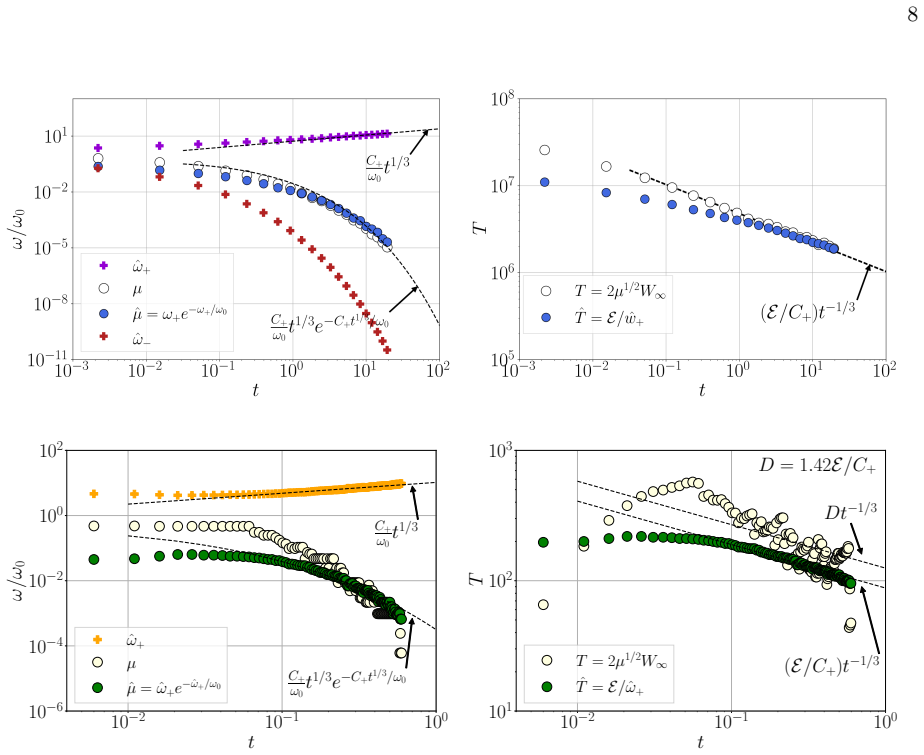
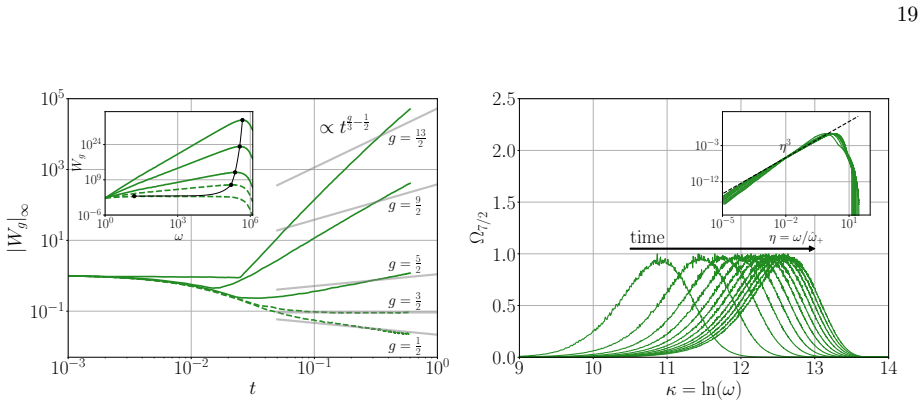
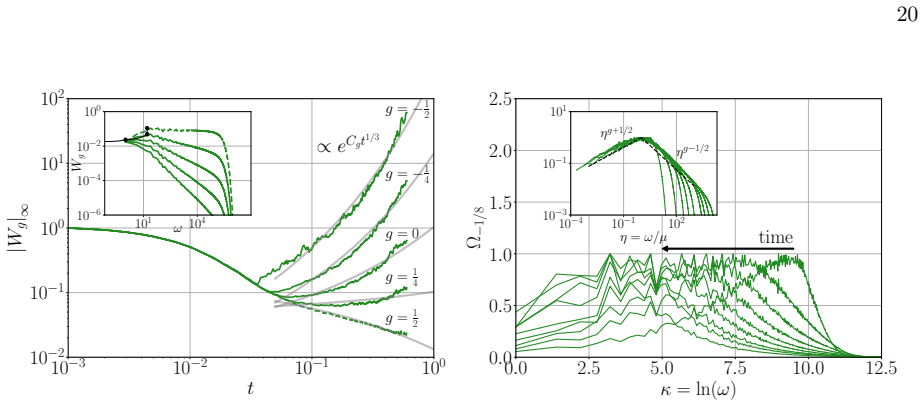
In the defocusing two-dimensional nonlinear Schrödinger model the evolving wave-kinetic spectrum develops a quasi-thermal core and an ultraviolet tail, while the differential approximation model exhibits an additional infrared self-similarity. The self-similar fronts stretch the quasi-thermal region and thereby drive an effective dynamical cooling toward the formal but ill-defined equilibrium state at vanishing temperature, analogous to an ultraviolet catastrophe in a system of classical waves.
What carries the argument
Self-similar fronts that propagate through the wave spectrum by stretching the quasi-thermal core.
If this is right
- The system undergoes partial thermalization before the cooling phase begins.
- Cooling proceeds without external dissipation solely through the stretching action of the fronts.
- The process continuously approaches the zero-temperature state that would otherwise be unreachable by ordinary thermalization.
- The same front-driven stretching may operate in other conservative nonlinear wave systems that support wave-kinetic descriptions.
Where Pith is reading between the lines
- If the mechanism holds, similar dynamical cooling should appear in three-dimensional or higher-dimensional variants once appropriate similarity ranges are identified.
- The ultraviolet tail may saturate or change character once the quasi-thermal core reaches a critical size, offering a testable cutoff in long-time simulations.
- The analogy to the classical ultraviolet catastrophe suggests that the zero-temperature equilibrium remains formally unreachable in an infinite system, which could be probed by monitoring the growth of the infrared self-similar range.
Load-bearing premise
The wave-kinetic equations and differential approximation model capture the full nonlinear Schrödinger dynamics well enough to identify the self-similar ranges and their role in driving cooling.
What would settle it
A direct numerical simulation of the 2D nonlinear Schrödinger equation that shows neither the predicted self-similar fronts nor the associated expansion of the quasi-thermal region would falsify the mechanism.
Figures



read the original abstract
We analyze the dynamics towards partial thermalization and subsequent cooling in the defocusing two-dimensional nonlinear Schr\"odinger model, using direct simulations and insights from the wave-kinetic equations (WKE) and a fourth-order differential approximation model (DAM). We show that the evolving WKE spectrum exhibits two distinct similarity ranges--the quasi-thermal core and the ultraviolet tail--whereas in the DAM, an additional range of infrared self-similarity appears. By stretching the quasi-thermal region, the self-similar fronts drive an effective dynamical cooling process towards the formal but ill-defined equilibrium state at vanishing temperature--analogous to an ultraviolet catastrophe in a system of classical waves.
Editorial analysis
A structured set of objections, weighed in public.
Referee Report
Summary. The manuscript analyzes the dynamics toward partial thermalization and subsequent cooling in the defocusing two-dimensional nonlinear Schrödinger (NLS) model. Using direct numerical simulations together with the wave-kinetic equations (WKE) and a fourth-order differential approximation model (DAM), the authors identify distinct self-similar ranges in the evolving spectrum (quasi-thermal core and ultraviolet tail in the WKE; an additional infrared range in the DAM). They argue that propagation of self-similar fronts stretches the quasi-thermal region, producing an effective dynamical cooling toward the formal zero-temperature equilibrium, analogous to an ultraviolet catastrophe in classical waves.
Significance. If the quantitative correspondence between the reduced models and the full NLS dynamics holds, the work supplies a concrete mechanism for dynamical cooling in nonlinear wave systems and extends wave-turbulence theory by linking front propagation to spectral stretching. The multi-method approach (direct simulations plus WKE and DAM) is a methodological strength.
major comments (2)
- [Abstract and §4] Abstract and §4 (comparison of spectra): the central claim that self-similar fronts drive dynamical cooling requires that the quasi-thermal core and ultraviolet tail identified in the WKE (and the infrared range in the DAM) faithfully reproduce the full NLS spectra and cooling rates. The manuscript presents no quantitative metrics—e.g., fitted power-law exponents, front propagation speeds, or effective-temperature decay rates—with error bars or direct overlay between NLS, WKE, and DAM. Without such overlap, the stretching mechanism and the ultraviolet-catastrophe analogy remain unsupported by the simulations.
- [§3.2] §3.2 (DAM derivation): the fourth-order differential approximation model introduces an additional infrared self-similar range whose role in the cooling process is asserted but not tested against the full NLS evolution. If this range is an artifact of the truncation, the claimed universality of the front-driven cooling mechanism is weakened.
minor comments (2)
- [Figure 5] Figure 5: the spectral plots would benefit from an inset or table explicitly listing the measured similarity exponents and their uncertainties for each range and each model.
- [Notation] Notation: the symbol for the effective temperature is introduced without a clear definition in the main text; a short equation or sentence would remove ambiguity.
Simulated Author's Rebuttal
We thank the referee for the thorough review and valuable feedback on our manuscript. We address each of the major comments in detail below and outline the revisions we will make to strengthen the presentation of our results.
read point-by-point responses
-
Referee: [Abstract and §4] Abstract and §4 (comparison of spectra): the central claim that self-similar fronts drive dynamical cooling requires that the quasi-thermal core and ultraviolet tail identified in the WKE (and the infrared range in the DAM) faithfully reproduce the full NLS spectra and cooling rates. The manuscript presents no quantitative metrics—e.g., fitted power-law exponents, front propagation speeds, or effective-temperature decay rates—with error bars or direct overlay between NLS, WKE, and DAM. Without such overlap, the stretching mechanism and the ultraviolet-catastrophe analogy remain unsupported by the simulations.
Authors: We agree that providing quantitative metrics will better support our claims. In the revised manuscript, we will add fitted power-law exponents with associated uncertainties for the quasi-thermal core and ultraviolet tail in the WKE spectra, as well as for the infrared range in the DAM. We will also extract and report front propagation speeds from the time evolution in all three approaches (NLS, WKE, DAM) and compute effective-temperature decay rates. Direct spectral overlays at selected times will be included in §4, with quantitative measures of agreement such as L2 norms or correlation coefficients where appropriate. These additions will provide a more rigorous validation of the self-similar front propagation and the dynamical cooling mechanism. revision: yes
-
Referee: [§3.2] §3.2 (DAM derivation): the fourth-order differential approximation model introduces an additional infrared self-similar range whose role in the cooling process is asserted but not tested against the full NLS evolution. If this range is an artifact of the truncation, the claimed universality of the front-driven cooling mechanism is weakened.
Authors: The referee correctly identifies that the infrared self-similar range in the DAM has not been directly compared to the full NLS dynamics. The DAM is derived as a differential approximation to the wave-kinetic equation to facilitate analytical progress on the front dynamics. We will revise §3.2 to explicitly state the limitations of the truncation and clarify that the infrared range may be specific to the DAM. Additionally, we will perform and include comparisons of the low-wavenumber spectra between the DAM and the direct NLS simulations to test for the presence of this infrared self-similarity. If it is not observed in the NLS, we will adjust our discussion to emphasize that the primary cooling mechanism via the quasi-thermal core and ultraviolet tail is robust across models, while noting the DAM-specific feature. revision: yes
Circularity Check
No significant circularity detected
full rationale
The paper derives its central claims about self-similar fronts and dynamical cooling from direct numerical simulations of the 2D NLS equation combined with solutions of the wave-kinetic equations and a fourth-order differential approximation model. The quasi-thermal core, ultraviolet tail, and infrared ranges are identified as emergent features in the evolving spectra, with the cooling effect observed as a consequence of front propagation stretching the core region. No load-bearing steps reduce by construction to fitted parameters, self-definitions, or unverified self-citations; the approach remains self-contained against external benchmarks of numerical spectra and established kinetic approximations.
Axiom & Free-Parameter Ledger
Reference graph
Works this paper leans on
-
[1]
Scaling behaviour of the interaction kernelS ω,1 2,3 23
-
[2]
(a) Limitω 1, ω2, ω3 →ω23
-
[3]
(b) Limitω 1 ≪ω 2 ∼ω 3 ∼ω24
-
[4]
(c) Limitω 1, ω2 ≪ω 3 ∼ω24
-
[5]
(d) Limitω≪ω 1, ω2, ω3 25
-
[6]
(e) Limitω 3 ∼ω≪ω 1, ω2 25
-
[7]
Summary on the convergence criterion of the collision integralSt[x]. 26 B. Analysis of the Nonlocal Regions 26
-
[8]
Nonlocality at low frequencies - forω≪ω 1, ω2, ω3 26
-
[9]
ultraviolet catastrophe
Nonlocality at high frequencies 27 I. INTRODUCTION The two-dimensional (2D) nonlinear Schr¨ odinger (NLS) equation is a fundamental partial differ- ential equation in theoretical physics, arising in various physical contexts, from nonlinear optics and water-wave theory to Bose-Einstein condensations. It is an evolution equation for the complex wave functi...
2048
-
[10]
G. I. Barenblatt.Scaling, self-similarity, and intermediate asymptotics: dimensional analysis and intermediate asymptotics. Number 14. Cambridge University Press, 1996
1996
-
[11]
Beale, T
J. Beale, T. Kato, and A. Majda. Remarks on the breakdown of smooth solutions for the 3-D euler equations.Comm. Math. Phys., 94(1):61–66, 1984
1984
-
[12]
N. K. Bell and S. V. Nazarenko. Reflected wave solution of Alfv´ en wave turbulence.Journal of Physics A: Mathematical and Theoretical, 51(40):405501, sep 2018
2018
-
[13]
Bustamante and M
M. Bustamante and M. Brachet. Interplay between the Beale-Kato-Majda theorem and the analyticity- strip method to investigate numerically the incompressible Euler singularity problem.Phys. Rev. E, 22 86(6):066302, 2012
2012
-
[14]
S. M. Cox and P. C. Matthews. Exponential Time Differencing for Stiff Systems.Journal of Compu- tational Physics, 176(2):430–455, March 2002
2002
-
[15]
Dyachenko, A
S. Dyachenko, A. C. Newell, A. Pushkarev, and V. E. Zakharov. Optical turbulence: weak turbulence, condensates and collapsing filaments in the nonlinear Schr¨ odinger equation.Physica D: Nonlinear Phenomena, 57(1–2):96–160, June 1992
1992
-
[16]
Eggers and M
J. Eggers and M. Fontelos. The role of self-similarity in singularities of partial differential equations. Nonlinearity, 22(1):R1, 2008
2008
-
[17]
Giga and Robert V
Y. Giga and Robert V. Kohn. Characterizing blowup using similarity variables.Indiana Univ. Math. Journ., 36(1):1–40, 1987
1987
-
[18]
Gilson, I
J. Gilson, I. Daumont, and T. Dombre. A two-fluid picture of intermittency in shell-models of turbu- lence. InAdvances in Turbulence VII, pages 219–222. Springer, 1998
1998
-
[19]
Kassam and L
A. Kassam and L. Trefethen. Fourth-Order Time-Stepping for Stiff PDEs.SIAM Journal on Scientific Computing, 26(4):1214–1233, January 2005
2005
-
[20]
A. A. Mailybaev. Renormalization and universality of blowup in hydrodynamics flows.Physical Review E, 85(6):066317, 2012
2012
-
[21]
S. V. Nazarenko.Wave Turbulence. Number 825 in Lecture Notes in Physics. Springer Berlin Heidel- berg, 2011
2011
-
[22]
S. V. Nazarenko, V. N. Grebenev, S. B. Medvedev, and S. Galtier. The focusing problem for the Leith model of turbulence: a self-similar solution of the third kind.Journal of Physics A: Mathematical and Theoretical, 52(15):155501, mar 2019
2019
-
[23]
Schubring, V
D. Schubring, V. Rosenhaus, and S. Thalabard. Blowup driven by critical balance in a differential kinetic model of gravity wave turbulence.Phys. D: Nonlin. Phenom., page 135217, 2026
2026
-
[24]
Semisalov, V.N
B.V. Semisalov, V.N. Grebenev, S.B. Medvedev, and S.V. Nazarenko. Numerical analysis of a self- similar turbulent flow in Bose–Einstein condensates.Communications in Nonlinear Science and Nu- merical Simulation, 102:105903, 2021
2021
-
[25]
Thalabard, S
S. Thalabard, S. Medvedev, V. Grebenev, and S. Nazarenko. Inverse cascade anomalies in fourth-order Leith models.Journal of Physics A: Mathematical and Theoretical, 55(1):015702, 2021
2021
-
[26]
V. E. Zakharov, V. S. L’vov, and G. Falkovich.Kolmogorov Spectra of Turbulence I - Wave Turbulence. Springer Series in Nonlinear Dynamics. Springer Berlin Heidelberg, 1992
1992
-
[27]
Y. Zhu, B. Semisalov, G. Krstulovic, and S. Nazarenko. Self-similar evolution of wave turbulence in Gross-Pitaevskii system.Physical Review E, 108(6):064207, 2023. Appendix A: Collision integral convergence In this appendix, we will study the convergence of the collision integral in the frequency repre- sentation of the kinetic wave equation (2). Consider...
2023
-
[28]
Scaling behaviour of the interaction kernelS ω,1 2,3 First of all, let us recall the explicit expression for the interaction kernel as found in [6]. It reads Sω2,ω3 ω,ω1 =S(ω, ω 1, ω2, ω3) =S 1K(q) (A2) whereS 1 = 4/π(√ωω1 + √ω2ω3) andK(q) is the complete elliptic integral of the first-kind with elliptic modulusq= 2 4√ωω1ω2ω3/(√ωω1+√ω2ω3) [6]. We can chec...
-
[29]
In this limit, we observe thatq→1 andS ω,1 2,3 will have a logarithmic singularity
(a) Limitω 1, ω2, ω3 →ω Consider the limitω 1, ω2, ω3 →ω, which does not contradict the Dirac delta function of frequencies leading to the resonance conditionω+ω 1 =ω 2 +ω 3. In this limit, we observe thatq→1 andS ω,1 2,3 will have a logarithmic singularity. By applying the resonance condition,St[x] becomes St[x] =C 3 Z Sω,1 2,ω+1−2 [ωω1ω2(ω+ω 1 −ω 2)]−x ...
-
[30]
(A3) in the limit ofω 1 →0, whileω 2, ω3 ∼ω∼1
(b) Limitω 1 ≪ω 2 ∼ω 3 ∼ω Considering Eq. (A3) in the limit ofω 1 →0, whileω 2, ω3 ∼ω∼1. With this assumptionq∝ω 1/4 1 which implies thatq 2 ≪1, and henceK(q)→π/2, andS ω,1 2,ω+1−2 ∝1. In addition, we find that [ωω 1ω2(ω+ω 1 −ω 2)]−x ∝ω −x 1 , while the second squared bracket term in Eq. (A3) yields at leading order ωx +ω x 1 −ω x 2 −(ω+ω 1 −ω 2)x ∝ ...
-
[31]
Analysing the behaviour ofq, we find thatq <1 and thereforeK(q)<∞
(c) Limitω 1, ω2 ≪ω 3 ∼ω Taking into account the limitω 1, ω2 ≪1, andω 3 ∼ω∼1, consider the polar coordinate decom- positionω 1 =rcos(θ) andω 2 =rsin(θ). Analysing the behaviour ofq, we find thatq <1 and thereforeK(q)<∞. Consequently, we findS ω,1 2,ω+1−2 ∝r −1/2. The first square bracket in (A3) 25 leads to [ωω 1ω2(ω+ω 1 −ω 2)]−x ∝r −2x, while the second...
-
[32]
We use polar coordinatesω 1 =rcos(θ) andω 2 =rsin(θ) and considerθ̸=π/4
(d) Limitω≪ω 1, ω2, ω3 Consider three frequencies 1≪ω 1, ω2, ω3, whileω∼1. We use polar coordinatesω 1 =rcos(θ) andω 2 =rsin(θ) and considerθ̸=π/4. The latter condition leads to largeω 3 =ω+ω 1 −ω 2 asr→ ∞. Subsequently, we find thatq∝r −1/4 asr→ ∞, which impliesq≪1, andK(q)→ π/2. Consequently, we findS ω,1 2,ω+1−2 ∝r −1. The first square bracket term in ...
-
[33]
(e) Limitω 3 ∼ω≪ω 1, ω2 Considering two large frequencies 1≪ω 1, ω2, whileω 3 ∼ω∼1, we study a special case of subsection (d) whereθ→π/4. In such a situation, we observe thatq→1 meaning thatS ω,1 2,ω+1−2 contains a logarithmic singularity, but is regularised by the scaling ofS 1, leading toS ω,1 2,ω+1−2 ∝ r−1/2 The first square bracket term in (A3) leads ...
-
[34]
To summarise subsections (a)-(e), we display the convergence criteria in Fig
Summary on the convergence criterion of the collision integralSt[x]. To summarise subsections (a)-(e), we display the convergence criteria in Fig. 10 using green for convergent and red of divergent. Consequently, we find that the collision integral is convergent for 1/2< x≤1. Convergence Region (a)ω1, ω2, ω3 →ω (b)ω1 ≪ω2 ∼ω3 ∼ω (c)ω1, ω2 ≪ω3 ∼ω (d)ω≪ω 1 ∼...
-
[35]
Consequently, the low-frequency power-law behaviour approaches a constant
Nonlocality at low frequencies - forω≪ω 1, ω2, ω3 The system evolves toward a state close to the Rayleigh–Jeans distribution at low frequencies, as discussed in the main text. Consequently, the low-frequency power-law behaviour approaches a constant. According to Appendix A, case (e), this implies nonlocal behaviour; that is, the spectral evolution at low...
-
[36]
Nonlocality at high frequencies At high frequencies, we have a nonlocality of the collision integral occuring for case (b) in Appendix A for a spectrum steeper thanN ω ∝1/ω. In this case we should consider dominance of contributions to the collision integral from the nonlocal interactions with the IR end, i.e., where one frequencyω 1 ≪ωandω 2, ω3 ∼ω(and s...
discussion (0)
Sign in with ORCID, Apple, or X to comment. Anyone can read and Pith papers without signing in.