Recognition: unknown
Scalable GPU Construction of 3D Voronoi and Power Diagrams
Pith reviewed 2026-05-08 03:10 UTC · model grok-4.3
The pith
A GPU algorithm builds large 3D Voronoi and power diagrams by clipping cell volumes against candidate planes using directional bounds for neighbor search.
A machine-rendered reading of the paper's core claim, the machinery that carries it, and where it could break.
Core claim
We present a highly parallelizable GPU algorithm for the fast construction of large-scale 3D Voronoi and power diagrams. Our approach constructs each convex cell from a weighted 3D point by progressively clipping an initial cell volume against bisecting planes induced by candidate neighboring points. To efficiently identify candidate neighbors under arbitrary spatial distributions, we introduce a culling criterion based on directional geometric bounds of the evolving cell, combined with a hierarchical best-first traversal of bounding volumes. We achieve performance on par with state-of-the-art Delaunay tetrahedralization methods on small and moderate problem sizes, while exhibiting robust a
What carries the argument
Directional geometric bounds culling criterion combined with hierarchical best-first traversal of bounding volumes, which prunes candidate neighbors during progressive cell clipping.
Load-bearing premise
The directional bounds will correctly keep every true neighbor while discarding most irrelevant points for arbitrary point distributions and weight assignments.
What would settle it
A run on a point set containing tight clusters and large weight differences that produces a cell whose boundary differs from the boundary obtained by exhaustive neighbor search on the same set.
Figures




read the original abstract
Voronoi diagrams, and their more general weighted counterpart, power diagrams, are fundamental geometric constructs with wide-ranging applications. Recently, they have gained renewed attention in mesh-based neural rendering. Despite being extensively studied, the construction of 3D Voronoi diagrams for large-scale point sets remains computationally expensive, limiting their adoption in large-scale applications. Existing CPU-based approaches typically rely on computing its dual, the Delaunay tetrahedralization, but are prohibitively slow for large diagrams, while GPU-based methods either struggle to scale efficiently to large point sets or assume homogeneous point distributions. The weighted case, power diagrams, is even less explored in this context. Existing approaches are typically tailored to the application at hand, assuming homogeneous point distributions and small weight variations, making them unsuitable for general use in more complex heterogeneous data. In this paper, we present a highly parallelizable GPU algorithm for the fast construction of large-scale 3D Voronoi and power diagrams. Our approach constructs each convex cell from a weighted 3D point by progressively clipping an initial cell volume against bisecting planes induced by candidate neighboring points. To efficiently identify candidate neighbors under arbitrary spatial distributions, we introduce a culling criterion based on directional geometric bounds of the evolving cell, combined with a hierarchical best-first traversal of bounding volumes. We achieve performance on par with state-of-the-art Delaunay tetrahedralization methods on small and moderate problem sizes, while exhibiting robust scalability to large point sets and diverse spatial distributions. Moreover, our method naturally generalizes to power diagrams without additional assumptions. See https://research.zenseact.com/publications/paragram .
Editorial analysis
A structured set of objections, weighed in public.
Referee Report
Summary. The paper introduces a GPU-parallel algorithm for constructing large-scale 3D Voronoi and power diagrams. Each cell is built by clipping an initial volume against bisecting planes from candidate neighbors, identified using directional geometric bounds and hierarchical best-first traversal of bounding volumes. The authors claim this achieves performance comparable to state-of-the-art Delaunay tetrahedralization methods for small and moderate sizes, scales robustly to large point sets with diverse distributions, and generalizes naturally to power diagrams without extra assumptions.
Significance. If validated, the method could enable efficient large-scale diagram construction on GPUs for applications such as mesh-based neural rendering, addressing limitations of CPU Delaunay approaches and prior GPU methods that assume homogeneous distributions. The parallel clipping strategy and handling of arbitrary weights represent a potentially useful advance over tailored existing techniques.
major comments (2)
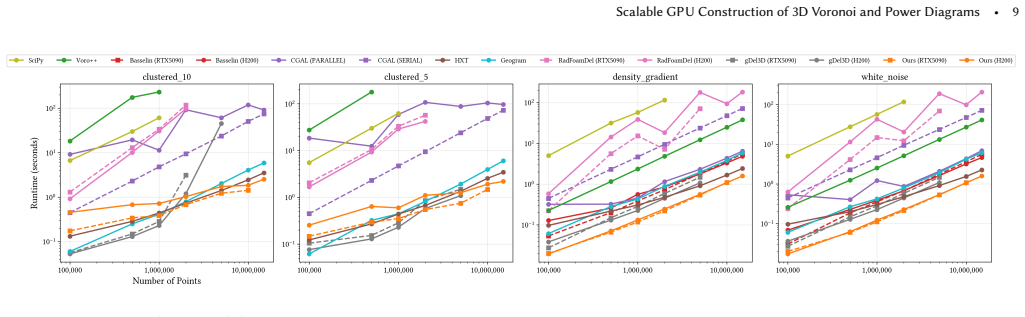
- [Abstract and experimental results] Abstract and results claims: The abstract states performance parity with SOTA Delaunay tetrahedralization methods and robust scalability, yet the manuscript supplies no quantitative benchmarks, timing tables, error analysis, or direct comparison details to support these assertions, leaving the central performance claims unsubstantiated.
- [Culling criterion and traversal description] Culling criterion for neighbor identification: The directional geometric bounds combined with hierarchical traversal are claimed to correctly identify all relevant neighbors for both unweighted and weighted (power) cases. No derivation, invariant, or argument is provided demonstrating that the bounds remain conservative when arbitrary weight differences translate the bisecting planes, which is required to guarantee that no true neighbor is excluded during cell clipping.
minor comments (1)
- [Abstract] The project URL is referenced but the manuscript lacks an explicit statement on code or data availability for reproducibility.
Simulated Author's Rebuttal
We thank the referee for the detailed and constructive review. We address each major comment below and have revised the manuscript to incorporate the suggested improvements.
read point-by-point responses
-
Referee: [Abstract and experimental results] Abstract and results claims: The abstract states performance parity with SOTA Delaunay tetrahedralization methods and robust scalability, yet the manuscript supplies no quantitative benchmarks, timing tables, error analysis, or direct comparison details to support these assertions, leaving the central performance claims unsubstantiated.
Authors: We agree that the performance claims would be strengthened by explicit quantitative support. In the revised manuscript we have expanded the experimental evaluation with timing tables comparing against state-of-the-art Delaunay tetrahedralization codes (CGAL, TetGen) across small-to-moderate and large point sets, scalability plots for diverse distributions, and error metrics confirming diagram correctness. These additions directly substantiate the abstract statements. revision: yes
-
Referee: [Culling criterion and traversal description] Culling criterion for neighbor identification: The directional geometric bounds combined with hierarchical traversal are claimed to correctly identify all relevant neighbors for both unweighted and weighted (power) cases. No derivation, invariant, or argument is provided demonstrating that the bounds remain conservative when arbitrary weight differences translate the bisecting planes, which is required to guarantee that no true neighbor is excluded during cell clipping.
Authors: The referee correctly notes the absence of a formal argument. While the directional culling criterion is described in Section 3, we did not supply an explicit proof of conservativeness under arbitrary weights. The revised manuscript adds a dedicated subsection deriving the invariant: the directional bounds are computed from the current cell extent and the maximum possible plane translation induced by any weight difference, ensuring that any true neighbor whose bisecting plane could intersect the cell is retained. This argument holds for both unweighted and weighted cases without additional assumptions. revision: yes
Circularity Check
No significant circularity; algorithmic description is self-contained
full rationale
The paper presents a GPU algorithm that builds each cell by successive clipping against bisecting planes, with candidate neighbors identified via directional geometric bounds and hierarchical best-first traversal of bounding volumes. This chain is described directly in terms of geometric operations without reducing any claimed result to a fitted parameter, self-citation, or input by construction. No equations or steps equate a derived quantity to its own definition, and the generalization to power diagrams is asserted as following from the same clipping procedure without additional fitted assumptions or renamed empirical patterns. The core derivation therefore remains independent of the enumerated circularity patterns.
Axiom & Free-Parameter Ledger
axioms (2)
- standard math Voronoi cells are convex polyhedra whose boundaries are defined by perpendicular bisecting planes between neighboring points.
- standard math Power diagrams generalize Voronoi diagrams via weighted distances and remain convex.
Reference graph
Works this paper leans on
-
[1]
Bowyer, A. , title =. The Computer Journal , volume =. 1981 , month =. doi:10.1093/comjnl/24.2.162 , url =
-
[2]
Watson, D. F. , title =. The Computer Journal , volume =. 1981 , month =. doi:10.1093/comjnl/24.2.167 , url =
-
[3]
SIAM journal on computing , volume=
Power diagrams: properties, algorithms and applications , author=. SIAM journal on computing , volume=. 1987 , publisher=
1987
-
[4]
The Quickhull Algorithm for Convex Hulls,
Barber, C. Bradford and Dobkin, David P. and Huhdanpaa, Hannu , title =. 1996 , issue_date =. doi:10.1145/235815.235821 , journal =
-
[5]
VORO++: A three-dimensional Voronoi cell library in C++ , author=
-
[6]
International Journal for Numerical Methods in Engineering , volume =
Chrisochoides, Nikos and Nave, Démian , title =. International Journal for Numerical Methods in Engineering , volume =. doi:https://doi.org/10.1002/nme.765 , url =. https://onlinelibrary.wiley.com/doi/pdf/10.1002/nme.765 , year =
-
[7]
Computer Physics Communications , volume=
An extension to Voro++ for multithreaded computation of Voronoi cells , author=. Computer Physics Communications , volume=. 2023 , publisher=
2023
-
[8]
Meshless voronoi on the GPU , year =
Ray, Nicolas and Sokolov, Dmitry and Lefebvre, Sylvain and L\'. Meshless voronoi on the GPU , year =. doi:10.1145/3272127.3275092 , journal =
-
[9]
Proceedings of the 21st international meshing roundtable , pages =
Variational anisotropic surface meshing with Voronoi parallel linear enumeration , author =. Proceedings of the 21st international meshing roundtable , pages =. 2013 , publisher =
2013
-
[10]
Computer Graphics Forum , volume =
Restricting Voronoi diagrams to meshes using corner validation , author =. Computer Graphics Forum , volume =. 2017 , organization =
2017
-
[11]
International Journal for Numerical Methods in Engineering , volume =
One machine, one minute, three billion tetrahedra , author =. International Journal for Numerical Methods in Engineering , volume =. 2019 , publisher =
2019
-
[12]
Computer Graphics Forum , volume =
Fast BVH construction on GPUs , author =. Computer Graphics Forum , volume =. 2009 , organization =
2009
-
[13]
Proceedings of the IEEE/CVF International Conference on Computer Vision (ICCV) , month =
Govindarajan, Shrisudhan and Rebain, Daniel and Yi, Kwang Moo and Tagliasacchi, Andrea , title =. Proceedings of the IEEE/CVF International Conference on Computer Vision (ICCV) , month =. 2025 , pages =
2025
-
[14]
2025 , eprint=
Radiance Meshes for Volumetric Reconstruction , author=. 2025 , eprint=
2025
-
[15]
Proceedings of the IEEE/CVF conference on computer vision and pattern recognition , pages=
Mip-nerf 360: Unbounded anti-aliased neural radiance fields , author=. Proceedings of the IEEE/CVF conference on computer vision and pattern recognition , pages=
-
[16]
Proceedings of the 18th meeting of the ACM SIGGRAPH Symposium on Interactive 3D Graphics and Games , pages=
A GPU accelerated algorithm for 3D Delaunay triangulation , author=. Proceedings of the 18th meeting of the ACM SIGGRAPH Symposium on Interactive 3D Graphics and Games , pages=
-
[17]
Computer Graphics Forum , title =
Basselin, Justine and Alonso, Laurent and Ray, Nicolas and Sokolov, Dmitry and Lefebvre, Sylvain and Lévy, Bruno , year =. Computer Graphics Forum , title =
-
[18]
and Haberland, Matt and Reddy, Tyler and Cournapeau, David and Burovski, Evgeni and Peterson, Pearu and Weckesser, Warren and Bright, Jonathan and
Virtanen, Pauli and Gommers, Ralf and Oliphant, Travis E. and Haberland, Matt and Reddy, Tyler and Cournapeau, David and Burovski, Evgeni and Peterson, Pearu and Weckesser, Warren and Bright, Jonathan and. Nature Methods , year =
-
[19]
and Shechtman, Eli and Wang, Oliver , title =
Zhang, Richard and Isola, Phillip and Efros, Alexei A. and Shechtman, Eli and Wang, Oliver , title =. Proceedings of the IEEE Conference on Computer Vision and Pattern Recognition (CVPR) , month =
-
[20]
2021 , publisher=
Mildenhall, Ben and Srinivasan, Pratul P and Tancik, Matthew and Barron, Jonathan T and Ramamoorthi, Ravi and Ng, Ren , journal=. 2021 , publisher=
2021
-
[21]
ACM Transactions on Graphics , number =
Kerbl, Bernhard and Kopanas, Georgios and Leimk. ACM Transactions on Graphics , number =. 2023 , url =
2023
-
[22]
arXiv preprint arXiv:2106.10689 , year=
Neus: Learning neural implicit surfaces by volume rendering for multi-view reconstruction , author=. arXiv preprint arXiv:2106.10689 , year=
-
[23]
Advances in neural information processing systems , volume=
Volume rendering of neural implicit surfaces , author=. Advances in neural information processing systems , volume=
-
[24]
ACM SIGGRAPH 2023 conference proceedings , pages=
Bakedsdf: Meshing neural sdfs for real-time view synthesis , author=. ACM SIGGRAPH 2023 conference proceedings , pages=
2023
-
[25]
Proceedings of the Asian Conference on Computer Vision , pages=
Meshgs: Adaptive mesh-aligned gaussian splatting for high-quality rendering , author=. Proceedings of the Asian Conference on Computer Vision , pages=
-
[26]
ACM Transactions on Graphics (TOG) , volume=
Real-time large-scale deformation of gaussian splatting , author=. ACM Transactions on Graphics (TOG) , volume=. 2024 , publisher=
2024
-
[27]
ACM Transactions on Graphics (ToG) , volume=
Gaussian opacity fields: Efficient adaptive surface reconstruction in unbounded scenes , author=. ACM Transactions on Graphics (ToG) , volume=. 2024 , publisher=
2024
-
[28]
arXiv preprint arXiv:2405.06945 , year=
Direct learning of mesh and appearance via 3d gaussian splatting , author=. arXiv preprint arXiv:2405.06945 , year=
-
[29]
ACM computing surveys (CSUR) , volume=
Voronoi diagrams—a survey of a fundamental geometric data structure , author=. ACM computing surveys (CSUR) , volume=. 1991 , publisher=
1991
-
[30]
ACM SIGGRAPH 2010 papers , pages=
Matching fluid simulation elements to surface geometry and topology , author=. ACM SIGGRAPH 2010 papers , pages=
2010
-
[31]
Computational geometry , volume=
Delaunay refinement algorithms for triangular mesh generation , author=. Computational geometry , volume=. 2002 , publisher=
2002
-
[32]
GitHub repository , howpublished =
Nanjappa, Ashwin , title =. GitHub repository , howpublished =. 2026 , publisher =
2026
-
[33]
GitHub repository , howpublished =
Govindarajan, Shrisudhan and Rebain, Daniel , title =. GitHub repository , howpublished =. 2026 , publisher =
2026
-
[34]
Structure-from-Motion Revisited , booktitle=
Sch\". Structure-from-Motion Revisited , booktitle=
-
[35]
arXiv preprint arXiv:2008.08508 , year=
Quality tetrahedral mesh generation with HXT , author=. arXiv preprint arXiv:2008.08508 , year=
-
[36]
2025 , howpublished =
Lévy, Bruno , title =. 2025 , howpublished =
2025
-
[37]
ACM Transactions on Graphics (ToG) , volume=
Deep blending for free-viewpoint image-based rendering , author=. ACM Transactions on Graphics (ToG) , volume=. 2018 , publisher=
2018
discussion (0)
Sign in with ORCID, Apple, or X to comment. Anyone can read and Pith papers without signing in.