Recognition: unknown
Residual-Corrected Equivalent-Circuit Model with Universal Differential Equations for Robust Battery Voltage Prediction under Operating-Condition Shift
Pith reviewed 2026-05-08 06:31 UTC · model grok-4.3
The pith
A warm-started Thevenin circuit model corrected by a compact neural universal differential equation predicts battery voltage more accurately and robustly than either pure circuit or LSTM models when operating conditions shift.
A machine-rendered reading of the paper's core claim, the machinery that carries it, and where it could break.
Core claim
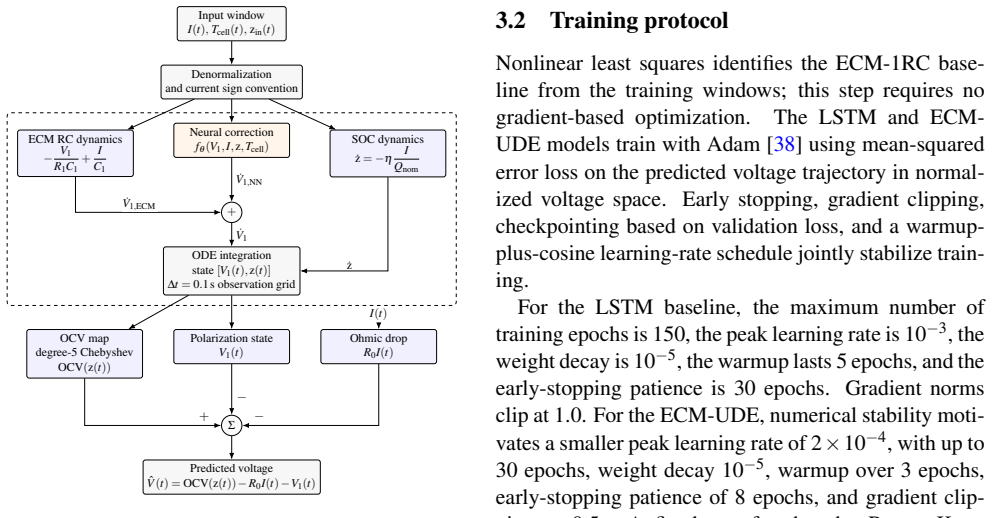
The residual-corrected ECMUDE consists of a first-order Thevenin equivalent-circuit model that supplies the dominant terminal-voltage structure together with a compact neural network embedded as a universal differential equation that corrects only the latent polarization mismatch; after nonlinear-least-squares warm-start of the circuit parameters the hybrid achieves the lowest mean absolute voltage error in every tested regime on the public Panasonic 18650PF dataset, reduces MAE by 48 percent relative to LSTM under matched conditions, shows an order-of-magnitude lower inter-seed coefficient of variation, and retains substantial gains under zero-shot temperature transfer to -20 C and zeroShot
What carries the argument
The residual-corrected hybrid formulation in which the first-order Thevenin ECM supplies the dominant voltage structure and a compact neural network embedded as a universal differential equation corrects only the latent polarization mismatch after warm-starting with nonlinear least-squares parameters.
If this is right
- The hybrid model supplies more accurate terminal-voltage forecasts for model-based battery management under transient loads.
- Performance advantages persist when the supplied state-of-charge input is perturbed or when temperature and drive cycle differ from training data.
- The physical base model anchors predictions where purely learned models degrade, yielding lower variability across random seeds.
- The approach remains lightweight and retains interpretability of the underlying circuit equations while adding targeted expressiveness.
Where Pith is reading between the lines
- The same residual-correction pattern could be applied to other partially accurate physical models in electrochemistry or fluid systems where only a few unmodeled effects need data-driven fixes.
- Because the neural component operates in a low-residual regime after warm-start, simpler base models might suffice for a wider range of applications without increasing real-time compute.
- Extending the evaluation to cells with different aging states or to online parameter adaptation would test whether the robustness gains survive gradual drift.
Load-bearing premise
Embedding the neural network as a universal differential equation correction on top of the warm-started ECM parameters will address only latent polarization mismatch without introducing instability, overfitting, or loss of robustness when operating conditions shift.
What would settle it
A new test condition (different temperature, drive cycle, or cell chemistry) in which the hybrid model's integrated voltage prediction error exceeds the LSTM error or the numerical integration becomes unstable.
Figures




read the original abstract
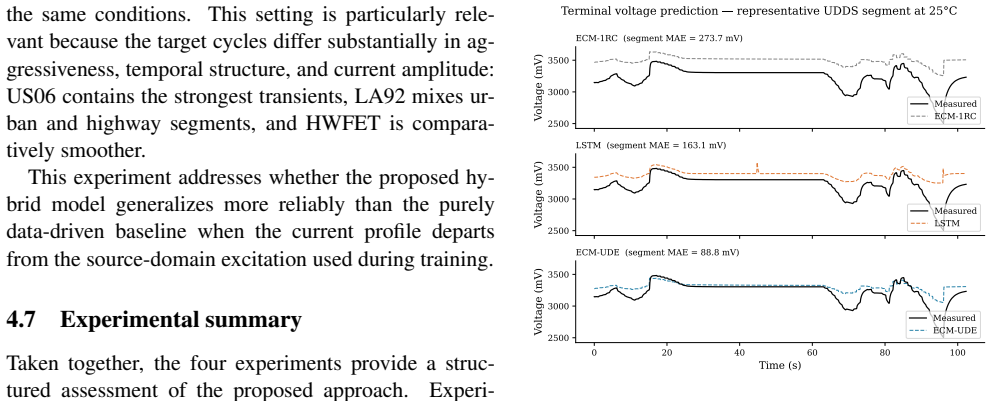
Accurate terminal-voltage prediction underpins model-based battery management, yet low-order equivalent-circuit models (\ecm{}) lack expressiveness under transient conditions, whereas purely data-driven predictors sacrifice interpretability and may degrade under operating-condition shift. This paper introduces a residual-corrected hybrid formulation in which a first-order Thevenin \ecm{} (\ecmrc{}) provides the dominant voltage structure, and a compact neural network embedded as a universal differential equation (\ude{}) corrects only the latent polarization mismatch. The \ecmrc{} parameters identified by nonlinear least squares warm-start the hybrid model so that the learned component operates in a low-residual regime. Experiments on a public Panasonic 18650PF dataset compare the proposed \ecmude{} with standalone \ecmrc{} and Long Short-Term Memory (\lstm{}) baselines across four axes: matched-condition prediction on UDDS at \SI{25}{\celsius}, inference-time perturbation of the supplied state-of-charge (\SOC{}, denoted $z$) input, zero-shot temperature transfer (\SI{25}{\celsius} to \SI{-20}{\celsius}), and zero-shot drive-cycle transfer to US06, LA92, and HWFET. The proposed \ecmude{} achieves the lowest voltage error in every setting, reducing mean absolute error (\mae{}) by 48\% relative to the \lstm{} under matched conditions and showing an order-of-magnitude lower inter-seed variability (coefficient of variation: 0.44\% vs.\ 6.20\%). Substantial gains persist under challenging distribution shifts, indicating that the physical model anchors prediction where a purely learned model is most vulnerable. These results position residual-corrected \ecmude{} as a lightweight and interpretable enhancement of low-order circuit models for voltage prediction in battery management systems (\bms{}).
Editorial analysis
A structured set of objections, weighed in public.
Referee Report
Summary. The paper claims that a hybrid residual-corrected equivalent-circuit model (ECMUDE) — a first-order Thevenin ECM whose parameters are NLS-fitted once for warm-starting, augmented by a compact neural network embedded as a universal differential equation that corrects only latent polarization dynamics — yields lower voltage prediction error and far lower inter-seed variability than either the standalone ECM or an LSTM baseline. Experiments on the public Panasonic 18650PF dataset demonstrate these gains across matched UDDS conditions at 25 °C, SOC-input perturbations, zero-shot temperature transfer to −20 °C, and zero-shot drive-cycle transfers to US06/LA92/HWFET, with a reported 48 % MAE reduction versus LSTM under matched conditions and an order-of-magnitude drop in coefficient of variation (0.44 % vs. 6.20 %).
Significance. If the hybrid formulation indeed anchors predictions under distribution shift without introducing instability or spurious dynamics, the work supplies a lightweight, partially interpretable route to improve low-order physical models for battery-management voltage prediction. The combination of a frozen physical warm-start with a low-residual neural correction is a concrete, reproducible design pattern that could be adopted in BMS applications where pure data-driven models are brittle.
major comments (2)
- [Model formulation and experimental results on distribution shifts] The central robustness claim under zero-shot temperature and drive-cycle shifts (abstract and experimental results) rests on the unverified assumption that the learned UDE vector field compensates polarization mismatch without altering closed-loop stability or boundedness. No Lipschitz bound, eigenvalue analysis of the augmented ODE, or long-horizon integration test under the shifted conditions is reported; the reported MAE and CV figures alone do not rule out short-horizon fitting or instability that would appear only under sustained operation.
- [Experiments and results] Quantitative performance numbers (48 % MAE reduction, 0.44 % CV) are presented without error-bar analysis, full training hyper-parameters, data-split details, or released code. This prevents verification that the low inter-seed variability and gains under shift are not artifacts of post-hoc choices, seed-specific initialization, or selective reporting, directly undermining the reproducibility of the headline comparison with LSTM.
minor comments (2)
- [Model description] Notation for the ECM parameters and the UDE correction term should be introduced with explicit equations rather than relying on the abstract's shorthand; readers cannot reconstruct the exact residual-correction ODE from the current description.
- [Results presentation] The four test axes are clearly motivated, but the manuscript would benefit from a single consolidated table that reports MAE, RMSE, and CV for all methods and all conditions side-by-side.
Simulated Author's Rebuttal
Thank you for your thorough review and constructive feedback on our manuscript. We address the major comments point by point below, proposing revisions to enhance the paper's rigor and reproducibility.
read point-by-point responses
-
Referee: [Model formulation and experimental results on distribution shifts] The central robustness claim under zero-shot temperature and drive-cycle shifts (abstract and experimental results) rests on the unverified assumption that the learned UDE vector field compensates polarization mismatch without altering closed-loop stability or boundedness. No Lipschitz bound, eigenvalue analysis of the augmented ODE, or long-horizon integration test under the shifted conditions is reported; the reported MAE and CV figures alone do not rule out short-horizon fitting or instability that would appear only under sustained operation.
Authors: We thank the referee for highlighting this important aspect of the robustness claim. The manuscript presents empirical evidence of stable performance across the tested distribution shifts, with the hybrid model maintaining low error over the full duration of the shifted drive cycles without observed divergence. The residual-correction approach, combined with the physical ECM warm-start, is designed to keep the neural component in a low-magnitude regime, reducing the risk of introducing unstable dynamics. However, we agree that formal analysis would provide additional assurance. In the revised manuscript, we will include a new subsection discussing the stability implications, provide numerical estimates of the Lipschitz constant for the learned vector field on the test data, and extend the long-horizon integration tests under shifted conditions to further validate boundedness. We believe this addresses the concern without requiring a full theoretical proof, which may be beyond the scope for this application-focused work. revision: partial
-
Referee: [Experiments and results] Quantitative performance numbers (48 % MAE reduction, 0.44 % CV) are presented without error-bar analysis, full training hyper-parameters, data-split details, or released code. This prevents verification that the low inter-seed variability and gains under shift are not artifacts of post-hoc choices, seed-specific initialization, or selective reporting, directly undermining the reproducibility of the headline comparison with LSTM.
Authors: We fully agree that the current presentation lacks sufficient details for reproducibility. The reported figures are averages over multiple training runs, but standard deviations and full experimental protocols were omitted. In the revised manuscript, we will add error bars (mean ± std) for all MAE and CV metrics across seeds, include a comprehensive table or appendix with all training hyperparameters (learning rates, network architecture, optimization settings, etc.), explicitly describe the data splitting procedure (including how the Panasonic dataset was partitioned for training, validation, and the various test conditions), and commit to releasing the complete source code and trained models upon acceptance. This will allow independent verification of the results and the low variability observed. revision: yes
Circularity Check
No significant circularity; hybrid model uses standard NLS warm-start followed by residual training and held-out evaluation.
full rationale
The derivation proceeds from a first-order Thevenin ECM whose parameters are obtained once via nonlinear least squares on training data to warm-start, after which a compact NN is trained as a UDE correction on the resulting residuals. All reported MAE, variability, and robustness metrics are computed on separate held-out or zero-shot shifted test conditions (temperature and drive-cycle transfers), not on quantities defined by the fitting process itself. No self-definitional equations, fitted inputs renamed as predictions, or load-bearing self-citations appear in the provided text. The chain is externally benchmarked against LSTM and standalone ECM baselines on public data.
Axiom & Free-Parameter Ledger
free parameters (2)
- ECM parameters
- Neural network weights and biases
axioms (2)
- domain assumption Nonlinear least squares yields suitable initial ECM parameters for subsequent hybrid training
- standard math Universal differential equations provide a stable embedding for the neural correction
Reference graph
Works this paper leans on
-
[1]
Plett.Battery Management Systems, Volume I: Battery Modeling
Gregory L. Plett.Battery Management Systems, Volume I: Battery Modeling. Artech House, Nor- wood, MA, USA, 2015
2015
-
[2]
Plett.Battery Management Systems, Volume II: Equivalent-Circuit Methods
Gregory L. Plett.Battery Management Systems, Volume II: Equivalent-Circuit Methods. Artech House, Norwood, MA, USA, 2016
2016
-
[3]
Machine learning applied to elec- trified vehicle battery state of charge and state of health estimation: State-of-the-art.IEEE Access, 8:52796–52814, 2020
Carlos Vidal, Pawel Malysz, Phillip Kollmeyer, and Ali Emadi. Machine learning applied to elec- trified vehicle battery state of charge and state of health estimation: State-of-the-art.IEEE Access, 8:52796–52814, 2020
2020
-
[4]
Towards a smarter battery management system for electric vehicle ap- plications: A critical review of lithium-ion battery state of charge estimation.Energies, 12(3):446, 2019
Muhammad Umair Ali, Amad Zafar, Sarvar Hus- sain Nengroo, Sadam Hussain, Muhammad Ju- naid Alvi, and Hee-Je Kim. Towards a smarter battery management system for electric vehicle ap- plications: A critical review of lithium-ion battery state of charge estimation.Energies, 12(3):446, 2019
2019
-
[5]
M. S. Hossain Lipu, M. A. Hannan, Aini Hussain, Afida Ayob, Mohamad H. M. Saad, Tahia Fahrin Karim, and Dickson N. T. How. Data-driven state of charge estimation of lithium-ion batteries: Al- gorithms, implementation factors, limitations and future trends.Journal of Cleaner Production, 277:124110, 2020
2020
-
[6]
On state-of-charge determination for lithium-ion batteries.Journal of Power Sources, 348:281–301, 2017
Zhe Li, Jun Huang, Bor Yann Liaw, and Jianbo Zhang. On state-of-charge determination for lithium-ion batteries.Journal of Power Sources, 348:281–301, 2017
2017
-
[7]
A multiscale framework with extended kalman filter for lithium-ion battery soc and capacity estimation
Chao Hu, Byeng D Youn, and Jaesik Chung. A multiscale framework with extended kalman filter for lithium-ion battery soc and capacity estimation. Applied Energy, 92:694–704, 2012
2012
-
[8]
Improved extended kalman filter for state of charge estimation of battery pack.Journal of Power Sources, 255:368–376, 2014
Saeed Sepasi, Reza Ghorbani, and Bor Yann Liaw. Improved extended kalman filter for state of charge estimation of battery pack.Journal of Power Sources, 255:368–376, 2014
2014
-
[9]
A practical methodology for real-time adjustment of kalman filter process noise for lithium battery state-of-charge estimation.Batteries, 10(7):233, 2024
Cynthia Thamires da Silva, Bruno Martin de Al- cântara Dias, Rui Esteves Araújo, Eduardo Loren- zetti Pellini, and Armando Antônio Maria Laganá. A practical methodology for real-time adjustment of kalman filter process noise for lithium battery state-of-charge estimation.Batteries, 10(7):233, 2024
2024
-
[10]
High fidelity electrical model with thermal dependence for characterization and simulation of high power lithium battery cells
Tarun Huria, Massimo Ceraolo, Javier Gazzarri, and Robyn Jackey. High fidelity electrical model with thermal dependence for characterization and simulation of high power lithium battery cells. Electric Vehicle Conference (IEVC), 2012 IEEE International, 2012
2012
-
[11]
A generic electro-thermal li-ion bat- tery model for rapid evaluation of cell temperature temporal evolution.IEEE Transactions on Indus- trial Electronics, 64(2):998–1008, 2016
Souleman Motapon, Alexandre Lupien-Bedard, Louis-A Dessaint, Handy Blanchette, and Kamal Al-Haddad. A generic electro-thermal li-ion bat- tery model for rapid evaluation of cell temperature temporal evolution.IEEE Transactions on Indus- trial Electronics, 64(2):998–1008, 2016
2016
-
[12]
Battery model identification approach for electric forklift application.Energies, 14(19):6221, 2021
Cynthia Thamires da Silva, Bruno Martin de Al- cântara Dias, Rui Esteves Araújo, Eduardo Loren- zetti Pellini, and Armando Antônio Maria Laganá. Battery model identification approach for electric forklift application.Energies, 14(19):6221, 2021
2021
-
[13]
Kollmeyer, Matthias Preindl, and Ali Emadi
Ephrem Chemali, Phillip J. Kollmeyer, Matthias Preindl, and Ali Emadi. State-of-charge estima- tion of Li-ion batteries using deep neural networks: A machine learning approach.Journal of Power Sources, 400:242–255, 2018
2018
-
[14]
Kollmeyer, Matthias Preindl, Ryan Ahmed, and Ali Emadi
Ephrem Chemali, Phillip J. Kollmeyer, Matthias Preindl, Ryan Ahmed, and Ali Emadi. Long short-term memory networks for accurate state-of- charge estimation of Li-ion batteries.IEEE Trans- actions on Industrial Electronics, 65(8):6730– 6739, 2018. 14
2018
-
[15]
Dickson N. T. How, M. A. Hannan, M. S. Hos- sain Lipu, and Pin Jern Ker. State-of-charge esti- mation of li-ion battery in electric vehicles: A deep neural network approach.IEEE Transactions on Industry Applications, 56(5):5565–5574, 2020
2020
-
[16]
Toward enhanced state of charge estimation of lithium-ion batteries using optimized machine learning techniques.Scientific Reports, 10(1):4687, 2020
Mahammad Abdul Hannan, MS Hossain Lipu, Aini Hussain, Pin Jern Ker, TM Indra Mahlia, Muhamad Mansor, Afida Ayob, Mohamad H Saad, and ZY Dong. Toward enhanced state of charge estimation of lithium-ion batteries using optimized machine learning techniques.Scientific Reports, 10(1):4687, 2020
2020
-
[17]
Hannan, Dickson N
Mahammad A. Hannan, Dickson N. T. How, M. S. Hossain Lipu, Muhamad Mansor, Pin Jern Ker, Z. Y . Dong, K. S. M. Sahari, S. K. Tiong, Kashem M. Muttaqi, T. M. Indra Mahlia, and Frede Blaabjerg. Deep learning approach towards ac- curate state of charge estimation for lithium-ion batteries using self-supervised transformer model. Scientific Reports, 11:19541, 2021
2021
-
[18]
Transformer- based deep learning models for state of charge and state of health estimation of li-ion batteries: A sur- vey study.Energies, 17(14):3502, 2024
John Guirguis and Ryan Ahmed. Transformer- based deep learning models for state of charge and state of health estimation of li-ion batteries: A sur- vey study.Energies, 17(14):3502, 2024
2024
-
[19]
State of charge estimation for lithium-ion batteries using transformer with im- mersion and invariance adaptive observer.Journal of Energy Storage, 45:103768, 2022
Chunsheng Hu, Fangjuan Cheng, Liang Ma, and Bingxiang Li. State of charge estimation for lithium-ion batteries using transformer with im- mersion and invariance adaptive observer.Journal of Energy Storage, 45:103768, 2022
2022
-
[20]
Enhanced battery state of charge estimation using a physics- informed transformer model.SSRN Preprint, 2025
Haiquan Zhao and Innocent Izabayo. Enhanced battery state of charge estimation using a physics- informed transformer model.SSRN Preprint, 2025
2025
-
[21]
Physics-informed neural network for lithium-ion battery degradation stable modeling and prognosis.Nature Communications, 15:4332, 2024
Fujin Wang, Zhi Zhai, Zhibin Zhao, Yi Di, and Xuefeng Chen. Physics-informed neural network for lithium-ion battery degradation stable modeling and prognosis.Nature Communications, 15:4332, 2024
2024
-
[22]
Physics-informed neural networks for a lithium-ion batteries model: A case of study.Applications of Computational Science and Engineering, 2024
Giulia Nascimbene et al. Physics-informed neural networks for a lithium-ion batteries model: A case of study.Applications of Computational Science and Engineering, 2024
2024
-
[23]
Nascimento, Matteo Corbetta, Chetan S
Renato G. Nascimento, Matteo Corbetta, Chetan S. Kulkarni, and Felipe A. C. Viana. A framework for li-ion battery prognosis based on hybrid bayesian physics-informed neural networks.Scientific Re- ports, 13:13856, 2023
2023
-
[24]
Physics- informed operator learning for real-time battery state estimation.Applied Energy, 402:126987, 2026
Lorenzo Brancato, Alexander Gabriel Harej, Marco Giglio, and Francesco Cadini. Physics- informed operator learning for real-time battery state estimation.Applied Energy, 402:126987, 2026
2026
-
[25]
Christopher Rackauckas, Yingbo Ma, Julius Martensen, Collin Warner, Kirill Zubov, Rohit Supekar, Dominic Skinner, Ali Ramadhan, and Alan Edelman. Universal differential equations for scientific machine learning.arXiv preprint arXiv:2001.04385, 2020
-
[26]
Neural equivalent circuit models: Universal differential equations for battery modelling.Applied Energy, 371:123692, 2024
Jishnu Ayyangatu Kuzhiyil, Theodoros Damoulas, and W Dhammika Widanage. Neural equivalent circuit models: Universal differential equations for battery modelling.Applied Energy, 371:123692, 2024
2024
-
[27]
Lithium-ion battery degradation modelling us- ing universal differential equations: Development of a cost-effective parameterisation methodology
Jishnu Ayyangatu Kuzhiyil, Theodoros Damoulas, Ferran Brosa Planella, and W Dhammika Widan- age. Lithium-ion battery degradation modelling us- ing universal differential equations: Development of a cost-effective parameterisation methodology. Applied Energy, 382:125221, 2025
2025
-
[28]
Test trajectory optimization for parameterizing a neu- ral network-based equivalent circuit battery model
Zahra Nozarijouybari and Hosam K Fathy. Test trajectory optimization for parameterizing a neu- ral network-based equivalent circuit battery model. IFAC-PapersOnLine, 58(28):198–203, 2024
2024
-
[29]
Huanhuan Wang and Huiyong Zhao. Differen- tiable physics information neural network with equivalent circuit model constraints for lithium-ion battery parameter identification.Journal of Energy Storage, 155:121685, 2026
2026
-
[30]
Physics-informed machine learning.Nature Re- views Physics, 3(6):422–440, 2021
George Em Karniadakis, Ioannis G Kevrekidis, Lu Lu, Paris Perdikaris, Sifan Wang, and Liu Yang. Physics-informed machine learning.Nature Re- views Physics, 3(6):422–440, 2021
2021
-
[31]
Lawrence, ed- itors.Dataset Shift in Machine Learning
Joaquin Quiñonero-Candela, Masashi Sugiyama, Anton Schwaighofer, and Neil D. Lawrence, ed- itors.Dataset Shift in Machine Learning. MIT Press, Cambridge, MA, USA, 2009
2009
-
[32]
Earnshaw, Imran S
Pang Wei Koh, Shiori Sagawa, Henrik Mark- lund, Sang Michael Xie, Marvin Zhang, Akshay Balsubramani, Weihua Hu, Michihiro Yasunaga, 15 Richard Lanas Phillips, Irena Gao, Tony Lee, Eti- enne David, Ian Stavness, Wei Guo, Berton A. Earnshaw, Imran S. Haque, Sara Beery, Jure Leskovec, Anshul Kundaje, Emma Pierson, Ser- ena Yeung Wang, and Percy Liang. Wilds:...
2021
-
[33]
V oltage prediction of lithium-ion battery based on time contrastive learning model.Energy Technol- ogy, 13(8):2401854, 2025
Xianglin Wang, Shengxi Jiao, and Qicheng Chen. V oltage prediction of lithium-ion battery based on time contrastive learning model.Energy Technol- ogy, 13(8):2401854, 2025
2025
-
[34]
Yue Song, Jinsong Yu, Jinhan Zhou, Jian Zhang, Diyin Tang, and Zetian Yu. Detection of volt- age fault in lithium-ion battery based on equiva- lent circuit model-informed neural network.IEEE Transactions on Instrumentation and Measure- ment, 73:1–10, 2024
2024
-
[35]
Neuroecm: A physics-informed neural network fusion model for equivalent circuit model of li-ion battery
Souris Sahu, Sirjan Acharya, Rashi Dutt, and Amit Acharyya. Neuroecm: A physics-informed neural network fusion model for equivalent circuit model of li-ion battery. In2025 23rd IEEE Interregional NEWCAS Conference (NEWCAS), pages 626–630. IEEE, 2025
2025
-
[36]
Hybrid physics–informed and machine learn- ing model for accurate lithium-ion battery voltage prediction.Energy Storage, 8(1):e70357, 2026
Seydali Ferahtia and Roozbeh Sadeghian Brou- jeny. Hybrid physics–informed and machine learn- ing model for accurate lithium-ion battery voltage prediction.Energy Storage, 8(1):e70357, 2026
2026
-
[37]
Long short-term memory.Neural computation, 9(8):1735–1780, 1997
Sepp Hochreiter and Jürgen Schmidhuber. Long short-term memory.Neural computation, 9(8):1735–1780, 1997
1997
-
[38]
Kingma and Jimmy Ba
Diederik P. Kingma and Jimmy Ba. Adam: A method for stochastic optimization. InInterna- tional Conference on Learning Representations, 2015
2015
-
[39]
Panasonic 18650PF Li-ion bat- tery data, 2018
Phillip Kollmeyer. Panasonic 18650PF Li-ion bat- tery data, 2018. Dataset. Available athttps:// data.mendeley.com/datasets/wykht8y7tg. 16
2018
discussion (0)
Sign in with ORCID, Apple, or X to comment. Anyone can read and Pith papers without signing in.