Recognition: unknown
Superconducting and correlated phases of an effective Hubbard model on the BCC lattice
Pith reviewed 2026-05-08 05:39 UTC · model grok-4.3
The pith
An effective Hubbard model on the BCC lattice undergoes first-order transitions to superconductivity and between Fermi-liquid, antiferromagnetic, and Mott states.
A machine-rendered reading of the paper's core claim, the machinery that carries it, and where it could break.
Core claim
The central claim is that the model exhibits a first-order normal-superconducting phase transition characterized by a discontinuous jump of the superconducting order parameter, and that the strong-coupling phase diagram contains first-order transitions between a Fermi-liquid phase, an antiferromagnetic phase, and a Mott insulating phase with a narrow intermediate region of phase competition. This captures the interplay of itinerancy, magnetic order, and Mott localization in three dimensions.
What carries the argument
The effective Hubbard model on the BCC lattice, treated via an exactly solvable Hatsugai-Kohmoto model with BCS pairing for intermediate coupling and spin-rotationally invariant slave-boson formalism for strong coupling.
If this is right
- The normal-superconducting transition is first-order with a discontinuous order parameter.
- First-order transitions separate the Fermi-liquid, antiferromagnetic, and Mott insulating phases.
- A narrow region exists where the three phases compete.
- The phase diagram unifies superconducting and correlation effects in three dimensions.
Where Pith is reading between the lines
- The first-order character could lead to hysteresis or latent heat at the transitions in experimental realizations.
- Similar competition regions might occur in other molecular solids if the lattice and interaction renormalizations are comparable.
- The narrow competition window suggests high sensitivity to tuning parameters like doping or pressure.
Load-bearing premise
The on-site repulsive interaction can be approximated by a long-range interaction in momentum space for exact solvability, and pairing fluctuations can be neglected in the strong-coupling regime.
What would settle it
Detection of a continuous second-order superconducting transition or lack of a narrow three-phase competition region in the phase diagram of the model or related materials would falsify the central claims.
Figures



read the original abstract
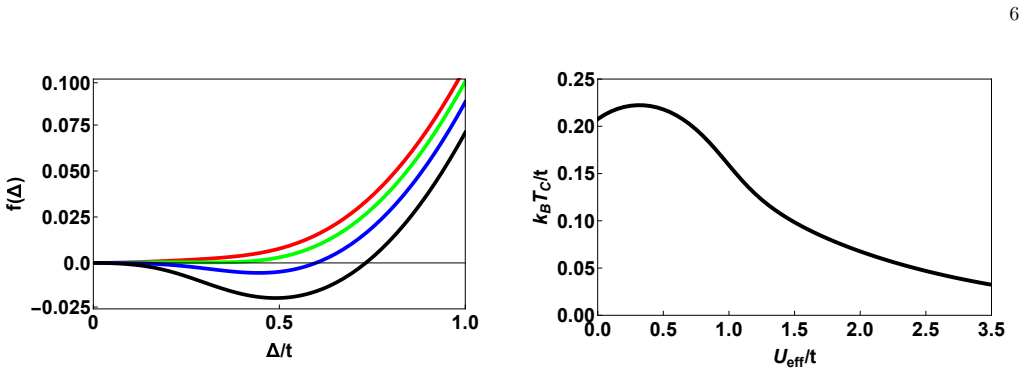
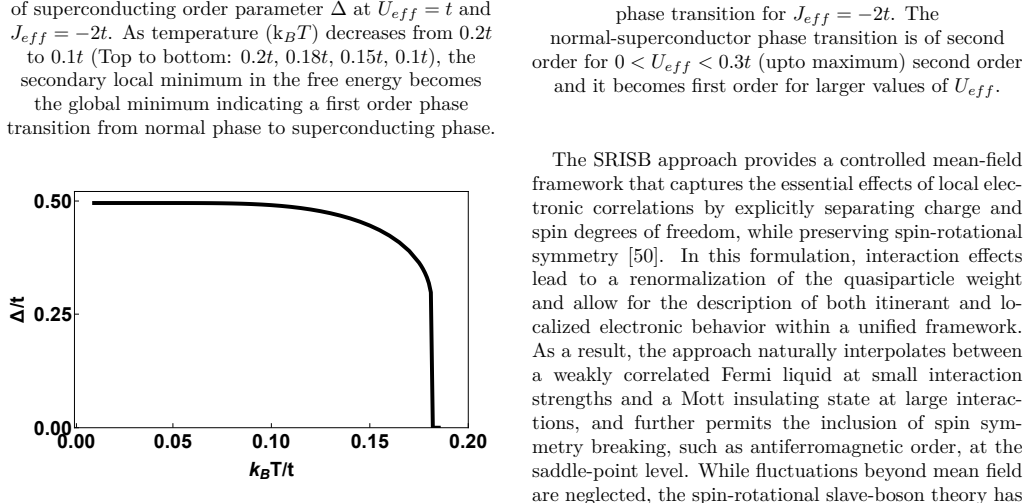
We investigate the electronic phases of an effective Hubbard model on the body-centered-cubic lattice, motivated by alkali-doped fulleride molecular solids. The model incorporates renormalized on-site interactions and an effective inverted Hund's coupling originating from electron-phonon interactions. To access complementary interaction regimes, we employ two theoretical approaches. In the intermediate-coupling regime, the on-site repulsive interaction is approximated by a long-range interaction in momentum space, yielding an exactly solvable Hatsugai-Kohmoto model supplemented by a BCS-type pairing term. Within this framework, we analyze the superconducting instability and demonstrate a first-order normal-superconducting phase transition, characterized by a discontinuous jump of the order parameter. In the strong-coupling regime, where pairing fluctuations are suppressed, we apply the spin rotationally invariant slave-boson formalism to map out the temperature-interaction phase diagram. This analysis reveals first-order transitions between a Fermi-liquid phase, an antiferromagnetic phase, and a Mott insulating phase, with a narrow intermediate region where all three phases compete. The resulting phase diagram captures the interplay of itinerancy, magnetic order, and Mott localization in three dimensions and provides a unified perspective on superconducting and correlation-driven phenomena in fulleride-inspired lattice systems.
Editorial analysis
A structured set of objections, weighed in public.
Referee Report
Summary. The manuscript investigates an effective Hubbard model on the BCC lattice motivated by alkali-doped fulleride solids, with renormalized on-site repulsion and inverted Hund's coupling from electron-phonon coupling. In the intermediate-coupling regime, the on-site interaction is replaced by a long-range momentum-space form to yield an exactly solvable Hatsugai-Kohmoto model supplemented by a BCS pairing term; this framework is used to analyze the superconducting instability and demonstrate a first-order normal-to-superconducting transition with a discontinuous jump in the order parameter. In the strong-coupling regime, a spin-rotationally invariant slave-boson formalism is applied (neglecting pairing fluctuations) to map the temperature-interaction phase diagram, revealing first-order transitions among Fermi-liquid, antiferromagnetic, and Mott-insulating phases together with a narrow region of three-phase competition.
Significance. If the central results hold, the work supplies a unified analytic perspective on the competition among superconductivity, itinerant magnetism, and Mott localization in a three-dimensional lattice model inspired by molecular solids. The exactly solvable HK+BCS construction permits an explicit demonstration of the discontinuous superconducting order-parameter jump, which is a concrete strength. The strong-coupling phase diagram complements this by delineating the boundaries of the competing phases. The overall significance is limited by the absence of quantitative checks on the key approximations.
major comments (2)
- [Abstract and intermediate-coupling section] Abstract and the intermediate-coupling analysis: the claim of a first-order normal-superconducting transition with a discontinuous jump in the order parameter rests on the Hatsugai-Kohmoto replacement U → U ∑_k n_{k↑} n_{k↓} plus BCS term. This long-range momentum-space interaction differs structurally from the strictly local on-site repulsion of the original effective Hubbard model; the change can alter the sign or magnitude of the quartic coefficient in the Landau expansion and thereby change the order of the transition. No comparison to a local-U calculation, no finite-size scaling, and no error estimate on the discontinuity are supplied.
- [Strong-coupling regime] Strong-coupling phase-diagram section: the slave-boson treatment assumes pairing fluctuations are negligible, yet the reported narrow intermediate region of Fermi-liquid/antiferromagnetic/Mott competition lies precisely where such fluctuations could be relevant. The first-order character of the transitions and the width of the competing region are therefore sensitive to this approximation; no cross-check against DMFT or quantum Monte Carlo is presented.
minor comments (2)
- [Abstract] The abstract states that the HK model is 'exactly solvable' but does not specify the explicit diagonalization or the form of the BCS mean-field equations used to obtain the order-parameter jump; adding one equation or a short derivation would improve reproducibility.
- [Model definition] Notation for the renormalized interaction strength and the effective inverted Hund's coupling is introduced without a dedicated table of symbols; a compact parameter table would aid readers.
Simulated Author's Rebuttal
We thank the referee for the careful reading and constructive comments on our manuscript. The points raised correctly identify key limitations of the approximations employed, and we address each below. Where appropriate, we will revise the text to clarify the scope and limitations of our results while preserving the analytic insights obtained within the chosen frameworks.
read point-by-point responses
-
Referee: [Abstract and intermediate-coupling section] Abstract and the intermediate-coupling analysis: the claim of a first-order normal-superconducting transition with a discontinuous jump in the order parameter rests on the Hatsugai-Kohmoto replacement U → U ∑_k n_{k↑} n_{k↓} plus BCS term. This long-range momentum-space interaction differs structurally from the strictly local on-site repulsion of the original effective Hubbard model; the change can alter the sign or magnitude of the quartic coefficient in the Landau expansion and thereby change the order of the transition. No comparison to a local-U calculation, no finite-size scaling, and no error estimate on the discontinuity are supplied.
Authors: We agree that the Hatsugai-Kohmoto (HK) replacement introduces a long-range momentum-space interaction that is structurally different from the strictly local on-site repulsion of the original effective Hubbard model. This approximation is adopted specifically to obtain an exactly solvable model that still incorporates the competition between the renormalized repulsion and the BCS pairing term arising from electron-phonon coupling. While the structural difference could in principle modify the Landau coefficients and the order of the transition, our explicit solution within the HK+BCS framework demonstrates a discontinuous jump in the superconducting order parameter. A direct comparison to local-U calculations is not performed because it would require non-perturbative numerical methods outside the analytic scope of the present work. Finite-size scaling is unnecessary, as the HK model is solved exactly in the thermodynamic limit. In the revised manuscript we will add a dedicated paragraph discussing the limitations of the HK approximation relative to the local Hubbard model and will supply the analytic expression for the magnitude of the order-parameter discontinuity. revision: partial
-
Referee: [Strong-coupling regime] Strong-coupling phase-diagram section: the slave-boson treatment assumes pairing fluctuations are negligible, yet the reported narrow intermediate region of Fermi-liquid/antiferromagnetic/Mott competition lies precisely where such fluctuations could be relevant. The first-order character of the transitions and the width of the competing region are therefore sensitive to this approximation; no cross-check against DMFT or quantum Monte Carlo is presented.
Authors: The spin-rotationally invariant slave-boson formalism is applied in the strong-coupling regime under the explicit assumption that pairing fluctuations are suppressed, allowing focus on the competition among itinerant, magnetic, and Mott physics. We acknowledge that the narrow three-phase coexistence region identified in the phase diagram is precisely where pairing fluctuations could become relevant and might alter the first-order character or the width of the competing region. The slave-boson treatment provides a controlled analytic description of the qualitative topology of the phase diagram. Cross-checks against DMFT or quantum Monte Carlo are not included, as they would require substantial additional numerical effort on the BCC lattice with the effective interactions considered here. In the revised manuscript we will expand the discussion of this approximation and its potential impact on the reported first-order lines and coexistence region. revision: partial
Circularity Check
No significant circularity; derivations follow from model definitions and standard methods.
full rationale
The paper states an effective Hubbard model on the BCC lattice, then explicitly approximates the on-site U by a long-range momentum-space interaction to obtain the exactly solvable Hatsugai-Kohmoto model plus BCS term; the first-order normal-SC transition with discontinuous order-parameter jump is obtained by direct solution of that model. In the strong-coupling regime the spin-rotationally invariant slave-boson formalism is applied to the same microscopic Hamiltonian to produce the phase diagram. Neither step reduces its output to its input by construction, renames a fitted quantity as a prediction, or relies on a load-bearing self-citation whose validity is presupposed. The derivation chain is therefore self-contained against the stated assumptions and external benchmarks.
Axiom & Free-Parameter Ledger
free parameters (2)
- renormalized on-site interaction strength
- effective inverted Hund's coupling strength
axioms (2)
- domain assumption On-site repulsion can be replaced by long-range momentum-space interaction to obtain the Hatsugai-Kohmoto model
- domain assumption Pairing fluctuations are suppressed in the strong-coupling regime
Reference graph
Works this paper leans on
-
[1]
8 16 17 18 19 20 21 220.0 0.2 0.4 0.6 0.8 1.0 Ueff/t kBTC/t MI AFM FL FIG
= 0, (34) where f (x) = 1 /(1 + ex) is the Fermi function. 8 16 17 18 19 20 21 220.0 0.2 0.4 0.6 0.8 1.0 Ueff/t kBTC/t MI AFM FL FIG. 6: Temperature -Interaction phase diagram for our effective Hubbard model on the BCC lattice. The spin-rotationally invariant slave-boson approach predicts three distinct phases, Fermi liquid (FL), Mott-insulating (MI), and...
-
[2]
Phys.: Condens
Yusuke Nomura et al 2016 J. Phys.: Condens. Matter 28 153001
2016
-
[3]
Iwahara, N., Chibotaru, L., Nat Commun 7, 13093 (2016)
2016
-
[4]
Capone et al., Strongly Correlated Superconductivity, Science 296,2364-2366(2002)
M. Capone et al., Strongly Correlated Superconductivity, Science 296,2364-2366(2002)
2002
-
[5]
Massimo Capone, Michele Fabrizio, Claudio Castellani, and Erio Tosatti, Rev. Mod. Phys. 81, 943 (2009)
2009
-
[6]
et al., Nat Com- mun 8, 14467 (2017)
Kasahara, Y., Takeuchi, Y., Zadik, R. et al., Nat Com- mun 8, 14467 (2017)
2017
-
[7]
Adv.1,e1500568(2015)
Yusuke Nomura et al., Sci. Adv.1,e1500568(2015)
2015
-
[8]
Theja De Silva, Phys. Rev. B 100, 155106 (2019)
2019
-
[9]
P. A. Borisova, M. S. Blanter, V. V. Brazhkin, S. G. Lyapin, V. P. Filonenko, E. V. Kukueva, and O. A. Kon- dratev, Bull. Russ. Acad. Sci. Phys. 85 765 (2021)
2021
-
[10]
P. A. Borisova, M. S. Blanter, V. V. Brazhkin, and V. P. Filonenko, Bull. Russ. Acad. Sci. Phys. 84 851 (2020)
2020
-
[11]
A. F. Hebard, M. J. Rosseinsky, R. C. Haddon, D. W. Murphy, S. H. Glarum, T. T. M. Palstra, A. P. Ramirez, and A. R. Kortan, Nature (London) 350, 600 (1991)
1991
-
[12]
M. J. Rosseinsky, A. P. Ramirez, S. H. Glarum, D. W. Murphy, R. C. Haddon, A. F. Hebard, T. T. M. Palstra, A. R. Kortan, S. M. Zahurak, and A. V. Makhija, Phys. Rev. Lett. 66, 2830 (1991)
1991
-
[13]
Holczer, O
K. Holczer, O. Klein, S. M. Huang, R. B. Kaner, K. J. Fu, R. L. Whetten, and F. Diederich, Science 252, 1154 (1991)
1991
-
[14]
Tanigaki, T
K. Tanigaki, T. W. Ebbesen, S. Saito, J. Mizuki, J. S. Tsai, Y. Kubo, and S. Kuroshima, Nature (London) 352, 222 (1991)
1991
-
[15]
R. M. Fleming, A. P. Ramirez, M. J. Rosseinsky, D. W. Murphy, R. C. Haddon, S. M. Zahurak, and A. V. Makhija, Nature (London) 352, 787 (1991)
1991
-
[16]
T. T. M. Palstra, O. Zhou, Y. Iwasa, P. E. Sulewski, R. M. Fleming, and B. R. Zegarski, Solid State Commun. 93, 327 (1995)
1995
-
[17]
A. Y. Ganin, Y. Takabayashi, Y. Z. Khimyak, S. Mar- gadonna, A. Tamai, M. J. Rosseinsky, and K. Prassides, Nat. Mater. 7, 367 (2008)
2008
-
[18]
Takabayashi et al., Science 323, 1585 (2009)
Y. Takabayashi et al., Science 323, 1585 (2009)
2009
-
[19]
Ihara, H
Y. Ihara, H. Alloul, P. Wzietek, D. Pontiroli, M. Mazzani, and M. Ricco, Phys. Rev. Lett. 104, 256402 (2010)
2010
-
[20]
A. Y. Ganin et al., Nature (London) 466, 221 (2010)
2010
-
[21]
R. H. Zadik et al., Sci. Adv. 1, e1500059 (2015)
2015
-
[22]
Ihara, H
Y. Ihara, H. Alloul, P. Wzietek, D. Pontiroli, M. Mazzani, and M. Ricco, Europhys. Lett. 94, 37007 (2011)
2011
-
[23]
Alloul, P
H. Alloul, P. Wzietek, T. Mito, D. Pontiroli, M. Aramini, M. Ricco, J. P. Itie, and E. Elkaim, Phys. Rev. Lett. 118, 237601 (2017)
2017
-
[24]
Jeglic, D
P. Jeglic, D. Arcon, A. Potocnik, A. Y. Ganin, Y. Tak- abayashi, M. J. Rosseinsky, and K. Prassides, Phys. Rev. B 80, 195424 (2009)
2009
-
[25]
Wzietek, T
P. Wzietek, T. Mito, H. Alloul, D. Pontiroli, M. Aramini, and M. Ricco, Phys. Rev. Lett. 112, 066401 (2014)
2014
-
[26]
Klupp et al., Nat
G. Klupp et al., Nat. Commun. 3, 912 (2012). 10
2012
-
[27]
Kamaras et al., J
K. Kamaras et al., J. Phys.: Conf. Ser. 428, 012002 (2013)
2013
-
[28]
Baldassarre, A
L. Baldassarre, A. Perucchi, M. Mitrano, D. Nicoletti, C. Marini, D. Pontiroli, M. Mazzani, M. Aramini, M. Ricc, G. Giovannetti, M. Capone, and S. Lupi, Sci. Rep. 5, 15240 (2015)
2015
-
[29]
Takabayashi and K
Y. Takabayashi and K. Prassides, Philos. Trans. R. Soc. A 374, 20150320 (2016)
2016
-
[30]
Brouet, H
V. Brouet, H. Alloul, T.-N. Le, S. Garaj, and L. Forro, Phys. Rev. Lett. 86, 4680 (2001)
2001
-
[31]
Brouet, H
V. Brouet, H. Alloul, S. Garaj, and L. Forro, Phys. Rev. B 66, 155124 (2002)
2002
-
[32]
Fausti et al., Science 331,189-191(2011)
D. Fausti et al., Science 331,189-191(2011)
2011
-
[33]
et al., Nature 530, 461–464 (2016)
Mitrano, M., Cantaluppi, A., Nicoletti, D. et al., Nature 530, 461–464 (2016)
2016
-
[34]
et al., Nat
Budden, M., Gebert, T., Buzzi, M. et al., Nat. Phys. 17, 611–618 (2021)
2021
-
[35]
et al., Nat
Rowe, E., Yuan, B., Buzzi, M. et al., Nat. Phys. 19, 1821–1826 (2023)
2023
-
[36]
Shintaro Hoshino and Philipp Werner, Phys. Rev. Lett. 118, 177002 (2017)
2017
-
[37]
et al., npj Quantum Mater
Witt, N., Nomura, Y., Brener, S. et al., npj Quantum Mater. 9, 100 (2024)
2024
-
[38]
J. S. Zhou, R. Z. Xu, X. Q. Yu al.,Phys. Rev. Lett. 130, 216004 (2023)
2023
-
[39]
Changming Yue, Yusuke Nomura, Kosmas Prassides and and Philipp Werner, Phys. Rev. B 108, L220508 (2023)
2023
-
[40]
Gregor Jotzu, Guido Meier, Alice Cantalupp, et al., Phys. Rev. X 13, 021008 (2023)
2023
-
[41]
Nomura, K
Y. Nomura, K. Nakamura, and R. Arita, Phys. Rev. B 85, 155452 (2012)
2012
-
[42]
Nomura, S
Y. Nomura, S. Sakai, M. Capone, and R. Arita, J. Phys.: Condens. Matter 28, 153001 (2016)
2016
-
[43]
K. V. Grigorishin, Physica C 562, 56 (2019)
2019
-
[44]
Matsuda, N
Y. Matsuda, N. Iwahara, K. Tanigaki, and L. F. Chibo- taru, Phys. Rev. B 98, 165410 (2018)
2018
-
[45]
Huang, and Philip W
Jinchao Zhao, Luke Yeo, Edwin W. Huang, and Philip W. Phillips, Phys. Rev. B 105, 184509 (2022)
2022
-
[46]
Hatsugai and M
Y. Hatsugai and M. Kohmoto, J. Phys. Soc. Jpn. 61, 2056 (1992)
2056
-
[47]
and Huang, E.W
Phillips, P.W., Yeo, L. and Huang, E.W. Exact theory for superconductivity in a doped Mott insulator. Nat. Phys. 16, 1175–1180 (2020)
2020
-
[48]
Yu Li et al 2022 New J. Phys. 24 103019
2022
-
[49]
Phillips, Phys
Jinchao Zhao, Gabriele La Nave, and Philip W. Phillips, Phys. Rev. B 108, 165135 (2023)
2023
-
[50]
Adam Bacsi and Balazs Dora, Phys. Rev. B 111, 075115 (2025)
2025
-
[51]
David Riegler, Michael Klett, Titus Neupert, Ronny Thomale, and Peter Wolfle, Phys. Rev. B 101, 235137 (2020)
2020
-
[52]
Fresard and P
R. Fresard and P. Wolfle, Int. J. Mod. Phys. B 06, 685 (1992)
1992
-
[53]
W. F. Brinkman and T. M. Rice, Phys. Rev. B 2, 4302 (1970)
1970
-
[54]
Kotliar and A
G. Kotliar and A. E. Ruckenstein, Phys. Rev. Lett. 57, 1362 (1986)
1986
-
[55]
M. C. Gutzwiller, Phys. Rev. Lett. 10, 159 (1963)
1963
-
[56]
Vollhardt, Rev
D. Vollhardt, Rev. Mod. Phys. 56, 99 (1984)
1984
-
[57]
For technical details, see the appendices B and F in ref- erence [50]
-
[58]
Georges, G
A. Georges, G. Kotliar, W. Krauth, M. Rozenberg, Rev. Mod. Phys. 68, 13 (1996)
1996
-
[59]
Rozenberg, G
M. Rozenberg, G. Kotliar, H. Kajueter, Phys. Rev. B 54, 8452 (1996)
1996
-
[60]
Ulmke, Eur
M. Ulmke, Eur. Phys. J. B 1, 301 (1998)
1998
-
[61]
Rohringer, A
G. Rohringer, A. Toschi, A. Katanin, and K. Held, Phys. Rev. Lett. 107, 256402 (2011)
2011
discussion (0)
Sign in with ORCID, Apple, or X to comment. Anyone can read and Pith papers without signing in.