Recognition: unknown
Distributed Online Learning for Time-Critical Communication in 6G Industrial Subnetworks
Pith reviewed 2026-05-08 06:27 UTC · model grok-4.3
The pith
A distributed DRL protocol lets local access points in 6G industrial subnetworks learn transmission patterns from a shared contention signal to raise the odds of delivering alarms on time.
A machine-rendered reading of the paper's core claim, the machinery that carries it, and where it could break.
Core claim
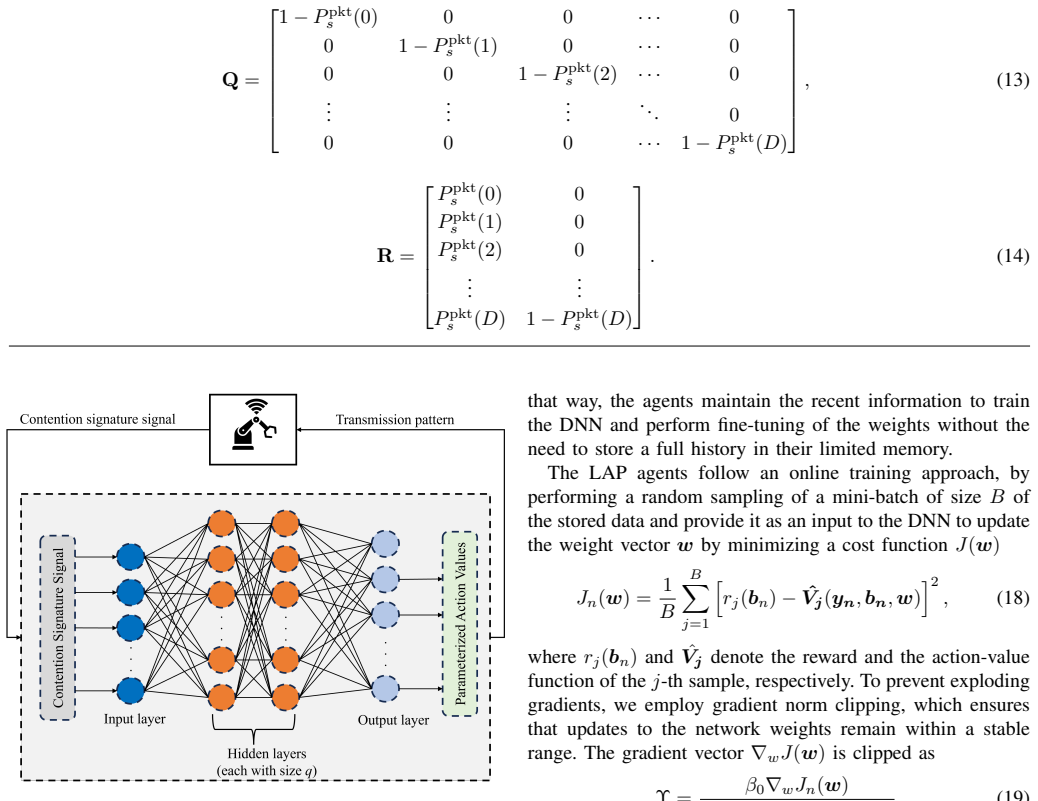
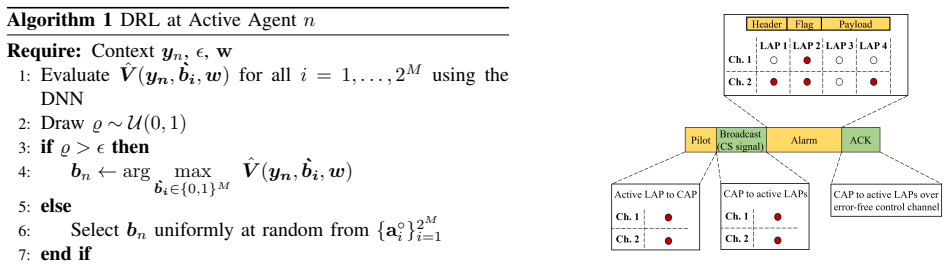
Each local access point autonomously learns, in an online fashion, to map a broadcast contention-signature signal to a transmission pattern over the available channels via a lightweight deep neural network and an epsilon-greedy policy, yielding a higher probability of in-time alarm delivery than random-access baselines and improved scalability as the number of subnetworks grows.
What carries the argument
Lightweight deep neural network with epsilon-greedy policy that processes a broadcast contention-signature signal to select channel transmission patterns in a fully distributed online setting.
If this is right
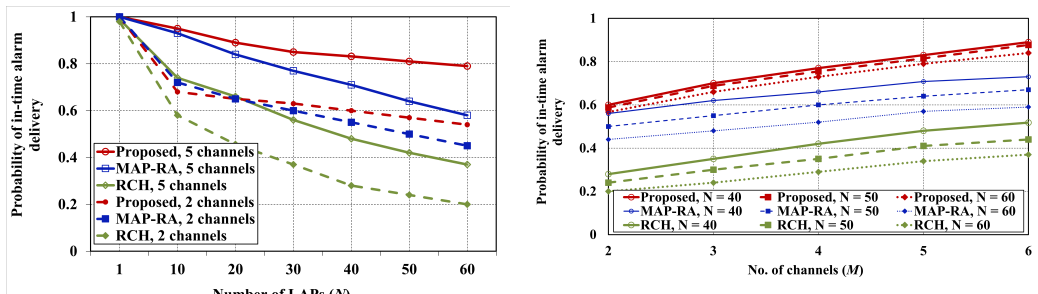
- Probability of in-time alarm delivery rises by at least 7 percent for 40 subnetworks and by 21 percent for 60 subnetworks.
- Performance advantage over random-access schemes grows with increasing network density.
- Each subnetwork operates without centralized coordination while still adapting to shared contention conditions.
- The protocol remains functional under mobility and bursty alarm traffic patterns.
Where Pith is reading between the lines
- The online learning loop could allow the system to track slow changes in traffic statistics without periodic retraining.
- If the contention-signature signal remains reliable at scale, similar distributed learning could be layered onto other industrial wireless protocols.
- The approach implies that explicit coordination messages may be replaceable by simple broadcast signatures in dense time-critical networks.
Load-bearing premise
The simulation models accurately represent real-world conditions including mobility, bursty event-driven traffic, and radio resource constraints.
What would settle it
A real 6G industrial testbed deployment with 60 simultaneously active subnetworks that measures the fraction of alarms delivered before deadline under the learned policy versus random-access baselines.
Figures





read the original abstract
6G industrial in-X subnetworks are expected to support highly time-critical alarm reporting in large-scale environments characterized by mobility, bursty event-driven traffic, and limited radio resources. In such settings, conventional medium access solutions are ill-suited to guarantee reliable delivery of critical traffic, e.g., emergency alarms, within strict deadlines, especially when multiple subnetworks become simultaneously active after a common alarm event, a scenario widely referred as medium access with a shared message. This paper proposes a distributed deep reinforcement learning (DRL)-based medium access control protocol for timely alarm transmission in time-critical industrial subnetworks. The proposed method enables each local access point (LAP) to learn, in an online manner, to infer contention conditions from a broadcast contention-signature signal and to autonomously select a transmission pattern over the available channels using a lightweight deep neural network and an (ephsilon)-greedy policy. Simulation results demonstrate that the proposed approach consistently achieves a higher probability of in-time alarm delivery than benchmark random-access schemes, while exhibiting better scalability with increasing network density. For instance, the proposed method improves probability of in-time alarm delivery by at least 7% with a network size of 40 subnetworks, while the gain increases to 21% when the number of subnetworks increases to 60.
Editorial analysis
A structured set of objections, weighed in public.
Referee Report
Summary. The paper proposes a distributed deep reinforcement learning (DRL)-based medium access control (MAC) protocol for time-critical alarm reporting in 6G industrial in-X subnetworks. Each local access point (LAP) learns online to infer contention conditions from a broadcast contention-signature signal and selects a transmission pattern over available channels via a lightweight deep neural network and an epsilon-greedy policy. Simulation results show the approach achieves higher probability of in-time alarm delivery than benchmark random-access schemes, with reported gains of at least 7% at 40 subnetworks increasing to 21% at 60 subnetworks, along with better scalability as network density grows.
Significance. If the simulation results hold, the work would be significant for 6G industrial IoT by addressing the shared-message medium access problem in dense, mobile, bursty-traffic environments through a practical online learning solution. The lightweight DNN design and distributed nature are strengths for real-time deployment, and the empirical scalability gains provide concrete evidence of advantage over conventional schemes in a challenging setting.
major comments (2)
- [Simulation Results] Simulation Results section: the reported 7% and 21% gains in probability of in-time alarm delivery are presented as point values without specifying the number of Monte Carlo runs, variance across runs, or any statistical significance testing; this weakens support for the claim of consistent outperformance and scalability.
- [System Model] System Model section: the modeling assumptions for bursty event-driven traffic (e.g., exact arrival process and rate parameters) and mobility (e.g., velocity distribution and correlation across subnetworks) are not fully specified with numerical values, which is load-bearing for assessing whether the observed gains would translate to practical 6G deployments.
minor comments (2)
- [Abstract] Abstract: the phrase 'at least 7%' should be clarified with the exact network and traffic conditions under which the minimum gain occurs, to avoid ambiguity.
- [Introduction] Notation and acronyms: ensure LAP, DRL, and MAC are defined at first use in the main text, and consider adding a table summarizing key simulation parameters for clarity.
Simulated Author's Rebuttal
We thank the referee for the constructive feedback and the recommendation for minor revision. We address the two major comments point by point below. We will update the manuscript accordingly to incorporate the suggested clarifications.
read point-by-point responses
-
Referee: [Simulation Results] Simulation Results section: the reported 7% and 21% gains in probability of in-time alarm delivery are presented as point values without specifying the number of Monte Carlo runs, variance across runs, or any statistical significance testing; this weakens support for the claim of consistent outperformance and scalability.
Authors: We agree that providing details on the simulation methodology would strengthen the support for our claims. The results in the paper are derived from extensive Monte Carlo simulations, but the exact number of runs and variance measures are not explicitly stated in the current version. In the revised manuscript, we will add this information to the Simulation Results section, including the number of independent runs performed, observed variance, and a brief discussion of statistical significance to demonstrate the consistency of the outperformance. revision: yes
-
Referee: [System Model] System Model section: the modeling assumptions for bursty event-driven traffic (e.g., exact arrival process and rate parameters) and mobility (e.g., velocity distribution and correlation across subnetworks) are not fully specified with numerical values, which is load-bearing for assessing whether the observed gains would translate to practical 6G deployments.
Authors: We thank the referee for highlighting this aspect. While the System Model section describes the traffic as bursty event-driven and the mobility model, we concur that explicit numerical values would improve clarity and allow better evaluation of practical applicability. We will revise the manuscript to include a table or subsection with all key parameter values used in the simulations, such as the arrival process details, rate parameters, velocity distributions, and assumptions regarding correlation across subnetworks. revision: yes
Circularity Check
No circularity: performance claims rest on direct simulation comparisons
full rationale
The paper proposes a DRL-based distributed MAC protocol and evaluates it through simulations against random-access baselines under modeled conditions (mobility, bursty traffic). No derivation chain, equations, or predictions are presented that reduce by construction to fitted parameters, self-definitions, or self-citation load-bearing steps. The reported gains (7-21%) are empirical outcomes of the protocol implementation versus benchmarks, with no renaming of known results or ansatz smuggling. The evaluation is self-contained against external simulation benchmarks and does not invoke uniqueness theorems or prior self-citations as the central justification.
Axiom & Free-Parameter Ledger
Reference graph
Works this paper leans on
-
[1]
Communications in the 6g era,
H. Viswanathan and P. E. Mogensen, “Communications in the 6g era,” IEEE Access, vol. 8, pp. 57 063–57 074, 2020
2020
-
[2]
Boosting short-range wireless communications in entities: the 6g-shine vision,
G. Berardinelliet al., “Boosting short-range wireless communications in entities: the 6g-shine vision,” in2023 IEEE Future Networks World F orum (FNWF), 2023, pp. 1–6
2023
-
[3]
Towards 6g in-x subnetworks with sub-millisecond communication cycles and extreme reliability,
R. Adeogun, G. Berardinelli, P. E. Mogensen, I. Rodriguez, and M. Razzaghpour, “Towards 6g in-x subnetworks with sub-millisecond communication cycles and extreme reliability,”IEEE Access, vol. 8, pp. 110 172–110 188, 2020
2020
-
[4]
D2.2: Refined definition of scenarios, use cases and service requirements for in- x subnetworks,
G.-S. Consortium, “D2.2: Refined definition of scenarios, use cases and service requirements for in- x subnetworks,” 6G-SHINE, Tech. Rep., Feb. 2024. [Online]. Available: https://6gshine.eu/deliverables-ii/
2024
-
[5]
Specification group services and system aspects; Study on communi- cation for automation in vertical domains (Release 16),
“Specification group services and system aspects; Study on communi- cation for automation in vertical domains (Release 16),” 3GPP, Tech. Rep. TR 22.804, Jul. 2020, v16.3.0
2020
-
[6]
5g swarm production: Advanced industrial manufac- turing concepts enabled by wireless automation,
I. Rodriguezet al., “5g swarm production: Advanced industrial manufac- turing concepts enabled by wireless automation,”IEEE Communications Magazine, vol. 59, no. 1, pp. 48–54, 2021
2021
-
[7]
Private 5g networks for cyber-physical control applications in vertical domains,
L. M. Bartol ´ın-Arnauet al., “Private 5g networks for cyber-physical control applications in vertical domains,” in2023 IEEE 19th Interna- tional Conference on Factory Communication Systems (WFCS), 2023, pp. 1–4
2023
-
[8]
Review on robotic systems for environmental monitoring,
D. M. G. Preethichandra, L. Piyathilaka, and U. Izhar, “Review on robotic systems for environmental monitoring,”IEEE Open Journal of Instrumentation and Measurement, vol. 4, pp. 1–17, 2025
2025
-
[9]
Autonomous mobile inspection robots in deep underground mining—the current state of the art and future perspectives,
M. Konieczna-Fuławkaet al., “Autonomous mobile inspection robots in deep underground mining—the current state of the art and future perspectives,”Sensors, vol. 25, no. 12, 2025. [Online]. Available: https://www.mdpi.com/1424-8220/25/12/3598
2025
-
[10]
Learning to speak on behalf of a group: Medium access control for sending a shared message,
S. u. Haqueet al., “Learning to speak on behalf of a group: Medium access control for sending a shared message,”IEEE Communications Letters, vol. 26, no. 8, pp. 1843–1847, 2022
2022
-
[11]
A delay-bounded mac protocol for mission- and time-critical applications in industrial wireless sensor networks,
H. Farag, M. Gidlund, and P. ¨Osterberg, “A delay-bounded mac protocol for mission- and time-critical applications in industrial wireless sensor networks,”IEEE Sens. J., vol. 18, no. 6, pp. 2607–2616, 2018
2018
-
[12]
Priority-aware wireless fieldbus protocol for mixed- criticality industrial wireless sensor networks,
H. Faraget al., “Priority-aware wireless fieldbus protocol for mixed- criticality industrial wireless sensor networks,”IEEE Sens. J., vol. 19, no. 7, pp. 2767–2780, 2019
2019
-
[13]
Deep reinforcement learning-based multi-access in massive machine-type communication,
N. Ravi, N. Lourenc ¸o, M. Curado, and a. Edmundo Monteiro, “Deep reinforcement learning-based multi-access in massive machine-type communication,”IEEE Access, vol. 12, pp. 178 690–178 704, 2024
2024
-
[14]
Reinforcement learning random access for delay-constrained heterogeneous wireless networks: A two-user case,
D. Wu, L. Deng, Z. Liu, Y . Zhang, and Y . S. Han, “Reinforcement learning random access for delay-constrained heterogeneous wireless networks: A two-user case,” in2021 IEEE Globecom Workshops (GC Wkshps), 2021, pp. 1–7
2021
-
[15]
Joint delay-energy optimization for multi-priority random access in machine-type communications,
W. Fan, P. Fan, and Y . Long, “Joint delay-energy optimization for multi-priority random access in machine-type communications,”IEEE Transactions on Wireless Communications, vol. 23, no. 2, pp. 1416– 1431, 2024
2024
-
[16]
Federated multi-agent drl for radio resource management in industrial 6g in-x subnetworks,
B. Madsen and R. Adeogun, “Federated multi-agent drl for radio resource management in industrial 6g in-x subnetworks,” in2024 IEEE 35th International Symposium on Personal, Indoor and Mobile Radio Communications (PIMRC), 2024, pp. 1–7
2024
-
[17]
Learning random access schemes for massive machine-type communication with marl,
M. A. Jadoon, A. Pastore, M. Navarro, and A. Valcarce, “Learning random access schemes for massive machine-type communication with marl,”IEEE Transactions on Machine Learning in Communications and Networking, vol. 2, pp. 95–109, 2024
2024
-
[18]
Coordinated random access for industrial iot with correlated traffic by reinforcement-learning,
A. Rech and S. Tomasin, “Coordinated random access for industrial iot with correlated traffic by reinforcement-learning,” in2021 IEEE Globecom Workshops (GC Wkshps), 2021, pp. 1–6
2021
-
[19]
Power control for 6g in- factory subnetworks with partial channel information using graph neural networks,
D. Abode, R. Adeogun, and G. Berardinelli, “Power control for 6g in- factory subnetworks with partial channel information using graph neural networks,”IEEE Open Journal of the Communications Society, vol. 5, pp. 3120–3135, 2024
2024
-
[20]
Power control for 6g industrial wireless subnetworks: A graph neural network approach,
——, “Power control for 6g industrial wireless subnetworks: A graph neural network approach,” in2023 IEEE Wireless Communications and Networking Conference (WCNC), 2023, pp. 1–6
2023
-
[21]
Multi-agent reinforcement learning for dynamic resource management in 6g in-x subnetworks,
X. Duet al., “Multi-agent reinforcement learning for dynamic resource management in 6g in-x subnetworks,”IEEE Transactions on Wireless Communications, vol. 22, no. 3, pp. 1900–1914, 2023
1900
-
[22]
Distributed channel allocation for mobile 6g subnetworks via multi-agent deep q-learning,
R. Adeogun and G. Berardinelli, “Distributed channel allocation for mobile 6g subnetworks via multi-agent deep q-learning,” in2023 IEEE Wireless Communications and Networking Conference (WCNC), 2023, pp. 1–6
2023
-
[23]
O. A. L ´opez and H. Alves,Wireless RF Energy Transfer in the Massive IoT Era: Towards Sustainable Zero-energy Networks. Hoboken, NJ, USA: John Wiley & Sons, 2022. [Online]. Available: https://www.wiley. com/en-us/Wireless+RF+Energy+Transfer+in+the+Massive+IoT+Era% 3A+Towards+Sustainable+Zero-energy+Networks-p-9781119718666
2022
-
[24]
Energy-efficient wake-up signalling for machine-type devices based on traffic-aware long short-term memory prediction,
D. E. Ru ´ız-Guirolaet al., “Energy-efficient wake-up signalling for machine-type devices based on traffic-aware long short-term memory prediction,”IEEE Internet of Things Journal, vol. 9, no. 21, pp. 21 620– 21 631, 2022
2022
-
[25]
Resource and power allocation in swipt-enabled device-to-device communications based on a nonlinear energy harvesting model,
H. Yang, Y . Ye, X. Chu, and M. Dong, “Resource and power allocation in swipt-enabled device-to-device communications based on a nonlinear energy harvesting model,”IEEE Internet of Things Journal, vol. 7, no. 11, pp. 10 813–10 825, 2020
2020
-
[26]
Modeling and clustering attacker activities in iot through machine learning techniques,
P. Sun, J. Li, M. Z. Alam Bhuiyan, L. Wang, and B. Li, “Modeling and clustering attacker activities in iot through machine learning techniques,” Information Sciences, vol. 479, pp. 456–471, 2019. [Online]. Available: https://www.sciencedirect.com/science/article/pii/S0020025518303311
2019
-
[27]
Heaton,Introduction to Neural Networks for Java
J. Heaton,Introduction to Neural Networks for Java. Heaton Research, Inc., 2008
2008
-
[28]
Goal-oriented scheduling in sensor networks with applica- tion timing awareness,
J. Holm, F. Chiariotti, A. E. Kalør, B. Soret, T. B. Pedersen, and P. Popovski, “Goal-oriented scheduling in sensor networks with applica- tion timing awareness,”IEEE Transactions on Communications, vol. 71, no. 8, pp. 4513–4527, 2023
2023
-
[29]
Channel scheduling for iot access with spatial correlation,
P. Raghuwanshi, O. L. A. L ´opez, P. Popovski, and M. Latva-Aho, “Channel scheduling for iot access with spatial correlation,”IEEE Communications Letters, vol. 28, no. 5, pp. 1014–1018, 2024
2024
-
[30]
Why gradient clipping accel- erates training: A theoretical justification for adaptivity,
J. Zhang, T. He, S. Sra, and A. Jadbabaie, “Why gradient clipping accel- erates training: A theoretical justification for adaptivity,” inProceedings of the International Conference on Learning Representations (ICLR), Feb. 2020, pp. 1–21
2020
-
[31]
Enhanced interfer- ence management for 6g in-x subnetworks,
R. Adeogun, G. Berardinelli, and P. E. Mogensen, “Enhanced interfer- ence management for 6g in-x subnetworks,”IEEE Access, vol. 10, pp. 45 784–45 798, 2022
2022
-
[32]
Control-aware transmit power allocation for 6g in- factory subnetwork control systems,
D. Abode, P. M. de Sant Ana, A. Artemenko, R. Adeogun, and G. Berardinelli, “Control-aware transmit power allocation for 6g in- factory subnetwork control systems,” in2024 IEEE 100th V ehicular Technology Conference (VTC2024-Fall), 2024, pp. 1–6
2024
-
[33]
3gpp standardized 5g channel model for iiot scenarios: A survey,
T. Jianget al., “3gpp standardized 5g channel model for iiot scenarios: A survey,”IEEE Internet of Things Journal, vol. 8, no. 11, pp. 8799–8815, 2021
2021
-
[34]
Study on channel model for frequencies from 0.5 to 100 GHz, Version 17.0.0,
3GPP, “Study on channel model for frequencies from 0.5 to 100 GHz, Version 17.0.0,” 3rd Generation Partnership Project (3GPP), Sophia Antipolis, France, Technical Report TR 38.901, Apr. 2022
2022
-
[35]
Smart factory of industry 4.0: Key technologies, application case, and challenges,
B. Chen, J. Wan, L. Shu, P. Li, M. Mukherjee, and B. Yin, “Smart factory of industry 4.0: Key technologies, application case, and challenges,” IEEE Access, vol. 6, pp. 6505–6519, 2018
2018
-
[36]
R. S. Sutton and A. G. Barto,Reinforcement Learning: An Introduction. Cambridge, MA, USA: The MIT press, 2018
2018
-
[37]
Priority-aware wireless fieldbus protocol for mixed-criticality industrial wireless sensor networks,
H. Farag, E. Sisinni, M. Gidlund, and P. ¨Osterberg, “Priority-aware wireless fieldbus protocol for mixed-criticality industrial wireless sensor networks,”IEEE Sensors Journal, vol. 19, no. 7, pp. 2767–2780, 2019
2019
discussion (0)
Sign in with ORCID, Apple, or X to comment. Anyone can read and Pith papers without signing in.