Recognition: unknown
AgenticPrecoding: LLM-Empowered Multi-Agent System for Precoding Optimization
Pith reviewed 2026-05-08 03:39 UTC · model grok-4.3
The pith
A multi-agent LLM system automates end-to-end precoding derivation from user requirements in wireless systems.
A machine-rendered reading of the paper's core claim, the machinery that carries it, and where it could break.
Core claim
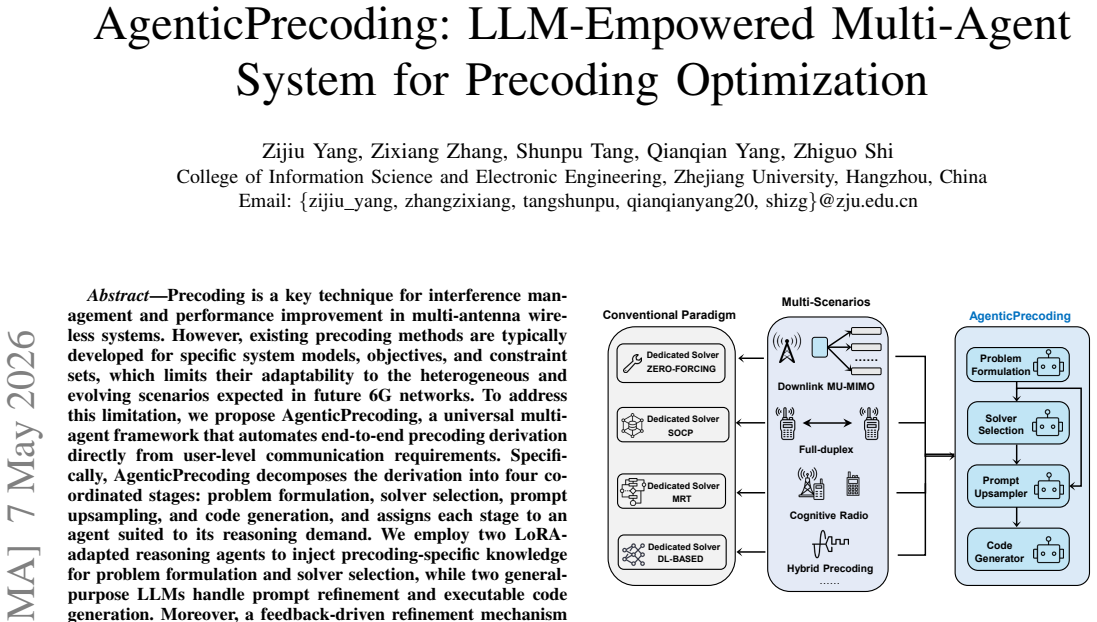
AgenticPrecoding is a multi-agent framework that automates end-to-end precoding derivation directly from user-level communication requirements by assigning problem formulation and solver selection to LoRA-adapted reasoning agents, prompt upsampling and code generation to general LLMs, and incorporating feedback-driven refinement to ensure executability and feasibility.
What carries the argument
The four-stage coordinated multi-agent system with LoRA-adapted agents for domain-specific tasks and a feedback mechanism for iterative improvement.
If this is right
- Precoding can be derived for new scenarios without developing custom code each time.
- The system produces solutions that better satisfy constraints and achieve higher quality across varied wireless setups.
- Users can specify requirements in natural language rather than mathematical terms.
- Performance exceeds both conventional optimization solvers and direct LLM approaches in adaptability.
Where Pith is reading between the lines
- Similar agent structures might automate other signal processing tasks in communications.
- Integration with real-time network monitoring could enable dynamic precoding adjustments.
- Reducing reliance on expert knowledge could democratize access to advanced wireless optimization.
Load-bearing premise
Large language models can consistently generate correct, executable optimization code that satisfies all constraints for diverse precoding problems.
What would settle it
Observing cases where the generated code either fails to run, violates constraints, or yields worse performance than a hand-crafted solution in an unseen precoding scenario.
Figures

read the original abstract
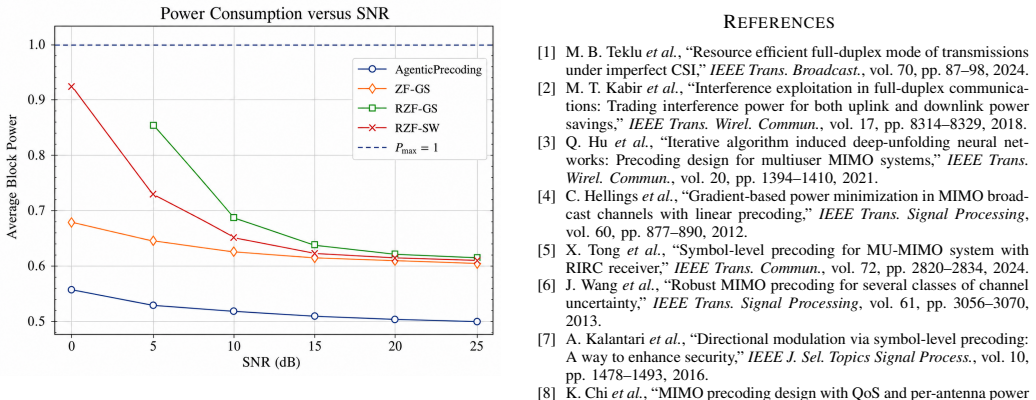
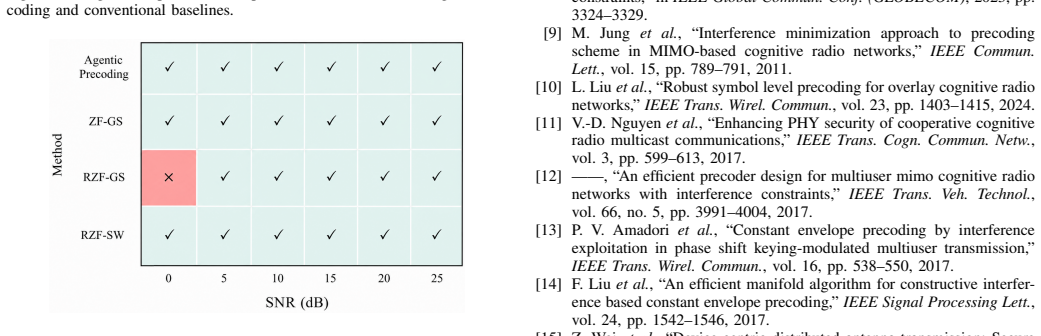
Precoding is a key technique for interference management and performance improvement in multi-antenna wireless systems. However, existing precoding methods are typically developed for specific system models, objectives, and constraint sets, which limits their adaptability to the heterogeneous and evolving scenarios expected in future 6G networks. To address this limitation, we propose AgenticPrecoding, a universal multi-agent framework that automates end-to-end precoding derivation directly from user-level communication requirements. Specifically, AgenticPrecoding decomposes the derivation process into four coordinated stages: problem formulation, solver selection, prompt upsampling, and code generation, assigning each stage to a specialized agent tailored to its specific reasoning demands. We employ two LoRA-adapted reasoning agents to inject precoding-specific domain knowledge for problem formulation and solver selection, while two general-purpose Large Language Models (LLMs) handle prompt refinement and executable code generation. Furthermore, a feedback-driven refinement mechanism is incorporated to enhance code executability, constraint feasibility, and solution quality. Extensive experiments across 10 representative precoding scenarios demonstrate that AgenticPrecoding achieves superior cross-scenario adaptability compared to conventional optimization-based and LLM-based baselines.
Editorial analysis
A structured set of objections, weighed in public.
Referee Report
Summary. The paper proposes AgenticPrecoding, a multi-agent LLM framework that automates end-to-end precoding derivation for multi-antenna wireless systems directly from user-level requirements. The framework decomposes the process into four coordinated stages—problem formulation, solver selection, prompt upsampling, and code generation—assigning specialized agents to each, with two LoRA-adapted agents injecting domain knowledge and two general LLMs handling refinement and code generation, plus a feedback-driven refinement loop for executability and feasibility. Experiments across 10 representative precoding scenarios are reported to show superior cross-scenario adaptability relative to conventional optimization-based and LLM-based baselines.
Significance. If the experimental claims hold with adequate quantitative support, the work has moderate significance for 6G wireless systems by offering a universal, automated alternative to scenario-specific precoding designs. The structured multi-agent decomposition combined with LoRA specialization and iterative feedback represents a practical way to mitigate LLM hallucinations in generating constraint-satisfying optimization code, and the emphasis on cross-scenario adaptability directly targets a known limitation of existing methods.
major comments (2)
- [§4] §4 (Experimental evaluation): the central claim of superior cross-scenario adaptability rests on experiments across 10 scenarios, yet the provided text supplies no quantitative metrics (e.g., sum-rate, BER, or feasibility rates), baseline implementations, variance across runs, or statistical tests; without these, the superiority cannot be verified and the evidence remains at the level of high-level summary.
- [§3.3] §3.3 (Feedback-driven refinement): while the loop is presented as addressing infeasible or erroneous code, no data are given on initial failure rates, average number of refinement iterations, or residual error frequency across the 10 scenarios; this information is load-bearing for the weakest assumption that LLMs can reliably produce constraint-satisfying solutions.
minor comments (2)
- The abstract would be strengthened by naming the specific performance metrics and at least two example baselines used in the 10-scenario comparison.
- Notation for agent roles and LoRA adaptation parameters could be introduced earlier (e.g., in §2 or §3) to improve readability for readers outside the LLM community.
Simulated Author's Rebuttal
We thank the referee for the constructive and detailed comments. We address each major point below and will revise the manuscript to incorporate the requested quantitative details and analyses.
read point-by-point responses
-
Referee: [§4] §4 (Experimental evaluation): the central claim of superior cross-scenario adaptability rests on experiments across 10 scenarios, yet the provided text supplies no quantitative metrics (e.g., sum-rate, BER, or feasibility rates), baseline implementations, variance across runs, or statistical tests; without these, the superiority cannot be verified and the evidence remains at the level of high-level summary.
Authors: We agree that the current manuscript presents the experimental results at a summarized level without the full quantitative support needed to substantiate the claims. In the revised version, Section 4 will be expanded to report specific metrics such as sum-rate, BER, and feasibility rates for each of the 10 scenarios, along with explicit baseline implementations, variance across multiple runs, and statistical tests to enable verification of the cross-scenario adaptability advantages. revision: yes
-
Referee: [§3.3] §3.3 (Feedback-driven refinement): while the loop is presented as addressing infeasible or erroneous code, no data are given on initial failure rates, average number of refinement iterations, or residual error frequency across the 10 scenarios; this information is load-bearing for the weakest assumption that LLMs can reliably produce constraint-satisfying solutions.
Authors: We acknowledge that additional data on the refinement loop is necessary to support its role in ensuring feasible solutions. The revised manuscript will add quantitative results in Section 3.3 and the experimental evaluation, including initial failure rates before refinement, average number of iterations per scenario, and residual error frequencies across the 10 scenarios. revision: yes
Circularity Check
No significant circularity; empirical framework evaluated externally
full rationale
The paper presents AgenticPrecoding as a multi-agent LLM system that decomposes precoding derivation into stages (problem formulation, solver selection, prompt upsampling, code generation) with LoRA-adapted agents and a feedback refinement loop. All performance claims rest on experimental comparisons against conventional optimization and LLM baselines across 10 scenarios, rather than any closed-form derivation, fitted parameter renamed as prediction, or self-citation chain. No equations, uniqueness theorems, or ansatzes are invoked that reduce the central result to its own inputs by construction. The architecture and evaluation are self-contained against external benchmarks.
Axiom & Free-Parameter Ledger
axioms (1)
- domain assumption LLMs can translate natural-language communication requirements into valid mathematical optimization problems and executable code for precoding.
Reference graph
Works this paper leans on
-
[1]
Resource efficient full-duplex mode of transmissions under imperfect CSI,
M. B. Tekluet al., “Resource efficient full-duplex mode of transmissions under imperfect CSI,”IEEE Trans. Broadcast., vol. 70, pp. 87–98, 2024
2024
-
[2]
Interference exploitation in full-duplex communica- tions: Trading interference power for both uplink and downlink power savings,
M. T. Kabiret al., “Interference exploitation in full-duplex communica- tions: Trading interference power for both uplink and downlink power savings,”IEEE Trans. Wirel. Commun., vol. 17, pp. 8314–8329, 2018
2018
-
[3]
Iterative algorithm induced deep-unfolding neural net- works: Precoding design for multiuser MIMO systems,
Q. Huet al., “Iterative algorithm induced deep-unfolding neural net- works: Precoding design for multiuser MIMO systems,”IEEE Trans. Wirel. Commun., vol. 20, pp. 1394–1410, 2021
2021
-
[4]
Gradient-based power minimization in MIMO broad- cast channels with linear precoding,
C. Hellingset al., “Gradient-based power minimization in MIMO broad- cast channels with linear precoding,”IEEE Trans. Signal Processing, vol. 60, pp. 877–890, 2012
2012
-
[5]
Symbol-level precoding for MU-MIMO system with RIRC receiver,
X. Tonget al., “Symbol-level precoding for MU-MIMO system with RIRC receiver,”IEEE Trans. Commun., vol. 72, pp. 2820–2834, 2024
2024
-
[6]
Robust MIMO precoding for several classes of channel uncertainty,
J. Wanget al., “Robust MIMO precoding for several classes of channel uncertainty,”IEEE Trans. Signal Processing, vol. 61, pp. 3056–3070, 2013
2013
-
[7]
Directional modulation via symbol-level precoding: A way to enhance security,
A. Kalantariet al., “Directional modulation via symbol-level precoding: A way to enhance security,”IEEE J. Sel. Topics Signal Process., vol. 10, pp. 1478–1493, 2016
2016
-
[8]
MIMO precoding design with QoS and per-antenna power constraints,
K. Chiet al., “MIMO precoding design with QoS and per-antenna power constraints,” inIEEE Global Commun. Conf. (GLOBECOM), 2023, pp. 3324–3329
2023
-
[9]
Interference minimization approach to precoding scheme in MIMO-based cognitive radio networks,
M. Junget al., “Interference minimization approach to precoding scheme in MIMO-based cognitive radio networks,”IEEE Commun. Lett., vol. 15, pp. 789–791, 2011
2011
-
[10]
Robust symbol level precoding for overlay cognitive radio networks,
L. Liuet al., “Robust symbol level precoding for overlay cognitive radio networks,”IEEE Trans. Wirel. Commun., vol. 23, pp. 1403–1415, 2024
2024
-
[11]
Enhancing PHY security of cooperative cognitive radio multicast communications,
V .-D. Nguyenet al., “Enhancing PHY security of cooperative cognitive radio multicast communications,”IEEE Trans. Cogn. Commun. Netw., vol. 3, pp. 599–613, 2017
2017
-
[12]
An efficient precoder design for multiuser mimo cognitive radio networks with interference constraints,
——, “An efficient precoder design for multiuser mimo cognitive radio networks with interference constraints,”IEEE Trans. Veh. Technol., vol. 66, no. 5, pp. 3991–4004, 2017
2017
-
[13]
Constant envelope precoding by interference exploitation in phase shift keying-modulated multiuser transmission,
P. V . Amadoriet al., “Constant envelope precoding by interference exploitation in phase shift keying-modulated multiuser transmission,” IEEE Trans. Wirel. Commun., vol. 16, pp. 538–550, 2017
2017
-
[14]
An efficient manifold algorithm for constructive interfer- ence based constant envelope precoding,
F. Liuet al., “An efficient manifold algorithm for constructive interfer- ence based constant envelope precoding,”IEEE Signal Processing Lett., vol. 24, pp. 1542–1546, 2017
2017
-
[15]
Device-centric distributed antenna transmission: Secure precoding and antenna selection with interference exploitation,
Z. Weiet al., “Device-centric distributed antenna transmission: Secure precoding and antenna selection with interference exploitation,”IEEE Internet Things J., vol. 7, pp. 2293–2308, 2020
2020
-
[16]
Faster-than-nyquist signaling through spatio-temporal symbol-level precoding for the multiuser MISO downlink channel,
D. Spanoet al., “Faster-than-nyquist signaling through spatio-temporal symbol-level precoding for the multiuser MISO downlink channel,” IEEE Trans. Wirel. Commun., vol. 17, pp. 5915–5928, 2018
2018
-
[17]
Hybrid analog-digital precoding for interference exploita- tion,
A. Liet al., “Hybrid analog-digital precoding for interference exploita- tion,” inProc. EUSIPCO, 2018, pp. 812–816
2018
-
[18]
Interference exploitation-based hybrid precoding with robustness against phase errors,
G. Hegdeet al., “Interference exploitation-based hybrid precoding with robustness against phase errors,”IEEE Trans. Wirel. Commun., vol. 18, pp. 3683–3696, 2019
2019
-
[19]
Unsuper- vised deep learning for massive MIMO hybrid beamforming,
H. Hojatian, J. Nadal, J.-F. Frigon, and F. Leduc-Primeau, “Unsuper- vised deep learning for massive MIMO hybrid beamforming,”IEEE Trans. Wirel. Commun., vol. 20, no. 11, pp. 7086–7099, 2021
2021
-
[20]
A deep learning-based framework for low complexity multiuser MIMO precoding design,
M. Zhang, J. Gao, and C. Zhong, “A deep learning-based framework for low complexity multiuser MIMO precoding design,”IEEE Trans. Wirel. Commun., vol. 21, no. 12, pp. 11 193–11 206, 2022
2022
-
[21]
Deep learning-based precoder design for network massive MIMO transmission,
W.-J. Zhu, C. Sun, X. Gao, and X.-G. Xia, “Deep learning-based precoder design for network massive MIMO transmission,”IEEE Trans. Wirel. Commun., vol. 25, pp. 2560–2573, 2026
2026
-
[22]
Model-driven deep learning-based optimization of downlink precoding and fronthaul compression in cell-free MIMO systems,
Y . Chen, W. Xia, S. Cai, G. Zheng, and H. Zhu, “Model-driven deep learning-based optimization of downlink precoding and fronthaul compression in cell-free MIMO systems,”IEEE Trans. Netw. Sci. Eng., vol. 12, no. 3, pp. 1804–1817, 2025
2025
-
[23]
LLM-OptiRA: LLM-driven optimization of re- source allocation for non-convex problems in wireless communications,
X. Peng, Y . Liuet al., “LLM-OptiRA: LLM-driven optimization of re- source allocation for non-convex problems in wireless communications,” 2025
2025
-
[24]
BeamAgent: LLM-aided MIMO beamforming with decoupled intent parsing and alternating optimization for joint site selection and precoding,
X. Wang, Y . Zhang, and N. Cheng, “BeamAgent: LLM-aided MIMO beamforming with decoupled intent parsing and alternating optimization for joint site selection and precoding,” 2026
2026
-
[25]
An LLM-based framework for beamform- ing optimization,
W. Guo and K. . e. a. Liang, “An LLM-based framework for beamform- ing optimization,”IEEE Commun. Mag., vol. 64, no. 4, pp. 98–104, 2026
2026
discussion (0)
Sign in with ORCID, Apple, or X to comment. Anyone can read and Pith papers without signing in.