Recognition: unknown
Atmospheric turbulence profiling with the Multistar Turbulence Monitor
Pith reviewed 2026-05-08 05:00 UTC · model grok-4.3
The pith
The Multistar Turbulence Monitor recovers vertical atmospheric turbulence profiles from differential image motions of multiple stars.
A machine-rendered reading of the paper's core claim, the machinery that carries it, and where it could break.
Core claim
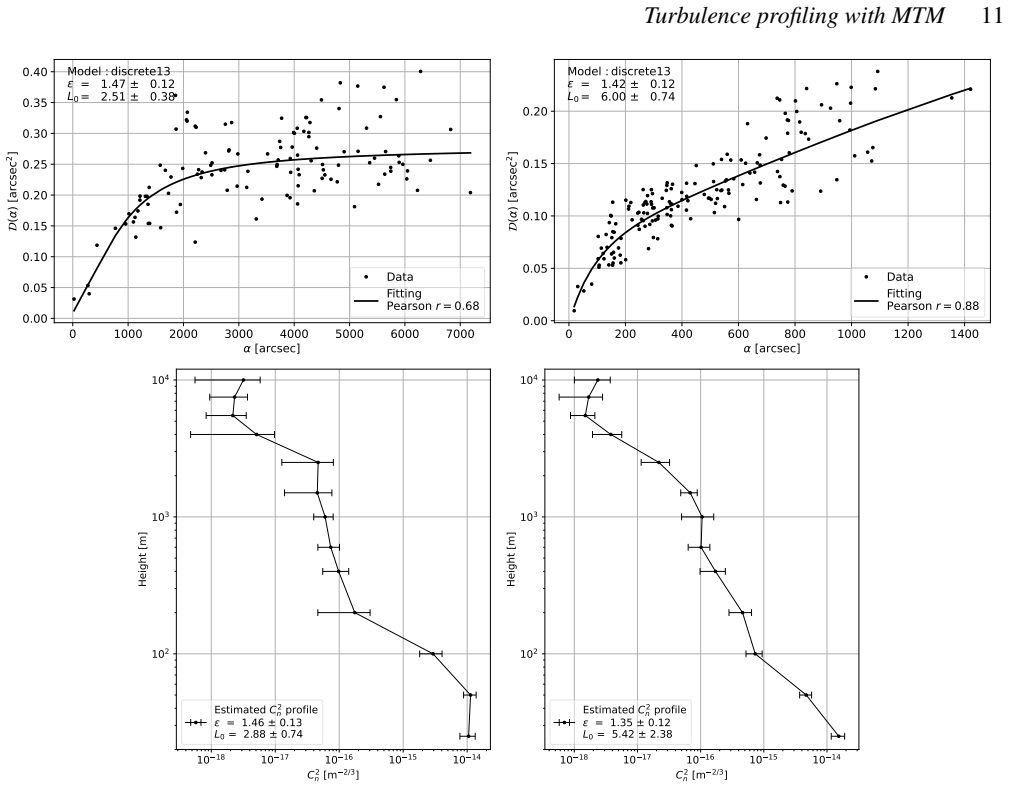
The MTM infers the vertical distribution of Cn2(z) from differential image motion measured between multiple stellar pairs in short-exposure frames. Simulations based on a standard HV turbulence model demonstrate that the MCMC inversion pipeline robustly recovers both the integrated seeing and the vertical turbulence profile under realistic centroiding noise and varying pixel scales. The MCMC inversion achieves stable results with thirteen discrete height nodes and provides reliable uncertainties. Three nights of MTM measurements at the Daocheng Astronomical Site show that MTM-derived seeing closely tracks simultaneous DIMM results, accurately reproducing both short-term fluctuations and the
What carries the argument
The MCMC inversion pipeline that maps differential image motions from stellar pairs to Cn2 values at thirteen discrete height nodes.
If this is right
- MTM supplies both integrated seeing and a layered Cn2 profile in a single portable instrument.
- The thirteen-node MCMC solution yields uncertainty estimates that can guide adaptive-optics performance predictions.
- Routine nightly monitoring of turbulence conditions becomes feasible without dedicated large-aperture profilers.
- The method supports site testing campaigns where equipment must be moved between locations.
Where Pith is reading between the lines
- Portable MTM units could be deployed in coordinated campaigns to compare turbulence statistics across candidate observatory sites.
- Feeding MTM layer heights into real-time AO controllers might improve correction bandwidth when strong layers are identified.
- The fixed thirteen-node grid could be replaced by an adaptive node placement if future work shows that certain height intervals dominate the error budget.
Load-bearing premise
Differential image motion between stellar pairs directly and uniquely determines the discrete Cn2(z) profile via MCMC inversion without significant biases from centroiding errors, pixel scale variations, or the choice of height discretization.
What would settle it
Simultaneous MTM and DIMM observations at a site with strong, rapidly changing ground-layer turbulence that show large systematic offsets in integrated seeing, or Monte Carlo simulations that fail to recover the input Cn2 profile once realistic centroiding noise is injected.
Figures




read the original abstract
Accurate characterization of atmospheric optical turbulence is essential for evaluating astronomical sites and optimizing adaptive optics systems. The Multistar Turbulence Monitor (MTM) infers the vertical distribution of the refractive-index structure constant Cn2(z) from differential image motion measured between multiple stellar pairs in short-exposure frames. We present a comprehensive investigation of the MTM method, combining theoretical analysis, instrument-performance assessment, numerical simulations, and on-sky observations obtained at the Daocheng Astronomical Site. Simulations based on a standard HV turbulence model demonstrate that the inversion pipeline robustly recovers both the integrated seeing and the vertical turbulence profile under realistic centroiding noise and varying pixel scales. The Markov Chain Monte Carlo (MCMC) inversion achieves stable results with thirteen discrete height nodes and provides reliable uncertainties. Three nights of MTM measurements at the Daocheng Astronomical Site show that MTM-derived seeing closely tracks simultaneous Differential Image Motion Monitor (DIMM) results, accurately reproducing both short-term fluctuations and nightly averages. These results confirm that MTM provides a simple, portable, and versatile solution for atmospheric turbulence profiling and routine seeing monitoring.
Editorial analysis
A structured set of objections, weighed in public.
Referee Report
Summary. The manuscript introduces the Multistar Turbulence Monitor (MTM), which infers the vertical Cn²(z) profile from differential image motion between multiple stellar pairs using MCMC inversion with thirteen discrete height nodes. Simulations based on the Hufnagel-Valley (HV) model show recovery of both integrated seeing and the profile under centroiding noise and pixel-scale variations. Three nights of on-sky data at Daocheng Astronomical Site demonstrate that MTM-derived seeing closely tracks simultaneous DIMM measurements, reproducing short-term fluctuations and nightly averages.
Significance. If the inversion reliably recovers unique vertical profiles, MTM would offer a portable, low-cost complement to existing profilers for site characterization and AO system design. The MCMC uncertainty quantification and simulation tests under realistic noise are methodological strengths. However, the on-sky component primarily validates integrated seeing rather than layer heights, limiting immediate impact for the profiling claim.
major comments (3)
- [On-sky observations and results] The on-sky validation (three nights at Daocheng) compares only the integrated seeing (integral of Cn²) to DIMM; no independent Cn²(z) profile measurements from MASS, SLODAR, or balloon sondes are reported. This leaves the recovered vertical distribution unverified on real data and weakens support for the central profiling claim.
- [Numerical simulations] Simulations recover the input HV profile, but the forward operator is constructed from the same HV model and fixed 13-node grid. No tests are shown for recovery of profiles with layers offset from the nodes, different layer counts, or non-HV distributions, raising questions about uniqueness under realistic misalignment.
- [Inversion method and MCMC pipeline] The MCMC inversion uses a fixed set of thirteen height nodes without reported sensitivity tests to node number, spacing, or priors. This discretization choice is load-bearing for the uniqueness of Cn²(z) solutions and could absorb centroiding noise into biased layer strengths while still matching the integral.
minor comments (2)
- Figure captions and axis labels in the seeing comparison plots should explicitly state the time resolution and any data exclusion criteria to improve reproducibility.
- [Numerical simulations] The HV model parameters used to generate the simulation inputs should be tabulated for direct comparison with the recovered profiles.
Simulated Author's Rebuttal
We thank the referee for their detailed and constructive review of our manuscript on the Multistar Turbulence Monitor (MTM). We appreciate the positive assessment of the MCMC uncertainty quantification and simulation framework. Below we respond point-by-point to the major comments. Where appropriate, we indicate revisions that will be incorporated in the next version of the manuscript to address the concerns raised.
read point-by-point responses
-
Referee: The on-sky validation (three nights at Daocheng) compares only the integrated seeing (integral of Cn²) to DIMM; no independent Cn²(z) profile measurements from MASS, SLODAR, or balloon sondes are reported. This leaves the recovered vertical distribution unverified on real data and weakens support for the central profiling claim.
Authors: We agree that the on-sky component validates the integrated seeing against simultaneous DIMM measurements but does not include independent Cn²(z) profile comparisons from other instruments. No such data were acquired during the Daocheng campaign. In the revised manuscript we will add an explicit discussion of this limitation, clarify that the on-sky results confirm the integrated turbulence strength, and note that the vertical profiling capability rests on the simulation results. We will also outline plans for future coordinated observations with MASS or SLODAR to provide direct profile validation. revision: partial
-
Referee: Simulations recover the input HV profile, but the forward operator is constructed from the same HV model and fixed 13-node grid. No tests are shown for recovery of profiles with layers offset from the nodes, different layer counts, or non-HV distributions, raising questions about uniqueness under realistic misalignment.
Authors: We acknowledge that additional robustness tests are needed. In the revised manuscript we will include new simulation results demonstrating recovery for (i) layers deliberately offset from the 13-node grid, (ii) different total layer counts, and (iii) non-HV profiles such as single-layer and multi-layer cases with varying strengths. These tests will quantify the method’s performance under realistic misalignment and support the uniqueness of the recovered solutions within the noise model. revision: yes
-
Referee: The MCMC inversion uses a fixed set of thirteen height nodes without reported sensitivity tests to node number, spacing, or priors. This discretization choice is load-bearing for the uniqueness of Cn²(z) solutions and could absorb centroiding noise into biased layer strengths while still matching the integral.
Authors: We will expand the methods and results sections to report sensitivity tests varying the number of nodes (e.g., 7, 13, and 20), node spacing, and prior choices. These analyses will show that the 13-node discretization yields stable, unique solutions consistent with the input profiles and that the reported MCMC uncertainties appropriately reflect potential biases from noise absorption. The revised text will include the corresponding figures and quantitative metrics. revision: yes
- Independent on-sky Cn²(z) profile measurements from MASS, SLODAR, or balloon sondes are unavailable for the Daocheng observations, so direct real-data verification of the vertical distribution cannot be provided.
Circularity Check
No significant circularity; derivation and validation are self-contained
full rationale
The paper derives a forward operator from standard turbulence theory relating differential image motion between stellar pairs to a discrete Cn2(z) profile, then applies MCMC inversion with 13 fixed height nodes to recover the profile and its integral (seeing). Simulations inject a standard HV model plus realistic noise and pixel-scale variations into this operator and recover the input profile, which is ordinary numerical validation of an inversion algorithm rather than a reduction by construction. On-sky results compare only the integrated seeing value against an independent DIMM instrument; no profile is claimed to be validated on-sky and no self-citation or ansatz is invoked as load-bearing. The method therefore does not reduce any claimed result to its own inputs.
Axiom & Free-Parameter Ledger
free parameters (1)
- thirteen discrete height nodes
axioms (2)
- standard math Differential image motion between stellar pairs is directly related to the refractive-index structure constant Cn2(z) via established theory
- domain assumption The standard HV turbulence model is representative of conditions for testing recovery
Reference graph
Works this paper leans on
-
[1]
Measuring Atmospheric Turbulence with a Lunar Scintillometer Array. , keywords =. doi:10.1086/427046 , adsurl =
-
[2]
Monthly Notices of the Royal Astronomical Society , volume =
Griffiths, R and Bardou, L and Butterley, T and Osborn, J and Wilson, R and Bustos, E and Tokovinin, A and Le Louarn, M and Otarola, A , title =. Monthly Notices of the Royal Astronomical Society , volume =. 2024 , month =. doi:10.1093/mnras/stae434 , url =
-
[3]
SExtractor: Software for source extraction. , keywords =. doi:10.1051/aas:1996164 , adsurl =
-
[4]
2007, MNRAS, 378, 910, doi: 10.1111/j.1365-2966.2007.11817.x
Combined MASS-DIMM instruments for atmospheric turbulence studies. , keywords =. doi:10.1111/j.1365-2966.2007.12467.x , archivePrefix =. 0709.2081 , primaryClass =
-
[5]
A Review of Daytime Atmospheric Optical Turbulence Profile Detection Technology , journal =
Deng Jian and Song Teng-fei and Liu Yu , keywords =. A Review of Daytime Atmospheric Optical Turbulence Profile Detection Technology , journal =. 2023 , issn =. doi:https://doi.org/10.1016/j.chinastron.2023.06.001 , url =
-
[6]
Ground-based and Airborne Instrumentation for Astronomy , year = 2006, editor =
Ground-layer turbulence profiling using a lunar SHABAR. Ground-based and Airborne Instrumentation for Astronomy , year = 2006, editor =. doi:10.1117/12.672640 , adsurl =
-
[7]
Ground-based and Airborne Telescopes III , year = 2010, editor =
Seeing measurements with autonomous, short-baseline shadow band rangers. Ground-based and Airborne Telescopes III , year = 2010, editor =. doi:10.1117/12.857643 , adsurl =
-
[8]
Monthly Notices of the Royal Astronomical Society , volume =
Zhou, Qing and Liu, Yu and Song, Tengfei and Sha, Feiyang and Liu, Qiang and Li, Haitang and Zhang, Xuefei and Huang, Weisen and Lu, Liyuan and Wang, Xinjian and Luo, Qiwang and Chen, Yangrui and Zhang, Huan , title =. Monthly Notices of the Royal Astronomical Society , volume =. 2025 , month =. doi:10.1093/mnras/staf2103 , url =
-
[9]
Science China Physics, Mechanics & Astronomy , volume=
Sciences with the 2.5-meter Wide Field Survey Telescope (WFST) , author=. Science China Physics, Mechanics & Astronomy , volume=. 2023 , publisher=
2023
-
[10]
MUltiplexed Survey Telescope: Perspectives for Large-Scale Structure Cosmology in the Era of Stage-V Spectroscopic Survey , author=. arXiv preprint arXiv:2411.07970 , year=
work page internal anchor Pith review Pith/arXiv arXiv
-
[11]
Progress in Astronomy , keywords =
Optical Observatory Site Selection in the Qinghai-Tibet Plateau: Lenghu as a Promising Site for the Future Development of Optical Astronomy in China. Progress in Astronomy , keywords =. doi:10.3969/j.issn.1000-8349.2024.02.05 , adsurl =
-
[12]
Research in Astronomy and Astrophysics , keywords =
Site testing campaign for the Large Optical/infrared Telescope of China: overview. Research in Astronomy and Astrophysics , keywords =. doi:10.1088/1674-4527/20/6/80 , archivePrefix =. 2001.11378 , primaryClass =
-
[13]
Research in Astronomy and Astrophysics , keywords =
Site-testing at Muztagh-ata site I: ground meteorology and sky brightness. Research in Astronomy and Astrophysics , keywords =. doi:10.1088/1674-4527/20/6/86 , archivePrefix =. 2003.14079 , primaryClass =
-
[14]
Research in Astronomy and Astrophysics , keywords =
Site testing campaign for the Large Optical Telescope at the Ali site. Research in Astronomy and Astrophysics , keywords =. doi:10.1088/1674-4527/20/6/84 , adsurl =
-
[15]
The optical system of the proposed Chinese 12-m optical/infrared telescope , year=
Su, Ding-qiang and Liang, Ming and Yuan, Xiangyan and Bai, Hua and Cui, Xiangqun , journal=. The optical system of the proposed Chinese 12-m optical/infrared telescope , year=
-
[16]
Ground-based and Airborne Telescopes VII , year = 2018, editor =
Introduction on Chinese 12m optical/infrared telescope (LOT). Ground-based and Airborne Telescopes VII , year = 2018, editor =. doi:10.1117/12.2313044 , adsurl =
-
[17]
Research in Astronomy and Astrophysics , year =
Song, Teng-Fei and Liu, Yu and Wang, Jing-Xing and Zhang, Xue-Fei and Liu, Shun-Qing and Zhao, Ming-Yu and Li, Xiao-Bo and Cai, Zhan-Chuan and Song, Qi-Wu and Cao, Zi-Huang and Ruan, Yu , title =. Research in Astronomy and Astrophysics , year =
-
[18]
Monthly Notices of the Royal Astronomical Society , year = 2020, volume =
Daytime optical turbulence profiling with a profiler of the differential solar limb. Monthly Notices of the Royal Astronomical Society , year = 2020, volume =
2020
-
[19]
Nature , year = 2021, volume =
Lenghu on the Tibetan Plateau as an astronomical observing site. Nature , year = 2021, volume =
2021
-
[20]
Thirty Meter Telescope site testing I: Overview , journal =
Sch. Thirty Meter Telescope site testing I: Overview , journal =. 2009 , doi =
2009
-
[21]
Ground-based and Airborne Telescopes V , year = 2014, editor =
Overview and status of the Giant Magellan Telescope project. Ground-based and Airborne Telescopes V , year = 2014, editor =. doi:10.1117/12.2055282 , adsurl =
-
[22]
Ground-based and Airborne Telescopes III , year = 2010, editor =
GMT overview. Ground-based and Airborne Telescopes III , year = 2010, editor =. doi:10.1117/12.857852 , adsurl =
-
[23]
and others , title =
Vernin, J. and others , title =. Publications of the Astronomical Society of the Pacific , volume =. 2011 , doi =
2011
-
[24]
Fried, D. L. , title =. Journal of the Optical Society of America , volume =. 1982 , doi =
1982
-
[25]
Journal of the Optical Society of America (1917-1983) , keywords =
Modulation Transfer Function Associated with Image Transmission through Turbulent Media. Journal of the Optical Society of America (1917-1983) , keywords =. doi:10.1364/JOSA.54.000052 , adsurl =
-
[26]
Valley, G. C. , title =. Applied Optics , volume =. 1980 , doi =
1980
-
[27]
, title =
Dierickx, P. , title =. Journal of Modern Optics , volume =. 1992 , doi =
1992
-
[28]
V. I. Tatarskii , title =. 1961 , publisher =
1961
-
[29]
D. L. Fried , title =. Journal of the Optical Society of America , volume =
-
[30]
, keywords =
The ESO differential image motion monitor. , keywords =
-
[31]
Tokovinin, A. , title =. 2002 , month =. doi:10.1086/342683 , url =
-
[32]
Monthly Notices of the Royal Astronomical Society , volume =
Hickson, Paul and Ma, Bin and Shang, Zhaohui and Xue, Suijian , title =. Monthly Notices of the Royal Astronomical Society , volume =. 2019 , doi =
2019
-
[33]
and Hubin, N
Le Louarn, M. and Hubin, N. , title =. Monthly Notices of the Royal Astronomical Society , volume =. 2006 , doi =
2006
-
[34]
Optical and Infrared Interferometry , year = 2008, editor =
LuSci: a lunar scintillometer to study ground layer turbulence. Optical and Infrared Interferometry , year = 2008, editor =. doi:10.1117/12.789042 , adsurl =
-
[35]
Beckers, J. M. , year =. Adaptive optics for astronomy: Principles, performance, and applications , journal =
-
[36]
, year =
Rigaut, F. , year =. Ground-layer adaptive optics for 8-m class telescopes: Performance, limitations, and prospects , journal =
-
[37]
Very Large Telescopes and their Instrumentation, Volume 2 , year = 1988, editor =
Increasing the Size of the Isoplanatic Patch with Multiconjugate Adaptive Optics. Very Large Telescopes and their Instrumentation, Volume 2 , year = 1988, editor =
1988
-
[38]
Focusing on a Turbulent Layer: Principle of the ``Generalized SCIDAR''. , keywords =. doi:10.1086/316109 , adsurl =
-
[39]
Profiling of atmospheric turbulence strength and velocity using a generalised SCIDAR technique. , keywords =. doi:10.1051/aas:1998217 , adsurl =
-
[40]
Adaptive Optical System Technologies II , year = 2003, editor =
MASS: a monitor of the vertical turbulence distribution. Adaptive Optical System Technologies II , year = 2003, editor =. doi:10.1117/12.457982 , adsurl =
-
[41]
Meteorologische Rundschau , keywords =
A new monostatic Doppler-SODAR system - Principle of measurement and comparison with direct measurements. Meteorologische Rundschau , keywords =
-
[42]
L., Crittenden, R., Melchiorri, A., Hobson, M
SLODAR: measuring optical turbulence altitude with a Shack-Hartmann wavefront sensor. , keywords =. doi:10.1046/j.1365-8711.2002.05847.x , adsurl =
-
[43]
Progess in Optics , keywords =
The effects of atmospheric turbulence in optical astronomy. Progess in Optics , keywords =. doi:10.1016/S0079-6638(08)70204-X , adsurl =
-
[44]
and Roddier, F
Vernin, J. and Roddier, F. , year =. Experimental determination of two-dimensional spectral density of atmospheric turbulence for optical propagation , journal =
-
[45]
, author=
Laser wind sensing: the effects of saturation of scintillation. , author=. Applied optics , year=
-
[46]
European Extremely Large Telescope Site Characterization. II. High Angular Resolution Parameters , journal =. 2012 , volume =
2012
-
[47]
Exceptional astronomical seeing conditions above Dome C in Antarctica , volume =
Lawrence, Jon and Ashley, Michael and Tokovinin, Andrei and Travouillon, Tony , year =. Exceptional astronomical seeing conditions above Dome C in Antarctica , volume =. Nature , pages =
-
[48]
Defense, Security, and Sensing , year=
Folding-up of the vertical atmospheric turbulence profile using an optical technique of movable observing plane , author=. Defense, Security, and Sensing , year=
-
[49]
and Lombardi, G
Masciadri, E. and Lombardi, G. and Lascaux, F. , title =. Monthly Notices of the Royal Astronomical Society , volume =. 2014 , doi =
2014
-
[50]
Bufton and Peter O
Jack L. Bufton and Peter O. Minott and Michael W. Fitzmaurice and Paul J. Titterton , journal =. Measurements of Turbulence Profiles in the Troposphere , volume =. 1972 , doi =
1972
-
[51]
Journal of Atmospheric and Solar-Terrestrial Physics , year=
Measurement and analysis of atmospheric optical turbulence in Lhasa based on thermosonde , author=. Journal of Atmospheric and Solar-Terrestrial Physics , year=
-
[52]
and Ziad, A
Tokovinin, Andrei and Vernin, J. and Ziad, A. and Chun, M. , year =. Optical turbulence profiles at Mauna Kea measured by MASS and SCIDAR , pages =. Publications of the Astronomical Society of the Pacific , doi =
-
[53]
Monthly Notices of the Royal Astronomical Society , year=
Stereo-SCIDAR: optical turbulence profiling with high sensitivity using a modified SCIDAR instrument , author=. Monthly Notices of the Royal Astronomical Society , year=
-
[54]
and Wilson, R
Butterley, T. and Wilson, R. W. and Sarazin, M. , title =. Monthly Notices of the Royal Astronomical Society , volume =. 2006 , doi =
2006
-
[55]
Monthly Notices of the Royal Astronomical Society , volume =
Osborn, James and Wilson, Richard and Butterley, Timothy and Shepherd, Harry and Sarazin, Marc , title =. Monthly Notices of the Royal Astronomical Society , volume =. 2010 , doi =
2010
-
[56]
Publications of the Astronomical Society of the Pacific , year = 1987, volume =
Image motion as a measure of seeing quality. Publications of the Astronomical Society of the Pacific , year = 1987, volume =
1987
-
[57]
Comparison of evaluation methods for the Differential Image Motion Monitor , author=
Seeing measurements using the solar limb – I. Comparison of evaluation methods for the Differential Image Motion Monitor , author=. Monthly Notices of the Royal Astronomical Society , year=
-
[58]
Publications of the Astronomical Society of the Pacific , year = 2015, volume =
Solar Ground-Layer Adaptive Optics. Publications of the Astronomical Society of the Pacific , year = 2015, volume =
2015
-
[59]
Publications of the Astronomical Society of the Pacific , year = 2016, volume =
Advanced Multiple Aperture Seeing Profiler. Publications of the Astronomical Society of the Pacific , year = 2016, volume =
2016
-
[60]
PML: a generalized monitor of atmospheric turbulence profile with high vertical resolution , volume =
Julien Chab\'. PML: a generalized monitor of atmospheric turbulence profile with high vertical resolution , volume =. Applied Optics , pages =. 2020 , doi =
2020
-
[61]
and Liu, Yu and Elmhamdi, Abouazza and Kordi, Ayman and Mingyu, Zhao and Zhang, X
Song, Tengfei and Wen, Y. and Liu, Yu and Elmhamdi, Abouazza and Kordi, Ayman and Mingyu, Zhao and Zhang, X. and Li, X. and Wang, J. and Fu, Y. and Cheng, Xiangming and Xu, F. , year =. Automatic Solar Seeing Observations at Mt. Wumingshan in Western China , volume =. Solar Physics , doi =
-
[62]
, author=
Improved detection of atmospheric turbulence with SLODAR. , author=. Optics express , year=
-
[63]
doi:10.1051/0004-6361/200913791
S-DIMM+ height characterization of day-time seeing using solar granulation , journal =. doi:10.1051/0004-6361/200913791
-
[64]
Research in Astronomy and Astrophysics , year=
Multi-aperture seeing profiler with multiple guide stars , author=. Research in Astronomy and Astrophysics , year=
-
[65]
Acta Astronomica Sinica , year = 2019, volume =
Numerical Simulation Research of Advanced Multiple Aperture Seeing Profiler. Acta Astronomica Sinica , year = 2019, volume =
2019
-
[66]
Monthly Notices of the Royal Astronomical Society , year = 2006, volume =
Single star scidar: atmospheric parameters profiling using the simulated annealing algorithm. Monthly Notices of the Royal Astronomical Society , year = 2006, volume =
2006
-
[67]
Ziad and C
A. Ziad and C. Giordano and A. Aresta and C. Aristidi and C. Bailet and C. Bertolin and M. Carbillet and others , title =. Adaptive Optics Systems IX , publisher =. 2024 , doi =
2024
-
[68]
Chinese Science Bulletin , year=
Optical turbulence profiling with single star SCIDAR technique , author=. Chinese Science Bulletin , year=
-
[69]
2007, MNRAS, 378, 910, doi: 10.1111/j.1365-2966.2007.11817.x
Accurate seeing measurements with MASS and DIMM. , keywords =. doi:10.1111/j.1365-2966.2007.12307.x , archivePrefix =. 0708.0195 , primaryClass =
discussion (0)
Sign in with ORCID, Apple, or X to comment. Anyone can read and Pith papers without signing in.