Recognition: unknown
Reduced-Order Modeling of Parameterized Visco-Plastic Shallow Flows
Pith reviewed 2026-05-08 05:49 UTC · model grok-4.3
The pith
A non-intrusive tensor model reconstructs parameterized visco-plastic shallow flows directly from compressed snapshot data without performing reduced time integration.
A machine-rendered reading of the paper's core claim, the machinery that carries it, and where it could break.
Core claim
The central claim is that higher-order singular value decomposition of snapshot tensors collected over a structured parameter space produces a tensorial reduced-order model that accurately recovers front propagation, plug and shear zones, and near-stopping behavior in visco-plastic shallow flows while delivering large speedups over full-order runs, all without solving any reduced dynamical system.
What carries the argument
The tensorial reduced-order model (TROM) formed by higher-order singular value decomposition of solution snapshots, which enables direct multilinear reconstruction of trajectories from the compressed factors.
If this is right
- Front propagation speeds and positions are recovered to high visual and quantitative accuracy.
- Plug and shear regions are identified correctly across the domain at each time.
- Near-stopping dynamics, including gradual cessation of motion, are reproduced without artificial continuation.
- Online evaluation requires only multilinear operations on the stored factors, yielding orders-of-magnitude speedups.
Where Pith is reading between the lines
- The same snapshot-tensor construction could be applied to other free-surface flows whose rheology produces sharp yield surfaces, such as certain granular or Bingham models.
- Because the method stores only the compressed factors, it offers a natural route to uncertainty propagation over the parameter space by sampling the low-rank representation.
- The non-intrusive character means the full-order solver can be treated as a black box, which simplifies incorporation into existing industrial simulation pipelines.
Load-bearing premise
The full set of flow solutions over the chosen parameter grid lies close enough to a low-rank tensor that the factors obtained by higher-order singular value decomposition still reconstruct the nonlinear non-smooth dynamics and moving fronts accurately.
What would settle it
A side-by-side comparison in which the reconstructed front location or the size of the unyielded plug region deviates by more than a few percent from a full-order simulation at a parameter combination inside the training grid but not used to build the tensor.
Figures



read the original abstract
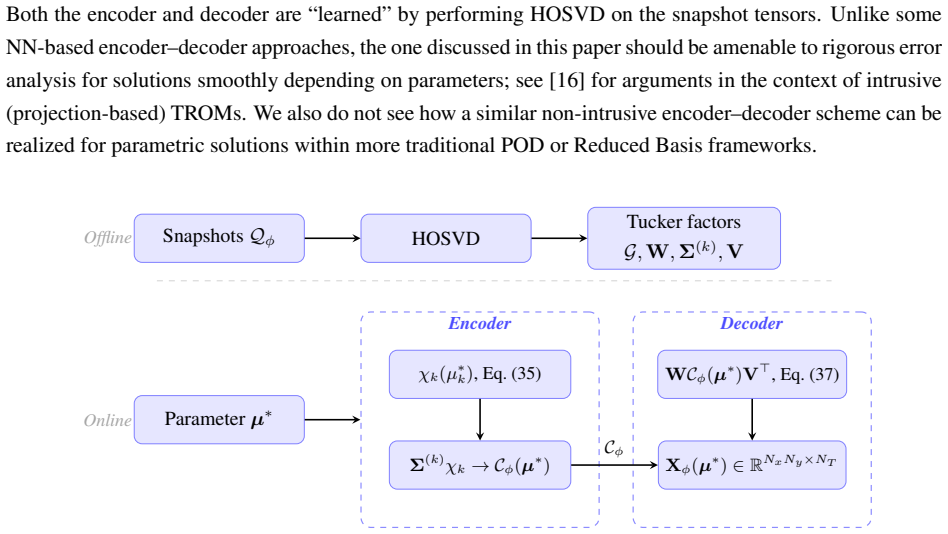
We propose a non-intrusive reduced-order modeling framework for parametrized visco-plastic free-surface flows governed by a shallow-water formulation of Herschel--Bulkley fluids. These flows exhibit strong nonlinearities, non-smooth rheology, moving fronts, and yield surfaces, making efficient surrogate modeling particularly challenging. To address this challenge, we employ a tensor-based approach in which the solution manifold is approximated using a low-rank representation obtained via higher-order singular value decomposition of snapshot data over a structured parameter space. The resulting tensorial reduced-order model (TROM) enables rapid online evaluation by directly reconstructing solution trajectories from the compressed representation, thereby avoiding the need to perform time integration of a reduced dynamical system. The proposed non-intrusive framework can be interpreted as an encoder--decoder architecture with a compressed latent representation and efficient multilinear decoding. Numerical experiments demonstrate that the proposed approach accurately captures key flow features, including front propagation, plug and shear regions, and near-stopping dynamics, while achieving substantial computational speedups relative to full-order simulations.
Editorial analysis
A structured set of objections, weighed in public.
Referee Report
Summary. The manuscript introduces a tensor-based reduced-order model (TROM) for parameterized visco-plastic shallow flows governed by the Herschel-Bulkley model. Snapshots from full-order simulations over a structured parameter space are compressed using higher-order singular value decomposition (HOSVD) to obtain a low-rank tensor representation. The online phase reconstructs the space-time solution fields directly via multilinear operations on the core tensor and factor matrices, without integrating a reduced-order dynamical system. This is presented as a non-intrusive encoder-decoder framework. The authors report through numerical experiments that the model accurately reproduces important physical features such as moving fronts, plug and yielded regions, and near-stopping behavior, while delivering significant computational savings.
Significance. If validated quantitatively, the proposed TROM could offer a practical tool for parametric exploration of visco-plastic flows, where full simulations are costly due to the nonlinear rheology and free-surface dynamics. The tensor approach is well-suited for multi-dimensional parameter spaces and the direct reconstruction avoids the difficulties of reduced dynamics for non-smooth problems. This represents a useful contribution to non-intrusive ROM techniques in fluid mechanics, particularly if the method maintains fidelity at yield surfaces for unseen parameters.
major comments (2)
- [Numerical Experiments] The section asserts that the TROM 'accurately captures key flow features' and achieves 'substantial computational speedups,' yet no specific quantitative metrics—such as relative L2 errors in height and velocity fields, errors in front position over time, or comparisons of stopping times—are provided. This absence makes it impossible to assess whether the low-rank approximation is sufficient for the central claim of accuracy in non-smooth dynamics.
- [§3] The reconstruction procedure relies on multilinear decoding of the HOSVD-compressed tensor. However, this linear operation in tensor space does not inherently satisfy the mass conservation or the yield-surface condition (variational inequality) of the original shallow-water system. Given that the location of the yield surface depends nonlinearly on the rheological parameters, it is unclear whether modest core ranks can avoid smearing of discontinuities or shifts in near-stopping dynamics for out-of-sample parameters.
minor comments (3)
- [Abstract] The speedup is described as 'substantial' without numerical values; including example factors (e.g., 100x) would strengthen the summary.
- Clarify the precise definition of the structured parameter space and the sampling strategy used for generating snapshots.
- [Introduction] A brief comparison to existing POD-based or intrusive ROM methods for non-Newtonian flows would help situate the contribution.
Simulated Author's Rebuttal
We thank the referee for the constructive and detailed report, which highlights key aspects of quantitative validation and the approximation properties of our non-intrusive TROM. We address each major comment below and have revised the manuscript to strengthen the presentation of results and discussion.
read point-by-point responses
-
Referee: [Numerical Experiments] The section asserts that the TROM 'accurately captures key flow features' and achieves 'substantial computational speedups,' yet no specific quantitative metrics—such as relative L2 errors in height and velocity fields, errors in front position over time, or comparisons of stopping times—are provided. This absence makes it impossible to assess whether the low-rank approximation is sufficient for the central claim of accuracy in non-smooth dynamics.
Authors: We agree that explicit quantitative metrics are necessary to substantiate the accuracy claims, especially for non-smooth features such as yield surfaces. In the revised manuscript, we have added a new table and accompanying figures in the Numerical Experiments section that report relative L2 errors for the height and velocity fields over the full space-time domain, as well as time-dependent errors in front position and stopping times. These metrics are provided for both in-sample and out-of-sample parameter values and confirm that the low-rank approximation remains accurate without excessive smearing. revision: yes
-
Referee: [§3] The reconstruction procedure relies on multilinear decoding of the HOSVD-compressed tensor. However, this linear operation in tensor space does not inherently satisfy the mass conservation or the yield-surface condition (variational inequality) of the original shallow-water system. Given that the location of the yield surface depends nonlinearly on the rheological parameters, it is unclear whether modest core ranks can avoid smearing of discontinuities or shifts in near-stopping dynamics for out-of-sample parameters.
Authors: The referee correctly identifies that the multilinear reconstruction is a linear operation in tensor space and therefore does not enforce the variational inequality or mass conservation of the original system; this is an intrinsic characteristic of non-intrusive data-driven ROMs that prioritize computational efficiency over strict constraint satisfaction. We have expanded the discussion in §3 to clarify this approximation nature and to explain how the HOSVD-based compression captures the dominant modes of the solution manifold. Additional out-of-sample numerical tests have been included to demonstrate that, for the modest core ranks employed, smearing of yield surfaces and shifts in stopping dynamics remain small, as evidenced by the newly reported quantitative metrics. revision: partial
Circularity Check
Snapshot-driven HOSVD tensor reconstruction is a standard non-intrusive ROM with independent numerical validation
full rationale
The derivation consists of collecting full-order snapshots over a structured parameter grid, computing a low-rank tensor approximation via HOSVD, and performing direct multilinear reconstruction for new parameter values without reduced dynamics. This process is self-contained: the reconstruction operator is explicitly defined from the input data tensor, the accuracy claims rest on separate numerical comparisons to full-order solutions (not on any tautological identity), and the low-rank manifold assumption is imported from tensor algebra rather than derived from the visco-plastic equations. No self-definitional steps, fitted inputs renamed as predictions, or load-bearing self-citations appear in the method description.
Axiom & Free-Parameter Ledger
axioms (1)
- domain assumption The solution manifold of parameterized visco-plastic shallow flows admits a low-rank tensor representation via higher-order singular value decomposition over a structured parameter space.
Reference graph
Works this paper leans on
-
[1]
The dam-break problem for Herschel–Bulkley viscoplastic fluids down steep flumes.Journal of Non-Newtonian Fluid Mechanics, 158(1-3):18–35, 2009
Christophe Ancey and Steve Cochard. The dam-break problem for Herschel–Bulkley viscoplastic fluids down steep flumes.Journal of Non-Newtonian Fluid Mechanics, 158(1-3):18–35, 2009
2009
-
[2]
Francesco Ballarin and Gianluigi Rozza. Supremizer stabilization of POD–Galerkin approximation of parametrized steady incompressible navier–stokes equations.International Journal for Numerical Methods in Engineering, 102(5):1136–1161, 2016. 20
2016
-
[3]
Viscoplastic flow over an inclined surface.Journal of non-newtonian fluid mechanics, 139(1-2):103–127, 2006
Neil J Balmforth, Richard V Craster, Alison C Rust, and Roberto Sassi. Viscoplastic flow over an inclined surface.Journal of non-newtonian fluid mechanics, 139(1-2):103–127, 2006
2006
-
[4]
A consistent thin-layer theory for Bingham plastics.Journal of non- newtonian fluid mechanics, 84(1):65–81, 1999
NJ Balmforth and RV Craster. A consistent thin-layer theory for Bingham plastics.Journal of non- newtonian fluid mechanics, 84(1):65–81, 1999
1999
-
[5]
Survey of projection-based model reduction meth- ods for parametric dynamical systems.SIAM Review, 57(4):483–531, 2015
Peter Benner, Serkan Gugercin, and Karen Willcox. Survey of projection-based model reduction meth- ods for parametric dynamical systems.SIAM Review, 57(4):483–531, 2015
2015
-
[6]
Compar- ing different stabilization strategies for reduced order modeling of viscoelastic fluid flow problems
Manisha Chetry, Domenico Borzacchiello, Gaetano D’Avino, and Luisa Rocha Da Silva. Compar- ing different stabilization strategies for reduced order modeling of viscoelastic fluid flow problems. Computers & Fluids, 265:106013, 2023
2023
-
[7]
A multilinear singular value decomposi- tion.SIAM journal on Matrix Analysis and Applications, 21(4):1253–1278, 2000
Lieven De Lathauwer, Bart De Moor, and Joos Vandewalle. A multilinear singular value decomposi- tion.SIAM journal on Matrix Analysis and Applications, 21(4):1253–1278, 2000
2000
-
[8]
Shallow water equations for non- Newtonian fluids.Journal of Non-Newtonian Fluid Mechanics, 165(13-14):712–732, 2010
Enrique D Fern ´andez-Nieto, Pascal Noble, and Jean-Paul Vila. Shallow water equations for non- Newtonian fluids.Journal of Non-Newtonian Fluid Mechanics, 165(13-14):712–732, 2010
2010
-
[9]
Multilayer models for hy- drostatic Herschel–Bulkley viscoplastic flows.Computers & Mathematics with Applications, 139:99– 117, 2023
Enrique Domingo Fern ´andez-Nieto, Jos´e Garres-D´ıaz, and Paul Vigneaux. Multilayer models for hy- drostatic Herschel–Bulkley viscoplastic flows.Computers & Mathematics with Applications, 139:99– 117, 2023
2023
-
[10]
Thermo-rheological reduced order models for non-Newtonian fluid flows with power-law viscosity via the modal identification method
Manuel Girault, Qiao Lin, Nadine Allanic, and Pierre Mousseau. Thermo-rheological reduced order models for non-Newtonian fluid flows with power-law viscosity via the modal identification method. International Journal of Heat and Mass Transfer, 203:123692, 2023
2023
-
[11]
Digital twins of the earth with and for humans.Communications earth & environment, 5(1):463, 2024
W Hazeleger, JPM Aerts, Peter Bauer, MFP Bierkens, Gustau Camps-Valls, MM Dekker, FJ Doblas- Reyes, Veronika Eyring, C Finkenauer, Arthur Grundner, et al. Digital twins of the earth with and for humans.Communications earth & environment, 5(1):463, 2024
2024
-
[12]
A Herschel–Bulkley model for mud flow down a slope.Journal of fluid mechanics, 374:305–333, 1998
Xin Huang and Marcelo H Garcia. A Herschel–Bulkley model for mud flow down a slope.Journal of fluid mechanics, 374:305–333, 1998
1998
-
[13]
Numerical modeling of mudflows.Journal of hydraulic engineering, 123(7):617–623, 1997
Dominique Laigle and Philippe Coussot. Numerical modeling of mudflows.Journal of hydraulic engineering, 123(7):617–623, 1997
1997
-
[14]
Interpolatory tensorial reduced order models for parametric dynamical systems.Computer Methods in Applied Mechanics and Engineering, 397:115122, 2022
Alexander V Mamonov and Maxim A Olshanskii. Interpolatory tensorial reduced order models for parametric dynamical systems.Computer Methods in Applied Mechanics and Engineering, 397:115122, 2022
2022
-
[15]
Tensorial parametric model order reduction of nonlinear dynamical systems.SIAM Journal on Scientific Computing, 46(3):A1850–A1878, 2024
Alexander V Mamonov and Maxim A Olshanskii. Tensorial parametric model order reduction of nonlinear dynamical systems.SIAM Journal on Scientific Computing, 46(3):A1850–A1878, 2024
2024
-
[16]
A priori analysis of a tensor ROM for parameter dependent parabolic problems.SIAM Journal on Numerical Analysis, 63(1):239–261, 2025
Alexander V Mamonov and Maxim A Olshanskii. A priori analysis of a tensor ROM for parameter dependent parabolic problems.SIAM Journal on Numerical Analysis, 63(1):239–261, 2025. 21
2025
-
[17]
Derivation and numerical resolution of 2D shallow water equations for multi-regime flows of Herschel–Bulkley fluids.European Journal of Mechanics-B/Fluids, 109:22–36, 2025
David K Muchiri, Jerome Monnier, and Mathieu Sellier. Derivation and numerical resolution of 2D shallow water equations for multi-regime flows of Herschel–Bulkley fluids.European Journal of Mechanics-B/Fluids, 109:22–36, 2025
2025
-
[18]
Numerical simulations of dam-break flows of viscoplastic fluids via shallow water equations
David Kibe Muchiri, James N Hewett, Mathieu Sellier, Miguel Moyers-Gonzalez, and Jerome Mon- nier. Numerical simulations of dam-break flows of viscoplastic fluids via shallow water equations. Theoretical and Computational Fluid Dynamics, 38(4):557–581, 2024
2024
-
[19]
Comparing lubrication approximation with shallow water equations for viscoplastic flows.Wave Motion, page 103648, 2025
David Kibe Muchiri, Mathieu Sellier, James N Hewett, Miguel Moyers-Gonz ´alez, and J ´erˆome Mon- nier. Comparing lubrication approximation with shallow water equations for viscoplastic flows.Wave Motion, page 103648, 2025
2025
-
[20]
Nonlinear parametric models of viscoelastic fluid flows.Royal Society Open Science, 11(10), 2024
Cassio M Oishi, Alan A Kaptanoglu, J Nathan Kutz, and Steven L Brunton. Nonlinear parametric models of viscoelastic fluid flows.Royal Society Open Science, 11(10), 2024
2024
-
[21]
Springer, 2015
Alfio Quarteroni, Andrea Manzoni, and Federico Negri.Reduced Basis Methods for Partial Differen- tial Equations: An Introduction. Springer, 2015
2015
-
[22]
Model reduction for fluids, using balanced proper orthogonal decomposition
Clarence W Rowley. Model reduction for fluids, using balanced proper orthogonal decomposition. International Journal of Bifurcation and Chaos, 15(03):997–1013, 2005
2005
-
[23]
The calculation of the interaction of non-stationary shock waves and obstacles.USSR Computational Mathematics and Mathematical Physics, 1(2):304–320, 1962
Vladimir Vasil’evich Rusanov. The calculation of the interaction of non-stationary shock waves and obstacles.USSR Computational Mathematics and Mathematical Physics, 1(2):304–320, 1962
1962
-
[24]
Enhancing risk analysis toward a landscape digital twin framework: A multi-hazard approach in the context of a socio- economic perspective.Sustainability, 15(16):12429, 2023
Francesca Maria Ugliotti, Anna Osello, Muhammad Daud, and Ozan Onur Yilmaz. Enhancing risk analysis toward a landscape digital twin framework: A multi-hazard approach in the context of a socio- economic perspective.Sustainability, 15(16):12429, 2023
2023
-
[25]
Yue Wang, Hanghang Ma, Weihua Cai, Hongna Zhang, Jianping Cheng, and Xin Zheng. A POD- Galerkin reduced-order model for two-dimensional Rayleigh-B ´enard convection with viscoelastic fluid.International Communications in Heat and Mass Transfer, 117:104747, 2020
2020
-
[26]
Data-driven physics-informed neural networks: A digital twin perspective.Computer Methods in Applied Mechanics and Engineering, 428:117075, 2024
Sunwoong Yang, Hojin Kim, Yoonpyo Hong, Kwanjung Yee, Romit Maulik, and Namwoo Kang. Data-driven physics-informed neural networks: A digital twin perspective.Computer Methods in Applied Mechanics and Engineering, 428:117075, 2024. 22
2024
discussion (0)
Sign in with ORCID, Apple, or X to comment. Anyone can read and Pith papers without signing in.