Recognition: unknown
Emergence of a correlated insulating state in bulk 1T-NbSe₂ via metal intercalation
Pith reviewed 2026-05-08 05:34 UTC · model grok-4.3
The pith
Sn intercalation stabilizes bulk 1T-NbSe2 and induces an insulating state driven by electronic correlations.
A machine-rendered reading of the paper's core claim, the machinery that carries it, and where it could break.
Core claim
Electrochemical Sn intercalation induces the 1T structure in bulk NbSe2, as confirmed by transmission electron microscopy. The resulting crystals display insulating transport while density functional theory calculations yield a metallic band structure, indicating that strong electronic correlations are responsible for the gap. Raman spectroscopy further detects vibrational signatures of Sn intercalation together with modes suggestive of charge-density-wave order.
What carries the argument
Electrochemical Sn intercalation that drives the 2H-to-1T structural conversion and thereby activates correlation-induced insulation.
If this is right
- Bulk 1T-NbSe2 becomes experimentally accessible beyond the monolayer limit.
- Electrochemical intercalation provides a scalable method to stabilize other metastable polytypes of transition-metal dichalcogenides.
- The insulating state coexists with Raman signatures that may indicate charge-density-wave order, opening a route to study intertwined orders.
- Direct comparison between metallic 2H-NbSe2 and insulating 1T-NbSe2 becomes possible within the same material family.
Where Pith is reading between the lines
- Similar intercalation protocols could be tested on other metallic TMDs to search for additional correlation-driven insulators.
- The DFT-transport mismatch implies that advanced many-body methods will be required to model the 1T phase quantitatively.
- If the correlations are tunable by Sn concentration, the system may allow continuous control of the metal-insulator transition.
Load-bearing premise
The measured insulating transport is produced by intrinsic electron correlations rather than by disorder or defects created during the Sn insertion process.
What would settle it
Preparation of bulk 1T-NbSe2 by a non-intercalation route that yields metallic transport would indicate that the insulation arises from intercalation-induced disorder rather than from correlations inherent to the 1T phase.
Figures



read the original abstract
The 1T polymorph of NbSe$_2$, long confined to the monolayer limit, has remained inaccessible in bulk. Here, we report the realization of bulk 1T-NbSe$_2$ via electrochemical Sn intercalation. Transmission electron microscopy directly reveals the formation of the 1T structure induced by Sn intercalation. The intercalated samples exhibit insulating transport behavior, in stark contrast to metallic 2H-NbSe$_2$. Density functional theory calculations, however, predict a metallic band structure, highlighting the crucial role of emergent electronic correlations in the observed insulating state. Raman spectroscopy further reveals vibrational modes associated with Sn intercalation and possible charge density wave order. Our results establish electrochemical intercalation as an effective route to stabilize otherwise inaccessible bulk polytypes, positioning bulk 1T-NbSe$_2$ as a new platform for investigating correlated electronic states.
Editorial analysis
A structured set of objections, weighed in public.
Referee Report
Summary. The manuscript reports stabilization of bulk 1T-NbSe2 via electrochemical Sn intercalation of 2H-NbSe2. TEM directly confirms the 1T polytype. Intercalated samples show insulating transport, in contrast to metallic 2H-NbSe2. DFT on the 1T structure predicts a metal, from which the authors infer that emergent electronic correlations drive the observed insulation. Raman spectroscopy identifies modes linked to Sn intercalation and possible CDW order.
Significance. If the central attribution to intrinsic correlations is substantiated, the result is significant: it supplies a bulk platform for correlated insulating states in a TMDC polytype previously restricted to monolayers and demonstrates electrochemical intercalation as a general route to otherwise inaccessible polytypes. The experimental contrast with metallic DFT is a clear strength when properly controlled.
major comments (3)
- [Transport measurements] Transport section: the insulating behavior is reported without quantitative characterization (resistivity magnitude, activation energy, Arrhenius or VRH fits, or low-T upturn analysis). This information is required to distinguish correlation-driven insulation from disorder-induced localization caused by random Sn potentials or residual 2H domains.
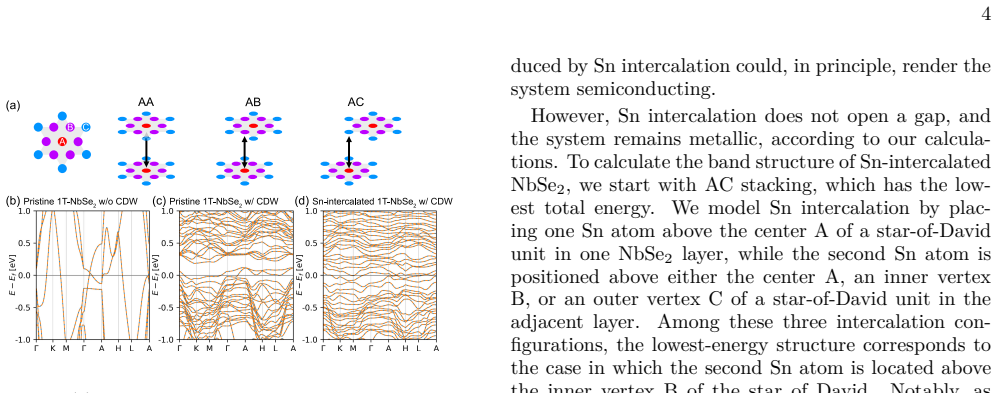
- [DFT calculations] DFT calculations: performed on an idealized Sn-free 1T-NbSe2 cell. Because the experimental samples contain intercalated Sn, the metallic prediction does not directly apply to the measured material; a calculation including Sn (or explicit disorder) is needed to support the claim that the gap is correlation-induced rather than structural or chemical.
- [TEM and structural characterization] Structural and transport linkage: TEM establishes local 1T stacking, yet transport is a macroscopic average. No data or discussion address possible phase inhomogeneity, stacking faults, or incomplete conversion that could produce insulating behavior through percolation or localization without invoking emergent correlations.
minor comments (3)
- [Raman spectroscopy] Raman section: the assignment of modes to possible CDW order should include explicit peak positions, temperature dependence, and direct comparison to literature spectra for monolayer 1T-NbSe2.
- [Figures] Figure captions and labels: TEM images should explicitly mark 1T vs. residual 2H regions and scale bars; transport plots would benefit from log-scale resistivity and comparison to pristine 2H data on the same axes.
- [Introduction and discussion] References: add citations to prior monolayer 1T-NbSe2 studies and to intercalation-induced polytype changes in related TMDCs (e.g., TaS2, TiSe2) to contextualize the novelty.
Simulated Author's Rebuttal
We thank the referee for the constructive and detailed report. The comments highlight important points that will strengthen the manuscript. We address each major comment below and will revise the manuscript accordingly.
read point-by-point responses
-
Referee: Transport section: the insulating behavior is reported without quantitative characterization (resistivity magnitude, activation energy, Arrhenius or VRH fits, or low-T upturn analysis). This information is required to distinguish correlation-driven insulation from disorder-induced localization caused by random Sn potentials or residual 2H domains.
Authors: We agree that quantitative transport analysis is needed to distinguish mechanisms. In the revised manuscript we will report the absolute resistivity values, extract activation energies via Arrhenius fits over the appropriate temperature range, and include variable-range-hopping analysis at lower temperatures. We will also discuss the absence of a low-T upturn that would be expected for strong disorder localization. These additions will directly address the possibility of Sn-induced disorder or residual 2H domains. revision: yes
-
Referee: DFT calculations: performed on an idealized Sn-free 1T-NbSe2 cell. Because the experimental samples contain intercalated Sn, the metallic prediction does not directly apply to the measured material; a calculation including Sn (or explicit disorder) is needed to support the claim that the gap is correlation-induced rather than structural or chemical.
Authors: The referee is correct that the published DFT calculations omit Sn. We will add new DFT results for 1T-NbSe2 with Sn intercalated at the experimentally determined concentration. These calculations will show that the system remains metallic, thereby reinforcing that the observed gap lies beyond standard DFT and is consistent with emergent correlations. If the Sn-containing calculations reveal any gap opening, we will revise our interpretation accordingly. revision: yes
-
Referee: Structural and transport linkage: TEM establishes local 1T stacking, yet transport is a macroscopic average. No data or discussion address possible phase inhomogeneity, stacking faults, or incomplete conversion that could produce insulating behavior through percolation or localization without invoking emergent correlations.
Authors: We will expand the structural section with additional TEM images acquired from multiple regions of several samples, together with laboratory XRD patterns that confirm the absence of detectable 2H-NbSe2 reflections in the bulk. We will also add a quantitative estimate of the 1T conversion fraction and a brief discussion of why residual metallic domains would not produce the observed fully insulating transport. These data and arguments will be included in the revised manuscript. revision: yes
Circularity Check
No circularity: experimental observations and standard DFT interpretation are self-contained
full rationale
The paper's core claims rest on direct experimental results (electrochemical Sn intercalation producing bulk 1T-NbSe2, TEM confirmation of structure, and measured insulating transport) contrasted with routine DFT band-structure calculations on an idealized cell that predict metallicity. This leads to a post-hoc interpretation invoking emergent correlations. No equations, fitted parameters, or derivations are present that reduce by construction to the inputs; there are no self-citations invoked as uniqueness theorems or load-bearing premises, no ansatzes smuggled via prior work, and no renaming of known results as new derivations. The derivation chain is therefore independent of the reported data and does not exhibit any of the enumerated circularity patterns.
Axiom & Free-Parameter Ledger
axioms (2)
- domain assumption DFT calculations without electron correlations accurately predict a metallic band structure for 1T-NbSe2
- domain assumption TEM images confirm a uniform 1T phase induced by Sn intercalation without significant mixed phases or disorder
invented entities (1)
-
emergent electronic correlations
no independent evidence
Reference graph
Works this paper leans on
-
[1]
D. E. Moncton, J. D. Axe, and F. J. DiSalvo, Neu- tron scattering study of the charge-density wave transi- tions in 2H- TaSe2 and 2H- NbSe2, Phys. Rev. B 16, 801 (1977)
1977
-
[2]
T. Kiss, T. Yokoya, A. Chainani, S. Shin, T. Hanaguri, M. Nohara, and H. Takagi, Charge-order-maximized momentum-dependent superconductivity, Nature Physics 3, 720 (2007)
2007
-
[3]
Harper, T
J. Harper, T. Geballe, and F. Di Salvo, Heat capacity of 2H-NbSe2 at the charge density wave transition, Physics Letters A 54, 27 (1975)
1975
-
[4]
X. Xi, Z. Wang, W. Zhao, J.-H. Park, K. T. Law, H. Berger, L. Forró, J. Shan, and K. F. Mak, Ising pairing in superconducting NbSe 2 atomic layers, Nature Physics 12, 139 (2016)
2016
- [5]
-
[6]
Patra, T
C. Patra, T. Agarwal, R. Verma, P. Manna, S. Srivas- tava, R. S. Singh, M. S. Scheurer, B. Singh, and R. P. Singh, Ising Superconductivity in Bulk Layered Noncen- trosymmetric 4H−NbSe2, Phys. Rev. Lett. 135, 216002 (2025)
2025
-
[7]
Martino, A
E. Martino, A. Arakcheeva, H. Berger, Y. Prots, M. König, L. Forró, and K. Semeniuk, Towards atomically-thin regime in bulk 4H-NbSe 2 with inter- layer disorder, npj 2D Materials and Applications 10, 23 (2026)
2026
-
[8]
Nakata, K
Y. Nakata, K. Sugawara, R. Shimizu, Y. Okada, P. Han, T. Hitosugi, K. Ueno, T. Sato, and T. Takahashi, Monolayer 1T-NbSe 2 as a Mott insulator, NPG Asia Materials 8, e321 (2016)
2016
-
[9]
Nakata, K
Y. Nakata, K. Sugawara, A. Chainani, H. Oka, C. Bao, S. Zhou, P.-Y. Chuang, C.-M. Cheng, T. Kawakami, Y. Saruta, T. Fukumura, S. Zhou, T. Takahashi, and T. Sato, Robust charge-density wave strengthened by electron correlations in monolayer 1T-TaSe 2 and 1T- NbSe2, Nature Communications 12, 5873 (2021)
2021
-
[10]
Z.-Y. Liu, S. Qiao, B. Huang, Q.-Y. Tang, Z.-H. Ling, W.-H. Zhang, H.-N. Xia, X. Liao, H. Shi, W.-H. Mao, G.-L. Zhu, J.-T. Lü, and Y.-S. Fu, Charge Transfer Gap Tuning via Structural Distortion in Monolayer 1T- NbSe2, Nano Letters 21, 7005 (2021)
2021
-
[11]
M. Liu, J. Leveillee, S. Lu, J. Yu, H. Kim, C. Tian, Y. Shi, K. Lai, C. Zhang, F. Giustino, and C.-K. Shih, Monolayer 1T-NbSe2 as a 2D-correlated magnetic insu- lator, Science Advances 7, eabi6339 (2021)
2021
-
[12]
Zhang, W.-Y
Q. Zhang, W.-Y. He, Y. Zhang, Y. Chen, L. Jia, Y. Hou, H. Ji, H. Yang, T. Zhang, L. Liu, H.-J. Gao, T. A. Jung, and Y. Wang, Quantum spin liquid signatures in monolayer 1T-NbSe2, Nature Communications 15, 2336 (2024)
2024
-
[13]
X. Shi, D. Lin, Z. Xiao, Y. Weng, H. Zhou, X. Long, Z. Ding, F. Liang, Y. Huang, G. Chen, K. Li, and T.- Y. Zhang, Exfoliation of bulk 2H-MoS 2 into bilayer 1T- phase nanosheets via ether-induced superlattices, Nano Research 17, 5705 (2024)
2024
-
[14]
Kresse and J
G. Kresse and J. Hafner, Ab initio molecular dynamics for liquid metals, Phys. Rev. B 47, 558(R) (1993)
1993
-
[15]
Kresse and J
G. Kresse and J. Furthmüller, Efficient iterative schemes for ab initio total-energy calculations using a plane-wave basis set, Phys. Rev. B 54, 11169 (1996) . 6
1996
-
[16]
P. E. Blöchl, Projector augmented-wave method, Phys. Rev. B 50, 17953 (1994)
1994
-
[17]
Kresse and D
G. Kresse and D. Joubert, From ultrasoft pseudopoten- tials to the projector augmented-wave method, Phys. Rev. B 59, 1758 (1999)
1999
-
[18]
J. P. Perdew, K. Burke, and M. Ernzerhof, Generalized Gradient Approximation Made Simple, Phys. Rev. Lett. 77, 3865 (1996)
1996
-
[19]
J. P. Perdew, K. Burke, and M. Ernzerhof, Generalized Gradient Approximation Made Simple [Phys. Rev. Lett. 77, 3865 (1996)], Phys. Rev. Lett. 78, 1396 (1997)
1996
-
[20]
Z.-Y. Liu, H. Jin, Y. Zhang, K. Fan, T.-F. Guo, H.-J. Qin, L.-F. Zhu, L.-Z. Yang, W.-H. Zhang, B. Huang, and Y.-S. Fu, Charge-density wave mediated quasi-one- dimensional Kondo lattice in stripe-phase monolayer 1T-NbSe2, Nature Communications 15, 1039 (2024)
2024
-
[21]
Grimme, J
S. Grimme, J. Antony, S. Ehrlich, and H. Krieg, A con- sistent and accurate ab initio parametrization of density functional dispersion correction (DFT-D) for the 94 el- ements H-Pu, The Journal of Chemical Physics 132, 154104 (2010)
2010
-
[22]
S. F. Meyer, R. E. Howard, G. R. Stewart, J. V. Acrivos, and T. H. Geballe, Properties of intercalated 2HNbSe 2, 4HbTaS2, and 1TTaS2, The Journal of Chemical Physics 62, 4411 (1975)
1975
-
[23]
S. Naik, G. K. Pradhan, S. G. Bhat, B. C. Behera, P. A. Kumar, S. L. Samal, and D. Samal, The effect of Sn intercalation on the superconducting properties of 2H- NbSe2, Physica C: Superconductivity and its Applica- tions 561, 18 (2019)
2019
-
[24]
F. J. Di Salvo, J. A. Wilson, and J. V. Waszczak, Lo- calization of Conduction Electrons by Fe, Co, and Ni in 1T-TaS2 and 1T-TaSe2, Phys. Rev. Lett. 36, 885 (1976)
1976
-
[25]
Wilson, F
J. Wilson, F. D. Salvo, and S. Mahajan, Charge-density waves and superlattices in the metallic layered transi- tion metal dichalcogenides, Advances in Physics 24, 117 (1975)
1975
-
[26]
K. T. Law and P. A. Lee, 1T-TaS 2 as a quantum spin liquid, Proceedings of the National Academy of Sciences 114, 6996 (2017)
2017
-
[27]
Zhang and J
W. Zhang and J. Wu, Stacking order and driving forces in the layered charge density wave phase of 1T-MX 2 (M = Nb, Ta and X = S, Se), Materials Research Express 10, 046302 (2023)
2023
-
[28]
C. M. Pereira and W. Y. Liang, Raman studies of the normal phase of 2H-NbSe 2, Journal of Physics C: Solid State Physics 15, L991 (1982)
1982
discussion (0)
Sign in with ORCID, Apple, or X to comment. Anyone can read and Pith papers without signing in.