Recognition: unknown
Twisted Kagome Bilayers: Higher-Order Magic Angles, Topological Flat Bands, and Sublattice Interference
Pith reviewed 2026-05-08 05:59 UTC · model grok-4.3
The pith
Twisting kagome bilayers produces higher-order magic angles that flatten bands and generate topological states.
A machine-rendered reading of the paper's core claim, the machinery that carries it, and where it could break.
Core claim
The central discovery is that a low-energy continuum model for twisted bilayer kagome metals near 1/3 filling reveals higher-order magic angles at which significant local band flattening takes place due to the emergence of a high-order Van Hove singularity. Furthermore, twisting alone suffices to induce non-trivial topology in the bands, although sublattice interference effects are present but less dominant than in the monolayer case.
What carries the argument
The generalized low-energy continuum model for moiré physics in twisted bilayer kagome, which identifies higher-order magic angles associated with high-order Van Hove singularities.
Load-bearing premise
The low-energy continuum model accurately captures the moiré physics of electrons in twisted bilayer kagome near 1/3 filling where monolayer Dirac cones lie.
What would settle it
If angle-resolved photoemission spectroscopy on fabricated twisted bilayer kagome samples shows no local band flattening or topological features at the predicted higher-order magic angles, the central claims would be falsified.
Figures
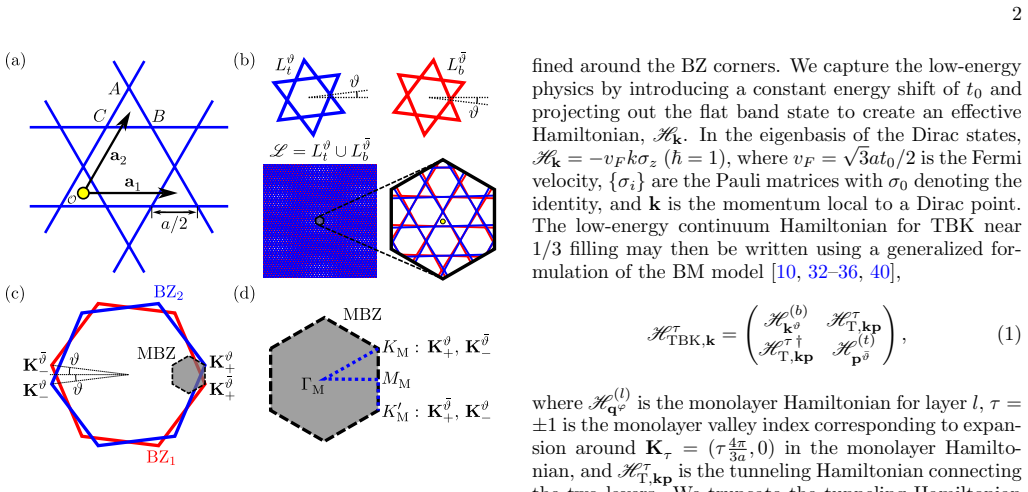
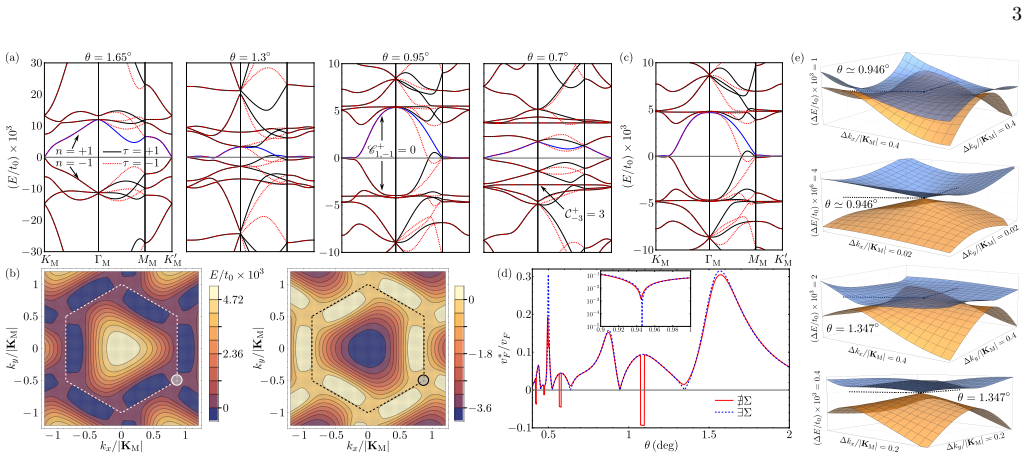
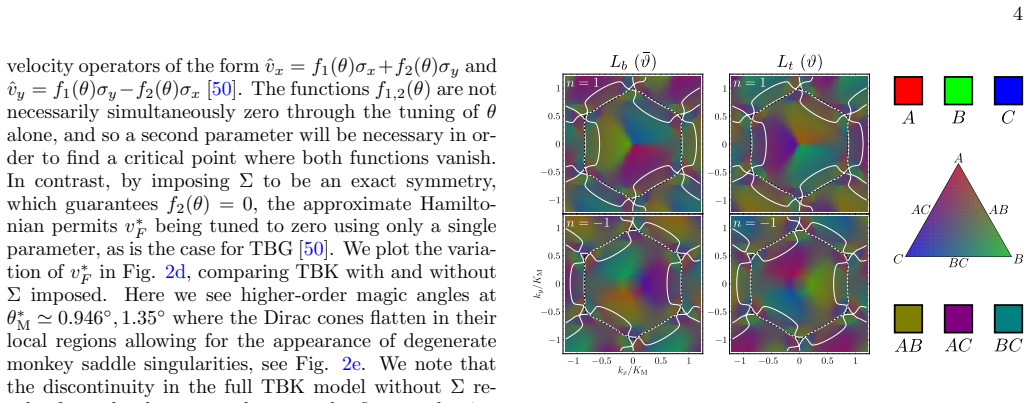
read the original abstract
We develop a low-energy continuum model to describe the moir\'{e} physics of heterostructures, which is a generalization of the celebrated Bistritzer-MacDonald (BM) method [R. Bistritzer and A. H. MacDonald, Proc. Natl. Acad. Sci. U.S.A. 108, 12233 (2011)]. We take as an example the moir\'{e} physics of electrons in twisted bilayer kagom\'{e} (TBK) metals near $1/3$ filling where monolayer Dirac cones lie. We demonstrate the emergence of higher-order magic angles where significant local band flattening occurs as a high-order Van Hove singularity emerges and show how twisting alone can induce non-trivial topology. We, furthermore, show that while sublattice interference effects are present, their role is not as prominent as in monolayer kagome.
Editorial analysis
A structured set of objections, weighed in public.
Referee Report
Summary. The paper develops a low-energy continuum model generalizing the Bistritzer-MacDonald approach to describe moiré physics in twisted bilayer kagome (TBK) near 1/3 filling, where monolayer Dirac cones are relevant. It claims to demonstrate higher-order magic angles with significant local band flattening tied to the emergence of high-order Van Hove singularities, twisting-induced non-trivial topology in the resulting bands, and the presence of sublattice interference effects that are weaker than in the monolayer kagome case.
Significance. If the continuum results hold under validation, the work extends magic-angle and moiré engineering concepts to kagome lattices, identifying a route to flat bands with non-trivial topology via twist angle alone. This could open new platforms for correlated topological states in heterostructures, building on the BM framework with concrete predictions for higher-order singularities and reduced sublattice interference.
major comments (2)
- [§3] §3 (Continuum model and magic angles): The higher-order magic angles and associated local flattening are derived within the generalized BM continuum model, but the manuscript provides no direct comparison of these bands to a microscopic tight-binding calculation on the same moiré supercell; this validation is load-bearing for the claim that the low-energy Dirac-cone approximation captures the physics at 1/3 filling without significant corrections from the underlying kagome lattice.
- [§4] §4 (Topology): The demonstration that twisting alone induces non-trivial topology (via Chern numbers) assumes the continuum bands remain accurate near the high-order Van Hove singularities, yet the potential influence of neglected kagome-specific terms (next-nearest hoppings or umklapp processes) on the topological invariants is not quantified or bounded.
minor comments (2)
- [Figs. 3-5] Figure captions and axis labels in the band-structure plots could explicitly note the energy scale relative to the monolayer Dirac point for easier comparison.
- [§2] The definition of the interlayer tunneling parameters in the model Hamiltonian would benefit from an explicit statement of their momentum dependence (or lack thereof) to clarify the approximation level.
Simulated Author's Rebuttal
We thank the referee for their careful reading of our manuscript and for the constructive comments, which help clarify the scope and limitations of our continuum approach. We address each major point below, indicating revisions where appropriate while defending the validity of our low-energy model.
read point-by-point responses
-
Referee: [§3] §3 (Continuum model and magic angles): The higher-order magic angles and associated local flattening are derived within the generalized BM continuum model, but the manuscript provides no direct comparison of these bands to a microscopic tight-binding calculation on the same moiré supercell; this validation is load-bearing for the claim that the low-energy Dirac-cone approximation captures the physics at 1/3 filling without significant corrections from the underlying kagome lattice.
Authors: We agree that explicit validation against a microscopic tight-binding model on the moiré supercell would provide stronger evidence. However, such calculations involve supercells with thousands of atoms and are computationally intensive, placing them outside the primary scope of this work, which focuses on developing and analyzing the generalized continuum model. Our model is systematically derived by retaining only the low-energy Dirac cones relevant at 1/3 filling, analogous to the original BM treatment of twisted bilayer graphene where the continuum approximation has been widely accepted and later validated. In the revised manuscript, we have added a dedicated paragraph in §3 discussing the validity regime, including estimates showing that corrections from higher-lying kagome bands and lattice effects are suppressed by the Dirac cone velocity scale near the relevant energies and fillings. This supports our claim that the essential moiré physics, including higher-order magic angles and local flattening, is captured without dominant corrections. revision: partial
-
Referee: [§4] §4 (Topology): The demonstration that twisting alone induces non-trivial topology (via Chern numbers) assumes the continuum bands remain accurate near the high-order Van Hove singularities, yet the potential influence of neglected kagome-specific terms (next-nearest hoppings or umklapp processes) on the topological invariants is not quantified or bounded.
Authors: We appreciate this point on the robustness of the topological invariants. The non-trivial topology arises directly from the moiré-induced hybridization and gap openings in the continuum bands at the higher-order magic angles. To address the referee's concern, the revised manuscript now includes a brief analysis bounding the effects of neglected terms: next-nearest-neighbor hoppings in the monolayer kagome lattice are typically 10-30% of the nearest-neighbor strength and primarily shift the overall band structure without closing the moiré gaps near the high-order Van Hove singularities; umklapp processes are further suppressed at small twist angles due to momentum mismatch. These perturbations preserve the gap structure and thus the Chern numbers in the low-energy limit. While a fully quantitative microscopic calculation of their impact would require extending beyond the continuum model, our estimates indicate that the twist-induced topology remains stable within the regime considered. revision: yes
Circularity Check
No significant circularity detected in derivation chain
full rationale
The paper constructs a low-energy continuum model by generalizing the independent Bistritzer-MacDonald framework to the kagome lattice geometry, expanding around monolayer Dirac cones and introducing interlayer tunneling amplitudes as parameters. Higher-order magic angles, local flattening at high-order Van Hove singularities, and twisting-induced topology are then computed as outputs of this model via numerical diagonalization or analytic approximations. No step reduces a claimed prediction to a fitted input by construction, nor does any load-bearing premise rely on self-citation chains or ansatze smuggled from prior author work. The model is explicitly presented as an approximation whose validity is an external assumption, not derived from the target results themselves. Sublattice interference is analyzed within the same framework but does not circularly define the flattening or topology claims.
Axiom & Free-Parameter Ledger
axioms (1)
- domain assumption Low-energy continuum model remains valid for TBK heterostructures near 1/3 filling with monolayer Dirac cones
Reference graph
Works this paper leans on
-
[1]
Classen and J
L. Classen and J. J. Betouras, High-Order Van Hove Sin- gularities and Their Connection to Flat Bands, Annu. Rev. Condens. Matter Phys.16, 229 (2025)
2025
-
[2]
D. V. Efremov, A. Shtyk, A. W. Rost, C. Chamon, A. P. Mackenzie, and J. J. Betouras, Multicritical Fermi Surface Topological Transitions, Phys. Rev. Lett.123, 207202 (2019)
2019
-
[3]
Chandrasekaran, A
A. Chandrasekaran, A. Shtyk, J. J. Betouras, and C. Chamon, Catastrophe theory classification of Fermi surface topological transitions in two dimensions, Phys. Rev. Res.2, 013355 (2020)
2020
-
[4]
N. F. Q. Yuan, H. Isobe, and L. Fu, Magic of high-order van Hove singularity, Nat. Commun.10, 5769 (2019)
2019
-
[5]
M. Kang, S. Fang, J.-K. Kim, B. R. Ortiz, S. H. Ryu, J. Kim, J. Yoo, G. Sangiovanni, D. Di Sante, B.-G. Park, C. Jozwiak, A. Bostwick, E. Rotenberg, E. Kaxiras, S. D. Wilson, J.-H. Park, and R. Comin, Twofold van Hove sin- gularity and origin of charge order in topological kagome superconductor CsV 3Sb5, Nat. Phys.18, 301 (2022)
2022
-
[6]
Y. Hu, X. Wu, B. R. Ortiz, S. Ju, X. Han, J. Ma, N. C. Plumb, M. Radovic, R. Thomale, S. D. Wilson, A. P. Schnyder, and M. Shi, Rich nature of Van Hove singular- ities in Kagome superconductor CsV3Sb5, Nat. Commun. 13, 2220 (2022)
2022
-
[7]
S. Cho, H. Ma, W. Xia, Y. Yang, Z. Liu, Z. Huang, Z. Jiang, X. Lu, J. Liu, Z. Liu, J. Li, J. Wang, Y. Liu, J. Jia, Y. Guo, J. Liu, and D. Shen, Emergence of New van Hove Singularities in the Charge Density Wave State of a Topological Kagome Metal RbV 3Sb5, Phys. Rev. Lett.127, 236401 (2021)
2021
-
[8]
Chandrasekaran, L
A. Chandrasekaran, L. C. Rhodes, E. A. Morales, C. A. Marques, P. D. C. King, P. Wahl, and J. J. Betouras, On the engineering of higher-order Van Hove singularities in two dimensions, Nat. Commun.15, 9521 (2024)
2024
-
[9]
Y. Cao, V. Fatemi, S. Fang, K. Watanabe, T. Taniguchi, E. Kaxiras, and P. Jarillo-Herrero, Unconventional super- conductivity in magic-angle graphene superlattices, Na- ture556, 43 (2018)
2018
-
[10]
Z. Song, Z. Wang, W. Shi, G. Li, C. Fang, and B. A. Bernevig, All Magic Angles in Twisted Bilayer Graphene are Topological, Phys. Rev. Lett.123, 036401 (2019)
2019
-
[11]
Y. Cao, D. Chowdhury, D. Rodan-Legrain, O. Rubies- Bigorda, K. Watanabe, T. Taniguchi, T. Senthil, and P. Jarillo-Herrero, Strange Metal in Magic-Angle Graphene with near Planckian Dissipation, Phys. Rev. Lett.124, 076801 (2020)
2020
-
[12]
J. Park, Y. Cao, L.-Q. Xia, S. Sun, K. Watanabe, T. T., and P. Jarillo-Herrero, Robust superconductivity in magic-angle multilayer graphene family, Nat. Mater. 21, 877 (2022)
2022
-
[13]
S. J. Ahn, P. Moon, T.-H. Kim, H.-W. Kim, H.-C. Shin, E. H. Kim, H. W. Cha, S.-J. Kahng, P. Kim, M. Koshino, Y.-W. Son, C.-W. Yang, and J. R. Ahn, Dirac electrons in a dodecagonal graphene quasicrystal, Science361, 782 (2018)
2018
-
[14]
P. Moon, M. Koshino, and Y.-W. Son, Quasicrystalline electronic states in 30 ◦ rotated twisted bilayer graphene, Phys. Rev. B99, 165430 (2019)
2019
-
[15]
G. Yu, Z. Wu, Z. Zhan, M. I. Katsnelson, and S. Yuan, Dodecagonal bilayer graphene quasicrystal and its ap- proximants, npj Comput. Mater.5, 122 (2019)
2019
-
[16]
Pezzini, V
S. Pezzini, V. Miˇ seikis, G. Piccinini, S. Forti, S. Pace, R. Engelke, F. Rossella, K. Watanabe, T. Taniguchi, P. Kim, and C. Coletti, 30 ◦-Twisted Bilayer Graphene 6 Quasicrystals from Chemical Vapor Deposition, Nano Lett.20, 3313 (2020)
2020
-
[17]
Li and M
Y. Li and M. Koshino, Twist-angle dependence of the proximity spin-orbit coupling in graphene on transition- metal dichalcogenides, Phys. Rev. B99, 075438 (2019)
2019
-
[18]
Sousa, D
F. Sousa, D. T. S. Perkins, and A. Ferreira, Weak lo- calisation driven by pseudospin-spin entanglement, Com- mun. Phys.5, 291 (2022)
2022
-
[19]
P´ eterfalvi, A
C. P´ eterfalvi, A. David, P. Rakyta, G. Burkard, and A. Korm´ anyos, Quantum interference tuning of spin- orbit coupling in twisted van der Waals trilayers, Phys. Rev. Res.4, L022049 (2022)
2022
-
[20]
Veneri, D
A. Veneri, D. T. S. Perkins, C. G. P´ eterfalvi, and A. Fer- reira, Twist angle controlled collinear Edelstein effect in van der Waals heterostructures, Phys. Rev. B106, L081406 (2022)
2022
-
[21]
Perkins, A
D. Perkins, A. Veneri, and A. Ferreira, Spin Hall effect: Symmetry breaking, twisting, and giant disorder renor- malization, Phys. Rev. B109, L241404 (2024)
2024
-
[22]
Wojciechowska and A
I. Wojciechowska and A. Dyrda l, Twist tunable spin to charge conversion and valley contrasting effects in graphene on 2D transition metal dichalcogenides, Scien- tific Reports15, 39156 (2025)
2025
-
[23]
Moon and M
P. Moon and M. Koshino, Electronic properties of graphene/hexagonal-boron-nitride moir´ e superlattice, Phys. Rev. B90, 155406 (2014)
2014
-
[24]
E. H. Lieb, Two theorems on the Hubbard model, Phys. Rev. Lett.62, 1201 (1989)
1989
-
[25]
A. J. Koll´ ar, M. Fitzpatrick, P. Sarnak, and A. A. Houck, Line-Graph Lattices: Euclidean and Non-Euclidean Flat Bands, and Implementations in Circuit Quantum Elec- trodynamics, Commun. Math. Phys.376, 1909 (2020)
1909
-
[26]
D.-S. Ma, Y. Xu, C. S. Chiu, N. Regnault, A. A. Houck, Z. Song, and B. A. Bernevig, Spin-Orbit-Induced Topo- logical Flat Bands in Line and Split Graphs of Bipartite Lattices, Phys. Rev. Lett.125, 266403 (2020)
2020
-
[27]
Di Sante, T
D. Di Sante, T. Neupert, G. Sangiovanni, R. Thomale, R. Comin, J. G. Checkelsky, I. Zeljkovic, and S. D. Wil- son, Kagome metals, Rev. Mod. Phys.98, 015002 (2026)
2026
-
[28]
Regnault, Y
N. Regnault, Y. Xu, M.-R. Li, D.-S. Ma, M. Jovanovic, A. Yazdani, S. S. P. Parkin, C. Felser, L. M. Schoop, N. P. Ong, R. J. Cava, L. Elcoro, Z.-D. Song, and B. A. Bernevig, Catalogue of flat-band stoichiometric materi- als, Nature603, 824 (2022)
2022
-
[29]
D. T. S. Perkins, A. Chandrasekaran, and J. J. Be- touras, Designing topological high-order Van Hove sin- gularities: Twisted bilayer kagome, Phys. Rev. B112, 235134 (2025)
2025
-
[30]
E. Wang, L. Pullasseri, and L. H. Santos, Higher-order Van Hove singularities in kagome topological bands, Phys. Rev. B111, 075114 (2025)
2025
- [31]
-
[32]
Bistritzer and A
R. Bistritzer and A. H. MacDonald, Moir´ e bands in twisted double-layer graphene, Proc. Natl. Acad. Sci. U.S.A.108, 12233 (2011)
2011
-
[33]
Koshino, N
M. Koshino, N. F. Q. Yuan, T. Koretsune, M. Ochi, K. Kuroki, and L. Fu, Maximally Localized Wannier Or- bitals and the Extended Hubbard Model for Twisted Bi- layer Graphene, Phys. Rev. X8, 031087 (2018)
2018
-
[34]
Catarina, B
G. Catarina, B. Amorim, E. V. Castro, J. M. V. P. Lopes, J. M. V. P. Lopes, and N. Peres, Twisted Bilayer Graphene: Low-Energy Physics, Electronic and Optical Properties, inHandbook of Graphene Set(John Wiley & Sons, Ltd, 2019) Chap. 6, pp. 177–231
2019
-
[35]
Koshino, Band structure and topological properties of twisted double bilayer graphene, Phys
M. Koshino, Band structure and topological properties of twisted double bilayer graphene, Phys. Rev. B99, 235406 (2019)
2019
-
[36]
F. Wu, T. Lovorn, E. Tutuc, I. Martin, and A. H. MacDonald, Topological Insulators in Twisted Transition Metal Dichalcogenide Homobilayers, Phys. Rev. Lett. 122, 086402 (2019)
2019
-
[37]
B. A. Bernevig, Z.-D. Song, N. Regnault, and B. Lian, Twisted bilayer graphene. I. Matrix elements, approxi- mations, perturbation theory, and ak·ptwo-band model, Phys. Rev. B103, 205411 (2021)
2021
-
[38]
M. G. Scheer, K. Gu, and B. Lian, Magic angles in twisted bilayer graphene near commensuration: Towards a hy- permagic regime, Phys. Rev. B106, 115418 (2022)
2022
-
[39]
Ma, Y.-G
D. Ma, Y.-G. Chen, Y. Yu, and X. Luo, Moir´ e semicon- ductors on the twisted bilayer dice lattice, Phys. Rev. B 109, 155159 (2024)
2024
-
[40]
Zhou, Y.-C
X. Zhou, Y.-C. Hung, B. Wang, and A. Bansil, Gen- eration of Isolated Flat Bands with Tunable Numbers through Moir´ e Engineering, Phys. Rev. Lett.133, 236401 (2024)
2024
-
[41]
C˘ alug˘ aru, Y
D. C˘ alug˘ aru, Y. Jiang, H. Hu, H. Pi, J. Yu, M. G. Vergniory, J. Shan, C. Felser, L. M. Schoop, D. K. Efetov, K. F. Mak, and B. A. Bernevig, Moir´ e materials based on M-point twisting, Nature643, 376 (2025)
2025
-
[42]
We include Refs
See the Supplemental Material where we provide a sum- mary of the Hamiltonian and electronic structure for the monolayer kagome system, show how the BM model can be generalised to TBK, demonstrate approxiamte particle-hole symmetry, provide additional band struc- tures and sublattice projection plots, discuss the rapid changes inv ∗ F that only appear whe...
-
[43]
A. N. Mihalyuk, D. V. Gruznev, L. V. Bondarenko, A. Y. Tupchuya, Y. E. Vekovshinin, S. V. Eremeev, A. V. Zo- tov, and A. A. Saranin, A 2D heavy fermion CePb 3 kagome material on silicon: emergence of unique spin po- larized states for spintronics, Nanoscale14, 14732 (2022)
2022
-
[44]
Y. E. Vekovshinin, L. V. Bondarenko, A. Y. Tupchaya, A. N. Mihalyuk, N. V. Denisov, D. V. Gruznev, A. V. Zotov, and A. A. Saranin, Lifshitz Transition in a Single-Atom-Thick Gd xYb1–xPb3 Kagome Compound on Si(111), Nano Lett.24, 9931 (2024)
2024
-
[45]
N. V. Denisov, L. V. Bondarenko, Y. E. Vekovshinin, A. N. Mihalyuk, S. V. Eremeev, D. V. Gruznev, A. V. Zo- tov, and A. A. Saranin, Magnetotransport properties of a single-atom-thick GdPb 3 kagome compound on Si(111), J. Mater. Chem. C13, 7219 (2025)
2025
-
[46]
Y. E. Vekovshinin, L. V. Bondarenko, A. Y. Tupchaya, T. V. Utas, E. Wang, A. N. Mihalyuk, D. V. Gruznev, A. V. Zotov, and A. A. Saranin, High-Order Van Hove Singularities in Atomically Thin Kagome Metal LaTl 3, ACS Nano19, 36510 (2025)
2025
-
[47]
N. V. Denisov, L. V. Bondarenko, A. Y. Tupchaya, Y. E. Vekovshinin, V. G. Kotlyar, T. V. Utas, P. V. Burkovskaya, L. O. Brykin, A. N. Mihalyuk, S. V. Ere- meev, D. V. Gruznev, A. V. Zotov, and A. A. Saranin, Magnetism in the single-atom-thick EuPb 3 kagome com- pound on Si(111) studied using in situ transport and 7 magnetotransport measurements, Phys. Rev...
2026
-
[48]
Crasto de Lima, R
F. Crasto de Lima, R. H. Miwa, and E. Su´ arez Morell, Double flat bands in kagome twisted bilayers, Phys. Rev. B100, 155421 (2019)
2019
-
[49]
D. T. S. Perkins, Symmetry preservation in commensu- rate twisted bilayers, Phys. Rev. B112, 035410 (2025)
2025
-
[50]
Sheffer, R
Y. Sheffer, R. Queiroz, and A. Stern, Symmetries as the Guiding Principle for Flattening Bands of Dirac Fermions, Phys. Rev. X13, 021012 (2023)
2023
-
[51]
M. L. Kiesel and R. Thomale, Sublattice interference in the kagome Hubbard model, Phys. Rev. B86, 121105 (2012)
2012
-
[52]
P. K. Nag, R. Batabyal, J. Ingham, N. Morali, H. Tan, J. Koo, A. Consiglio, E. Liu, N. Avraham, R. Queiroz, R. Thomale, B. Yan, C. Felser, and H. Bei- denkopf, Pomeranchuk Instability Induced by an Emer- gent Higher-Order van Hove Singularity on the Distorted Kagome Surface of Co 3Sn2S2 (2024), arXiv:2410.01994 [cond-mat.str-el]
-
[53]
J. Beck, J. Bodky, M. D¨ urrnagel, R. Thomale, J. Ingham, L. Klebl, and H. Hohmann, Kekul´ e Order from Diffuse Nesting near Higher-Order Van Hove Points, Phys. Rev. Lett.136, 106503 (2026)
2026
-
[54]
J. C. Slater and G. F. Koster, Simplified LCAO Method for the Periodic Potential Problem, Phys. Rev.94, 1498 (1954)
1954
-
[55]
Dai and X
J. Dai and X. C. Zeng, Bilayer phosphorene: Effect of stacking order on bandgap and its potential applications in thin-film solar cells, J. Phys. Chem. Lett.5, 1289 (2014)
2014
-
[56]
Uchida, S
K. Uchida, S. Furuya, J.-I. Iwata, and A. Oshiyama, Atomic corrugation and electron localization due to moir´ e patterns in twisted bilayer graphenes, Phys. Rev. B90, 155451 (2014)
2014
-
[57]
L. L. Li, D. Moldovan, W. Xu, and F. M. Peeters, Elec- tronic properties of bilayer phosphorene quantum dots in the presence of perpendicular electric and magnetic fields, Phys. Rev. B96, 155425 (2017)
2017
-
[58]
L. Ye, M. Kang, J. Liu, F. von Cube, C. R. Wicker, T. Suzuki, C. Jozwiak, A. Bostwick, E. Rotenberg, D. C. Bell, L. Fu, R. Comin, and J. G. Checkelsky, Massive Dirac fermions in a ferromagnetic kagome metal, Nature 555, 638 (2018)
2018
-
[59]
Shi, E.-M
Q. Shi, E.-M. Shih, D. Rhodes, B. Kim, K. Barmak, K. Watanabe, T. Taniguchi, Z. Papi´ c, D. A. Abanin, J. Hone, and C. R. Dean, Bilayer WSe 2 as a natural platform for interlayer exciton condensates in the strong coupling limit, Nat. Nanotechnol.17, 577 (2022)
2022
-
[60]
Y. Luo, Y. Han, J. Liu, H. Chen, Z. Huang, L. Huai, H. Li, B. Wang, J. Shen, S. Ding, Z. Li, S. Peng, Z. Wei, Y. Miao, X. Sun, Z. Ou, Z. Xiang, M. Hashimoto, D. Lu, Y. Yao, H. Yang, X. Chen, H.-J. Gao, Z. Qiao, Z. Wang, and J. He, A unique van Hove singularity in kagome superconductor CsV3−xTaxSb5 with enhanced supercon- ductivity, Nat. Commun.14, 3819 (2023)
2023
-
[61]
Y. Wang, H. Wu, G. T. McCandless, J. Y. Chan, and M. N. Ali, Quantum states and intertwining phases in kagome materials, Nat. Rev. Phys.5, 635 (2023)
2023
-
[62]
TWISTED KAGOME BILA YERS: HIGHER-ORDER MAGIC ANGLES, TOPOLOGICAL FLA T BANDS, AND SUBLA TTICE INTERFERENCE
Y. Xia, Z. Han, K. Watanabe, T. Taniguchi, J. Shan, and K. F. Mak, Superconductivity in twisted bilayer WSe 2, Nature637, 833 (2025). 1 SUPPLEMENT AL MA TERIAL FOR “TWISTED KAGOME BILA YERS: HIGHER-ORDER MAGIC ANGLES, TOPOLOGICAL FLA T BANDS, AND SUBLA TTICE INTERFERENCE” S1. MONOLA YER KAGOME The kagome lattice is the line graph of honeycomb lattice and ...
2025
-
[63]
In this section, we shall focus on deriving the matrices describing tunnelling between the two layers of this twisted heterostrcture due to its differences compared with TBG. S2.1. General T unnelling Between Twisted Kagome Layers To construct the Hamiltonian for TBK near 1/3 filling, we will construct a generalised Bistritzer-MacDonald (BM) model in term...
-
[64]
(S35) (black) and ourp z-oribtal model in Eq
summarised in Eq. (S35) (black) and ourp z-oribtal model in Eq. (S37). We taked ⊥ = 0.6596nm here. (b): Illustrating how our Eq. (S37) depends upon the choice ofd ⊥ with ˜γ= 12/a. justify this on the basis that next-nearest-neighbour intralayer tunnelling is ignored when it is 10% oft 0. Nonetheless, changing these parameters and the tunnelling model can ...
-
[65]
= 16π 3a sin θ 2 0 1 =−2q b,(S39a) qbr = (K ¯ϑ + +G ¯ϑ 3)−(K ϑ + +G ϑ
-
[66]
= 8π 3a sin θ 2 √ 3 −1 =−2q tl,(S39b) qbl = (K ¯ϑ + +G ¯ϑ 4)−(K ϑ + +G ϑ
-
[67]
= 8π 3a sin θ 2 − √ 3 −1 =−2q tr.(S39c) Returning to theq-lattice depiction of momentum conserving interlayer tunnelling processes, we see that theD 2 Dirac points connect third-nearest-neighbours in theq-lattice, see Fig. S1b. At the level of the continuum Hamiltonian, the effect of theD 2 Dirac points can only be seen when including shells beyond the se...
discussion (0)
Sign in with ORCID, Apple, or X to comment. Anyone can read and Pith papers without signing in.