Recognition: unknown
Probability of Quota Violations in Divisor Apportionment Methods with Nonzero Allocations
Pith reviewed 2026-05-08 05:56 UTC · model grok-4.3
The pith
Divisor apportionment methods admit exact formulas for quota violation probabilities through asymptotic stabilization.
A machine-rendered reading of the paper's core claim, the machinery that carries it, and where it could break.
Core claim
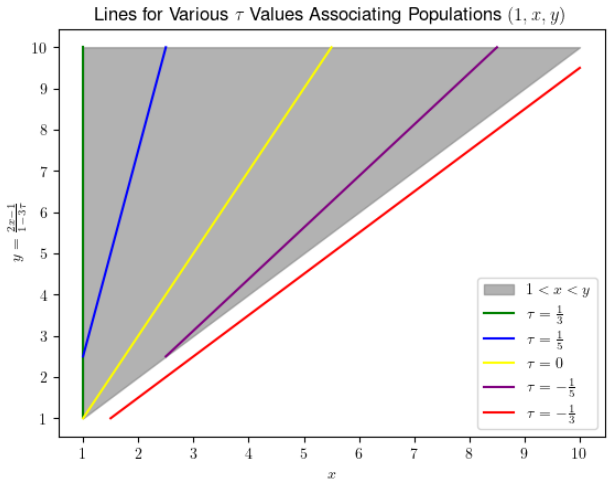
We prove an Asymptotic Quota Stabilization theorem: for fixed τ, quota behavior stabilizes as populations grow, yielding probability results for quota violations determined by the set of ultimately violatory τ values. Applying this framework to the five classical divisor methods, we derive exact probability formulas. Additionally, we show that as the number of seats M → ∞, these probabilities converge to method-specific constants.
What carries the argument
The τ statistic that parametrizes relative population sizes among three states, which supports the Asymptotic Quota Stabilization theorem identifying limiting quota violation behavior.
If this is right
- Exact probability formulas are derived for quota violations in the five classical divisor methods.
- As the number of seats tends to infinity, violation probabilities converge to method-specific constants.
- Quota violations are completely determined by the ultimately violatory τ values for each method.
- The nonzero allocation constraint is isolated as the source of these violations in the analysis.
Where Pith is reading between the lines
- The stabilization result may extend to cases with more than three states under suitable generalizations of the τ parameter.
- These probabilities offer a basis for comparing the long-run fairness of different apportionment methods in practice.
- Numerical checks with growing populations could confirm the predicted convergence.
- The work connects to broader questions of monotonicity versus quota satisfaction in fair division.
Load-bearing premise
The analysis assumes exactly three states whose populations are fully described by the single parameter τ, which may limit direct applicability to systems with more groups or arbitrary distributions.
What would settle it
Simulating large populations drawn with fixed τ, computing the observed frequency of quota violations for each divisor method and house size M, then checking agreement with the closed-form probabilities and their convergence to the stated constants.
Figures
read the original abstract
Apportionment assigns indivisible items among groups. By the Balinski-Young theorem, no method can satisfy both house monotonicity and the quota rule. This paper investigates quota violations caused by nonzero allocation constraints, and derives exact probability formulas for their frequency. Such violations occur in systems like the U.S. House of Representatives, where each state is guaranteed at least one seat. We analyze the three-state case, introduce the $\tau$ statistic to parametrize population distributions, and prove an Asymptotic Quota Stabilization theorem: for fixed $\tau$, quota behavior stabilizes as populations grow, yielding probability results for quota violations determined by the set of ultimately violatory $\tau$ values. Applying this framework to the five classical divisor methods, we derive exact probability formulas. Additionally, we show that as the number of seats $M \to \infty$, these probabilities converge to method-specific constants. These results provide a precise, quantitative foundation for evaluating the fairness and frequency of quota violations in constrained apportionment systems.
Editorial analysis
A structured set of objections, weighed in public.
Referee Report
Summary. The manuscript analyzes quota violations in divisor apportionment methods under nonzero minimum allocations (e.g., one seat per state). It restricts to the three-state case, parametrizes population distributions via a single statistic τ, proves an Asymptotic Quota Stabilization theorem asserting that quota behavior stabilizes for fixed τ as total population grows, and uses the set of ultimately violatory τ values to derive exact probability formulas for quota violations under each of the five classical divisor methods. It further establishes that these probabilities converge to method-specific constants as house size M tends to infinity.
Significance. If the central claims hold, the work supplies exact closed-form probabilities rather than simulation-based estimates or bounds, furnishing a precise quantitative benchmark for the frequency of quota violations in constrained apportionment. The stabilization theorem cleanly reduces an infinite-population problem to the identification of a measure-zero set of violatory parameters, which is a technically useful contribution for evaluating fairness trade-offs between house monotonicity and quota satisfaction.
minor comments (3)
- [Abstract] Abstract: the phrase 'ultimately violatory τ values' is introduced without a forward reference; add a parenthetical pointer to the section (likely §3 or §4) where the set is formally defined.
- [Introduction] The manuscript would benefit from an explicit statement, perhaps in the introduction or conclusion, of the precise measure used on the space of τ (e.g., Lebesgue measure on [0,1]) when computing the probabilities, to make the 'exact probability formulas' fully unambiguous.
- [§2 or §3] Notation: ensure that the definition of the τ statistic (presumably Eq. (1) or (2)) is cross-referenced each time the stabilization theorem is invoked, to avoid any ambiguity about the fixed-τ regime.
Simulated Author's Rebuttal
We thank the referee for the positive summary, significance assessment, and recommendation of minor revision. No specific major comments appear in the report, so there are no points requiring point-by-point responses.
Circularity Check
No significant circularity; derivation self-contained via new parametrization and theorem proof
full rationale
The paper introduces the τ statistic as a parametrization of population distributions restricted to the three-state case, then proves the Asymptotic Quota Stabilization theorem directly from the definitions of divisor methods and quota rules under fixed τ as populations scale. Exact probability formulas for the five classical methods follow by determining the measure of ultimately violatory τ values, with M→∞ limits obtained as a direct consequence. No step reduces by construction to a fitted input, self-citation, or definitional equivalence; the central claims rest on independent mathematical analysis of the parametrized system rather than circular renaming or imported uniqueness.
Axiom & Free-Parameter Ledger
free parameters (1)
- τ
axioms (2)
- domain assumption Balinski-Young theorem on impossibility of satisfying both house monotonicity and quota
- standard math Standard probabilistic models for population distributions in the limit
Reference graph
Works this paper leans on
-
[1]
2026 , eprint=
Quantifying the Balinski-Young Theorem: Structure and Probability of Quota Violations in Divisor Methods for Three States (preprint) , author=. 2026 , eprint=
2026
-
[2]
and Young, H
Balinski, Michel L. and Young, H. Peyton , title =. 2001 , publisher =
2001
-
[3]
and Young, H
Balinski, Michel L. and Young, H. Peyton , title =. SIAM Journal on Applied Mathematics , volume =. 1974 , doi =
1974
-
[4]
, title =
Huntington, Edward V. , title =. Proceedings of the National Academy of Sciences , volume =. 1921 , doi =
1921
-
[5]
and Sziklai, Balázs , title =
Kóczy, László Á. and Sziklai, Balázs , title =. IEHAS Discussion Papers , number =
-
[6]
Hodge, Jonathan K. and Klima, Richard E. , title =. 2018 , publisher =. doi:10.1090/mawrld/030 , url =
-
[7]
Pukelsheim, Friedrich , title =. 2017 , publisher =. doi:10.1007/978-3-319-64707-2 , url =
-
[8]
, title =
Huntington, Edward V. , title =. Quarterly Publications of the American Statistical Association , volume =. 1921 , doi =
1921
-
[9]
2017 , publisher =
Elections, Voting Rules and Paradoxical Outcomes , author =. 2017 , publisher =
2017
-
[10]
2004 , eprint=
Voting in the European Union: The square root system of Penrose and a critical point , author=. 2004 , eprint=
2004
-
[11]
From a Toy Model to the Double Square Root Voting System , journal =
S. From a Toy Model to the Double Square Root Voting System , journal =. 2007 , volume =
2007
-
[12]
Seat allocation distributions and seat biases of stationary apportionment methods for proportional representation , journal =
Schwingenschl. Seat allocation distributions and seat biases of stationary apportionment methods for proportional representation , journal =. 2004 , doi =
2004
-
[13]
, title =
Schuster, Karsten and Pukelsheim, Friedrich and Drton, Mathias and Draper, Norman R. , title =. Electoral Studies , volume =. 2003 , doi =
2003
-
[14]
Asymptotic seat bias formulas , journal =
Drton, Mathias and Schwingenschl. Asymptotic seat bias formulas , journal =. 2005 , volume =. doi:10.1007/s001840400352 , url =
-
[15]
Journal of the Operations Research Society of Japan , year =
Ichimori, Tetsuo , title =. Journal of the Operations Research Society of Japan , year =. doi:10.15807/jorsj.55.63 , url =
-
[16]
El-Helaly, Sherif , title =. 2019 , address =. doi:10.1007/978-3-030-14768-6 , url =
-
[17]
Theory and Decision , pages =
Pandit, Virochan and Cutrone, Joseph , title =. Theory and Decision , pages =. 2025 , doi =
2025
discussion (0)
Sign in with ORCID, Apple, or X to comment. Anyone can read and Pith papers without signing in.