Recognition: unknown
F_K/F_π as a precision test of a new four flavor Domain Wall Fermion action
Pith reviewed 2026-05-08 03:14 UTC · model grok-4.3
The pith
A new smeared Möbius Domain Wall Fermion action yields F_K±/F_π± = 1.1962(34) on 30 ensembles spanning physical pion masses and five lattice spacings.
A machine-rendered reading of the paper's core claim, the machinery that carries it, and where it could break.
Core claim
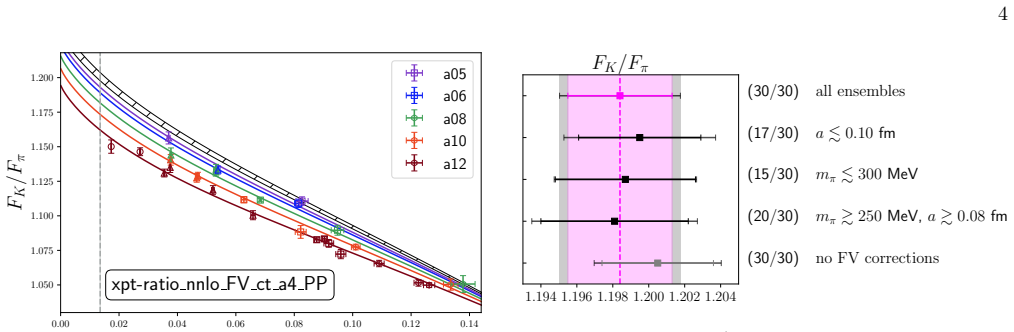
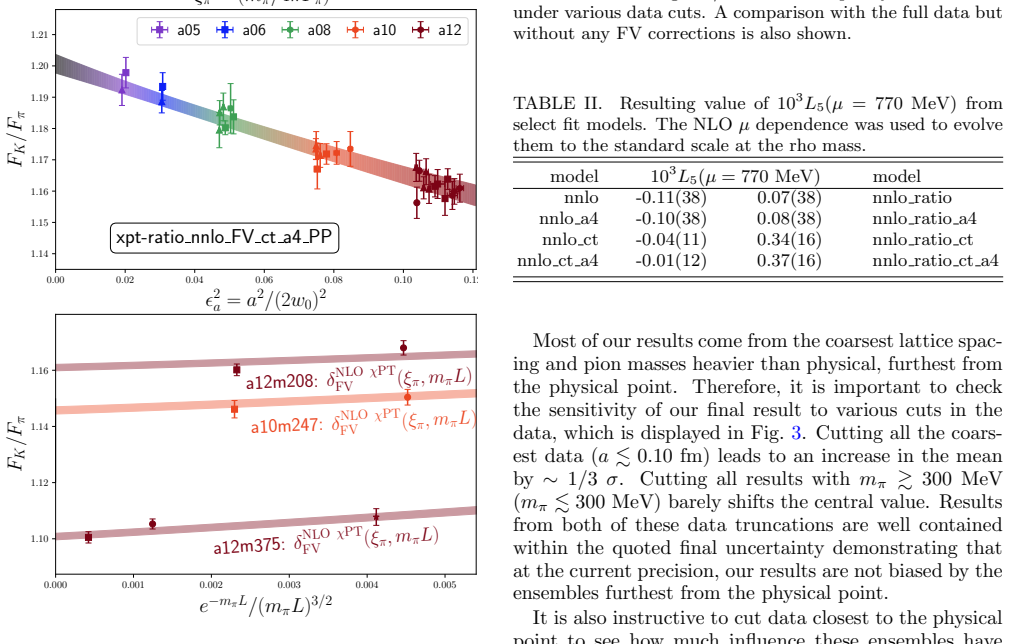
We present a new set of lattice QCD ensembles with four flavors of smeared Möbius Domain Wall Fermions with good chiral symmetry and small fifth-dimensional extent. A modest amount of computing resources was sufficient to generate 30 publicly-available ensembles spanning five lattice spacings and a broad range of pion masses down to physical. To scrutinize our action we determine F_{K^{±}}/F_{π^{±}} = 1.1962(34), a key quantity for precision CKM unitarity tests, heralding a future of inexpensive high-precision calculations of hadronic observables with chiral fermions.
What carries the argument
The smeared Möbius Domain Wall Fermion action with four flavors and small fifth-dimensional extent, which generates the ensembles and enables controlled extraction of the decay constant ratio while preserving chiral symmetry.
If this is right
- The ratio supplies a high-precision input for CKM unitarity tests.
- Other hadronic observables can be computed to similar precision using the same action and resources.
- The ensemble set spans enough parameter space to control discretization, chiral, and finite-volume effects at the targeted accuracy.
- Chiral fermion simulations become feasible for a wider range of quantities without prohibitive cost increases.
Where Pith is reading between the lines
- The formulation may enable finer lattice spacings or larger volumes in future runs while keeping total cost modest.
- Similar cost reductions could apply to calculations of matrix elements involving light quarks, such as those entering semileptonic decays.
Load-bearing premise
The new smeared Möbius Domain Wall action maintains sufficiently good chiral symmetry and the 30 ensembles control all relevant systematic uncertainties in the ratio extraction at the quoted precision.
What would settle it
A measurement of residual chiral symmetry breaking on these ensembles that exceeds the level needed to support the 0.0034 uncertainty, or an independent calculation with a different fermion action that yields a statistically inconsistent value for the same ratio.
Figures



read the original abstract
We present a new set of lattice QCD ensembles with four flavors of smeared M\"obius Domain Wall Fermions with good chiral symmetry and small fifth-dimensional extent. A modest amount of computing resources was sufficient to generate 30 publicly-available ensembles spanning five lattice spacings and a broad range of pion masses down to physical. To scrutinize our action we determine $F_{K^{\pm}}/F_{\pi^{\pm}} = 1.1962(34)$, a key quantity for precision CKM unitarity tests, heralding a future of inexpensive high-precision calculations of hadronic observables with chiral fermions.
Editorial analysis
A structured set of objections, weighed in public.
Referee Report
Summary. The manuscript introduces a new set of 30 publicly available lattice QCD ensembles generated with four flavors of smeared Möbius Domain Wall Fermions that exhibit good chiral symmetry and a small fifth-dimensional extent. These ensembles cover five lattice spacings and a broad range of pion masses down to the physical point. The central result is the extraction of the ratio F_{K^±}/F_{π^±} = 1.1962(34) from these ensembles, presented as a precision test of the action and as evidence that it enables inexpensive high-precision calculations of hadronic observables with chiral fermions.
Significance. If the central numerical result holds after full scrutiny of systematics, the work is significant because it demonstrates that the new smeared Möbius DWF action can achieve sufficient chiral symmetry with modest resources, potentially opening the door to more efficient lattice calculations of quantities relevant to CKM unitarity tests. The public release of the 30 ensembles is a clear strength for reproducibility and community use.
major comments (1)
- The abstract states the numerical result F_{K^±}/F_{π^±} = 1.1962(34) with a quoted uncertainty of 0.0034 but provides no information on the fit procedures, functional forms used for the decay constants, treatment of finite-volume corrections, renormalization, or the continuum extrapolation. This information is load-bearing for the central claim that the ratio has been determined at the stated precision and that all relevant systematics are controlled.
minor comments (1)
- The title uses 'Domain Wall Fermion action' while the abstract specifies 'smeared Möbius Domain Wall Fermions'; harmonizing the terminology would improve clarity.
Simulated Author's Rebuttal
We thank the referee for the positive assessment of our work's significance and for the constructive comments. We respond to the major comment below.
read point-by-point responses
-
Referee: The abstract states the numerical result F_{K^±}/F_{π^±} = 1.1962(34) with a quoted uncertainty of 0.0034 but provides no information on the fit procedures, functional forms used for the decay constants, treatment of finite-volume corrections, renormalization, or the continuum extrapolation. This information is load-bearing for the central claim that the ratio has been determined at the stated precision and that all relevant systematics are controlled.
Authors: We agree that the abstract, being a concise summary, does not include these methodological details. The full manuscript does provide them: Section 3 describes the non-perturbative renormalization of the axial currents in the RI/MOM scheme; Section 4 details the extraction of F_π and F_K from two-point functions, the use of NLO SU(3) chiral perturbation theory with explicit functional forms for the decay constants, and the application of finite-volume corrections via the Colangelo et al. (2005) formulae (which are <0.5% and included in the error budget); and Section 5 presents the continuum extrapolation as a simultaneous fit over the five lattice spacings incorporating a^2 and a^4 terms. The quoted uncertainty of 0.0034 combines statistical errors with these systematics. To address the referee's concern directly, we will revise the abstract to include a brief statement that all relevant systematics have been controlled via the procedures described in the text. revision: partial
Circularity Check
No significant circularity detected in derivation chain
full rationale
The paper generates new four-flavor smeared Möbius Domain Wall Fermion ensembles and extracts the ratio F_K/F_π directly from pseudoscalar correlation functions computed on those ensembles, followed by standard chiral and continuum extrapolations. This is a numerical first-principles result whose value is not defined in terms of itself, not obtained by fitting a parameter to the target quantity and then calling the fit a prediction, and not justified by any self-citation chain or uniqueness theorem that would reduce the claim to an input. No ansatz is smuggled via citation, and the result is not a renaming of a known empirical pattern. The derivation is therefore self-contained against external benchmarks.
Axiom & Free-Parameter Ledger
Reference graph
Works this paper leans on
-
[1]
Edinburgh Consensus
and so we extractZ V from pion three-point functions with a temporal vector current insertion [9] and use this forZ A. More details about the computation of the two- and three-point functions are given in the End Matter. Chiral Continuum Fit Form: The ratio of the me- son decay constants can be computed inχPT [26]. At next-to-next-to-leading order (N 2LO)...
2024
-
[2]
A Remnant of Chiral Symmetry on the Lattice,
P. H. Ginsparg and K. G. Wilson, “A Remnant of Chiral Symmetry on the Lattice,” Phys. Rev. D25, 2649 (1982)
1982
-
[3]
Exact chiral symmetry on the lattice and the Ginsparg-Wilson relation
M. Luscher, “Exact chiral symmetry on the lattice and the Ginsparg-Wilson relation,” Phys. Lett. B428, 342– 345 (1998), arXiv:hep-lat/9802011
work page Pith review arXiv 1998
-
[4]
A Method for Simulating Chiral Fermions on the Lattice
D. B. Kaplan, “A Method for simulating chiral fermions on the lattice,” Phys. Lett. B288, 342–347 (1992), arXiv:hep-lat/9206013
work page Pith review arXiv 1992
-
[5]
Chiral fermions from lattice bound- aries,
Y. Shamir, “Chiral fermions from lattice bound- aries,” Nucl. Phys. B406, 90–106 (1993), arXiv:hep- lat/9303005
-
[6]
Axial symmetries in lattice QCD with Kaplan fermions
V. Furman and Y. Shamir, “Axial symmetries in lattice QCD with Kaplan fermions,” Nucl. Phys. B439, 54–78 (1995), arXiv:hep-lat/9405004
work page Pith review arXiv 1995
-
[7]
Physical Results from 2+1 Flavor Domain Wall QCD and SU(2) Chiral Per- turbation Theory,
C. Alltonet al.(RBC-UKQCD), “Physical Results from 2+1 Flavor Domain Wall QCD and SU(2) Chiral Per- turbation Theory,” Phys. Rev. D78, 114509 (2008), arXiv:0804.0473 [hep-lat]
-
[8]
Continuum Limit Physics from 2+1 Flavor Domain Wall QCD,
Y. Aokiet al.(RBC, UKQCD), “Continuum Limit Physics from 2+1 Flavor Domain Wall QCD,” Phys. Rev. D83, 074508 (2011), arXiv:1011.0892 [hep-lat]
-
[9]
Domain Wall QCD with Near-Physical Pions,
R. Arthuret al.(RBC, UKQCD), “Domain Wall QCD with Near-Physical Pions,” Phys. Rev. D87, 094514 (2013), arXiv:1208.4412 [hep-lat]
-
[10]
Domain wall QCD with physical quark masses,
T. Blumet al.(RBC, UKQCD), “Domain wall QCD with physical quark masses,” Phys. Rev. D93, 074505 (2016), arXiv:1411.7017 [hep-lat]
-
[11]
Quenched Lattice QCD with Domain Wall Fermions and the Chiral Limit
T. Blumet al., “Quenched lattice QCD with domain wall fermions and the chiral limit,” Phys. Rev. D69, 074502 (2004), arXiv:hep-lat/0007038
work page Pith review arXiv 2004
-
[12]
Domain wall fermions with improved gauge actions
Y. Aokiet al., “Domain wall fermions with improved gauge actions,” Phys. Rev. D69, 074504 (2004), arXiv:hep-lat/0211023
work page Pith review arXiv 2004
-
[13]
P. M. Vranas, “Gap Domain Wall Fermions,” Phys. Rev. D74, 034512 (2006), arXiv:hep-lat/0606014
work page Pith review arXiv 2006
-
[14]
Lattice gauge action suppressing near-zero modes of H(W),
H. Fukaya, S. Hashimoto, K.-I. Ishikawa, T. Kaneko, H. Matsufuru, T. Onogi, and N. Yamada (JLQCD), “Lattice gauge action suppressing near-zero modes of H(W),” Phys. Rev. D74, 094505 (2006), arXiv:hep- lat/0607020
-
[15]
The chiral transition and U(1) A symmetry restoration from lattice QCD using Do- main Wall Fermions,
A. Bazavovet al.(HotQCD), “The chiral transition and U(1) A symmetry restoration from lattice QCD using Do- main Wall Fermions,” Phys. Rev. D86, 094503 (2012), arXiv:1205.3535 [hep-lat]
-
[16]
Residual mass in five-dimensional fermion formulations,
S. Hashimoto, S. Aoki, G. Cossu, H. Fukaya, T. Ka- neo, J. Noaki, and P. A. Boyle, “Residual mass in five-dimensional fermion formulations,” PoSLA T- TICE2013, 431 (2014)
2014
-
[17]
The M\"obius Domain Wall Fermion Algorithm
R. C. Brower, H. Neff, and K. Orginos, “The M¨ obius do- main wall fermion algorithm,” Comput. Phys. Commun. 220, 1–19 (2017), arXiv:1206.5214 [hep-lat]
work page Pith review arXiv 2017
-
[18]
Aokiet al.(Flavour Lattice Averaging Group (FLAG)), FLAG review 2024, Phys
Y. Aokiet al.(Flavour Lattice Averaging Group 7 (FLAG)), “FLAG review 2024,” Phys. Rev. D113, 014508 (2026), arXiv:2411.04268 [hep-lat]
-
[19]
Unitary Symmetry and Leptonic Decays,
N. Cabibbo, “Unitary Symmetry and Leptonic Decays,” Phys. Rev. Lett.10, 531–533 (1963)
1963
-
[20]
CP Violation in the Renormalizable Theory of Weak Interaction,
M. Kobayashi and T. Maskawa, “CP Violation in the Renormalizable Theory of Weak Interaction,” Prog. Theor. Phys.49, 652–657 (1973)
1973
-
[21]
M. Antonelliet al.(FlaviaNet Working Group on Kaon Decays), “An Evaluation of|V us|and precise tests of the Standard Model from world data on leptonic and semilep- tonic kaon decays,” Eur. Phys. J. C69, 399–424 (2010), arXiv:1005.2323 [hep-ph]
-
[22]
Experimental determination ofV us from kaon decays,
M. Moulson, “Experimental determination ofV us from kaon decays,” PoSCKM2016, 033 (2017), arXiv:1704.04104 [hep-ex]
-
[23]
Scrutinizing CKM unitarity with a new measure- ment of the Kµ3/Kµ2 branching fraction,
V. Cirigliano, A. Crivellin, M. Hoferichter, and M. Moul- son, “Scrutinizing CKM unitarity with a new measure- ment of the Kµ3/Kµ2 branching fraction,” Phys. Lett. B 838, 137748 (2023), arXiv:2208.11707 [hep-ph]
-
[24]
Vus from pi and K decay constants in full lattice QCD with physical u, d, s and c quarks,
R. J. Dowdall, C. T. H. Davies, G. P. Lepage, and C. Mc- Neile, “Vus from pi and K decay constants in full lattice QCD with physical u, d, s and c quarks,” Phys. Rev. D 88, 074504 (2013), arXiv:1303.1670 [hep-lat]
-
[25]
B- andD-meson leptonic decay con- stants from four-flavor lattice QCD,
A. Bazavovet al., “B- andD-meson leptonic decay con- stants from four-flavor lattice QCD,” Phys. Rev. D98, 074512 (2018), arXiv:1712.09262 [hep-lat]
-
[26]
Chiral Perturbation Theory to One Loop,
J. Gasser and H. Leutwyler, “Chiral Perturbation Theory to One Loop,” Annals Phys.158, 142 (1984)
1984
-
[27]
Chiral Perturbation The- ory: Expansions in the Mass of the Strange Quark,
J. Gasser and H. Leutwyler, “Chiral Perturbation The- ory: Expansions in the Mass of the Strange Quark,” Nucl. Phys. B250, 465–516 (1985)
1985
-
[28]
A note on isospin violation in Pl2(gamma) decays,
V. Cirigliano and H. Neufeld, “A note on isospin violation in Pl2(gamma) decays,” Phys. Lett. B700, 7–10 (2011), arXiv:1102.0563 [hep-ph]
-
[29]
F K /Fπ from M¨ obius Domain-Wall fermions solved on gradient-flowed HISQ ensembles,
N. Milleret al., “F K /Fπ from M¨ obius Domain-Wall fermions solved on gradient-flowed HISQ ensembles,” Phys. Rev. D102, 034507 (2020), arXiv:2005.04795 [hep- lat]
-
[30]
Ratio of kaon and pion leptonic decay constants with Nf=2+1+1 Wilson-clover twisted-mass fermions,
C. Alexandrouet al.(Extended Twisted Mass), “Ratio of kaon and pion leptonic decay constants with Nf=2+1+1 Wilson-clover twisted-mass fermions,” Phys. Rev. D104, 074520 (2021), arXiv:2104.06747 [hep-lat]
-
[31]
High Precision de- termination of the pi, K, D and D(s) decay constants from lattice QCD,
E. Follana, C. T. H. Davies, G. P. Lepage, and J. Shigemitsu (HPQCD, UKQCD), “High Precision de- termination of the pi, K, D and D(s) decay constants from lattice QCD,” Phys. Rev. Lett.100, 062002 (2008), arXiv:0706.1726 [hep-lat]
-
[32]
S. Durr, Z. Fodor, C. Hoelbling, S. D. Katz, S. Krieg, T. Kurth, L. Lellouch, T. Lippert, A. Ramos, and K. K. Szabo (BMW), “The ratio FK/Fpi in QCD,” Phys. Rev. D81, 054507 (2010), arXiv:1001.4692 [hep-lat]
-
[33]
S. D¨ urret al., “Leptonic decay-constant ratiofK /fπ from lattice QCD using 2+1 clover-improved fermion flavors with 2-HEX smearing,” Phys. Rev. D95, 054513 (2017), arXiv:1601.05998 [hep-lat]
-
[34]
Flavour breaking effects in the pseudoscalar meson decay constants,
V. G. Bornyakov, R. Horsley, Y. Nakamura, H. Perlt, D. Pleiter, P. E. L. Rakow, G. Schierholz, A. Schiller, H. St¨ uben, and J. M. Zanotti (QCDSF-UKQCD), “Flavour breaking effects in the pseudoscalar meson decay constants,” Phys. Lett. B767, 366–373 (2017), arXiv:1612.04798 [hep-lat]
-
[35]
Quark masses and low-energy constants in the continuum from the tadpole-improved clover ensembles,
Z.-C. Huet al.(CLQCD), “Quark masses and low-energy constants in the continuum from the tadpole-improved clover ensembles,” Phys. Rev. D109, 054507 (2024), arXiv:2310.00814 [hep-lat]
-
[36]
$f_K/f_{\pi}$ in iso-symmetric QCD and the CKM matrix unitarity
A. Conigli, J. Frison, and A. S´ aez, “f K /fπ in iso- symmetric QCD and the CKM matrix unitarity,” (2025), arXiv:2512.19294 [hep-lat]
work page internal anchor Pith review Pith/arXiv arXiv 2025
-
[37]
Highly improved staggered quarks on the lattice, with applications to charm physics,
E. Follana, Q. Mason, C. Davies, K. Hornbostel, G. P. Lepage, J. Shigemitsu, H. Trottier, and K. Wong (HPQCD, UKQCD), “Highly improved staggered quarks on the lattice, with applications to charm physics,” Phys. Rev. D75, 054502 (2007), arXiv:hep-lat/0610092
-
[38]
Scaling studies of QCD with the dynamical HISQ action,
A. Bazavovet al.(MILC), “Scaling studies of QCD with the dynamical HISQ action,” Phys. Rev. D82, 074501 (2010), arXiv:1004.0342 [hep-lat]
-
[39]
Lattice QCD Ensembles with Four Flavors of Highly Improved Staggered Quarks,
A. Bazavovet al.(MILC), “Lattice QCD Ensembles with Four Flavors of Highly Improved Staggered Quarks,” Phys. Rev. D87, 054505 (2013), arXiv:1212.4768 [hep- lat]
-
[40]
Continuum Limit and Improved Action in Lattice Theories. 2. O(N) Nonlinear Sigma Model in Per- turbation Theory,
K. Symanzik, “Continuum Limit and Improved Action in Lattice Theories. 2. O(N) Nonlinear Sigma Model in Per- turbation Theory,” Nucl. Phys. B226, 205–227 (1983)
1983
-
[41]
Analytic Smearing of SU(3) Link Variables in Lattice QCD
C. Morningstar and M. J. Peardon, “Analytic smearing of SU(3) link variables in lattice QCD,” Phys. Rev. D 69, 054501 (2004), arXiv:hep-lat/0311018
work page Pith review arXiv 2004
-
[42]
M¨ obius domain-wall fermions on gradient-flowed dynamical HISQ ensembles,
E. Berkowitzet al., “M¨ obius domain-wall fermions on gradient-flowed dynamical HISQ ensembles,” Phys. Rev. D96, 054513 (2017), arXiv:1701.07559 [hep-lat]
-
[43]
Oscillatory terms in the domain wall transfer matrix,
S. Syritsyn and J. W. Negele, “Oscillatory terms in the domain wall transfer matrix,” PoSLA TTICE2007, 078 (2007), arXiv:0710.0425 [hep-lat]
-
[44]
R. J. Dowdallet al.(HPQCD), “The Upsilon spectrum and the determination of the lattice spacing from lattice QCD including charm quarks in the sea,” Phys. Rev. D 85, 054509 (2012), arXiv:1110.6887 [hep-lat]
-
[45]
Properties and uses of the Wilson flow in lattice QCD,
M. L¨ uscher, “Properties and uses of the Wilson flow in lattice QCD,” JHEP08, 071 (2010), [Erratum: JHEP 03, 092 (2014)], arXiv:1006.4518 [hep-lat]
-
[46]
Exact Pseud- ofermion Action for Monte Carlo Simulation of Domain- Wall Fermion,
Y.-C. Chen and T.-W. Chiu (TWQCD), “Exact Pseud- ofermion Action for Monte Carlo Simulation of Domain- Wall Fermion,” Phys. Lett. B738, 55–60 (2014), arXiv:1403.1683 [hep-lat]
-
[47]
Four flavor M¨ obius Domain Wall Fermions with 8 steps of stout smearing,
R. Hudspithet al., “Four flavor M¨ obius Domain Wall Fermions with 8 steps of stout smearing,” In preparation
-
[48]
Analytic representation ofF K /Fπ in two loop chiral perturbation theory,
B. Ananthanarayan, J. Bijnens, S. Friot, and S. Ghosh, “Analytic representation ofF K /Fπ in two loop chiral perturbation theory,” Phys. Rev. D97, 091502 (2018), arXiv:1711.11328 [hep-ph]
-
[49]
f(K)/f(pi) in Full QCD with Domain Wall Valence Quarks,
S. R. Beane, P. F. Bedaque, K. Orginos, and M. J. Sav- age, “f(K)/f(pi) in Full QCD with Domain Wall Valence Quarks,” Phys. Rev. D75, 094501 (2007), arXiv:hep- lat/0606023
-
[50]
Light Quarks at Low Tem- peratures,
J. Gasser and H. Leutwyler, “Light Quarks at Low Tem- peratures,” Phys. Lett. B184, 83–88 (1987)
1987
-
[51]
An Asymptotic formula for the pion decay constant in a large volume,
G. Colangelo and C. Haefeli, “An Asymptotic formula for the pion decay constant in a large volume,” Phys. Lett. B590, 258–264 (2004), arXiv:hep-lat/0403025
-
[52]
Finite volume ef- fects for meson masses and decay constants,
G. Colangelo, S. Durr, and C. Haefeli, “Finite volume ef- fects for meson masses and decay constants,” Nucl. Phys. B721, 136–174 (2005), arXiv:hep-lat/0503014
-
[53]
Finite Volume at Two-loops in Chiral Perturbation Theory,
J. Bijnens and T. R¨ ossler, “Finite Volume at Two-loops in Chiral Perturbation Theory,” JHEP01, 034 (2015), arXiv:1411.6384 [hep-lat]
-
[54]
A New Measurement of the Lifetime of the Positive Pion,
M. Eckhause, R. J. Harris, and W. B. Shuler, “A New Measurement of the Lifetime of the Positive Pion,” Phys. Lett.19, 348 (1965)
1965
-
[55]
Remeasurement of theπ + Lifetime,
M. E. Nordberg, Jr., F. Lobkowicz, and R. L. Burman, 8 “Remeasurement of theπ + Lifetime,” Phys. Lett. B24, 594–596 (1967)
1967
-
[56]
Measurement of the branching ratios of K+ (mu2), K+ (pi2), K+ (e3), and K+ (mu3),
L. B. Auerbach, J. M. Dobbs, A. K. Mann, W. K. Mc- Farlane, D. H. White, R. Cester, P. T. Eschstruth, G. K. O’Neill, and D. Yount, “Measurement of the branching ratios of K+ (mu2), K+ (pi2), K+ (e3), and K+ (mu3),” Phys. Rev.155, 1505 (1967), [Erratum: Phys.Rev.D 9, 3216–3217 (1974)]
1967
-
[57]
Measurements of the lifetimes of positive and negative pions,
D. S. Ayers, A. M. Cormack, A. J. Greenberg, R. W. Kenney, D. O. Caldwell, V. B. Elings, W. P. Hesse, and R. J. Morrison, “Measurements of the lifetimes of positive and negative pions,” Phys. Rev. D3, 1051–1063 (1971)
1971
-
[58]
K + Decay in Flight,
I. H. Chiang, J. L. Rosen, S. Shapiro, R. Handler, S. Olsen, and L. Pondrom, “K + Decay in Flight,” Phys. Rev. D6, 1254 (1972)
1972
-
[59]
On measuring the mean life-time of pi+ meson with a high-speed multiray scope,
A. F. Dunaitsev, Y. D. Prokoshkin, E. A. Razuvaev, V. A. Sergeev, and Y. N. Simonov, “On measuring the mean life-time of pi+ meson with a high-speed multiray scope,” Yad. Fiz.16, 524–534 (1972)
1972
-
[60]
Measurement of the Branching Ratios for K+(Mu2), K+(Pi2), K+(Mu3) and K+(e3) Decays Us- ing a Magnetic Spectrometer with Streamer Chambers,
A. O. Vaisenberg, O. K. Egorov, Z. V. Minervina, E. A. Pozharova, V. A. Smirnitsky, M. I. Dayon, and S. A. Krylov, “Measurement of the Branching Ratios for K+(Mu2), K+(Pi2), K+(Mu3) and K+(e3) Decays Us- ing a Magnetic Spectrometer with Streamer Chambers,” Nucl. Phys. B115, 55–60 (1976)
1976
-
[61]
Measurement of theπ→ν e Branching Ratio,
D. A. Bryman, M. S. Dixit, R. Dubois, J. A. Macdonald, T. Numao, B. Olaniyi, A. Olin, and J. M. Poutissou, “Measurement of theπ→ν e Branching Ratio,” Phys. Rev. D33, 1211 (1986)
1986
-
[62]
Measurement of the pi+ —>e+ neutrino branching ratio,
D. I. Brittonet al., “Measurement of the pi+ —>e+ neutrino branching ratio,” Phys. Rev. Lett.68, 3000– 3003 (1992)
1992
-
[63]
A Precision measurement of the branching ratio K+ —>pi+ pi0 / K+ —>mu+ muon-neutrino,
T. Usher, M. Fero, M. Gee, N. A. Graf, M. Mandelkern, D. Schultz, and J. Schultz, “A Precision measurement of the branching ratio K+ —>pi+ pi0 / K+ —>mu+ muon-neutrino,” Phys. Rev. D45, 3961–3964 (1992)
1992
-
[64]
Branching ratio for the rare pion decay into positron and neutrino,
G. Czapeket al., “Branching ratio for the rare pion decay into positron and neutrino,” Phys. Rev. Lett.70, 17–20 (1993)
1993
-
[65]
A New pi+ lifetime measurement,
T. Numao, J. A. Macdonald, G. M. Marshall, A. Olin, and M. C. Fujiwara, “A New pi+ lifetime measurement,” Phys. Rev. D52, 4855–4859 (1995)
1995
-
[66]
Measurement of the lifetimes of pi+ and K+ mesons,
V. P. Koptevet al., “Measurement of the lifetimes of pi+ and K+ mesons,” JETP Lett.61, 877–881 (1995)
1995
-
[67]
Measurement of the ab- solute branching ratio for theK + →µ +ν(γ) decay with the KLOE detector,
F. Ambrosinoet al.(KLOE), “Measurement of the ab- solute branching ratio for theK + →µ +ν(γ) decay with the KLOE detector,” Phys. Lett. B632, 76–80 (2006), arXiv:hep-ex/0509045
-
[68]
Measurement of the ab- solute branching ratio of theK + →π +π0(γ) decay with the KLOE detector,
F. Ambrosinoet al.(KLOE), “Measurement of the ab- solute branching ratio of theK + →π +π0(γ) decay with the KLOE detector,” Phys. Lett. B666, 305–310 (2008), arXiv:0804.4577 [hep-ex]
-
[69]
Improved Measure- ment of theπ→eνBranching Ratio,
A. Aguilar-Arevaloet al.(PiENu), “Improved Measure- ment of theπ→eνBranching Ratio,” Phys. Rev. Lett. 115, 071801 (2015), arXiv:1506.05845 [hep-ex]
-
[70]
First lattice calculation of the QED corrections to lep- tonic decay rates,
D. Giusti, V. Lubicz, G. Martinelli, C. T. Sachrajda, F. Sanfilippo, S. Simula, N. Tantalo, and C. Tarantino, “First lattice calculation of the QED corrections to lep- tonic decay rates,” Phys. Rev. Lett.120, 072001 (2018), arXiv:1711.06537 [hep-lat]
-
[71]
Light-meson leptonic decay rates in lat- tice QCD+QED,
M. Di Carlo, D. Giusti, V. Lubicz, G. Martinelli, C. T. Sachrajda, F. Sanfilippo, S. Simula, and N. Tantalo, “Light-meson leptonic decay rates in lat- tice QCD+QED,” Phys. Rev. D100, 034514 (2019), arXiv:1904.08731 [hep-lat]
-
[72]
P. Boyleet al., “Isospin-breaking corrections to light-meson leptonic decays from lattice simulations at physical quark masses,” JHEP02, 242 (2023), arXiv:2211.12865 [hep-lat]
-
[73]
callat-qcd/project fkfpi:mdwf,
CalLat, “callat-qcd/project fkfpi:mdwf,” (2026),https: //github.com/callat-qcd/project_fkfpi
2026
-
[74]
Grid: A next generation data parallel C++ QCD library,
P. Boyle, G. Cossu, A. Yamaguchi, and A. Portelli, “Grid: A next generation data parallel C++ QCD library,” PoSLA TTICE2015, 023 (2016), arXiv:1512.03487 [hep-lat]
-
[75]
Fourier Accelerated Conjugate Gradient Lattice Gauge Fixing,
R. J. Hudspith (RBC, UKQCD), “Fourier Accelerated Conjugate Gradient Lattice Gauge Fixing,” Comput. Phys. Commun.187, 115–119 (2015), arXiv:1405.5812 [hep-lat]
-
[76]
Solving Lattice QCD sys- tems of equations using mixed precision solvers on GPUs,
M. A. Clark, R. Babich, K. Barros, R. C. Brower, and C. Rebbi (QUDA), “Solving Lattice QCD sys- tems of equations using mixed precision solvers on GPUs,” Comput. Phys. Commun.181, 1517–1528 (2010), arXiv:0911.3191 [hep-lat]
-
[77]
Scaling lattice QCD beyond 100 GPUs,
R. Babich, M. A. Clark, B. Joo, G. Shi, R. C. Brower, and S. Gottlieb (QUDA), “Scaling lattice QCD beyond 100 GPUs,” inInternational Conference for High Per- formance Computing, Networking, Storage and Analysis (2011) arXiv:1109.2935 [hep-lat]
-
[78]
The Chroma software system for lattice QCD,
R. G. Edwards and B. Joo (SciDAC, LHPC, UKQCD), “The Chroma software system for lattice QCD,” Nucl. Phys. B Proc. Suppl.140, 832 (2005), arXiv:hep- lat/0409003
-
[79]
gplepage/gvar,
P. Lepage, “gplepage/gvar,” (2020),https://github. com/gplepage/gvar
2020
-
[80]
gplepage/lsqfit,
P. Lepage, “gplepage/lsqfit,” (2020),https://github. com/gplepage/lsqfit
2020
discussion (0)
Sign in with ORCID, Apple, or X to comment. Anyone can read and Pith papers without signing in.