Recognition: unknown
Dynamic Treatment on Networks
Pith reviewed 2026-05-08 04:40 UTC · model grok-4.3
The pith
Q-Ising estimates network adoption dynamics with a Bayesian Ising model then learns dynamic treatment policies via offline RL, with a regret bound that separates estimation errors.
A machine-rendered reading of the paper's core claim, the machinery that carries it, and where it could break.
Core claim
We integrate static network interference methods with dynamic treatment frameworks by introducing Q-Ising, a pipeline that estimates adoption dynamics from one panel using a Bayesian dynamic Ising model, augments histories with continuous posterior latent states, and learns policies through offline reinforcement learning. The approach yields a regret bound decomposing into standard offline-RL uncertainty, network abstraction error, and first-stage Ising estimation error, along with interpretable spillover estimates from posterior ensembles. Applications to microfinance data and synthetic SIS processes show adaptive targeting improves on static benchmarks.
What carries the argument
The Q-Ising three-stage pipeline that combines Bayesian dynamic Ising model estimation of network adoption with posterior latent-state augmentation and offline RL policy learning.
Load-bearing premise
A single observed panel suffices to estimate the full network adoption dynamics reliably via the Bayesian dynamic Ising model, with the resulting posterior states accurate enough for effective offline RL without substantial model misspecification.
What would settle it
If adaptive policies learned this way fail to outperform static centrality benchmarks on the Indian village microfinance data or on new synthetic SIS simulations, or if the decomposed regret bound is violated in controlled experiments with known dynamics, the central claims would not hold.
Figures


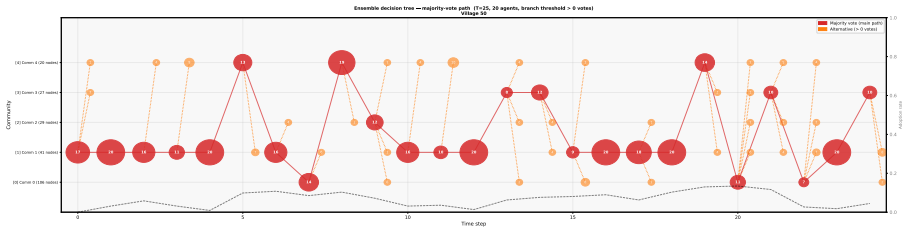

read the original abstract
In networks, effective dynamic treatment allocation requires deciding both whom to treat and also when, so as to amplify policy impact through spillovers. An early intervention at a well-connected node can trigger cascades that change which nodes are worth targeting in the next period. Existing treatment strategies under network interference are largely static while dynamic treatment frameworks typically ignore network structure altogether. We integrate these perspectives and propose Q-Ising, a three-stage pipeline that (i) estimates network adoption dynamics via a Bayesian dynamic Ising model from a single observed panel, (ii) augments treatment adoption histories with continuous posterior latent states, and (iii) learns a dynamic policy via offline reinforcement learning. The Bayesian mechanism enables uncertainty quantification over dynamic decisions, yielding posterior ensemble policies with interpretable spillover estimates. We provide a finite-sample regret upper bound that decomposes into standard offline-RL uncertainty, network abstraction error, and first stage error in Ising state estimation. We apply our method to data from Indian village microfinance networks and synthetic stochastic block models under simulated heterogeneous susceptible-infected-susceptible (SIS) dynamics and demonstrate that adaptive targeting outperforms static centrality benchmarks.
Editorial analysis
A structured set of objections, weighed in public.
Referee Report
Summary. The paper proposes Q-Ising, a three-stage pipeline for dynamic treatment allocation under network interference: (i) fit a Bayesian dynamic Ising model to a single observed panel to estimate adoption dynamics, (ii) augment histories with continuous posterior latent states, and (iii) learn an offline RL policy. It supplies a finite-sample regret upper bound that decomposes into offline-RL uncertainty, network abstraction error, and first-stage Ising estimation error, and reports that the resulting adaptive policies outperform static centrality benchmarks on both synthetic stochastic block models under SIS dynamics and real Indian village microfinance networks.
Significance. If the Ising modeling assumption is adequate and the regret decomposition is tight, the work usefully integrates dynamic treatment regimes with network spillovers, supplies posterior uncertainty over policies, and gives an explicit three-term bound that isolates the contribution of the first-stage estimator. The empirical demonstration on village networks is a concrete test case for adaptive targeting.
major comments (2)
- [Abstract] The finite-sample regret bound (abstract) decomposes the first-stage term as Ising state estimation error, yet the manuscript supplies no derivation details, explicit rates, or assumptions under which this term vanishes when the true process deviates from the dynamic Ising form (e.g., higher-order interactions or time-varying shocks). Without these, it is impossible to verify whether the bound remains informative for the real-data application.
- [Empirical Results] In the empirical application to Indian village microfinance networks, adaptive targeting is reported to outperform static centrality benchmarks, but no model diagnostics (posterior predictive checks, comparison to alternative dynamics, or sensitivity to Ising parameter priors) are provided to assess whether the single-panel Bayesian Ising fit is adequate. This directly affects the size of the first-stage error term and therefore the practical value of both the bound and the policy.
minor comments (2)
- [Method] The three-stage pipeline description would benefit from an explicit diagram or pseudocode showing how posterior samples are converted into the augmented state for the offline RL step.
- [Notation] Notation for the posterior latent states and the ensemble policy should be introduced once and used consistently; several symbols appear to be redefined across sections.
Simulated Author's Rebuttal
We thank the referee for the detailed and constructive comments. We address each major point below and will revise the manuscript to incorporate additional details and diagnostics where possible.
read point-by-point responses
-
Referee: [Abstract] The finite-sample regret bound (abstract) decomposes the first-stage term as Ising state estimation error, yet the manuscript supplies no derivation details, explicit rates, or assumptions under which this term vanishes when the true process deviates from the dynamic Ising form (e.g., higher-order interactions or time-varying shocks). Without these, it is impossible to verify whether the bound remains informative for the real-data application.
Authors: We agree that the current manuscript states the regret bound and its three-term decomposition but does not supply the full derivation or explicit rates. In the revision we will add the derivation steps and rates for the Ising estimation error term (under correct specification of the dynamic Ising model) to an appendix, with a clear statement of the assumptions required for the term to vanish. We will also add a remark noting that the bound is derived under correct specification; when the true process deviates via higher-order interactions or time-varying shocks, the first-stage term need not vanish and the bound may lose tightness. For the village-network application we will discuss this limitation explicitly while retaining the empirical demonstration as evidence of practical utility under the modeling assumptions. revision: yes
-
Referee: [Empirical Results] In the empirical application to Indian village microfinance networks, adaptive targeting is reported to outperform static centrality benchmarks, but no model diagnostics (posterior predictive checks, comparison to alternative dynamics, or sensitivity to Ising parameter priors) are provided to assess whether the single-panel Bayesian Ising fit is adequate. This directly affects the size of the first-stage error term and therefore the practical value of both the bound and the policy.
Authors: We concur that diagnostics are needed to gauge the adequacy of the single-panel Ising fit and the resulting first-stage error. In the revision we will add posterior predictive checks for the fitted model on the village networks together with sensitivity analyses to the prior specifications. A comprehensive comparison against alternative dynamics is constrained by the single observed panel; we will include a discussion of this limitation and limited robustness checks where feasible. These additions will clarify the practical reliability of the bound and the reported policy gains. revision: partial
Circularity Check
No circularity: regret bound explicitly separates first-stage Ising error
full rationale
The paper's central derivation is a finite-sample regret upper bound that decomposes into three distinct terms (offline-RL uncertainty, network abstraction error, and first-stage Ising estimation error). This decomposition treats the Bayesian dynamic Ising estimation from a single panel as an explicit input whose error is bounded rather than assumed away or redefined. The three-stage pipeline (Ising estimation → posterior state augmentation → offline RL) is sequential and the bound accounts for each stage without reducing any term to a fitted parameter or self-citation. No self-definitional equations, no renaming of known results, and no load-bearing self-citations are present in the provided description. Empirical demonstrations on synthetic SIS data (where the model holds by construction) and real networks are presented as validation, not as part of the derivation chain. The analysis is therefore self-contained against external benchmarks.
Axiom & Free-Parameter Ledger
Reference graph
Works this paper leans on
-
[1]
Science , volume=
Model-informed COVID-19 vaccine prioritization strategies by age and serostatus , author=. Science , volume=. 2021 , publisher=
2021
-
[2]
Proceedings of the National Academy of Sciences , volume=
Dynamic prioritization of COVID-19 vaccines when social distancing is limited for essential workers , author=. Proceedings of the National Academy of Sciences , volume=. 2021 , publisher=
2021
-
[3]
Econometrica , volume=
General equilibrium effects of cash transfers: experimental evidence from Kenya , author=. Econometrica , volume=. 2022 , publisher=
2022
-
[4]
PloS one , volume=
Social network sensors for early detection of contagious outbreaks , author=. PloS one , volume=. 2010 , publisher=
2010
-
[5]
The Lancet , volume=
Social network targeting to maximise population behaviour change: a cluster randomised controlled trial , author=. The Lancet , volume=. 2015 , publisher=
2015
-
[6]
Econometrica , volume=
Who should be treated? empirical welfare maximization methods for treatment choice , author=. Econometrica , volume=. 2018 , publisher=
2018
-
[7]
arXiv preprint arXiv:2205.03970 , year=
Policy choice in time series by empirical welfare maximization , author=. arXiv preprint arXiv:2205.03970 , year=
-
[8]
arXiv preprint arXiv:2302.05747 , year=
Individualized treatment allocation in sequential network games , author=. arXiv preprint arXiv:2302.05747 , year=
work page internal anchor Pith review arXiv
-
[9]
Journal of Econometrics , volume=
Who should get vaccinated? Individualized allocation of vaccines over SIR network , author=. Journal of Econometrics , volume=. 2023 , publisher=
2023
-
[10]
Review of Economic Studies , volume=
Policy targeting under network interference , author=. Review of Economic Studies , volume=. 2025 , publisher=
2025
-
[11]
Econometrica , volume=
Policy learning with observational data , author=. Econometrica , volume=. 2021 , publisher=
2021
-
[12]
arXiv preprint arXiv:2507.00312 , year=
Optimal Targeting in Dynamic Systems , author=. arXiv preprint arXiv:2507.00312 , year=
-
[13]
Advances in Neural Information Processing Systems , volume=
Multi-armed bandits with network interference , author=. Advances in Neural Information Processing Systems , volume=
-
[14]
Advances in neural information processing systems , volume=
From bandits to experts: On the value of side-observations , author=. Advances in neural information processing systems , volume=
-
[15]
Journal of the Royal Statistical Society: Series B , volume=
Besag, Julian , title=. Journal of the Royal Statistical Society: Series B , volume=
-
[16]
Journal of the American Statistical Association , volume=
Marginal mean models for dynamic regimes , author=. Journal of the American Statistical Association , volume=. 2001 , publisher=
2001
-
[17]
Offline Reinforcement Learning: Tutorial, Review, and Perspectives on Open Problems
Offline reinforcement learning: Tutorial, review, and perspectives on open problems , author=. arXiv preprint arXiv:2005.01643 , year=
work page internal anchor Pith review arXiv 2005
-
[18]
Wainwright and John D
Pradeep Ravikumar and Martin J. Wainwright and John D. Lafferty , title =. The Annals of Statistics , number =. 2010 , doi =
2010
-
[19]
Physical Review B , volume=
Glauber dynamics of the kinetic Ising model , author=. Physical Review B , volume=. 1992 , publisher=
1992
-
[20]
Journal of the American Statistical Association , volume=
EMVS: The EM approach to Bayesian variable selection , author=. Journal of the American Statistical Association , volume=. 2014 , publisher=
2014
-
[21]
Annual review of statistics and its application , volume=
Dynamic treatment regimes , author=. Annual review of statistics and its application , volume=. 2014 , publisher=
2014
-
[22]
Journal of applied probability , volume=
Restless bandits: Activity allocation in a changing world , author=. Journal of applied probability , volume=. 1988 , publisher=
1988
-
[23]
Journal of applied probability , volume=
On an index policy for restless bandits , author=. Journal of applied probability , volume=. 1990 , publisher=
1990
-
[24]
Advances in Neural Information Processing Systems (NeurIPS) , volume =
Collapsing bandits and their application to public health interventions , author =. Advances in Neural Information Processing Systems (NeurIPS) , volume =
-
[25]
Proceedings of the AAAI Conference on Artificial Intelligence , volume=
Networked restless bandits with positive externalities , author=. Proceedings of the AAAI Conference on Artificial Intelligence , volume=
-
[26]
and Kempe, David and Vorobeychik, Yevgeniy and Tambe, Milind , title =
Ou, Han-Ching and Siebenbrunner, Christoph and Killian, Jackson and Brooks, Meredith B. and Kempe, David and Vorobeychik, Yevgeniy and Tambe, Milind , title =. Proceedings of the 21st International Conference on Autonomous Agents and Multiagent Systems , pages =. 2022 , isbn =
2022
-
[27]
Science , volume =
The diffusion of microfinance , author =. Science , volume =. 2013 , publisher =
2013
-
[28]
Proceedings of the 36th International Conference on Machine Learning (
Information-Theoretic Considerations in Batch Reinforcement Learning , author=. Proceedings of the 36th International Conference on Machine Learning (. 2019 , publisher=
2019
-
[29]
Conservative
Kumar, Aviral and Zhou, Aurick and Tucker, George and Levine, Sergey , booktitle=. Conservative
-
[30]
Journal of Machine Learning Research , volume=
d3rlpy: An Offline Deep Reinforcement Learning Library , author=. Journal of Machine Learning Research , volume=
-
[31]
Proceedings of the ninth ACM SIGKDD international conference on Knowledge discovery and data mining , pages=
Maximizing the spread of influence through a social network , author=. Proceedings of the ninth ACM SIGKDD international conference on Knowledge discovery and data mining , pages=
-
[32]
Proceedings of the seventh ACM SIGKDD international conference on Knowledge discovery and data mining , pages=
Mining the network value of customers , author=. Proceedings of the seventh ACM SIGKDD international conference on Knowledge discovery and data mining , pages=
-
[33]
Scientific reports , volume=
A fast and efficient algorithm for mining top-k nodes in complex networks , author=. Scientific reports , volume=. 2017 , publisher=
2017
-
[34]
Proceedings of the 15th ACM SIGKDD international conference on Knowledge discovery and data mining , pages=
Efficient influence maximization in social networks , author=. Proceedings of the 15th ACM SIGKDD international conference on Knowledge discovery and data mining , pages=
-
[35]
arXiv preprint arXiv:1503.00024 , year=
Influence maximization with bandits , author=. arXiv preprint arXiv:1503.00024 , year=
-
[36]
Proceedings of the 30th ACM SIGKDD Conference on Knowledge Discovery and Data Mining , pages=
Influence maximization via graph neural bandits , author=. Proceedings of the 30th ACM SIGKDD Conference on Knowledge Discovery and Data Mining , pages=
-
[37]
Proceedings of the 24th ACM SIGKDD international conference on knowledge discovery & data mining , pages=
Multi-round influence maximization , author=. Proceedings of the 24th ACM SIGKDD international conference on knowledge discovery & data mining , pages=
-
[38]
International Conference on Machine Learning , pages=
Controlling graph dynamics with reinforcement learning and graph neural networks , author=. International Conference on Machine Learning , pages=. 2021 , organization=
2021
-
[39]
Advances in Neural Information Processing Systems , volume=
Gcomb: Learning budget-constrained combinatorial algorithms over billion-sized graphs , author=. Advances in Neural Information Processing Systems , volume=
-
[40]
Proceedings of the 22nd international conference on Machine learning , pages=
Exploration and apprenticeship learning in reinforcement learning , author=. Proceedings of the 22nd international conference on Machine learning , pages=
-
[41]
Machine learning , volume=
Q-learning , author=. Machine learning , volume=. 1992 , publisher=
1992
-
[42]
1998 , publisher=
Reinforcement learning: An introduction , author=. 1998 , publisher=
1998
-
[43]
Journal of the American Statistical Association , volume=
Variable selection via Gibbs sampling , author=. Journal of the American Statistical Association , volume=. 1993 , publisher=
1993
-
[44]
Journal of the American Statistical Association , volume=
Fair policy targeting , author=. Journal of the American Statistical Association , volume=. 2024 , publisher=
2024
-
[45]
Proceedings of the royal society of london
A contribution to the mathematical theory of epidemics , author=. Proceedings of the royal society of london. Series A, Containing papers of a mathematical and physical character , volume=. 1927 , publisher=
1927
-
[46]
Physical review letters , volume=
Epidemic spreading in scale-free networks , author=. Physical review letters , volume=. 2001 , publisher=
2001
-
[47]
Management science , volume=
A new product growth for model consumer durables , author=. Management science , volume=. 1969 , publisher=
1969
-
[48]
science , volume=
The spread of behavior in an online social network experiment , author=. science , volume=. 2010 , publisher=
2010
-
[49]
Scalable Policy Maximization Under Network Interference
Scalable Policy Maximization Under Network Interference , author=. arXiv preprint arXiv:2505.18118 , year=
work page internal anchor Pith review Pith/arXiv arXiv
-
[50]
Journal of King Saud University-Computer and Information Sciences , volume=
Influence maximization frameworks, performance, challenges and directions on social network: A theoretical study , author=. Journal of King Saud University-Computer and Information Sciences , volume=. 2022 , publisher=
2022
-
[51]
International conference on machine learning , pages=
Is pessimism provably efficient for offline rl? , author=. International conference on machine learning , pages=. 2021 , organization=
2021
-
[52]
Hoffman and Andrew Gelman , title =
Matthew D. Hoffman and Andrew Gelman , title =. Journal of Machine Learning Research , year =
-
[53]
Abbeel, Pieter and Ng, Andrew Y. , title =. Proceedings of the 22nd International Conference on Machine Learning , pages =. 2005 , isbn =. doi:10.1145/1102351.1102352 , abstract =
-
[54]
Improved Algorithms for Linear Stochastic Bandits , booktitle =
Yasin Abbasi-Yadkori and D. Improved Algorithms for Linear Stochastic Bandits , booktitle =
-
[55]
arXiv preprint arXiv:1904.01047 , year=
Dynamically optimal treatment allocation using reinforcement learning , author=. arXiv preprint arXiv:1904.01047 , year=
-
[56]
SIAM review , volume=
The mathematics of infectious diseases , author=. SIAM review , volume=. 2000 , publisher=
2000
-
[57]
Pliska Stud
The SIS-model on time scales , author=. Pliska Stud. Math , volume=
-
[58]
The BE Journal of Theoretical Economics , volume=
Relating network structure to diffusion properties through stochastic dominance , author=. The BE Journal of Theoretical Economics , volume=
discussion (0)
Sign in with ORCID, Apple, or X to comment. Anyone can read and Pith papers without signing in.