Recognition: unknown
Minimal Homotopies in Three Dimensions: A Cable System Approach
Pith reviewed 2026-05-08 04:18 UTC · model grok-4.3
The pith
The cable index of an immersed sphere equals the Brouwer degree on each complementary region and supplies a sharp lower bound on the volume swept by any Lipschitz null homotopy.
A machine-rendered reading of the paper's core claim, the machinery that carries it, and where it could break.
Core claim
For a smooth immersion of the sphere into R^3 having finitely many transverse self-intersections, a cable system connecting each bounded complementary region to the exterior yields a cable index that equals the Brouwer degree on that region. Consequently any Lipschitz null homotopy sweeps a volume at least as large as the sum of the absolute degrees times the appropriate region volumes. This lower bound is attained precisely when the homotopy is sense-preserving and the index evolves monotonically. When the immersion arises as the boundary of an immersed ball, deforming the ball produces an explicit homotopy that meets the bound. All cable indices can be obtained from the finite cable system
What carries the argument
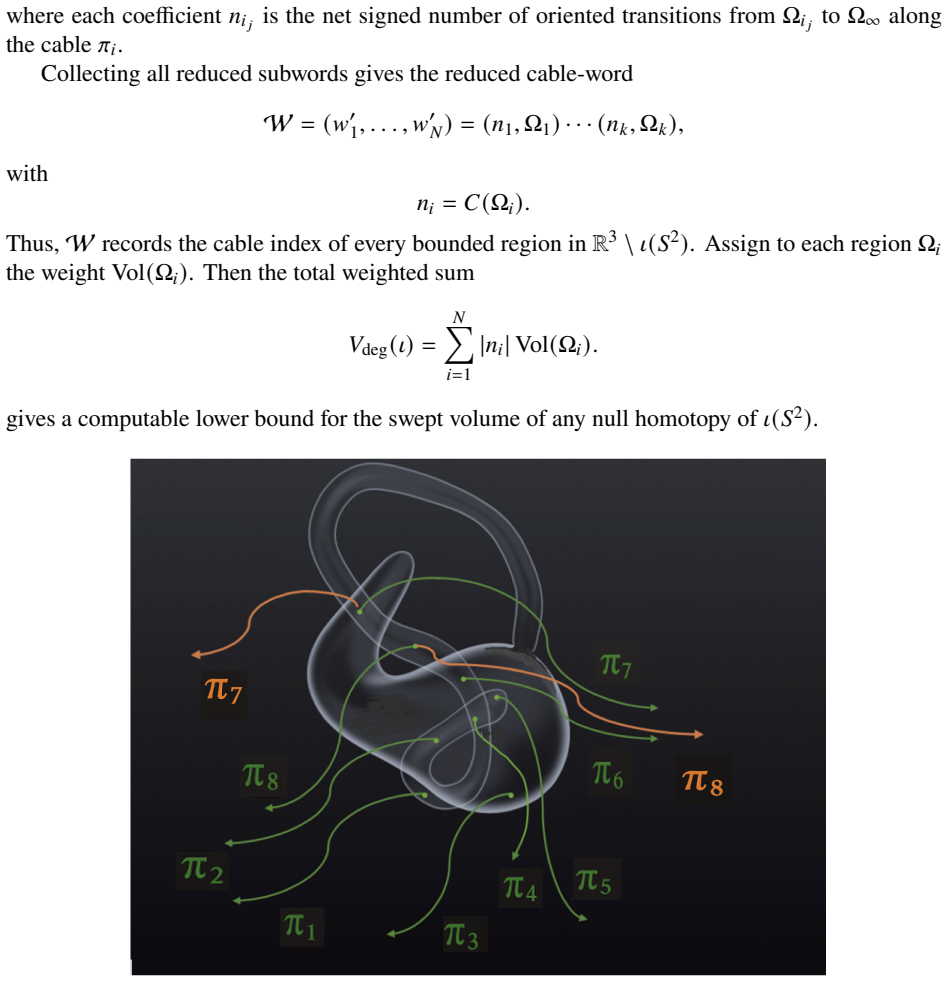
The cable system, a finite collection of paths from each bounded complementary region to the exterior, from which the cable index is defined and shown to equal the Brouwer degree.
If this is right
- Any Lipschitz null homotopy must sweep at least the degree-weighted volume bound obtained from the cable indices.
- Sense-preserving homotopies with monotonic index evolution attain the minimal swept volume.
- When the sphere bounds an immersed ball an explicit deformation of the ball realizes the minimal volume.
- The cable indices and therefore the lower bound can be computed in linear time from the finite cable system.
Where Pith is reading between the lines
- The identification of cable index with Brouwer degree supplies a concrete computational substitute for degree calculations in volume estimates.
- The linear-time algorithm makes the bound practical for numerical minimization of homotopy volumes in geometric modeling.
- The same cable construction may adapt to bound swept volumes for other classes of maps or in higher-dimensional settings.
Load-bearing premise
The immersion is smooth with only finitely many transverse self-intersections, and equality holds only for sense-preserving homotopies in which the index evolves monotonically.
What would settle it
An explicit immersed sphere together with one Lipschitz null homotopy whose swept volume is strictly smaller than the degree-weighted lower bound obtained from its cable indices.
Figures


read the original abstract
We study null homotopies of immersed spheres in $\mathbb{R}^3$ and the volume they sweep during contraction. For a smooth immersion with finitely many transverse self-intersections, we introduce a cable system that connects each bounded region of the complement to the exterior. From this construction we define the cable index and prove that it agrees with the Brouwer degree on each complementary region. Using this identification, we derive a degree-weighted lower bound for the swept volume of any Lipschitz null homotopy. We show that the bound is attained whenever the homotopy is sense-preserving, meaning the surface moves in a consistent direction, and the index evolves monotonically along the homotopy. In addition, in the case where the immersion arises as the boundary of an immersed ball, we construct an explicit homotopy that realizes this lower bound via a deformation of the ball. Finally, we present a linear-time algorithm that computes all cable indices from a finite cable system, providing a concrete and computable method for evaluating the lower bound.
Editorial analysis
A structured set of objections, weighed in public.
Referee Report
Summary. The paper introduces a cable system connecting each bounded complementary region of a smooth immersion of a sphere in R^3 (with finitely many transverse self-intersections) to the exterior. It defines the cable index from this system and proves its agreement with the Brouwer degree on each region. This identification yields a degree-weighted lower bound on the swept volume of any Lipschitz null homotopy, attained precisely when the homotopy is sense-preserving and the indices evolve monotonically. The manuscript also constructs an explicit homotopy realizing the bound for immersions bounding an immersed ball and provides a linear-time algorithm to compute all cable indices from the finite cable data.
Significance. If the identification and bound hold, the work supplies a concrete, computable lower bound on minimal homotopy volumes together with an explicit attaining construction and an efficient algorithm. The cable index is shown to coincide with the independently defined Brouwer degree via homotopy invariance in the complement, without circularity or fitted parameters. The explicit deformation of an immersed ball and the linear-time algorithm constitute direct, verifiable support for the claims and enhance applicability in geometric topology and computational geometry.
minor comments (3)
- The precise definition of 'sense-preserving' and the monotonic evolution of the index should be stated explicitly in terms of the homotopy parameter t (e.g., in the section introducing the volume bound) to avoid ambiguity in the attainment statement.
- A diagram or figure illustrating a simple example of a cable system for an immersed sphere with one or two transverse intersections would greatly aid the reader's understanding of the construction.
- The manuscript would benefit from a short comparison, in the introduction or final section, of the cable-index algorithm's complexity with existing methods for computing Brouwer degrees of immersed surfaces.
Simulated Author's Rebuttal
We thank the referee for the positive and accurate summary of our work, as well as for the favorable assessment of its significance. We note the recommendation for minor revision and will prepare an updated manuscript accordingly.
Circularity Check
Derivation self-contained; cable index proven equal to Brouwer degree via independent topological arguments
full rationale
The paper introduces a cable system for a smooth immersion with transverse self-intersections, defines the cable index directly from this construction, and proves agreement with the Brouwer degree on complementary regions using the standard intersection-number definition along paths in the complement together with homotopy invariance. This identification is independent of the cable choice and does not reduce to self-definition or prior self-citation. The degree-weighted lower bound on swept volume is then obtained by integrating total variation of these degrees over the homotopy parameter, with attainment conditions (sense-preserving monotonic evolution) stated separately. No load-bearing step relies on fitted inputs renamed as predictions, ansatzes smuggled via citation, or uniqueness theorems imported from the authors' prior work; the argument rests on external facts about degrees and Lipschitz homotopies.
Axiom & Free-Parameter Ledger
axioms (2)
- standard math Brouwer degree is well-defined and integer-valued for maps from spheres to R^3 minus a point
- domain assumption Lipschitz null homotopies exist for any continuous immersion of a sphere
invented entities (1)
-
cable system
no independent evidence
Reference graph
Works this paper leans on
-
[1]
Computation of topological degree using interval arithmetic, and applica- tions
Oliver Aberth. “Computation of topological degree using interval arithmetic, and applica- tions”. In:mathematics of computation62.205 (1994), pp. 171–178
1994
-
[2]
Almgren.Almgren’s big regularity paper: Q-valued functions minimizing Dirich- let’s integral and the regularity of area-minimizing rectifiable currents up to codimension 2
Frederick J. Almgren.Almgren’s big regularity paper: Q-valued functions minimizing Dirich- let’s integral and the regularity of area-minimizing rectifiable currents up to codimension 2. Vol. 1. World scientific Publishing Co. Inc., River Edge, NJ, 2000
2000
-
[3]
Fast winding numbers for soups and clouds
Gavin Barill, Neil G Dickson, Ryan Schmidt, David IW Levin, and Alec Jacobson. “Fast winding numbers for soups and clouds”. In:ACM Transactions on Graphics (TOG)37.4 (2018), pp. 1–12
2018
-
[4]
Extending Immersions and Regular Homotopies in Codimension 1
Samuel Blank. “Extending Immersions and Regular Homotopies in Codimension 1”. PhD thesis. University of Michigan, 1967
1967
-
[5]
Complexity of computing topological degree of Lipschitz functions in n dimensions
Terrance E Boult and Krzysztof Sikorski. “Complexity of computing topological degree of Lipschitz functions in n dimensions”. In:Journal of Complexity2.1 (1986), pp. 44–59
1986
-
[6]
¨Uber abbildung von mannigfaltigkeiten
Luitzen Egbertus Jan Brouwer. “ ¨Uber abbildung von mannigfaltigkeiten”. In:Mathematische annalen71.1 (1911), p. 97115. 22
1911
-
[7]
Measuring Similarity Between Curves on 2-manifolds via Homotopy Area
Erin Wolf Chambers and Yusu Wang. “Measuring Similarity Between Curves on 2-manifolds via Homotopy Area”. In:Proceedings of the Twenty-ninth Annual Symposium on Com- putational Geometry. SoCG ’13. Rio de Janeiro, Brazil: ACM, 2013, pp. 425–434.doi: 10.1145/2462356.2462375
-
[8]
Measuring similarity between curves on 2-manifolds via homotopy area
Erin Wolf Chambers and Yusu Wang. “Measuring similarity between curves on 2-manifolds via homotopy area”. In:Journal of Computational Geometry10.1 (2019), pp. 96–126
2019
-
[9]
From Curves to Words and Back Again: Geometric Computation of Minimum-Area Homotopy
Hsien-Chih Chang, Brittany Terese Fasy, Bradley McCoy, David L Millman, and Carola Wenk. “From Curves to Words and Back Again: Geometric Computation of Minimum-Area Homotopy”. In:Algorithms and Data Structures (WADS 2023). Springer. 2023, pp. 605–619
2023
-
[10]
Springer-Verlag Berlin Heidelberg New York Tokyo, 1985
Klaus Deimling.Nonlinear functional analysis. Springer-Verlag Berlin Heidelberg New York Tokyo, 1985
1985
-
[11]
Evans Lawrence C.Measure theory and fine properties of functions
Gariepy Ronald F. Evans Lawrence C.Measure theory and fine properties of functions. CRC Press, 2015
2015
-
[12]
On minimum area homotopies of normal curves in the plane
Brittany Terese Fasy, Selc ¸uk Karakoc ¸, and Carola Wenk. “On minimum area homotopies of normal curves in the plane”. In:arXiv(2017). arXiv:1707.02251
-
[13]
Springer, 1969
Herbert Federer.Geometric measure theory. Springer, 1969
1969
-
[14]
Normal and integral currents
Herbert Federer and Wendell H. Fleming. “Normal and integral currents”. In:Annals of Mathematics72.3 (1960), pp. 458–520
1960
-
[15]
Effective topological degree computation based on interval arithmetic
Peter Franek and Stefan Ratschan. “Effective topological degree computation based on interval arithmetic”. In:Mathematics of Computation84.293 (2015), pp. 1265–1290
2015
-
[16]
Filling riemannian manifolds
Mikhael Gromov. “Filling riemannian manifolds”. In:Journal of Differential Geometry18.1 (1983), pp. 1–147
1983
-
[17]
Academic press, 1959
Sze-Tsen Hu.Homotopy theory. Academic press, 1959
1959
-
[18]
Robust inside-outside seg- mentation using generalized winding numbers
Alec Jacobson, Ladislav Kavan, and Olga Sorkine-Hornung. “Robust inside-outside seg- mentation using generalized winding numbers”. In:ACM Transactions on Graphics (TOG) 32.4 (2013), pp. 1–12
2013
-
[19]
Lee.Introduction to Smooth Manifolds
John M. Lee.Introduction to Smooth Manifolds. 2nd ed. Springer, 2013
2013
-
[20]
Numerical computation of the mapping degree using computational homology
Kansaku Nakakura and Sunao Murashige. “Numerical computation of the mapping degree using computational homology”. In:12th GAMM-IMACS International Symposium on Sci- entific Computing, Computer Arithmetic and Validated Numerics (SCAN 2006). IEEE. 2006, pp. 34–34
2006
-
[21]
On The Minimum Area Of Null Homotopies Of Curves Traced Twice
Zipei Nei. “On The Minimum Area Of Null Homotopies Of Curves Traced Twice”. In: (2014). arXiv:1412.0101
-
[22]
The calculation of the topological degree by quadra- ture
Thomas O’Neil and John W. Thomas. “The calculation of the topological degree by quadra- ture”. In:SIAM Journal on Numerical Analysis12.5 (1975), pp. 673–680
1975
-
[23]
Computing the topological degree of a mapping in R n
Frank Stenger. “Computing the topological degree of a mapping in R n”. In:Numerische Mathematik25.1 (1975), pp. 23–38
1975
-
[24]
Existence of least-area mappings of N-dimensional domains
Brian White. “Existence of least-area mappings of N-dimensional domains”. In:Annals of Mathematics118.1 (1983), pp. 179–185. 23
1983
discussion (0)
Sign in with ORCID, Apple, or X to comment. Anyone can read and Pith papers without signing in.