Recognition: unknown
History-Aware Conformal Prediction Sets for Censored Time-to-Event Outcomes
Pith reviewed 2026-05-08 07:18 UTC · model grok-4.3
The pith
History-aware conformal sets use covariate histories and censoring weights to produce shorter prediction intervals for event times that cover the truth among survivors.
A machine-rendered reading of the paper's core claim, the machinery that carries it, and where it could break.
Core claim
The central claim is that conformal prediction sets for right-censored time-to-event outcomes can be constructed to achieve PAAC coverage among survivors by incorporating the observed covariate history up to the decision time and reweighting uncensored observations by the inverse probability of remaining uncensored; two doubly robust variants are also given that protect the coverage guarantee if either the censoring or outcome model is correct.
What carries the argument
History-Aware Prediction Sets (HAPS) that condition the nonconformity score on the full observed covariate process up to the decision time and reweight by inverse probability of censoring.
If this is right
- The sets remain valid conditionally on survival to the decision time rather than only unconditionally from baseline.
- Doubly robust extensions preserve the coverage property even when one of the two models is misspecified.
- Interval lengths shrink because the method uses updated, individual-specific information instead of fixed baseline data alone.
- The same weighting approach can be applied at multiple decision times to produce a sequence of updating forecasts.
Where Pith is reading between the lines
- The method could be extended to streaming settings where new covariate measurements arrive continuously and predictions are refreshed in real time.
- It may improve resource planning in clinical cohorts by supplying tighter bounds on remaining time for patients still under observation.
- The framework suggests a general route for bringing dynamic histories into other conformal procedures that currently use only static features.
Load-bearing premise
The censoring weights must be estimated consistently or at least one model in the doubly robust version must be correct.
What would settle it
A simulation or dataset in which both the censoring and outcome models are misspecified in a manner not protected by double robustness, and the empirical coverage among survivors falls materially below the target probability.
Figures


read the original abstract
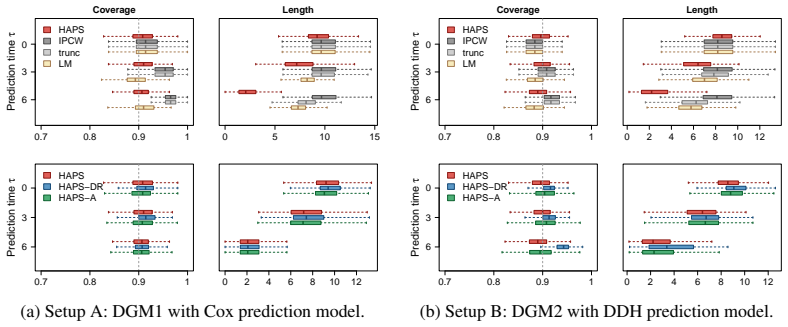
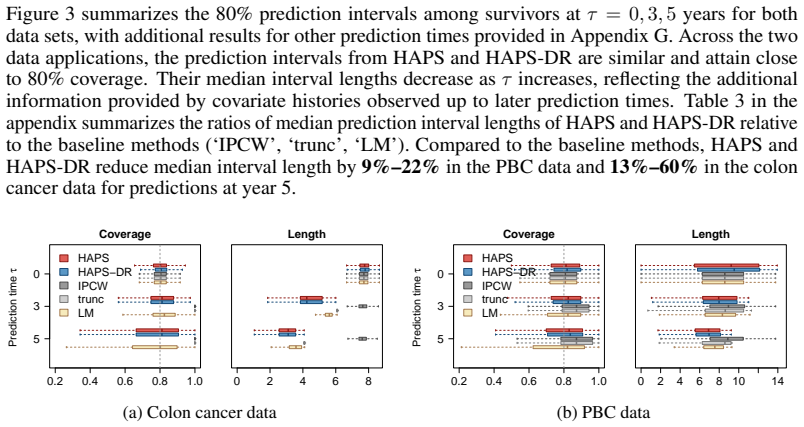
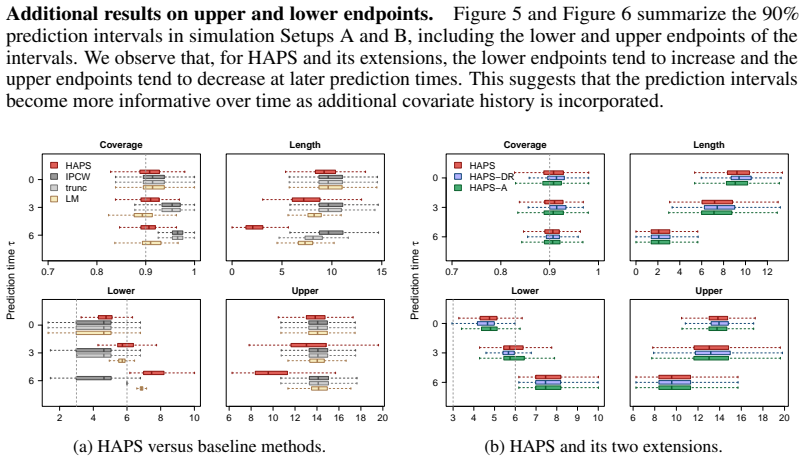
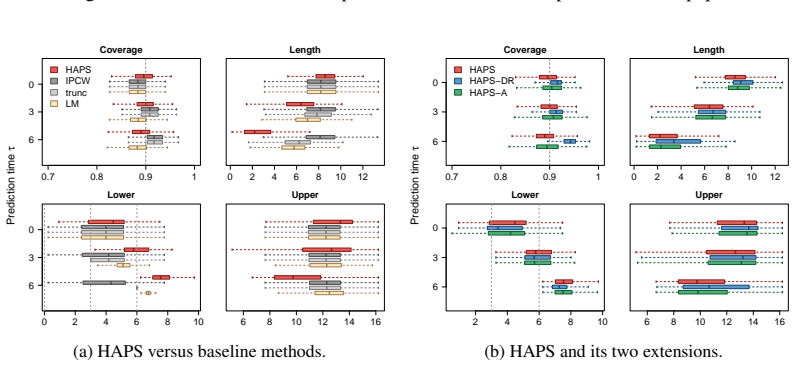
Existing conformal prediction methods for time-to-event outcomes leverage only baseline covariates, producing prediction intervals that are insufficiently informative to facilitate decision making. We propose History-Aware Prediction Sets (HAPS), a conformal framework that constructs prediction sets for individual event times using covariate histories observed up to a decision time, targeting coverage among individuals who have survived to this time. HAPS handles right censoring adjusted for time-varying confounders via inverse probability of censoring weighting. When the censoring weights are consistently estimated, it achieves PAAC (probably asymptotically approximately correct) coverage among survivors. We further propose two doubly robust extensions of HAPS to weaken reliance on consistent estimation of the censoring distribution. In simulations, HAPS and its extensions reduce median prediction interval length by up to 75\% relative to baseline comparators while maintaining close to nominal coverage. On two public benchmark data sets, HAPS reduces the median interval length by up to 60\% for predictions at year 5, compared to the baseline comparators.
Editorial analysis
A structured set of objections, weighed in public.
Referee Report
Summary. The paper proposes History-Aware Prediction Sets (HAPS), a conformal prediction framework for right-censored time-to-event outcomes that incorporates covariate histories observed up to a decision time and targets coverage among survivors. It adjusts for censoring via inverse probability of censoring weighting (IPCW) with time-varying confounders, claims probably asymptotically approximately correct (PAAC) coverage when censoring weights are consistent, introduces two doubly robust extensions, and reports up to 75% reduction in median interval length in simulations and up to 60% at year 5 on real data while maintaining nominal coverage.
Significance. If the coverage guarantees are rigorously established, the work would meaningfully extend conformal prediction to dynamic, history-dependent survival settings, enabling tighter and more actionable intervals for time-specific decisions. The empirical gains in interval efficiency and the attempt to weaken reliance on censoring model correctness via double robustness are clear strengths relative to baseline-only conformal methods.
major comments (2)
- [Abstract] Abstract: the claim that HAPS achieves PAAC coverage among survivors when censoring weights are consistently estimated is load-bearing, yet the abstract provides no definition of the history-aware conformity scores, the precise form of the IPCW-adjusted residuals, or the argument establishing (asymptotic) exchangeability of the weighted scores conditional on survival to the decision time.
- [Abstract] Abstract: for the doubly robust extensions, it is not indicated whether the coverage argument uses the standard DR expansion (which debiases the point estimate but does not automatically protect the quantile of the score distribution) or a conformal-specific argument; without this, it remains possible that joint misspecification of the censoring and outcome models in correlated ways (e.g., shared time-varying confounders) can distort the rank distribution of the scores and invalidate PAAC coverage among survivors.
minor comments (2)
- [Abstract] The abstract refers to 'two public benchmark data sets' without naming them or providing access details, which hinders immediate reproducibility assessment.
- Simulation results are summarized only at a high level (up to 75% length reduction); reporting the number of Monte Carlo replications, exact censoring mechanisms, and the precise baseline comparators would strengthen the empirical section.
Simulated Author's Rebuttal
We thank the referee for their constructive comments, which highlight opportunities to improve the clarity of the abstract. We address each point below and have revised the abstract to incorporate more precise technical descriptions while preserving its conciseness.
read point-by-point responses
-
Referee: [Abstract] Abstract: the claim that HAPS achieves PAAC coverage among survivors when censoring weights are consistently estimated is load-bearing, yet the abstract provides no definition of the history-aware conformity scores, the precise form of the IPCW-adjusted residuals, or the argument establishing (asymptotic) exchangeability of the weighted scores conditional on survival to the decision time.
Authors: We agree that the abstract should supply sufficient context for the coverage claim. In the revision we have expanded the abstract to define the history-aware conformity scores as the IPCW-weighted residuals that incorporate the full covariate history up to the decision time. We also state the form of the IPCW-adjusted residuals and indicate that the PAAC coverage follows from the asymptotic exchangeability of these weighted scores conditional on survival, as proved in Theorem 1. These additions make the abstract self-contained without exceeding length limits. revision: yes
-
Referee: [Abstract] Abstract: for the doubly robust extensions, it is not indicated whether the coverage argument uses the standard DR expansion (which debiases the point estimate but does not automatically protect the quantile of the score distribution) or a conformal-specific argument; without this, it remains possible that joint misspecification of the censoring and outcome models in correlated ways (e.g., shared time-varying confounders) can distort the rank distribution of the scores and invalidate PAAC coverage among survivors.
Authors: We thank the referee for this distinction. The coverage guarantee for the doubly robust extensions rests on a conformal-specific argument: double robustness ensures the weighted scores remain asymptotically exchangeable conditional on survival, thereby preserving the quantile properties required for conformal validity. This is distinct from the standard DR expansion for point estimation. We have added a clarifying sentence to the revised abstract and expanded the discussion in Section 4.2 to state the conditions under which joint misspecification (including correlated errors) may invalidate coverage. We have also added simulation results under partial misspecification to illustrate the practical behavior. revision: partial
Circularity Check
No significant circularity
full rationale
The paper proposes HAPS, a history-aware conformal prediction framework for censored time-to-event data. Its core coverage guarantee relies on standard conformal prediction exchangeability arguments applied to IPCW-weighted or doubly-robust pseudo-residuals. The abstract and claimed derivations invoke established IPCW and DR theory rather than re-deriving coverage from fitted quantities by construction. No self-definitional reduction, fitted-input-called-prediction, or load-bearing self-citation chain appears in the provided text. The length-reduction claims are simulation- and data-based rather than tautological. Overall, the derivation is self-contained against external benchmarks (standard CP + IPCW/DR).
Axiom & Free-Parameter Ledger
axioms (2)
- domain assumption Data satisfy approximate exchangeability conditional on histories for conformal coverage to hold
- domain assumption Censoring mechanism is correctly modeled or the doubly robust property protects against misspecification
Reference graph
Works this paper leans on
-
[1]
Theoretical foundations of conformal prediction , author=
-
[2]
Conformal predictions for longitudinal data , author=
-
[3]
Clinical
Banerji, Christopher RS and Chakraborti, Tapabrata and Harbron, Chris and MacArthur, Ben D , journal=. Clinical. 2023 , publisher=
2023
-
[4]
Journal of the Royal Statistical Society Series B: Statistical Methodology , volume=
Conformalized survival analysis , author=. Journal of the Royal Statistical Society Series B: Statistical Methodology , volume=. 2023 , publisher=
2023
-
[5]
New England Journal of Medicine , volume=
Two randomized trials of neutralizing antibodies to prevent HIV-1 acquisition , author=. New England Journal of Medicine , volume=. 2021 , publisher=
2021
-
[6]
Scientific reports , volume=
Comparing machine learning approaches to incorporate time-varying covariates in predicting cancer survival time , author=. Scientific reports , volume=. 2023 , publisher=
2023
-
[7]
The Thirteenth International Conference on Learning Representations , year=
Conformalized Survival Analysis for General Right-Censored Data , author=. The Thirteenth International Conference on Learning Representations , year=
-
[8]
Journal of the Royal Statistical Society Series B: Statistical Methodology , volume=
Causal mediation analysis for stochastic interventions , author=. Journal of the Royal Statistical Society Series B: Statistical Methodology , volume=. 2020 , publisher=
2020
-
[9]
On the probability function in the collective theory of risk , author=. Skand. Aktuarie Tidskr. , volume=
-
[10]
Doubly Robust and Efficient Calibration of Prediction Sets for Censored Time-to-Event Outcomes , author=
-
[11]
On the role of surrogates in conformal inference of individual causal effects , author=
-
[12]
2013 , publisher=
Counting processes and survival analysis , author=. 2013 , publisher=
2013
-
[13]
Advances in Neural Information Processing Systems , volume=
Adaptive conformal inference under distribution shift , author=. Advances in Neural Information Processing Systems , volume=
-
[14]
Journal of Machine Learning Research , volume=
Conformal inference for online prediction with arbitrary distribution shifts , author=. Journal of Machine Learning Research , volume=
-
[15]
Biometrika , volume=
Conformalized survival analysis with adaptive cut-offs , author=. Biometrika , volume=. 2024 , publisher=
2024
-
[16]
Statistics in Medicine , volume=
Accuracy of point predictions in survival analysis , author=. Statistics in Medicine , volume=. 2001 , publisher=
2001
-
[17]
Two-sided conformalized survival analysis , author=
-
[18]
Journal of the Royal Statistical Society Series B: Statistical Methodology , volume=
Long-term causal inference under persistent confounding via data combination , author=. Journal of the Royal Statistical Society Series B: Statistical Methodology , volume=. 2025 , publisher=
2025
-
[19]
Journal of Machine Learning Research , volume=
Localized debiased machine learning: Efficient inference on quantile treatment effects and beyond , author=. Journal of Machine Learning Research , volume=
-
[20]
Journal of the Royal Statistical Society Series B: Statistical Methodology , volume=
On the role of surrogates in the efficient estimation of treatment effects with limited outcome data , author=. Journal of the Royal Statistical Society Series B: Statistical Methodology , volume=. 2025 , publisher=
2025
-
[21]
Journal of the American Statistical Association , volume=
Nonparametric causal effects based on incremental propensity score interventions , author=. Journal of the American Statistical Association , volume=. 2019 , publisher=
2019
-
[22]
The North Central Cancer Treatment Group and the Mayo Clinic
Surgical adjuvant therapy of large-bowel carcinoma: an evaluation of levamisole and the combination of levamisole and fluorouracil. The North Central Cancer Treatment Group and the Mayo Clinic. , author=. Journal of clinical oncology , volume=
-
[23]
Dynamic-
Lee, Changhee and Yoon, Jinsung and Van Der Schaar, Mihaela , journal=. Dynamic-. 2019 , publisher=
2019
-
[24]
Journal of the American Statistical Association , volume=
Distribution-free predictive inference for regression , author=. Journal of the American Statistical Association , volume=. 2018 , publisher=
2018
-
[25]
Journal of the Royal Statistical Society Series B: Statistical Methodology , volume=
Conformal inference of counterfactuals and individual treatment effects , author=. Journal of the Royal Statistical Society Series B: Statistical Methodology , volume=. 2021 , publisher=
2021
-
[26]
Stochastic interventions, sensitivity analysis, and optimal transport , author=
-
[27]
Statistics in Medicine , volume=
Deep learning for the dynamic prediction of multivariate longitudinal and survival data , author=. Statistics in Medicine , volume=. 2022 , publisher=
2022
-
[28]
Prediction Sets and Conformal Inference with Interval Outcomes , author=
-
[29]
Weighted aggregation of conformity scores for classification , author=
-
[30]
Biometrika , volume=
Doubly robust estimation under a possibly misspecified marginal structural Cox model , author=. Biometrika , volume=. 2025 , publisher=
2025
-
[31]
Uncertainty quantification for intervals , author=
-
[32]
New England Journal of Medicine , volume=
Levamisole and fluorouracil for adjuvant therapy of resected colon carcinoma , author=. New England Journal of Medicine , volume=. 1990 , publisher=
1990
-
[33]
Hepatology , volume=
Primary biliary cirrhosis: prediction of short-term survival based on repeated patient visits , author=. Hepatology , volume=. 1994 , publisher=
1994
-
[34]
Multiply Robust Conformal Risk Control with Coarsened Data , author=
-
[35]
BMC medical research methodology , volume=
Random survival forests for dynamic predictions of a time-to-event outcome using a longitudinal biomarker , author=. BMC medical research methodology , volume=. 2021 , publisher=
2021
-
[36]
Proceedings of the Thirty-Seventh Conference on Uncertainty in Artificial Intelligence , pages =
Distribution-free uncertainty quantification for classification under label shift , author =. Proceedings of the Thirty-Seventh Conference on Uncertainty in Artificial Intelligence , pages =. 2021 , editor =
2021
-
[37]
Conformalized survival distributions: A generic post-process to increase calibration , author=
-
[38]
Toward Conditional Distribution Calibration in Survival Prediction , volume =
Qi, Shi-ang and Yu, Yakun and Greiner, Russell , booktitle =. Toward Conditional Distribution Calibration in Survival Prediction , volume =
-
[39]
Biometrics , volume=
Conformal predictive intervals in survival analysis: a resampling approach , author=. Biometrics , volume=. 2025 , publisher=
2025
-
[40]
Journal of the Royal Statistical Society Series B: Statistical Methodology , volume=
Prediction sets adaptive to unknown covariate shift , author=. Journal of the Royal Statistical Society Series B: Statistical Methodology , volume=. 2023 , publisher=
2023
-
[41]
Multiply Robust Estimation of Conditional Survival Probability with Time-Varying Covariates , author=
-
[42]
Biometrical Journal , volume=
Dynamic predictions with time-dependent covariates in survival analysis using joint modeling and landmarking , author=. Biometrical Journal , volume=. 2017 , publisher=
2017
-
[43]
Statistics in medicine , volume=
Optimizing dynamic predictions from joint models using super learning , author=. Statistics in medicine , volume=. 2024 , publisher=
2024
-
[44]
Annals of Applied Statistics , volume=
Dynamic prediction of residual life with longitudinal covariates using long short-term memory networks , author=. Annals of Applied Statistics , volume=
-
[45]
AIDS epidemiology , pages=
Recovery of information and adjustment for dependent censoring using surrogate markers , author=. AIDS epidemiology , pages=. 1992 , publisher=
1992
-
[46]
Advances in neural information processing systems , volume=
Conformalized quantile regression , author=. Advances in neural information processing systems , volume=
-
[47]
Encyclopedia of Biostatistics , volume=
Inverse probability weighting in survival analysis , author=. Encyclopedia of Biostatistics , volume=. 2005 , publisher=
2005
-
[48]
Biometrika , volume=
Characterization of parameters with a mixed bias property , author=. Biometrika , volume=. 2021 , publisher=
2021
-
[49]
Incremental effects for continuous exposures , author=
-
[50]
arXiv preprint arXiv:2505.04568 , year=
Conformal Survival Bands for Risk Screening under Right-Censoring , author=. arXiv preprint arXiv:2505.04568 , year=
-
[51]
The International Conference on Machine Learning , year=
Doubly Robust Conformalized Survival Analysis with Right-Censored Data , author=. The International Conference on Machine Learning , year=
-
[52]
Training-Set Conditionally Valid Prediction Sets with Right-Censored Data , author=
-
[53]
Biometrics , volume=
Semi-parametric sensitivity analysis for trials with irregular and informative assessment times , author=. Biometrics , volume=. 2024 , publisher=
2024
-
[54]
Journal of the Royal Statistical Society Series A: Statistics in Society , volume=
Dynamic survival prediction combining landmarking with a machine learning ensemble: Methodology and empirical comparison , author=. Journal of the Royal Statistical Society Series A: Statistics in Society , volume=. 2021 , publisher=
2021
-
[55]
2000 , isbn =
Modeling Survival Data: Extending the Cox Model , author =. 2000 , isbn =
2000
-
[56]
Advances in neural information processing systems , volume=
Conformal prediction under covariate shift , author=. Advances in neural information processing systems , volume=
-
[57]
2006 , publisher=
Semiparametric Theory and Missing Data , author=. 2006 , publisher=
2006
-
[58]
2005 , publisher=
Algorithmic Learning in a Random World , author=. 2005 , publisher=
2005
-
[59]
Biometrika , volume=
Minimal dispersion approximately balancing weights: asymptotic properties and practical considerations , author=. Biometrika , volume=. 2020 , publisher=
2020
-
[60]
Journal of the American Statistical Association , volume=
Inference for treatment-specific survival curves using machine learning , author=. Journal of the American Statistical Association , volume=. 2024 , publisher=
2024
-
[61]
Annals of Applied Statistics , volume=
Support vector machine for dynamic survival prediction with time-dependent covariates , author=. Annals of Applied Statistics , volume=. 2024 , publisher=
2024
-
[62]
IEEE transactions on pattern analysis and machine intelligence , volume=
Conformal prediction for time series , author=. IEEE transactions on pattern analysis and machine intelligence , volume=. 2023 , publisher=
2023
-
[63]
International Conference on Machine Learning , pages=
Sequential predictive conformal inference for time series , author=. International Conference on Machine Learning , pages=. 2023 , organization=
2023
-
[64]
Biometrika , volume=
Semiparametric estimation of structural failure time models in continuous-time processes , author=. Biometrika , volume=. 2020 , publisher=
2020
-
[65]
Journal of the Royal Statistical Society Series B: Statistical Methodology , volume=
Doubly robust calibration of prediction sets under covariate shift , author=. Journal of the Royal Statistical Society Series B: Statistical Methodology , volume=. 2024 , publisher=
2024
-
[66]
Journal of the American Statistical Association , volume=
Selection and aggregation of conformal prediction sets , author=. Journal of the American Statistical Association , volume=. 2025 , publisher=
2025
-
[67]
Stat , volume=
Survival Conformal Prediction Under Random Censoring , author=. Stat , volume=. 2025 , publisher=
2025
-
[68]
International Conference on Artificial Intelligence and Statistics , pages=
Positivity-free policy learning with observational data , author=. International Conference on Artificial Intelligence and Statistics , pages=. 2024 , organization=
2024
-
[69]
doi:10.1088/1742-6596/78/1/012057 , booktitle =
The open science grid , author =. doi:10.1088/1742-6596/78/1/012057 , booktitle =
-
[70]
The pilot way to grid resources using glideinWMS
The pilot way to grid resources using glideinWMS , author =. doi:10.1109/CSIE.2009.950 , booktitle =
-
[71]
OSPool , publisher =. doi:10.21231/906P-4D78 , author =
-
[72]
Open Science Data Federation , publisher =. doi:10.21231/0KVZ-VE57 , note =
discussion (0)
Sign in with ORCID, Apple, or X to comment. Anyone can read and Pith papers without signing in.