Recognition: unknown
On the dual nature of a plane angle
Pith reviewed 2026-05-08 02:58 UTC · model grok-4.3
The pith
Plane angle is dimensional when measured but appears as a dimensionless ratio in equations, so the radian should be a base SI unit.
A machine-rendered reading of the paper's core claim, the machinery that carries it, and where it could break.
Core claim
Depending on the physical situation, a plane angle is described by either a dimensional or a dimensionless quantity. When measuring, expressing, and communicating an angle's size, physicists use the dimensional quantity plane angle. Its dimension and unit are independent of the dimensions of other quantities and their units. This quantity, plane angle, should be classified as a base quantity, and its unit, the radian, should be included in the class of base SI units. In theoretical studies of physical systems with angular quantities, the latter always enter into equations as a dimensionless combination of dimensional plane angles. This dimensionless combination, in turn, is also a physical 1
What carries the argument
The context-dependent treatment of plane angle as an independent dimensional quantity in measurement versus a dimensionless derived combination in theoretical equations.
If this is right
- Plane angle should be reclassified as a base quantity in the SI system.
- The radian should be added to the list of base SI units.
- Theoretical equations involving angles remain valid because they operate on the dimensionless derived form.
- Measurement and communication of angles already treat them as having a dimension separate from length.
Where Pith is reading between the lines
- This distinction could allow explicit dimensional tracking of angles in practical applications like surveying or navigation without altering rotation formulas.
- Unit conversion tools and standards documents might need updates to support both the dimensional measurement form and the dimensionless equation form.
- Solid angle quantities could be examined under the same dual treatment in future metrology work.
Load-bearing premise
The observed differences in how plane angle is used for measurement versus in theoretical equations justify assigning it an independent dimension without creating inconsistencies in physical laws or the SI system.
What would settle it
A concrete calculation or measurement in which assigning an independent dimension to plane angle produces a unit inconsistency or numerical mismatch with experiment in a standard physical formula that cannot be resolved by rewriting the angle as its dimensionless combination.
Figures
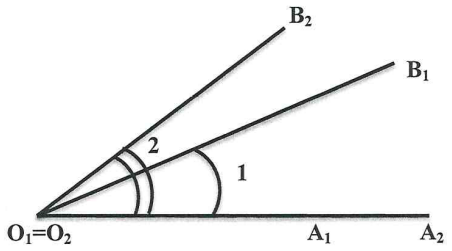
read the original abstract
For decades, metrologists have debated heatedly whether a plane angle is a dimensional or dimensionless quantity; whether it is a base quantity in the International System of Units (SI) or a derived quantity. Two main points of view have emerged in the international metrology community. Those who hold the first view believe that a plane angle is a dimensionless derived quantity equal to the ratio of two lengths, and its unit, the radian, is the dimensionless number one (1 rad = 1 m/m = 1). Those who hold the second view believe that a plane angle is a dimensional quantity with its own independent dimension, and its unit, the radian, is not the dimensionless number one, as is currently accepted in the SI. This article demonstrates that, depending on the physical situation, a plane angle is described by either a dimensional or a dimensionless quantity. When measuring, expressing, and communicating an angle's size, physicists use the dimensional quantity plane angle. Its dimension and unit are independent of the dimensions of other quantities and their units. This quantity, plane angle, should be classified as a base quantity, and its unit, radian, should be included in the class of base SI units. In theoretical studies of physical systems with angular quantities, the latter always enter into equations as a dimensionless combination of dimensional plane angles. This dimensionless combination, in turn, is also a physical quantity characterizing the plane angle in question. This new quantity is a dimensionless derived quantity, which physicists also call an angle.
Editorial analysis
A structured set of objections, weighed in public.
Referee Report
Summary. The manuscript argues that plane angle possesses a dual nature: in metrological contexts of measurement, expression, and communication it is a dimensional base quantity with an independent dimension, warranting classification as a base SI quantity and inclusion of the radian among base units; in theoretical studies of physical systems, however, angular quantities always enter equations solely as dimensionless derived combinations of those dimensional angles, which are themselves also termed angles.
Significance. If the context-dependent distinction can be made rigorous, the work would address a long-standing metrological debate by reconciling the two prevailing views on whether plane angle is dimensional or dimensionless, potentially justifying a change to the SI base units. The attempt to separate usage in measurement from usage in dynamics is a constructive framing of the problem, though the manuscript provides no formal derivations or consistency checks to support the separation.
major comments (3)
- [Abstract] Abstract: the claim that the article 'demonstrates' the dual nature is unsupported; no derivations, explicit transition rules, or worked examples are supplied showing how a measured dimensional angle is converted into the dimensionless combination used in equations such as sin(θ) or ω = dθ/dt while preserving dimensional homogeneity and information content.
- [Main argument] Main argument on dual usage: the assertion that angles 'always enter into equations as a dimensionless combination' is stated without a formal criterion for when a given physical angle must be treated as dimensional versus dimensionless, leaving open the possibility of unit mismatches when the same quantity crosses from metrology into dynamics.
- [Classification proposal] Classification as base quantity: the proposal rests on observed differences in usage across contexts rather than an independent derivation of an additional base dimension; this risks circularity, as the dimension is defined by the very applications it is meant to explain, without demonstrating that the dual treatment leaves all existing physical laws and SI coherence intact.
minor comments (1)
- [Abstract] The repeated use of 'plane angle' for both the dimensional and the dimensionless quantities could be disambiguated by introducing distinct notation (e.g., Θ for the dimensional quantity and θ for the dimensionless combination) to improve readability.
Simulated Author's Rebuttal
We thank the referee for the constructive and detailed report. The comments highlight areas where the manuscript can be strengthened with additional formal elements. We address each major comment below and indicate the revisions we will make.
read point-by-point responses
-
Referee: [Abstract] Abstract: the claim that the article 'demonstrates' the dual nature is unsupported; no derivations, explicit transition rules, or worked examples are supplied showing how a measured dimensional angle is converted into the dimensionless combination used in equations such as sin(θ) or ω = dθ/dt while preserving dimensional homogeneity and information content.
Authors: We accept that the abstract's phrasing 'demonstrates' is too strong for the current conceptual presentation. In revision we will change the abstract to state that the work 'proposes and illustrates' the dual nature. We will also add a new section containing explicit transition rules and two worked examples: (1) conversion of a measured dimensional angle (arc-to-radius ratio with unit radian) to the dimensionless argument of sin(θ) by normalization to the unit, and (2) the time derivative yielding angular velocity while preserving homogeneity. These additions will show that numerical values and physical information are retained. revision: yes
-
Referee: [Main argument] Main argument on dual usage: the assertion that angles 'always enter into equations as a dimensionless combination' is stated without a formal criterion for when a given physical angle must be treated as dimensional versus dimensionless, leaving open the possibility of unit mismatches when the same quantity crosses from metrology into dynamics.
Authors: The manuscript grounds the distinction in established physical practice rather than an arbitrary rule. We will introduce an explicit criterion in the revised text: an angle is treated as dimensional when it results from a direct metrological comparison of lengths (arc versus radius) and is reported with its unit; it is rendered dimensionless by division by the radian unit precisely when it enters a transcendental function or a derivative in a dynamical equation. This rule is applied at the boundary between metrology and theory, thereby eliminating unit mismatches by construction. revision: partial
-
Referee: [Classification proposal] Classification as base quantity: the proposal rests on observed differences in usage across contexts rather than an independent derivation of an additional base dimension; this risks circularity, as the dimension is defined by the very applications it is meant to explain, without demonstrating that the dual treatment leaves all existing physical laws and SI coherence intact.
Authors: The classification is deliberately usage-driven, consistent with the historical development of other SI base quantities. To reduce the appearance of circularity we will add a consistency section showing that every standard dynamical equation retains its conventional form once the dimensionless combination is substituted, and that no existing law is altered. A fully independent, non-usage-based derivation of the angle dimension lies outside the scope of the present work and would constitute a separate foundational study. revision: partial
Circularity Check
No significant circularity in the dual-nature metrological argument
full rationale
The paper advances an interpretive position that plane angle exhibits dual character—dimensional when measured or communicated, dimensionless when appearing in theoretical equations—by reference to observed usage patterns across contexts. No mathematical derivation chain, equations, fitted parameters, or self-citations are present in the text that would reduce any claimed result to its own inputs by construction. The argument is offered as a resolution to an existing metrology debate rather than a first-principles derivation whose conclusion is definitionally equivalent to its premises.
Axiom & Free-Parameter Ledger
axioms (1)
- domain assumption A plane angle takes on dimensional or dimensionless character depending on the physical situation (measurement versus theoretical equations).
Reference graph
Works this paper leans on
-
[1]
Comit´ e International des Poids et Mesures, 58e session, 7-9 octobre, 1969
1969
-
[2]
Comit´ e Consultatif des Unit´ es 7e session, 1980
1980
-
[3]
24, Recommanda- tion 1 (CI-1980)
Comit´ e International des Poids et Mesures, 69e Session, 1980, P. 24, Recommanda- tion 1 (CI-1980)
1980
-
[4]
Sovetskaya encyclopedia
Vinogradov I.M. (ed). Mathematical Encyclopedia, 1985, vol. 5, P. 467, article ‘An- gle’. Moscow: Publishing house “Sovetskaya encyclopedia” (in Russian)
1985
-
[5]
Sovetskaya encyclopedia
Vinogradov I.M. (ed). Mathematical Encyclopedia, 1977, vol. 1, P. 651, article ‘Quan- tity’. Moscow: Publishing house “Sovetskaya encyclopedia” (in Russian)
1977
-
[6]
Plane Angle
Eder W.E. A Viewpoint on the Quantity “Plane Angle”. Metrologia, 1982, V. 18, Iss. 1, P. 1-12
1982
-
[7]
Proposal for the dimensionally consistent treatment of angle and solid angle by the International System of Units (SI)
Leonard B.P. Proposal for the dimensionally consistent treatment of angle and solid angle by the International System of Units (SI). Metrologia, 2021, vol. 58, Iss. 5, 052001
2021
-
[8]
Wittmann H.A., Metrologia, 1988, vol. 25, No. 4, pp. 193-203. https://doi.org/10.1088/0026-1394/25/4/001
-
[9]
Differing angles on angle
Emerson W.H. Differing angles on angle. Metrologia, 2005, vol. 42, Iss. 4, P. L23-L26
2005
-
[10]
On the status of plane and solid angles in the International System of Units (SI)
Kalinin M.I. On the status of plane and solid angles in the International System of Units (SI). arXiv:1810.12057v3 (8 Nov 2018)
-
[11]
Kalinin M. I. Plane and solid angles in the International System of Units. Legislative and Applied Metrology, 2018, No. 6, P. 12-16. (in Russian)
2018
-
[12]
and Phillips W.D
Quincey P., Mohr P.J. and Phillips W.D. Angles are inherently neither length ratios nor dimensionless. Metrologia, 2019, V. 56, Iss 4, 043001
2019
-
[13]
On the status of plane and solid angles in the International System of Units (SI)
Kalinin M.I. On the status of plane and solid angles in the International System of Units (SI). Metrologia, 2019, V. 56, No 6, 065009. https://doi.org/10.1088/1681- 7575/ab3fbf
-
[14]
Dimensions of plane and solid angles and their units in the international system of units (SI)
Kalinin M.I., Isaev L.K., and Bulygin F.V. Dimensions of plane and solid angles and their units in the international system of units (SI). Measurement Techniques, 2021, vol. 63, No. 10, P. 798-805
2021
-
[15]
Methods of similarity and dimensionality in mechanics
Sedov L.I. Methods of similarity and dimensionality in mechanics. Moscow: Nauka, 1977, 438 p. (in Russian)
1977
-
[16]
Theoria motus corporum solidorum seu rigidorum (1765)
Euler Leonhard. Theoria motus corporum solidorum seu rigidorum (1765). Euler Archive — All Works by Enestr¨om Number. 289. https://scholarlycommons.pacific.edu/euler-works/289. 8
-
[17]
Analysis of definitions of key metrological terms in the International System of Units
Bulygin F.V., Kalinin M.I. Analysis of definitions of key metrological terms in the International System of Units. Measurement Techniques, 2025, vol. 68, Iss. 1-2, P. 57-63. 9
2025
discussion (0)
Sign in with ORCID, Apple, or X to comment. Anyone can read and Pith papers without signing in.