Recognition: unknown
Unbiased estimation in two-stage adaptive enrichment designs
Pith reviewed 2026-05-08 07:13 UTC · model grok-4.3
The pith
A unified formula for the uniformly minimum variance conditional unbiased estimator applies to any subpopulation selection rule that meets the sample space partition condition in two-stage adaptive enrichment designs.
A machine-rendered reading of the paper's core claim, the machinery that carries it, and where it could break.
Core claim
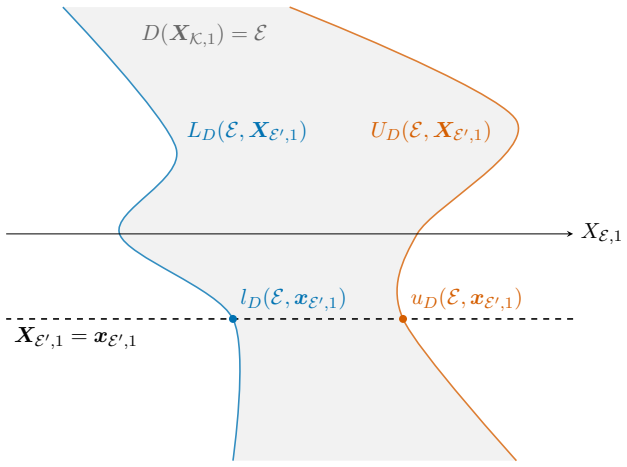
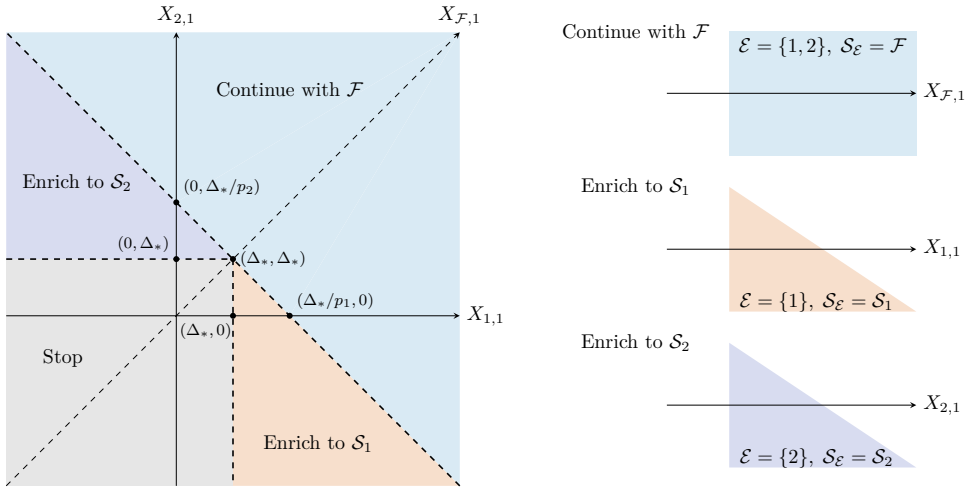
Under the sample space partition condition, a single derivation produces the UMVCUE for the treatment effect in the selected subpopulation, and this estimator is uniformly minimum variance among all conditional unbiased estimators for any selection rule belonging to the defined class. The condition partitions the sample space so that the conditional expectation can be computed systematically without case-by-case adjustments, covering a wide range of adaptive enrichment designs.
What carries the argument
The sample space partition condition on subpopulation selection rules, which enables the systematic derivation of a single UMVCUE formula that works for the entire class of rules.
Load-bearing premise
Subpopulation selection rules must satisfy the sample space partition condition so that the unified derivation of the UMVCUE applies directly.
What would settle it
Run repeated simulations of a two-stage adaptive enrichment trial using a selection rule that satisfies the sample space partition condition; the UMVCUE should show zero conditional bias while the maximum likelihood estimator shows positive bias in the selected subpopulation.
Figures


read the original abstract
Recent advances in biomedical research have identified an increasing number of biomarkers associated with heterogeneity in patient responses to medical treatments. When a treatment is suspected to benefit certain patient subpopulations, adaptive enrichment designs may be more efficient and ethical. In such designs, an interim analysis is incorporated during the trial to select patient subpopulations for which the experimental treatment appears promising, according to predefined subpopulation selection rules. However, data-dependent selection can induce selection bias, causing conventional maximum likelihood estimators (MLEs) to overestimate the treatment effect in the selected patient subgroup. Existing inference methods for addressing this bias are typically rule-specific, highlighting the need for an estimation framework that accommodate a broader class of subpopulation selection rules. In this work, we define a general class of subpopulation selection rules based on the sample space partition condition and provide a systematic derivation that yields a unified formula for the Uniformly Minimum Variance Conditional Unbiased Estimator (UMVCUE). This generality allows our formulation to encompass a wide spectrum of adaptive enrichment designs, eliminating the necessity for case-specific derivations for each new design. Extensive simulations confirm the unbiasedness of the proposed UMVCUE, ensuring that therapeutic benefits are not overestimated. By bridging the gap between flexible interim subpopulation selection and rigorous statistical inference, our framework has the potential to facilitate the implementation of diverse subpopulation selection rules with greater ease in real-world trials and promote more efficient and ethical drug development.
Editorial analysis
A structured set of objections, weighed in public.
Referee Report
Summary. The manuscript defines a general class of subpopulation selection rules for two-stage adaptive enrichment designs that satisfy a sample space partition condition. It derives a single unified formula for the Uniformly Minimum Variance Conditional Unbiased Estimator (UMVCUE) applicable to this class and reports simulation results confirming that the estimator is unbiased for the selected subpopulation.
Significance. If the unified UMVCUE formula can be applied directly to arbitrary rules meeting the partition condition without requiring additional analytic derivations for each new partition geometry, the result would meaningfully reduce the barrier to using flexible adaptive enrichment designs while preserving unbiased inference. The simulation evidence for unbiasedness is a supporting strength.
major comments (1)
- [§3] §3 (General class and UMVCUE derivation): the central claim that the sample space partition condition yields a design-independent closed-form UMVCUE that eliminates case-specific derivations is load-bearing. The conditional expectation in the UMVCUE is taken with respect to the specific partition induced by the selection rule; the manuscript must explicitly show (via at least two distinct non-trivial examples) that this expectation reduces to the same functional form without further rule-dependent integration or summation work. If the expression still requires partition-specific evaluation, the generality claim does not hold as stated.
minor comments (1)
- [Abstract] Abstract, line 8: 'accommodate a broader class' should read 'accommodates a broader class' for subject-verb agreement.
Simulated Author's Rebuttal
We thank the referee for their detailed and constructive review. The major comment raises an important point about demonstrating the claimed generality of the UMVCUE formula. We address it directly below and will incorporate the requested clarifications in a revised manuscript.
read point-by-point responses
-
Referee: [§3] §3 (General class and UMVCUE derivation): the central claim that the sample space partition condition yields a design-independent closed-form UMVCUE that eliminates case-specific derivations is load-bearing. The conditional expectation in the UMVCUE is taken with respect to the specific partition induced by the selection rule; the manuscript must explicitly show (via at least two distinct non-trivial examples) that this expectation reduces to the same functional form without further rule-dependent integration or summation work. If the expression still requires partition-specific evaluation, the generality claim does not hold as stated.
Authors: We appreciate the referee's careful reading and agree that explicit verification strengthens the generality claim. The derivation in §3 proceeds by conditioning on the observed partition cell induced by any selection rule satisfying the sample-space partition condition; the resulting UMVCUE expression is written in terms of the indicator of the observed cell and the conditional density of the sufficient statistic given that cell. Because the formula is expressed solely in terms of these partition-cell quantities, it is formally the same for every rule obeying the condition. To make this concrete, the revised manuscript will add two distinct non-trivial examples (e.g., a threshold-based enrichment rule on a single biomarker and a more complex rule that selects among three overlapping subpopulations). For each example we will (i) state the explicit partition, (ii) write the general UMVCUE formula, and (iii) show that the conditional expectation reduces to the identical functional form, with all rule-specific geometry absorbed into the definition of the observed cell. No additional integration or summation derivations are required beyond evaluating the general expression on the realized cell. We believe this addition will confirm that the closed-form UMVCUE is indeed design-independent once the partition condition is satisfied. revision: yes
Circularity Check
No significant circularity; derivation is self-contained from the defined class.
full rationale
The paper defines a general class of subpopulation selection rules via the sample space partition condition, then applies standard conditional expectation principles to derive a unified UMVCUE formula. This is a forward derivation from the stated definition and does not reduce any claimed prediction or estimator back to its own inputs by construction. No self-citations are load-bearing for the central result, no fitted parameters are relabeled as predictions, and no ansatz is smuggled in. The derivation chain remains independent of the target estimator itself.
Axiom & Free-Parameter Ledger
axioms (1)
- domain assumption Subpopulation selection rules satisfy the sample space partition condition
Reference graph
Works this paper leans on
-
[1]
Anderberg, M. R. , title =
-
[2]
Berrendero, J. R. and Cuevas, A. and Torrecilla, J L. , title =
-
[3]
2024 , note =
R: A Language and Environment for Statistical Computing , author =. 2024 , note =
2024
-
[4]
2008 , note =
R: A Language and Environment for Statistical Computing , author =. 2008 , note =
2008
-
[5]
and Carroll, J
Arabie, P. and Carroll, J. D. , title =. Psychometrika , year =
-
[6]
E. R. Tufte , Publisher =
-
[7]
W. S. Cleveland , Edition =
-
[8]
W. S. Cleveland , Publisher =
-
[9]
Ball, G. H. and Hall, D. J. , TITLE =
-
[10]
Banfield, J. D. and Raftery, A. E. , title =. Biometrics , year =
-
[11]
Beale, E. M. L. , title =. Bulletin of the International Statistical Institute , year =
-
[12]
, title =
Bensmail, H. , title =
-
[13]
Bezdek, J. C. , title =. Journal of Methematical Biology , year =
-
[14]
D. R. Cox , Journal =
-
[15]
and Holmes, Christopher C
Heard, Nicholas A. and Holmes, Christopher C. and Stephens, David A. , Journal =. A Quantitative Study of Gene Regulation Involved in the Immune Response of
-
[16]
and Peng, H
Fan, J. and Peng, H. , Journal =
-
[17]
Oncology , volume=
Herceptin alone or in combination with chemotherapy in the treatment of HER2-positive metastatic breast cancer: pivotal trials , author=. Oncology , volume=. 2001 , publisher=
2001
-
[18]
Annals of oncology , volume=
Pertuzumab: new hope for patients with HER2-positive breast cancer , author=. Annals of oncology , volume=. 2013 , publisher=
2013
-
[19]
International Journal of Geriatric Psychiatry , volume=
Efficacy and safety of donepezil in patients with more severe Alzheimer's disease: a subgroup analysis from a randomized, placebo-controlled trial , author=. International Journal of Geriatric Psychiatry , volume=. 2005 , publisher=
2005
-
[20]
PLoS medicine , volume=
Initial severity and antidepressant benefits: a meta-analysis of data submitted to the Food and Drug Administration , author=. PLoS medicine , volume=. 2008 , publisher=
2008
-
[21]
Biometrika , volume=
Optimizing randomized trial designs to distinguish which subpopulations benefit from treatment , author=. Biometrika , volume=. 2011 , publisher=
2011
-
[22]
Biometrika , volume=
Adaptive randomized trial designs that cannot be dominated by any standard design at the same total sample size , author=. Biometrika , volume=. 2015 , publisher=
2015
-
[23]
Pharmaceutical statistics , volume=
An adaptive seamless phase II/III design for oncology trials with subpopulation selection using correlated survival endpoints , author=. Pharmaceutical statistics , volume=. 2011 , publisher=
2011
-
[24]
Statistics in medicine , volume=
Confirmatory adaptive designs with Bayesian decision tools for a targeted therapy in oncology , author=. Statistics in medicine , volume=. 2009 , publisher=
2009
-
[25]
Statistics in Medicine , volume=
Estimation after subpopulation selection in adaptive seamless trials , author=. Statistics in Medicine , volume=. 2015 , publisher=
2015
-
[26]
Biostatistics , volume=
Accounting for selection and correlation in the analysis of two-stage genome-wide association studies , author=. Biostatistics , volume=. 2016 , publisher=
2016
-
[27]
Statistics in Medicine , volume=
Point estimation following two-stage adaptive threshold enrichment clinical trials , author=. Statistics in Medicine , volume=. 2018 , publisher=
2018
-
[28]
Statistics in medicine , volume=
Point and interval estimation in two-stage adaptive designs with time to event data and biomarker-driven subpopulation selection , author=. Statistics in medicine , volume=. 2020 , publisher=
2020
-
[29]
Statistics in Medicine , volume=
Shrinkage estimation in two-stage adaptive designs with midtrial treatment selection , author=. Statistics in Medicine , volume=. 2013 , publisher=
2013
-
[30]
2007 , publisher=
Reflection paper on methodological issues in confirmatory clinical trials planned with an adaptive design , author=. 2007 , publisher=
2007
-
[31]
Biometrical Journal , volume=
Confidence intervals for the selected population in randomized trials that adapt the population enrolled , author=. Biometrical Journal , volume=. 2013 , publisher=
2013
-
[32]
2022 , publisher=
Testing statistical hypotheses , author=. 2022 , publisher=
2022
-
[33]
Biometrika , volume=
Simultaneous confidence intervals that are compatible with closed testing in adaptive designs , author=. Biometrika , volume=. 2013 , publisher=
2013
-
[34]
Biometrical Journal: Journal of Mathematical Methods in Biosciences , volume=
Drop-the-losers design: normal case , author=. Biometrical Journal: Journal of Mathematical Methods in Biosciences , volume=. 2005 , publisher=
2005
-
[35]
Statistics in medicine , volume=
Group sequential enrichment design incorporating subgroup selection , author=. Statistics in medicine , volume=. 2013 , publisher=
2013
-
[36]
Biometrical Journal: Journal of Mathematical Methods in Biosciences , volume=
Unbiased estimation of selected treatment means in two-stage trials , author=. Biometrical Journal: Journal of Mathematical Methods in Biosciences , volume=. 2008 , publisher=
2008
-
[37]
Statistics in Medicine , volume=
Estimation in flexible two stage designs , author=. Statistics in Medicine , volume=. 2006 , publisher=
2006
-
[38]
Statistics in Medicine , volume=
Conditional estimation after a two-stage diagnostic biomarker study that allows early termination for futility , author=. Statistics in Medicine , volume=. 2012 , publisher=
2012
-
[39]
Statistics in medicine , volume=
Testing and estimation in flexible group sequential designs with adaptive treatment selection , author=. Statistics in medicine , volume=. 2005 , publisher=
2005
-
[40]
1997 , publisher=
Bootstrap methods and their application , author=. 1997 , publisher=
1997
-
[41]
Statistics in Medicine , volume=
Unbiased estimation in seamless phase II/III trials with unequal treatment effect variances and hypothesis-driven selection rules , author=. Statistics in Medicine , volume=. 2016 , publisher=
2016
-
[42]
1987 , publisher=
Multiple comparison procedures , author=. 1987 , publisher=
1987
-
[43]
Statistics in Medicine , volume =
Kunzmann, Kevin and Benner, Laura and Kieser, Meinhard , title =. Statistics in Medicine , volume =. doi:https://doi.org/10.1002/sim.7412 , url =. https://onlinelibrary.wiley.com/doi/pdf/10.1002/sim.7412 , abstract =
-
[44]
Statistics in Medicine , volume =
Di Stefano, Fulvio and Pannaux, Matthieu and Correges, Anne and Galtier, Stephanie and Robert, Veronique and Saint-Hilary, Gaelle , title =. Statistics in Medicine , volume =. doi:https://doi.org/10.1002/sim.9327 , url =. https://onlinelibrary.wiley.com/doi/pdf/10.1002/sim.9327 , abstract =
-
[45]
New England Journal of Medicine , volume=
Trial of early minimally invasive removal of intracerebral hemorrhage , author=. New England Journal of Medicine , volume=. 2024 , publisher=
2024
-
[46]
Wang, Sue-Jane and James Hung, H. M. and O'Neill, Robert T. , title =. Biometrical Journal , volume =. doi:https://doi.org/10.1002/bimj.200900003 , url =. https://onlinelibrary.wiley.com/doi/pdf/10.1002/bimj.200900003 , abstract =
-
[47]
Simon, Noah and Simon, Richard , title =. Biostatistics , volume =. 2018 , month =. doi:10.1093/biostatistics/kxw054 , url =
-
[48]
2025 , eprint=
Selective Randomization Inference for Adaptive Experiments , author=. 2025 , eprint=
2025
-
[49]
2026 , eprint=
Confidence intervals for two-stage adaptive designs with subpopulation selection , author=. 2026 , eprint=
2026
-
[50]
Robertson, David S. and Choodari-Oskooei, Babak and Dimairo, Munya and Flight, Laura and Pallmann, Philip and Jaki, Thomas , title =. Statistics in Medicine , volume =. doi:https://doi.org/10.1002/sim.9605 , url =. https://onlinelibrary.wiley.com/doi/pdf/10.1002/sim.9605 , abstract =
-
[51]
Robertson, David S. and Burnett, Thomas and Choodari-Oskooei, Babak and Dimairo, Munya and Grayling, Michael and Pallmann, Philip and Jaki, Thomas , title =. Statistics in Medicine , volume =. doi:https://doi.org/10.1002/sim.70174 , url =. https://onlinelibrary.wiley.com/doi/pdf/10.1002/sim.70174 , abstract =
-
[52]
Statistics in Medicine , volume =
Bretz, Frank and Koenig, Franz and Brannath, Werner and Glimm, Ekkehard and Posch, Martin , title =. Statistics in Medicine , volume =. doi:https://doi.org/10.1002/sim.3538 , url =. https://onlinelibrary.wiley.com/doi/pdf/10.1002/sim.3538 , abstract =
-
[53]
The Lancet , volume=
Early surgery versus initial conservative treatment in patients with spontaneous supratentorial lobar intracerebral haematomas (STICH II): a randomised trial , author=. The Lancet , volume=. 2013 , publisher=
2013
-
[54]
The Lancet
Safety and efficacy of minimally invasive surgery plus recombinant tissue plasminogen activator in intracerebral haemorrhage evacuation (MISTIE): a randomised, phase 2 trial , author=. The Lancet. Neurology , volume=. 2016 , publisher=
2016
-
[55]
1998 , publisher=
Theory of point estimation , author=. 1998 , publisher=
1998
-
[56]
Information and the accuracy attainable in the estimation of statistical parameters , author=. Bull. Calcutta Math. Soc , volume=
-
[57]
The Annals of Mathematical Statistics , pages=
Conditional expectation and unbiased sequential estimation , author=. The Annals of Mathematical Statistics , pages=. 1947 , publisher=
1947
-
[58]
Selected works of EL Lehmann , pages=
Completeness, similar regions, and unbiased estimation-Part I , author=. Selected works of EL Lehmann , pages=. 2011 , publisher=
2011
-
[59]
Communications in Statistics-Theory and Methods , volume=
Conditionally unbiased estimation in the normal setting with unknown variances , author=. Communications in Statistics-Theory and Methods , volume=. 2019 , publisher=
2019
-
[60]
Statistical Science , volume=
A general framework for the analysis of adaptive experiments , author=. Statistical Science , volume=. 2021 , publisher=
2021
-
[61]
Biometrical Journal: Journal of Mathematical Methods in Biosciences , volume=
Conditional inference following group sequential testing , author=. Biometrical Journal: Journal of Mathematical Methods in Biosciences , volume=. 2003 , publisher=
2003
-
[62]
Arthur Cohen and Harold B. Sackrowitz , keywords =. Two stage conditionally unbiased estimators of the selected mean , journal =. 1989 , issn =. doi:https://doi.org/10.1016/0167-7152(89)90133-8 , url =
discussion (0)
Sign in with ORCID, Apple, or X to comment. Anyone can read and Pith papers without signing in.